Enterprise Software Pronunciation Guide
Why is this Databases meme funny?
Level 1: Saying The Name Costs Money
This is like asking how to say the names of different toys, and most answers are normal until one toy is pronounced "ask your parents for a lot of money." The joke is that everyone expects another silly word lesson, but Oracle's name gets treated like a warning label for an expensive shopping trip.
Level 2: Names, Databases, And Bills
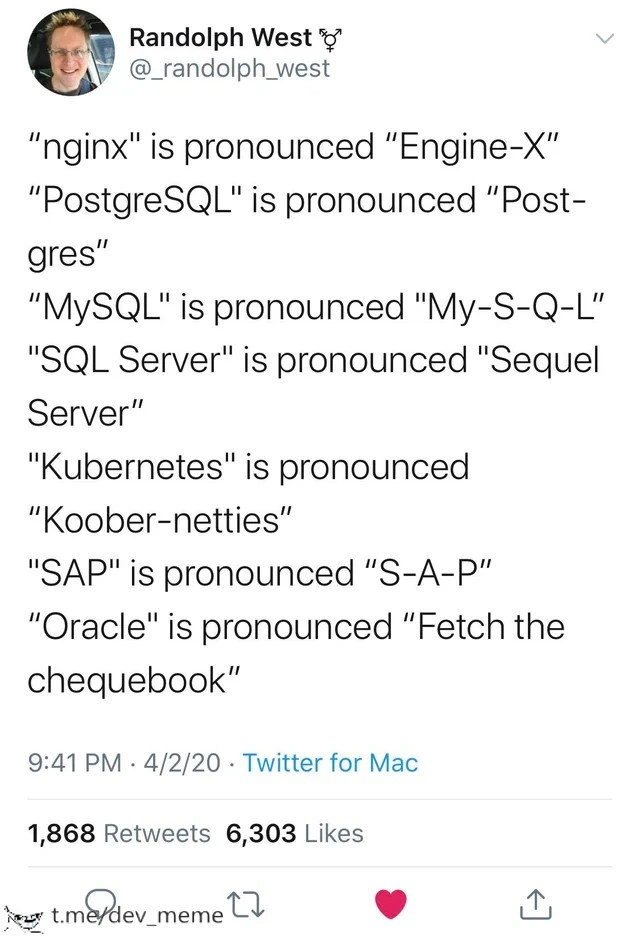
This image is a tweet listing how different technologies are "pronounced." Some entries are about real naming confusion. nginx is commonly said like "Engine-X" because it is a web server. PostgreSQL is often shortened to Postgres, a popular relational database. MySQL is another relational database, and people argue about whether to say each letter or use a phrase-like pronunciation. SQL Server is Microsoft's database product, where SQL is often said as "sequel."
Kubernetes is a container orchestration system, which means it helps run and manage many application containers across machines. People often abbreviate it as K8s because the full word is long and easy to mangle. SAP is enterprise business software, often pronounced as letters.
The final Oracle joke is different. Oracle Database is a major commercial database platform often associated with large companies. The meme says its pronunciation is really about getting money ready, because enterprise software can involve expensive licenses and support contracts. That is why the last line is funnier than the earlier ones: it turns a language joke into a budget joke.
For a newer developer, the useful lesson is that technology names carry culture. Some names tell people which tools you know. Some tell people which ecosystem you came from. Some tell people the project may need procurement approval before anyone writes a single migration.
Level 3: Procurement Pronounces Last
The visible tweet starts like a pronunciation guide for common infrastructure names: nginx, PostgreSQL, MySQL, SQL Server, Kubernetes, and SAP. Then it arrives at the final line:
"Oracle" is pronounced "Fetch the chequebook"
That punchline works because every earlier entry is a harmless naming argument, while the last one swerves into enterprise finance. Developers can spend endless time debating whether SQL is said as letters or as "sequel," whether PostgreSQL deserves its full ceremonial title, and how badly someone can abuse Kubernetes before a platform engineer quietly opens a support ticket for their soul. But Oracle carries a different cultural payload: database software, enterprise contracts, licensing audits, support renewals, procurement meetings, and invoices large enough to have their own weather system.
The meme is not really about correct pronunciation. It is about tribal knowledge. Knowing how a technology is pronounced marks whether someone has lived around that ecosystem. nginx as "Engine-X" signals web-server familiarity. Postgres is the everyday developer shorthand for PostgreSQL. My-S-Q-L versus "my sequel" can expose which community, vendor docs, or decade shaped someone's habits. These are tiny verbal passwords in software culture.
The Oracle line breaks the pattern by replacing phonetics with consequence. The sound of the word matters less than the budget conversation it summons. In many enterprise environments, selecting a database is not just a technical decision about indexing, replication, query planning, backup strategy, or operational maturity. It is also a legal and financial commitment. Licensing can be tied to cores, editions, features, virtualization rules, support tiers, and contract language that developers often do not see until the architecture has already fossilized.
That is why the joke sits comfortably in both databases and enterprise software. Open-source tools like PostgreSQL, MySQL, nginx, and Kubernetes come with their own operational complexity, but their names mostly trigger debates about convention. Oracle triggers the memory of a vendor meeting where someone from finance asks why the dev environment appears to require a small sovereign fund.
The post message adds another layer by saying JavaScript is pronounced E-C-M-A Script, which extends the same kind of pedantry. Technically, ECMAScript is the standardized language specification behind JavaScript, but nobody casually says they are debugging an ECMA Script promise chain unless they are either writing a standards document or trying to lose friends at lunch.
Description
A tweet screenshot from Randolph West @_randolph_west lists technology pronunciation jokes: "nginx" is pronounced "Engine-X"; "PostgreSQL" is pronounced "Post-gres"; "MySQL" is pronounced "My-S-Q-L"; "SQL Server" is pronounced "Sequel Server"; "Kubernetes" is pronounced "Koober-netties"; "SAP" is pronounced "S-A-P"; and "Oracle" is pronounced "Fetch the chequebook." The tweet is dated 9:41 PM, 4/2/20, posted via Twitter for Mac, with 1,868 retweets and 6,303 likes, plus a t.me/dev_meme watermark near the bottom. The humor mixes perennial pronunciation bikeshedding with the very real enterprise cost reputation of Oracle.
Comments
1Comment deleted
The pronunciation debate ends quickly once procurement asks whether the vowel sounds are licensed per core.