Skip to content
DevMeme
4638 of 7435
Deep-learning devotee calls statistician brainwashed, statistician responds with simple linear model
AI ML Post #5086, on Dec 30, 2022 in TG

Deep-learning devotee calls statistician brainwashed, statistician responds with simple linear model

Why is this AI ML meme funny?

Level 1: Fancy Gadgets vs Simple Tools

Imagine two friends trying to solve a problem. One friend shows up with a gigantic swiss-army knife gadget that has every tool you can think of – flashing lights, a built-in computer, maybe even a tiny robot arm. He’s super proud of it and claims it can solve anything. The other friend is holding a single hammer. The first friend looks at the hammer and says, “Wow, you’re still using that? They really tricked you into thinking a plain hammer is all you need. You’re so brainwashed!” The second friend just raises an eyebrow and gently taps a nail into a board with the hammer, solving the problem in one go, and replies, “Really?”

In this little story, the guy with the fancy gadget is like the deep-learning fan in the meme – he’s got all the shiny new tools (even if he might not need them for this task) and he thinks anyone using an old simple tool must have been misled or left behind. The friend with the hammer is like the statistician – he sticks to a basic tool that he knows works. The humor comes from how absurd it is for the gadget guy to call the hammer guy “brainwashed” for using a straightforward solution. In everyday terms, it’s like someone with a high-tech, complicated solution teasing someone who uses a simple, reliable solution. Usually, we’d expect the opposite (maybe you’d tease the person with the overkill gadget), so this role reversal is what makes it funny. It highlights that sometimes the simplest solution is perfectly fine, and calling someone brainwashed for trusting the basics is pretty silly – maybe it’s actually the gadget guy who’s a bit too caught up (almost like he’s in a gadget cult!). In the end, the hammer drives the nail just fine, and the second friend stands there with a kind of “Did you hear yourself? That was a ridiculous thing to say” look. The joke reminds us that new and complex isn’t always better, and if someone says you’re brainwashed for keeping it simple, well… you can just say “really?” and carry on nailing it with your hammer.

Level 2: Buzzwords vs Basics

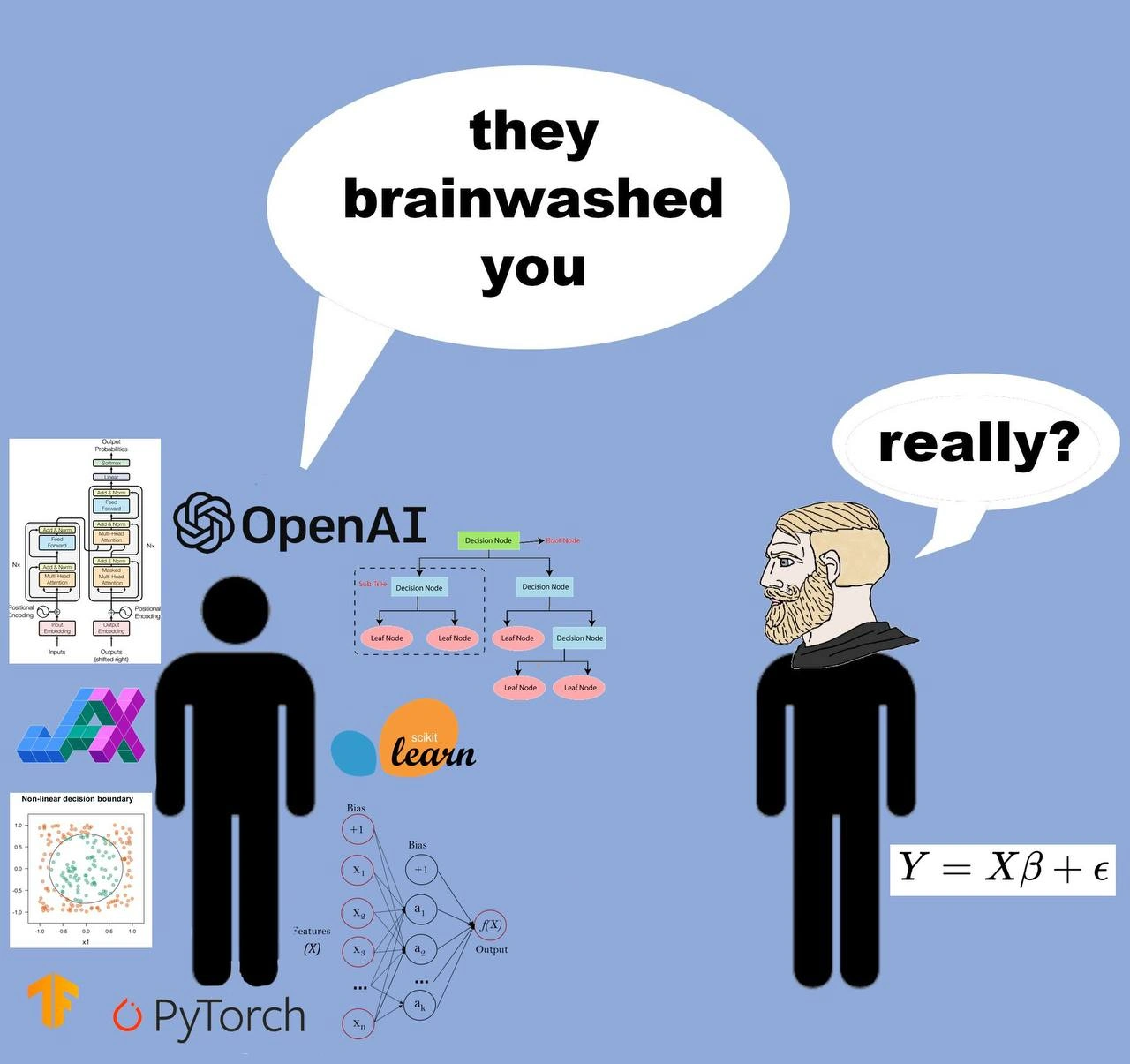
Let’s break down what’s happening in this meme in simpler terms. On the left side, we have a character who is clearly into all the latest AI and machine learning buzz. How can we tell? He’s literally surrounded by the logos and visuals of modern machine learning tools and techniques:

  • OpenAI – This is the company famous for cutting-edge AI models like GPT-3 and ChatGPT. Seeing that logo suggests our left character is into the trendiest AI stuff out there (OpenAI’s work is basically the face of the recent AI hype).
  • TensorFlow and PyTorch – These are two major frameworks (software libraries) used to build and train deep learning models (those complex neural networks). If someone mentions TensorFlow or PyTorch, they’re probably doing serious neural network work, like training image recognizers or language models. Our left guy has both logos, which is funny because typically you’d use one or the other – it’s like he’s flaunting “I know them all!”.
  • JAX – Another fancy tool, specifically a high-performance library from Google that’s popular among researchers for advanced machine learning and numerical computing. Dropping the JAX logo is like extra cred: “I’m even on to the next new thing in ML!”.
  • scikit-learn – This is a popular Python library that offers a bunch of machine learning algorithms, from simple ones (linear regression, decision trees) to more complex ones. Its logo being there shows the left character isn’t just deep-learning-only; he’s basically showcasing every ML tool in the box. Scikit-learn is often the first library people learn for machine learning tasks in Python, beloved for its simplicity and broad coverage of algorithms.

Around that left figure, there are also some diagrams and plots:

  • A convolutional neural network diagram – likely those stacked boxes or layers shown. Convolutional neural networks (CNNs) are specialized neural nets especially good for image data (e.g., recognizing objects in a picture). The diagram indicates multiple layers of processing – this is definitely a nod to deep learning architecture.
  • A decision tree flowchart – you can see colored boxes and arrows splitting into branches labeled things like “Leaf Node”. A decision tree is a more classical ML model that splits data by asking a series of questions (conditions) – it’s not “deep learning” per se, but it’s a staple of machine learning taught alongside linear regression. Including it in the collage means the left guy is basically pulling in any kind of model that isn’t plain linear… he’s armed with every algorithm he can think of.
  • A non-linear decision boundary plot – there’s an image of a 2D scatter plot with points of different colors or classes, and a squiggly boundary looping around them (as opposed to a straight line). This represents what a complex model can do: draw a complicated curve to separate classes. A linear model, by contrast, would draw just a straight line (or one rough curve if we allow a bit of bend, but nothing too twisty). So this picture is like “look, fancy models can carve out weird shapes to fit the data perfectly!”. It’s a visual brag that non-linear models can fit things that linear models would miss.
  • A feed-forward neural network sketch – those little circles connected by lines (often drawn layer by layer). This is the quintessential representation of a neural network: inputs go into some “hidden” neurons, which connect to more neurons, and so on, until an output comes out. It’s basically the blueprint of how deep learning models are structured internally.

So, the left side figure is equipped with every modern machine learning tool and concept. He’s like someone who just came back from an “AI Conference” or finished an online course marathon and is now super excited (maybe too excited) about using neural networks, decision trees, and every other algorithm on every problem. In the speech bubble above him, he says “they brainwashed you”. In context, “they” could mean the school, professors, the older generation of data folks, or just “the establishment”. He’s effectively telling the other guy, “You’ve been brainwashed into using only simple methods!” You can almost hear him say, “Can’t you see? There’s a whole new world of AI out here and you’re stuck in the past.” The word “brainwashed” is a very strong, almost combative term – it suggests he thinks the other person has been misled or indoctrinated to not embrace the new way of doing things (the new way being deep learning and fancy ML frameworks). This is a pretty exaggerated way to put it, which is partly why it’s funny — it’s not a polite disagreement, it’s an over-the-top accusation, as if sticking with a linear model is the result of some conspiracy! It humorously reveals how fanatical the left character is about his AI approach, as if he joined a tech cult.

Now, the right side character is depicted differently. He looks like a Wojak meme character (a kind of simple cartoon used a lot in internet memes to represent different stereotypes or feels). This Wojak has a beard and a black hoodie, which often is how people draw a slightly older, wiser, maybe more skeptical person in these memes. He’s meant to represent a statistician or traditional data scientist – someone who’s perhaps more classically trained, maybe with a background in mathematics or statistics rather than pure computer science. He has a speech bubble, but all it says is “really?”. Just one word, in a smaller bubble – implying he’s quietly, dryly questioning the outrageous statement from the left. It’s the tone of, “Are you serious right now?” or “Do you even hear yourself?” That one-word response already tells us the statistician thinks the deep learning guy’s claim is ridiculous.

Crucially, look at what the statistician is holding: a sign with “Y = Xβ + ε” written on it. Let’s decode that:

  • Y = the outcome or the thing you want to predict (it could be anything: tomorrow’s sales, a person’s height, whatever).
  • X = the input data or features (could be multiple variables, hence X is often a matrix of inputs).
  • β (beta) = the coefficients (think of these as the numbers you multiply each input by to get a prediction, plus maybe an intercept term if we expand it out – often there’s β₀ for intercept).
  • ε (epsilon) = the error term, basically a reminder that the model isn’t perfect and there’s always some random noise or unexplained part.

Together, $Y = Xβ + ε$ is the standard form of a linear regression model. In plainer words, it says: “My prediction for Y is just a linear combination of the inputs X (using the coefficients β), and the rest is error.” If you had just one input x and one output y, this would look like the equation of a straight line: $y = β_0 + β_1 x + ε$. For multiple inputs, it’s a hyperplane, but still essentially a straight-line kind of relationship in a higher-dimensional space. Linear regression is like the “Hello World” of predictive modeling – it’s often the first model you learn in statistics or machine learning class because it’s simple, widely applicable, and gives you a lot of insight. It’s the basics. And that’s exactly the point the statistician is making. By holding up that sign, he’s proudly saying, “This is my tool. It’s straightforward, it’s powerful when used correctly, and I trust it.” It’s a bit tongue-in-cheek, as if he’s almost trolling the deep learning guy by responding to a complex rant with the most basic model formula out there.

So, the humor and message in simpler terms: The left guy is basically calling the right guy a blind follower (brainwashed) for sticking to old methods. The right guy responds with a bit of sass, essentially, “Really? You think I’m brainwashed just because I use this simple, sensible model?” He counters the flashy deep learning stuff by pointing out the virtue of a simple linear model. It’s like he’s saying, “Look, all your fancy neural networks boil down to a lot of complexity, but at the end of the day, I can often do a decent job with this one equation. Who’s really the one under a spell here?” The word “really?” carries a heavy ironic tone: the statistician finds it absurd that using fundamentals could ever be considered being brainwashed. If anything, he might suspect the deep learning devotee is the one who’s blindly following the hype (brainwashed by all the AI excitement).

For someone newer to this field, this meme is highlighting a real tension: machine learning vs. statistics, or more generally, complex models vs. simple models. New algorithms and frameworks (TensorFlow, PyTorch, etc.) are super powerful and exciting – they can solve problems that seemed impossible before (like making a computer understand images or language at a human-like level). This is the “deep learning revolution” and why people get very passionate about it. But not every problem is an image or language at massive scale. Sometimes you just have a small dataset or a straightforward relationship where a linear regression (or another simple technique) is not only enough, but actually better in terms of being easy to interpret, faster to run, and less prone to overfitting. Seasoned data folks will often try a simple approach first as a baseline. If the baseline works, great – if not, they’ll increase the complexity. That methodical approach can look “unimaginative” to an overly eager AI fan, who might think “Ugh, you’re doing the boring thing just because that’s what everyone taught you”, hence the “brainwashed” comment. The wise statistician knows it’s not about dogma; it’s about pragmatism and understanding the problem.

In short, the meme uses this exaggerated accusation and the stark contrast between a framework-fiend and a stats purist to poke fun at the current hype. It’s saying: Just because something is simple doesn’t mean someone is brainwashed into using it – maybe they use it because it works! And conversely, if you find yourself dismissing anything that isn’t the latest trend as “wrong” or “old-fashioned,” maybe you’re the one under the spell of hype. The whole scene is a lighthearted reminder in the data science world: don’t throw away basic, reliable tools just because shiny new ones exist – and certainly don’t insult someone as “brainwashed” for using tried-and-true methods.

Level 3: Backpropaganda

This meme brilliantly captures a generational clash in the AI/ML community, and it’s dripping with irony. On the left, we have a zealously enthusiastic deep-learning fan, practically wearing a collage of machine learning frameworks and diagrams. He’s surrounded by the emblems of modern AI hype: the OpenAI logo (think GPT and all the cutting-edge AI magic that wowed everyone), the logos for TensorFlow and PyTorch (the two dominant deep learning libraries that every ML engineer loves to debate about, like a techie Pepsi vs Coke rivalry), and even a flashy JAX icon (Google’s newer machine learning library for high-performance nerds). He’s included everything but the kitchen sink: there’s a convolutional neural network diagram (those layered boxes probably symbolizing how images get processed through convolutional filters), a decision tree visual with colorful nodes and branches (representing classic algorithmic machine learning, perhaps from scikit-learn, which actually caters to both simple models and advanced ones), and a funky scatter plot showing a non-linear decision boundary curving between data points (the kind of complex boundary you’d get from an ensemble or neural net, not a plain line). This character is essentially a walking Stack Overflow post of buzzwords and ML models — he’s clearly deep into the modern MachineLearning ecosystem.

And what does our ML devotee say? “They brainwashed you.” That’s a bold, almost comically exaggerated claim, and it’s the crux of the joke. In one corner, we have Mr. Deep Learning Fanboy implying that the statistician on the right has been indoctrinated by some establishment — perhaps “brainwashed” by academia or old-school thinking into using only simple models like linear regression. This is something you might actually hear in online AI forums or heated team discussions: a fresh AI enthusiast scoffing at a colleague for not reaching for a neural network, as if anyone using basic models must be an unenlightened sheeple following outdated dogma. It’s a techie twist on the classic “you just don’t get it, do you?” argument. The meme cranks that to 11 by using the phrase “brainwashed,” which makes the deep-learning guy sound a bit cultish himself — the exact image of someone so hyped on new tech that he thinks the only reason others aren’t as fervent is due to brainwashing. The term “backpropaganda” comes to mind: he’s effectively spreading propaganda for backpropagation-powered methods, convinced that older statistical approaches are a result of misinformation. The humor here is that in accusing the statistician of being brainwashed, the deep-learning devotee reveals his own near-fanatical mindset (he’s the pot calling the kettle black). We’ve all met developers or data scientists who become evangelists for the latest framework or technique, viewing dissenters as poor souls who “just don’t know better.” This meme nails that attitude.

Now look at the right side. The figure in black hoodie with a neat beard is drawn in the Wojak meme style, often used on the internet to depict a persona or archetype — in this case, he’s the calm, rational statistician (or classical data scientist). His expression is a simple “really?”, as in a deadpan, raised-eyebrow response to the ridiculous accusation. He’s unimpressed. And how does he respond? Not with a slew of logos or jargon, but by holding up a humble sign that reads $Y = Xβ + ε$. Just one equation – linear regression, plain and simple. It’s the ultimate mic drop for a statistician. That formula is basically saying, “I model the world with straightforward math, thank you very much.” It implies: my approach is transparent and proven; do I look brainwashed to you? The statistician doesn’t need a complex neural network diagram to make a point – a single linear equation does the trick. The contrast is both humorous and telling. On one side, dozens of moving parts and trendy tools claiming superior intelligence; on the other, a single elegant equation that’s been around for decades and still underpins a ton of real-world analysis. It highlights the absurdity of calling someone who favors simplicity “brainwashed,” when often it’s the hype-chasers who can’t see beyond their new toys.

This scenario hits home for many in the DataScience field. It’s common to see exuberant newcomers (or even well-meaning managers fresh from an “AI for Business” seminar) who want to apply DeepLearning to every problem – even ones where it’s overkill. For instance, imagine a junior data scientist who just learned about convolutional neural networks trying to use one to predict tomorrow’s stock price from 100 days of data. A senior colleague might suggest a simpler time-series model or linear regression due to the small dataset, and the junior responds, “Oh, come on, that old stuff? You’re just stuck in your ways – we have PyTorch now!” The meme basically distills that entire conversation into two speech bubbles. The deep-learning devotee is essentially saying, “You’re clinging to your linear regression like it’s a religion. Break free; join the AI revolution!” Meanwhile, the statistician is giving that gentle, sarcastic “really?” which speaks volumes: Isn’t it ironic to say I’m brainwashed just because I’m not jumping on your hype train?

The humor also lies in the visual exaggeration. The left figure has such an overload of AI hype around him that it’s almost satirical. It’s as if he’s accumulated every buzzword and framework possible – OpenAI GPT models, neural nets, decision trees, scikit-learn (which, funnily enough, is a library that includes linear regression too – the deep-learning guy may not even realize he’s championing a toolkit that also embraces the “boring” models). He’s basically the embodiment of an online ML-hype article: “15 frameworks you MUST know now!” In contrast, the right side’s simplicity – just a bearded guy and a monosyllabic reply with an age-old equation – paints him as grounded and immune to the frenzy. It reflects a common sentiment in industry: after you’ve been burned by enough fads, you learn to value tried-and-true methods. The seasoned statisticians and data analysts have seen waves of “silver bullet” techniques come and go. (Remember when decision trees and random forests were the hot new thing? Or when SVMs were all the rage before neural nets stole the spotlight? Each wave has its evangelists.) They know that often a well-tuned simpler model can outperform an ill-applied complex model, especially on small or noisy datasets. They’ve experienced the “overfitting hell” of an overly complex model that looks great on training data and then face-plants in production. So there’s a bit of PTSD humor here too: the statistician’s smug sign might also be saying, “I’ll stick to my linear model that I can trust and explain, you go ahead and chase the latest hype and see where it gets you.”

This AI humor resonates because it pokes fun at the current state of the industry. We live in a time of massive AI hype – every day there’s a headline about some new machine learning breakthrough, often deep learning-related, and a subtle pressure that if you’re not using the latest neural network architecture, you’re outdated. Some folks start to genuinely believe that older methods (like linear or logistic regression, or basic statistical inference) are obsolete and that anyone advocating for them must be “brainwashed” by the old guard. The meme turns that notion on its head by showing the deep learning devotee as the one acting irrational, almost like a conspiracist (“they brainwashed you!” has big tinfoil-hat energy). In reality, good data science is often about combining both worlds: use the complex stuff when it clearly adds value, and don’t discard the simple techniques that are effective, interpretable, and fast. The statistician’s response encapsulates that pragmatism – sometimes vanilla linear regression is exactly what you need, and there’s no grand conspiracy making you use it, it just works.

One can almost imagine the conversation continuing: The deep learning fan might boast about his model’s accuracy on some benchmark, and the statistician might counter, “Sure, but do you really understand what it’s doing? And can you deploy it under our production constraints? Also, who’s going to maintain that code with five different frameworks in the stack?” It’s highlighting an industry trend vs reality gap: fancy AI models grab the headlines, but on many business problems, interpretable models and simpler analyses are the day-to-day workhorses. The experienced folks know this, while the newcomers sometimes only learn it after trying (and failing) to apply a giant neural net where it wasn’t needed. So, the meme strikes a chord, especially with those who have been around long enough to see hype cycles. It’s a gentle reminder (with a laugh) that not every problem needs deep learning, and preferring a simpler model doesn’t mean you’re an ignorant or brainwashed – often, it means you’re wise.

Level 4: Beta vs Backprop

At the core of this meme is a showdown between a simple linear model and a complex deep neural network. In mathematical terms, the statistician’s sign Y = Xβ + ε represents the classic linear regression equation. This formula says that the output (vector Y) is explained by a linear combination of inputs (X times coefficient vector β) plus some noise or error term ε. It’s a linear model with a few parameters (the β coefficients), which makes it a low-capacity model – essentially a single-layer neural network with no hidden layers and an identity activation. Linear regression is well understood: there’s even a closed-form solution known as the Normal Equation that directly computes the best-fit β without iterative training. For example, if $X$ is our data matrix and $Y$ our target, the optimal coefficients can be obtained by:

$$ \hat{\beta} = (X^T X)^{-1} X^T Y, $$

assuming $X^T X$ is invertible. This analytical solution highlights how neat and transparent linear models are: given sufficient linear independence in features, you get one global optimum for β in a single equation. There’s no mystery – each β is the weight for a feature, and statistics even provides confidence intervals and significance tests for each coefficient. The $\epsilon$ in the formula explicitly acknowledges random error, aligning with a statistical view that data = signal (Xβ) + noise (ε).

Now contrast that with the deep-learning devotee’s world of neural nets. A deep neural network (like those built in TensorFlow or PyTorch) stacks many linear layers with non-linear activation functions, creating a high-capacity model with perhaps thousands or millions of parameters. There’s no one-shot formula to solve for all those weights; instead, we rely on iterative optimization algorithms (almost always some variant of gradient descent with backpropagation). In backprop, the model’s weights (analogous to β’s) start random and are repeatedly adjusted to reduce the prediction error. Formally, for each training step $t$, a weight $w$ might be updated as:

$$ w_{t+1} \leftarrow w_t - \eta \frac{\partial L}{\partial w_t}, $$

where $L$ is the loss function (measuring error like mean squared error or cross-entropy) and $\eta$ is the learning rate. This $w \leftarrow w - \eta \nabla L$ rule is the essence of backpropagation: compute gradients of the loss w.r.t all weights and nudge the weights in the direction that makes the output a little more accurate. Unlike linear regression solving for β in one go, neural network training is like slowly tuning a million dials to teach the network a complex pattern. The process is computationally intensive and can get stuck in local minima or saddle points because the loss surface for deep nets is highly non-convex. Yet, surprisingly often, gradient descent finds a good-enough minima and the network fits the data well — a bit of practical magic that still intrigues researchers (why don’t these large networks overfit every time? why does gradient descent work so well in huge parameter spaces?).

The meme’s humor hides an important theoretical dichotomy: simple vs complex hypothesis spaces. A linear model can only produce a flat plane (or straight line boundary) in feature space. In contrast, a sufficiently wide and deep neural network is a universal function approximator – it can approximate any continuous function on a compact domain given enough neurons (per the Universal Approximation Theorem). That means the deep model can carve highly non-linear decision boundaries in data, represented by that colorful scatter plot on the left figure (we see a twisty decision boundary that a linear model could never reproduce). If the true relationship in the data is complicated (say, image pixels to object categories), linear models underfit badly – their rigid straight-line assumptions create a large bias (error from missing complex patterns). A neural net can capture tiny nuances and interactions, driving bias low by fitting the training data closely. However, this comes at the cost of high variance: the complex model might latch onto noise or idiosyncrasies (essentially “memorizing” the training data, a form of overfitting akin to being brainwashed by the training set). Statisticians mitigate this with regularization or by preferring simpler models when data is limited, invoking Occam’s Razor – the idea that among competing hypotheses, the one with fewer assumptions (or parameters) should be selected unless complexity greatly improves accuracy. The deep learning ethos often counters: “more data and bigger models” can win, leveraging the law of large numbers to average out noise if you have millions of examples. It’s a classic bias–variance tradeoff tension, playing out in the meme as a humorous argument.

Another fundamental difference is interpretability and theoretical guarantees. The statistician’s linear model is transparent: each β tells you how much a feature contributes to the prediction, and the error term ε invites a probabilistic interpretation (often assumed Gaussian noise, enabling confidence intervals and hypothesis tests on β). In deep nets, interpretability is sacrificed for raw power – the model is mostly a black box with weights spread across many layers. Deep learning frameworks like OpenAI’s tools, TensorFlow, or JAX provide incredible flexibility and automation (auto-differentiation, GPU acceleration) to train these networks, but it’s hard to peek inside and get a simple explanation for why the model made a certain prediction. The linear model’s simplicity lets us derive proofs and expectations easily (e.g., Gauss-Markov theorem assures OLS gives best linear unbiased estimates under certain conditions). For a massive neural net, theoretical analysis is far more complex – we rely on empirical validation and have only recently started to develop theories (like the PAC framework, or insights from information theory and kernel approximations) to explain their behavior. In short, the meme pits old-school statistical rigor against the wild frontier of deep learning, highlighting how differently the two paradigms approach modeling.

So when the deep-learning devotee says “they brainwashed you,” it hints at this cultural rift in technical terms. He implies the statistician is clinging to a linear model due to academic indoctrination – perhaps referencing how traditional statisticians are taught to favor simple, well-understood models and to be skeptical of complex ones without interpretability. But from a technical stance, this accusation is ironic. Far from being brainwashed, the statistician is making a rational choice for simplicity and robustness given the data and problem at hand. It’s as if the deep learning guy believes in a “one model to rule them all” (neural nets for everything) which goes against the “No Free Lunch Theorem” in machine learning – the theorem that says no single model works best for every problem. If anything, an expert will select the right tool for the job: sometimes a deep neural network, sometimes a linear regression, sometimes a decision tree or even a humble average. True wisdom in AI/ML is knowing the strengths and limits of each approach. In that light, the meme isn’t just poking fun – it’s illustrating a core theoretical lesson: more complex isn’t always better, and dismissing simple models as “brainwashing” misunderstands the beautiful trade-offs at play in machine learning and statistics.

Description

The meme has a light blue background and shows two minimalist black figures facing each other. On the left, a plain silhouette is surrounded by AI/ML visuals: the OpenAI logo, TensorFlow and PyTorch logos, a colorful JAX-style icon, the scikit-learn logo, a convolutional-network block diagram, a decision-tree flowchart, a non-linear decision-boundary scatter plot, and a small feed-forward neural-network sketch. A large white speech bubble above this figure reads, in bold black letters, "they brainwashed you". On the right stands a bearded Wojak-style character in a black hoodie; a smaller bubble above him says "really?", and he holds a white sign with the linear regression formula "Y = Xβ + ε". The juxtaposition humorously contrasts modern deep-learning hype and framework fandom with classical statistics, poking fun at claims that sticking to simple models means being "brainwashed."


Comments

12
Anonymous ★ Top Pick Call me brainwashed all you like - my linear regression ships with a git push; your 3-billion-parameter sandbox needs a Kubeflow séance every time the feature store hiccups
  1. Anonymous ★ Top Pick

    Call me brainwashed all you like - my linear regression ships with a git push; your 3-billion-parameter sandbox needs a Kubeflow séance every time the feature store hiccups

  2. Anonymous

    After 15 years of watching ML frameworks come and go, you realize the real deep learning was discovering that your stakeholders just needed a pivot table all along - but hey, at least your GPU farm is keeping the office warm

  3. Anonymous

    When your junior ML engineer insists on deploying a 50-layer transformer with attention mechanisms for a problem that's literally Y = Xβ + ε, but you can't argue because they got 0.001% better accuracy on the validation set and now it takes 47 GPUs and three days to retrain

  4. Anonymous

    Brainwashed? No - it’s just preprocessing: standardization, dropout, and L2 on my priors. You’re the one still overfitting to Xβ+ε

  5. Anonymous

    Deep learning: linear regression that convinced VCs to fund GPU farms for the epsilon term

  6. Anonymous

    Six months of GPU burn later, the transformer beat OLS by 0.2% - right after we forgot to shuffle; turns out the strongest regularizer in enterprise ML is the marketing budget

  7. @Vlasoov 3y

    Based

  8. Deleted Account 3y

    Explain

    1. @deathstranger97 3y

      https://www.simplilearn.com/what-is-multiple-linear-regression-in-machine-learning-article

      1. @callofvoid0 3y

        ah another inaccessable source of knowledge

  9. @im_ali_pj 3y

    based😂

  10. @Draxly 3y

    so called

Use J and K for navigation