Skip to content
DevMeme
4639 of 7435
Where Are the Flying Cars? Calvin Rants About Overhyped Future Technology
IndustryTrends Hype Post #5087, on Jan 1, 2023 in TG

Where Are the Flying Cars? Calvin Rants About Overhyped Future Technology

Why is this IndustryTrends Hype meme funny?

Level 1: Where’s My Robot Butler?

Imagine you’ve been told that when you grow up, everything will be awesome like in your favorite sci-fi movie. You hear that in the future, you’ll have a flying car to soar over traffic, and a robot butler to do all your chores. You get super excited thinking, “I won’t have to clean my room or take out the trash ever again!” Fast forward to that “future” – you wake up on your big day expecting to see a cool robot and a car that flies… but nothing changed. You still have the same old car and yep, you still have to clean your room yourself. You’d feel pretty disappointed, right? Maybe even a little angry, like “C’mon, where’s all the cool stuff I was promised?!”

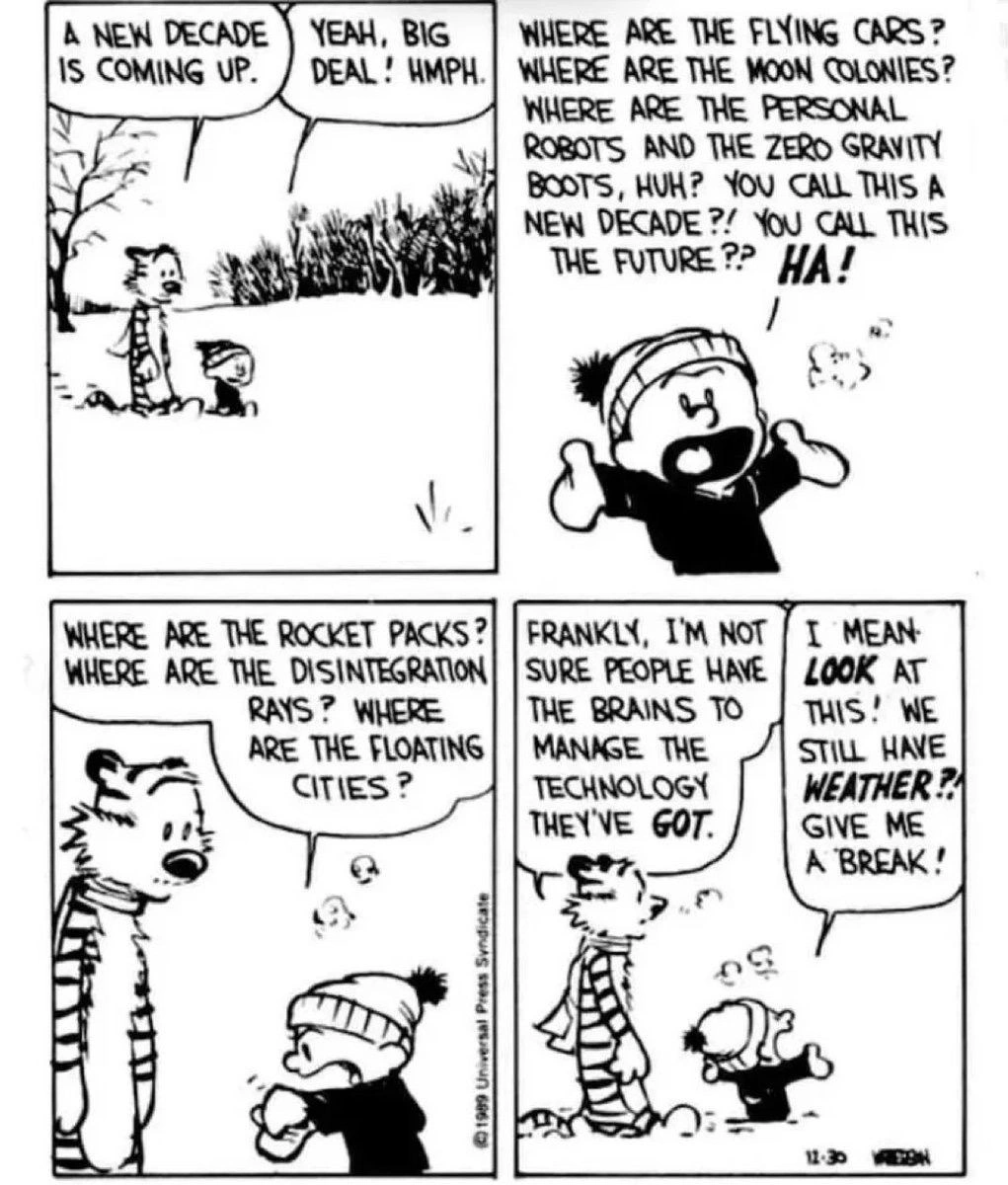
That’s exactly how Calvin feels in this comic. He’s basically a kid yelling, “It’s the future already! How come it’s just like now, but with none of the fun sci-fi gadgets?!” He even humorously complains that we “still have weather,” like he expected technology to control even the rain and snow. It’s a funny exaggeration of feeling let down. We laugh because we know his expectations were way too high – of course we can’t stop the weather or hand everyone a rocket pack! Calvin’s tantrum is like when a kid expects a super amazing gift and gets something ordinary instead. The humor comes from that big gap between what he imagined (a magical future with flying cars and no bad weather) and reality (things pretty much stayed the same). It’s a playful reminder that real life doesn’t usually change overnight, no matter how much we wish it would, and that can be both frustrating and comical when you think about it.

Level 2: Future Hype, Present Reality

This comic strip is a direct Calvin and Hobbes reference – a famous cartoon by Bill Watterson about a young boy (Calvin) and his stuffed tiger Hobbes. In Calvin’s mind, Hobbes is alive and often the voice of reason. Here, Calvin is super frustrated that the “future” didn’t bring all the awesome inventions he’d been expecting. Hobbes mentions a new decade is coming up (in the strip’s original context, the 1990s were about to begin), and Calvin basically says, “Big deal!” because he’s upset that life in the future still looks ordinary.

He then rattles off a list of future_tech_expectations that were popular in science fiction and futurism, but didn’t happen by the time he thought they would:

  • Flying cars – Cars that can lift off and fly through the air. People have imagined flying cars for ages (think of movies and shows like Back to the Future or The Jetsons). They symbolize “the future” in many old predictions. While a few inventors and companies have built prototypes or small flying vehicles, we do not have flying cars in every garage. They’re not practical yet due to engineering issues (like safety and how to manage sky traffic!). This is often used as a shorthand for “the future we were promised that hasn’t arrived.” The phrase flying_cars_hype refers to the continuous buzz about flying car technology that so far hasn’t lived up to expectations.
  • Moon colonies – This means people living on the Moon in bases or cities. Back in the 1960s, during the Space Race, many assumed that by the end of the 20th century we’d have permanent settlements on the Moon (or even Mars). In reality, after the Apollo moon landings, progress slowed. We haven’t built a colony; astronauts only stayed a few days during those missions. So, no city on the Moon exists even today. Calvin expected a cool moon city vacation, but nope!
  • Personal robots – Robots that would be our personal assistants or servants, helping with daily chores. In cartoons and futurist magazines, they imagined households in the 2000s would have robot butlers, like Rosie from The Jetsons. Now, while we do have some robots (a vacuum like Roomba is a simple example, or voice-activated assistants like Alexa and Siri, though they aren’t physical robots), we don’t have a walking, talking personal robot for every person. This is another case of TechHypeCycle disappointment – robots proved a lot harder to generalize beyond specific tasks.
  • Zero gravity boots – This is a fun one: boots that nullify gravity, letting you float or bounce around. It’s a fanciful idea from sci-fi (imagine being able to walk on the ceiling or leap high without coming down). We don’t have anything like this in real life. “Zero gravity” generally only happens in space or in special NASA planes that simulate weightlessness. There are magnetic boots astronauts use on the space station (to stick to floors), but no boots that cancel gravity on Earth. Calvin throwing this in shows how over-the-top his expectations are. It’s like saying, “Why can’t I just turn off gravity when I feel like it?” – clearly not possible with current technology or understanding of physics!
  • Rocket packs – Also known as jetpacks. This is a device you strap on like a backpack that lets a person fly using jets or rockets. Rocket_packs were heavily featured in past futurism; people in the 1950s-1970s imagined commuters flying to work with jetpacks by the 21st century. In reality, while a few experimental jetpacks exist, they are very limited: they can fly only for a short time, are extremely loud and dangerous, and require a lot of skill. They’re certainly not common – we’re not seeing folks fly over traffic with these. So Calvin is bemoaning, “Where’s my easy personal flight machine?!”
  • Disintegration rays – Essentially ray guns that can make objects (or people) vanish into thin air, often depicted as a sci-fi weapon (zap! and your target is dust). This is pure fiction; we don’t have disintegration beams. The idea shows up in classic sci-fi comics and alien movies. Calvin expected even the weapons of the future to be fantastical. In reality, the closest things we have are powerful lasers used in labs or industry, which are huge, not handheld, and definitely not something you’d see the average person with. Calvin shouting for a disintegration ray is a tongue-in-cheek way to say “nothing cool like in comics exists yet!”
  • Floating cities – Cities that hover in the sky, often imagined held up by anti-gravity or some advanced technology. This concept appears in many futuristic stories (for example, Cloud City in Star Wars or the floating city of Laputa in Gulliver’s Travels long ago). We absolutely don’t have floating cities. Buildings are firmly on the ground (or sometimes on water, like floating platforms, but not suspended in the air independently). This is another example of a far-out future idea that hasn’t happened.

Calvin essentially runs through a checklist of “Where is that awesome stuff we were promised?” You can almost hear the modern echo of this rant when tech enthusiasts talk about things like flying cars or hoverboards that still haven’t arrived in our daily lives. In fact, the phrase “Where’s my jetpack?” has become a popular idiom to joke about promised tech that hasn’t materialized.

Now Hobbes, the tiger, listens patiently and then delivers the punchline: “I’m not sure people have the brains to manage the technology they’ve got.” This is a humorous way of saying, maybe it’s a good thing we don’t have those crazy gadgets yet, because we’re not exactly using our current tech perfectly. Think about everyday technology we do have: smartphones, cars, the internet. Humans often struggle with these – for instance, people text while driving (which is dangerous), or don’t secure their computers and get viruses, or spread misinformation on social media. Hobbes is suggesting that if we can’t handle our present technology responsibly, giving everyone even more powerful tools (like disintegration rays or flying cars) might be a disaster! It’s a bit of wise, comedic commentary on human nature and MisalignedExpectations. We expect technology to advance quickly, but we forget that we have to be ready and wise enough to use it well.

For a junior developer or someone new to the tech world, the parallel might not be about flying cars but about new software tech hype. The meme is posted under IndustryTrends_Hype and TechHistory for a reason. It’s pointing out how, very often, we over-hype new technologies and then feel let down. For example, you might hear, “This new programming framework will basically write the code for you,” or “This software methodology will eliminate all delays and bugs.” Early in your career, it’s easy to believe the hype and expect magic solutions. But then you see in practice that you still have to do the hard work: bugs still happen, projects still get delayed. It’s like Calvin expecting an easy future with robot helpers and then yelling “Why is life still hard?!”

Let’s relate this to a concrete example. Around 2015, virtual reality was hyped as the next big thing – everyone would soon use VR headsets for work, education, and play. MarketingVsReality kicked in: marketing said “we’ll have virtual meetings on Mars” but reality a few years later is that VR is mostly used by a smaller group of gamers, and many people find the headsets cumbersome for everyday use. A developer who got caught in that hype might jokingly say, “You call this the future?? Where’s my VR office? Ha!” – exactly Calvin’s tone. Similarly, in software, someone might have told you “learn XYZ language or blockchain, it’s the future and will solve everything.” Fast-forward and you realize those technologies have some advantages but also their own problems, and the old problems (like needing to collaborate, write clear code, handle errors) never went away. That gap between what was promised and what actually happened is what’s making this comic strip so funny and relatable. It’s highlighting DeveloperExpectationsVsReality in a very exaggerated, cartoonish way.

The final line from Calvin, about still having weather, is the cherry on top of the joke. Why mention weather? It seems so mundane compared to rocket packs. But that’s the point – Calvin is effectively saying, “We’re so advanced, yet we can’t even control the weather? Give me a break!” It’s absurd because controlling weather is an almost impossible task (at least with today’s tech) due to how complex and chaotic nature is. This emphasizes just how unrealistic Calvin’s expectations are. No matter the tech, rain and snow won’t just stop because it’s inconvenient! For a junior in tech, think of “we still have weather” like “we still have to deal with boring but important stuff.” For example, no matter how high-level our programming gets, we still have to test and debug our code. There’s no magic button that fixes everything automatically. Every year new tools emerge that promise to simplify development, but you’ll notice you still spend time on the basics – understanding requirements, writing logic, fixing mistakes. Reality always keeps us a bit grounded, much like weather does.

So in simpler terms: Calvin is acting like a kid who’s been told fantastic stories about the future and is super annoyed those stories didn’t come true. Developers find this funny because we’ve all been Calvin at some point – excited about a new decade or a new technology, then realizing things haven’t changed as dramatically as we hoped. The comic is a light-hearted reminder to be skeptical of hype and to appreciate that improvement is usually gradual. It also gently pokes fun at our tendency to dream big (floating cities!) without considering practical limits. In the end, the message (delivered with humor) is: the future might arrive, but not exactly in the way we imagine – and maybe that’s okay, given how we handle what we have now.

Level 3: We Were Promised Jetpacks

Calvin’s heated rant about flying cars and moon colonies hits close to home for seasoned developers who’ve weathered countless hype cycles. In this classic Calvin and Hobbes strip, the boy’s frustration with an underwhelming “future” mirrors how engineers feel when tech reality falls short of sci-fi promises. It’s the dawn of a new decade in the comic (likely the 1990s approaching), and Calvin is basically shouting, “We were promised jetpacks!” – a rallying cry for all the miraculous gadgets we thought we’d have by now. This cartoon humorously encapsulates future tech expectations versus reality, a theme the tech industry knows all too well.

Every item Calvin screams about – personal robots, zero gravity boots, rocket packs, disintegration rays, floating cities – is a symbol of overhyped future technology. These were the Peak of Inflated Expectations back in the mid-20th century: the wild ideas in science fiction magazines, world’s fairs, and optimistic futurist predictions. Fast-forward to reality, and developers today have their own versions of these “missing” features: we entered the 2020s without our code-writing AI butlers or seamless VR meetings that were promised by countless tech headlines. It’s the Tech Hype Cycle in comic form. Calvin’s list reads like a backlog of unfulfilled Jira tickets from the 1960s future forecast project:

  • Flying cars? Still largely grounded. Engineers found out turning every commuter into a pilot leads to more nightmares than convenience (think traffic jams in 3D and the physics of keeping a car airborne safely). We do have drones and prototype hovercraft vehicles, but nothing like the carefree sky automobiles of The Jetsons.
  • Moon colonies? Delayed indefinitely. After the Apollo era, we haven’t colonized space because of staggering costs and technical complexity. The idea of cities on the Moon by the year 2000 was pure optimism. In 2023, we’re just planning to return humans to the Moon after half a century, and even that is a huge challenge, let alone having everyday folks living up there.
  • Personal robots and robot butlers? Aside from Roombas bumping into furniture and voice assistants that tell jokes, we don’t have C-3PO making our dinner. AI and robotics have advanced, but the general-purpose humanoid helper remains sci-fi (and when prototypes do appear, they walk painfully slow and fall down stairs).
  • Zero gravity boots? Now we’re verging on defying physics – no gadget lets you switch off gravity like in a video game. Magnetized boots exist for astronauts (to stick to spaceship floors), but boots that create personal zero-G fields are fiction. Calvin basically wants to moon-bounce to school, but nature says “not so fast.”
  • Rocket packs? Ah, the perennial “where’s my jetpack?” lament. We actually have some jetpacks, but they’re noisy, guzzle fuel, require a pilot’s skill, and tend to have ~30 seconds of flight before you run out of juice (hopefully not while over a canyon). Not exactly an everyday commute solution. The fact that tech conferences still demo new “flyboard” air devices with cautious safety harnesses shows this dream’s reality lag.
  • Disintegration rays? Thankfully, nobody’s handed out a hand-held vaporizer gun to the public – imagine the support tickets that would generate! High-energy lasers can cut metal, but a portable ray-gun that zaps your trash into oblivion remains a safety and science problem (and probably for the best – Hobbes’ point about “brains to manage the tech” shines here).
  • Floating cities? We’ve barely managed floating servers in the cloud; floating cities are on another level. Without anti-gravity technology (which doesn’t exist outside of theoretical physics thought experiments), cities stay firmly attached to ground or water. The closest we got are ambitious concepts of hovercraft platforms and some sci-fi concept art. We’re more likely to see cities under the ocean (and even that is a long shot) than levitating metropolises anytime soon.

Calvin’s tirade is funny because it’s an exaggerated version of how developers feel when bombarded with TechIndustryHumor about lofty tech forecasts. We’ve all seen those breathless keynote presentations and flashy marketing videos that basically promise “a revolutionary paradigm shift” in each new product. But a year or a decade later, we find ourselves grumbling like Calvin: “You call this the future?? HA!” For example, in the early 2010s, pundits hyped that by the 2020s we’d all be using VR headsets daily, 3D-printing our food, and offloading coding to AI. Here we are: most people still stare at 2D screens, order takeout the normal way, and yes, still debug code at 2 AM because the AI can’t handle a tricky edge case. DeveloperExpectationsVsReality is the adult version of Calvin’s meltdown, and it’s equal parts hilarious and sobering.

Hobbes’ deadpan response, “Frankly, I’m not sure people have the brains to manage the technology they’ve got,” adds a layer of TechHistory wisdom. This line could come straight from a battle-scarred senior engineer in a production incident post-mortem. It echoes the reality that even though we build powerful systems, people are often the weakest link. We dream up new frameworks and languages, but then struggle with using source control correctly or deploying without breaking things. Think about it: we created cloud computing with auto-scaling and container orchestration, yet “we still have outages? Give me a break!” – a modern Calvin might yell this after the latest multi-hour AWS region downtime. Hobbes is essentially saying, “Instead of whining about not having jetpacks and floating cities, maybe we should focus on responsibly handling Kubernetes and not leaving S3 buckets world-readable.” 🔒 It’s a snarky reminder that MisalignedExpectations (between what tech we want and what we can actually utilize) often cause our disappointments.

The final punchline, Calvin’s still_have_weather outburst – “We still have weather?! Give me a break!” – is comic genius and a perfect metaphor for enduring annoyances. It’s the equivalent of a developer screaming, “It’s 2023 and we still have buffer overflows?! Come on!” Weather, like certain perennial tech problems, is a force of nature – chaotic, hard to control, something you just learn to live with. In software, legacy code and bugs are our “weather” – no matter how advanced our tools get, completely eliminating them is a pipe dream. Calvin’s expectation that the future would abolish weather itself highlights how over-the-top our TechHypeCycle expectations can become. It’s as if some 1960s futurist promised, “By 2020, climate control will let us schedule sunny days for everyone’s picnic.” Meanwhile, here in reality, we’re still debating if tomorrow’s forecast requires an umbrella. ☂️

Developers chuckle at this strip because it resonates on multiple levels. It’s a nostalgia trip (Calvin & Hobbes comics were beloved reading for many of us) and a satire of MarketingVsReality in tech. We’ve grown jaded (like Calvin) after hearing one too many lofty promises at conferences: “This database will scale infinitely!”, “This new JavaScript framework will eliminate all bugs!”, “2020 is definitely the year of Linux on the Desktop!” – only to find that the old problems persist or new ones arise. The meme captures that shared, slightly cynical sentiment: the future is never quite what it’s cracked up to be, and maybe that’s because hype is easy, but execution and human nature are hard. As one famous venture capitalist quipped, “We wanted flying cars, instead we got 140 characters.” In other words, we got Twitter – a far cry from moon colonies. Calvin’s rant is basically the developer community’s collective eye-roll at all the TechHumor we’ve lived through: from the paperless office that never happened (look at your office printer queue) to the AI that was supposed to fix our code (and instead sometimes breaks it in new and exciting ways).

In summary, this meme strikes a chord because it humorously compresses decades of TechHistory and hype into a few angry questions. It reminds seasoned devs of every grand promise that fizzled out, and every “next big thing” that solved less than expected. Yet, through Hobbes’ wise comment, it also humbly acknowledges a core truth: perhaps we should master not crashing the systems we have before lusting after space-age miracles. It’s a gentle roast of our industry’s tendency to chase shiny objects, delivered with the wit and charm of a snowfield conversation between a boy and his imaginary tiger. We laugh, we nod, and maybe we check the sky one more time for that flying car… just in case.

Description

Four-panel black-and-white Calvin and Hobbes comic set in a snowy field. Panel 1 shows Hobbes walking while Calvin, bundled in a winter hat and coat, scowls; Hobbes says, “A NEW DECADE IS COMING UP.” and Calvin answers, “YEAH, BIG DEAL! HMPH.” Panel 2 zooms on an irate Calvin shouting: “WHERE ARE THE FLYING CARS? WHERE ARE THE MOON COLONIES? WHERE ARE THE PERSONAL ROBOTS AND THE ZERO GRAVITY BOOTS, HUH? YOU CALL THIS A NEW DECADE?! YOU CALL THIS THE FUTURE?? HA!” Panel 3 has Calvin shaking his fists beside a bemused Hobbes, yelling, “WHERE ARE THE ROCKET PACKS? WHERE ARE THE DISINTEGRATION RAYS? WHERE ARE THE FLOATING CITIES?” Panel 4 shows Hobbes replying, “FRANKLY, I’M NOT SURE PEOPLE HAVE THE BRAINS TO MANAGE THE TECHNOLOGY THEY’VE GOT.” while Calvin storms off screaming, “I MEAN - LOOK AT THIS! WE STILL HAVE WEATHER?! GIVE ME A BREAK!” The strip humorously captures perennial disappointment with promised sci-fi breakthroughs, mirroring modern developer skepticism toward hype cycles and unmet tech forecasts
Comments

8
Anonymous ★ Top Pick Execs: “This decade we’ll ship quantum, self-healing, blockchain-driven microservices on Mars!” Me: “Awesome - let’s just get the cron job to survive the next leap second first. We still have timezones, folks.”
  1. Anonymous ★ Top Pick

    Execs: “This decade we’ll ship quantum, self-healing, blockchain-driven microservices on Mars!” Me: “Awesome - let’s just get the cron job to survive the next leap second first. We still have timezones, folks.”

  2. Anonymous

    Just like Calvin waiting for flying cars, we're still waiting for that mythical 'year of Linux on the desktop' while simultaneously training AI models that hallucinate entire floating cities - turns out Hobbes was right about our ability to manage the tech we've already got

  3. Anonymous

    Every sprint planning meeting where the PM promises 'revolutionary AI features' and 'seamless integration' feels like Calvin waiting for his flying car - meanwhile, we're still debugging why the weather API returns null on Tuesdays. Hobbes had it right: maybe we should focus on managing the technology we've already shipped before promising the moon (colonies)

  4. Anonymous

    Zero-gravity boots? Try zero-downtime deploys - eternal myths senior SREs chase while prod burns

  5. Anonymous

    Everyone wants flying cars, but our stack can't even make weather deterministic - if cache invalidation and time zones still beat us, maybe hold off on zero-gravity boots

  6. Anonymous

    We asked for flying cars and moon colonies; we got multi‑cloud - and the forecast in prod is still “partly cloudy with a chance of cache invalidation.”

  7. @Araalith 3y

    Actually there are flying cars, personal robots and rocket packs.

    1. @azizhakberdiev 3y

      this was the actual point of meme ig

Use J and K for navigation