Skip to content
DevMeme
1485 of 7435
Low-Level Legends vs. High-Level Laments
Languages Post #1662, on Jun 4, 2020 in TG

Low-Level Legends vs. High-Level Laments

Why is this Languages meme funny?

Level 1: Chef vs Picky Eater

Imagine two friends in a kitchen to understand why this is funny. One friend is like a master chef who just baked a huge cake from scratch – we’re talking grinding the flour, churning the butter, the whole deal – all so that everyone can have a delicious dessert. This is a massive effort, and thanks to that, all the other friends can now just enjoy cake without knowing how it was made. Now the other friend is more like someone who just wants to microwave a quick snack, but he’s upset because the microwave’s buttons aren’t working perfectly. He’s pouting, saying, “I can’t make my snack because this microwave is annoying. Can someone buy me a better microwave, please?” He’s basically refusing to cook his easy meal because one little convenient feature is missing.

In this story, the master chef represents the low-level programmer: he did something really big and difficult (like inventing a new recipe from basic ingredients – or in the programming world, creating a whole new tool using the simplest code). The picky eater friend represents the high-level programmer: he has every ingredient and tool already provided (a ready-to-use microwave, just like a developer has an IDE and a high-level language), but stumbles over a small inconvenience (the broken button, like a broken autocomplete feature). It’s funny because the difference is so extreme. One person is solving a hard problem and helping everyone, while the other is complaining about a minor problem and asking for help. We laugh because it’s a bit like seeing a superhero next to someone who won’t tie their own shoelaces – the contrast is silly and exaggerated, and that’s exactly the point of the joke.

Level 2: From Bare Metal to Browser

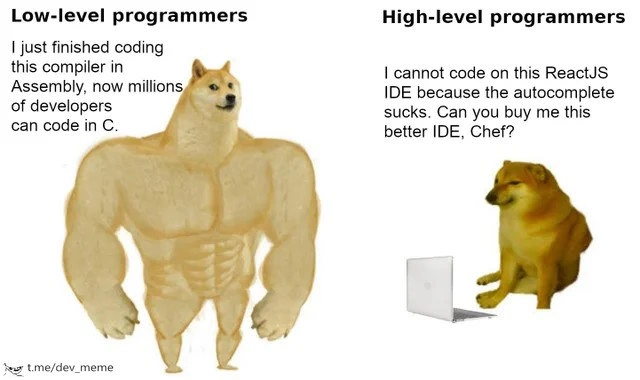
Dropping down to a more introductory explanation, let’s clarify what’s going on in the meme and define some terms for those newer to these concepts. The left side of the image is labeled “Low-level programmers” and shows a very muscular Doge (the buff doge meme). The caption says: “I just finished coding this compiler in Assembly, now millions of developers can code in C.” The right side is labeled “High-level programmers” with a smaller, normal Shiba Inu (Cheems) next to a laptop, saying: “I cannot code on this ReactJS IDE because the autocomplete sucks. Can you buy me this better IDE, Chef?”

First, what do we mean by low-level and high-level in programming? This refers to how close you are to the actual hardware and machine code when you program.

  • Low-level programming means coding in a way that’s very close to the hardware’s native language. Assembly language is a prime example of low-level coding. Assembly language uses short codes (like MOV, ADD, JMP) that correspond almost one-to-one with the binary instructions a CPU executes. It’s specific to a CPU architecture (for instance, x86 assembly is for Intel/AMD 32/64-bit processors, ARM assembly is for ARM processors, etc.). Low-level code doesn’t have conveniences like variables or complex logic structures built-in; you manage everything yourself (memory addresses, CPU registers, etc.). It’s powerful and efficient, but also difficult and time-consuming to write.

  • High-level programming means coding with languages and tools that abstract away the hardware details. High-level languages (like Python, JavaScript, or Java) let you write code using human-friendly concepts (like objects, loops, functions) without worrying about exactly which register or memory address everything goes into. High-level tools also include things like frameworks (e.g., ReactJS) and rich environments that handle a lot under the hood. High-level code is generally easier to write and understand (for humans), but you are further from the metal – meaning you trust the lower layers (like compilers, interpreters, and the operating system) to manage the details.

Now, what’s a compiler? A compiler is a special program that translates code from a high-level programming language (like C or C++) into low-level code (like assembly or directly into machine code). For example, if you write a program in C, a compiler will convert that into machine code that the computer’s CPU can execute. Writing a compiler is a complex task because you have to teach the computer how to understand an entire programming language – its syntax and semantics – and produce correct, optimized machine instructions for it. In the meme, the low-level programmer is bragging about having written a compiler in assembly. This means they wrote the compiler’s code using assembly language. That’s like writing an entire book using only a vocabulary of a few hundred words and no sentences – doable but extremely challenging. Why would someone do that? Historically, that’s how it had to be done for new languages! The very first C compiler, for instance, had to be written in something that already ran on the machine (which was assembly, because there was no C compiler yet!). Once a basic compiler existed, developers could use C itself to improve it or write new tools. So the buff Doge’s statement implies: “I did the really hard foundational work so that now a huge number of programmers can conveniently write in C, a higher-level language, instead of struggling with assembly like I did.” It’s a bit like saying “I built the first brick road so now millions of people can drive on a smooth highway.” Millions of developers coding in C is only possible because some experts build and maintain compilers (and the language specifications, standard libraries, etc.). So, the left side is essentially: a low-level expert proud of creating a tool that empowers others in a big way.

On the right side, we have a high-level programmer working with ReactJS. Let’s break that down: ReactJS (often just called React) is a JavaScript library for building user interfaces, particularly web applications. If you’ve ever used a dynamic website where parts of the page update without reloading, chances are React or a similar framework is at work behind the scenes. React allows developers to create components (like pieces of a web page: buttons, forms, menus) in a very organized way and manage the state of the application efficiently. React is considered high-level because the developer isn’t dealing with the raw browser internals or manual DOM updates; React provides an abstraction that makes it easier and faster to build complex UIs.

Now, what’s an IDE? IDE stands for Integrated Development Environment. It’s an application that bundles together many tools that programmers use into one cohesive user interface. For example, an IDE typically has a code editor (where you write your code), along with features like syntax highlighting (color-coding of keywords), build tools or compilers integration (so you can press a button to run your code), debugging tools (to step through code and inspect values), and autocomplete (also known as code completion). Autocomplete is the feature where as you type, the IDE suggests completions for what you might be typing. For instance, if you start typing a variable name or a function call, a little popup may show possible matches or even automatically fill it in after you type a few characters. This can greatly speed up coding and reduce typos. Modern IDEs or code editors (for example, Visual Studio Code, Atom, IntelliJ IDEA, or WebStorm) have pretty advanced autocomplete that can sometimes even suggest entire lines of code. They do this by understanding the language and context – some have a language server or built-in parser for languages like JavaScript/React that knows about your variables, functions, and imports.

In the meme, the high-level programmer is saying their ReactJS IDE’s autocomplete “sucks” – meaning it’s not giving good suggestions or is lacking in some way – and thus they claim they “cannot code” because of it. They then ask their boss (addressed humorously as “Chef”) to buy them a better IDE. This portrays the high-level dev as very tool-dependent. The idea is that without a good tool, they’re not comfortable coding. It’s an exaggerated scenario to be funny. Most programmers, even beginners, can still write code if the IDE doesn’t autocomplete (you can always type things out fully), but it might slow them down a bit. However, in this joke, the high-level dev acts as if it’s impossible to work under these conditions – like a spoiled child saying “I can’t do my homework because my special pen isn’t working, I need a new one.” And asking the boss to buy a better IDE suggests maybe the better IDE is a paid one or something that requires approval (for example, WebStorm is a paid IDE known to have great autocomplete for JavaScript/React, so maybe the dev is asking for that instead of a free editor). Calling the boss “Chef” is just a funny touch – it’s not a common term in real life for a boss in software teams (unless your boss literally is a chef, which would be a different story!). It’s likely derived from meme culture or a cute mispronunciation of “chief”. In some languages (like French), “chef” means boss, but here it’s used in a playful, almost subservient tone: like the high-level dev is saying “pretty please, can you get me this thing?”

The joke here is basically pointing out how different the mentality and struggles of these two programmers are. The low-level programmer’s challenge was immense – writing a compiler in assembly requires deep knowledge of how programming languages work and how hardware executes instructions. It’s something that would take a long time, lots of debugging, and a strong understanding of computer science theory (languages, grammars, etc.) and computer architecture. In contrast, the high-level programmer’s “struggle” is almost trivial: they’re complaining about a developer convenience feature not working ideally. It’s intentionally an absurd comparison. It’s like comparing a construction worker who built a bridge to someone who is upset that their smartphone case isn’t the right color. That’s why it’s funny – the scale of accomplishment and problem are completely mismatched.

To someone new to programming, it might help to know that both low-level and high-level programming are important and have their own challenges. Low-level code (like making compilers or operating systems) is hard because you manage everything and mistakes can crash the system or lead to very subtle bugs. High-level code (like making a React app) is “easier” in the sense that you’re not dealing with the hardware directly, but it has its own complexity – user requirements, keeping up with fast-evolving tools, and managing large codebases with many moving parts. Typically, though, a high-level programmer expects more help from tools. If you’re writing a web app, you’ll likely use an IDE or editor with a lot of features to help you navigate the code, because the project might be huge and written by many people over time. If you’re writing an assembly program, often it’s just you and maybe a simple editor or command-line assembler – it’s usually a smaller solo effort where you are the tool (in a manner of speaking).

The meme exaggerates a stereotype: the “old-school” programmer vs the “modern” programmer. Old-school (low-level) guy does amazing stuff with minimal resources; modern (high-level) guy struggles without fancy tools. It’s not universally true, but stereotypes often have a tiny grain of truth which makes them recognizable and funny. Many beginners today start directly with high-level languages and environments like Python notebooks or Visual Studio Code for web dev, and might find something like assembly programming utterly foreign and daunting (which it is!). Conversely, someone who learned programming 30 years ago might be less accustomed to today’s super-rich IDEs and could joke that people rely on autocomplete too much. This meme captures that generational/technical gap in a lighthearted way.

So in simpler terms: The big dog on the left built a tool (compiler) using very basic coding (assembly) that helps everyone else. The small dog on the right is using tools (React, an IDE) that others built, to do his job – and he’s complaining when one of those tools isn’t making coding easy enough for him. It’s contrasting being a tool-maker versus a tool-user. For someone new: think of it as the difference between an engineer who builds a car engine from scratch, versus a driver who just wants a nice GPS and complains if the GPS is outdated. Both are part of the car world, but at very different levels.

Level 3: Assembly Gains vs Autocomplete Pains

Now let’s step down a notch into a senior developer’s perspective on why this meme hits home. At this level, we’re looking at shared industry experiences and humor that an experienced programmer (especially one who’s been around both low-level and high-level work) would appreciate. The meme uses the popular “Buff Doge vs Cheems” format – a buff, confident Doge representing one group, and a smaller, anxious Doge (often called Cheems) representing another. Here it’s “Low-level programmers” (Buff Doge) versus “High-level programmers” (Cheems). The humor comes from the stark contrast between the two captions:

  • Low-level programmer (Buff Doge): “I just finished coding this compiler in Assembly, now millions of developers can code in C.”
  • High-level programmer (Cheems): “I cannot code on this ReactJS IDE because the autocomplete sucks. Can you buy me this better IDE, Chef?”

For a seasoned developer, this is immediately funny because it parodies a real divide in the programming world. Low-level programming is often seen as the realm of the hardcore – these are the folks writing compilers, operating systems kernels, device drivers, or highly optimized code. They work close to the hardware, understand how memory and CPUs actually function, and often have a certain pride (sometimes a snobbiness, truth be told) about how they don’t need fancy tools or high-level conveniences. They might reminisce about coding in vi or Emacs in a terminal, debugging with print statements or raw memory inspections, and so on. The Buff Doge’s boast reads like the ultimate humblebrag such an engineer might half-jokingly drop: essentially saying “I enabled an entire programming ecosystem by doing the hardest thing imaginable.” There’s an element of truth-flavored humor: compilers are indeed one of the most significant contributions a developer could make – enabling others to use a new programming language. And doing it in assembly? That’s a one-way ticket to legendary status (and possibly burnout, unless you truly love assembly). This line drips with exaggerated machismo: the Buff Doge is basically wearing the “10x engineer” cape here, as if it’s no big deal for him. It’s hyperbole – in reality, even brilliant low-level engineers don’t churn out new compilers casually – but it captures that ethos of the low-level guru who deals in arcane, powerful magic that the rest of us mere mortals benefit from.

Now the Cheems side – the high-level programmer – is funny in the opposite way. This side is poking fun at (and let’s be honest, slightly roasting) developers who work with very high-level tools and have perhaps become overly dependent on them. The specific scenario: a ReactJS developer complaining that their IDE’s autocomplete isn’t working well, and asking their boss (“Chef” – more on that in a second) to get them a better IDE. Why is this so comical to an experienced dev? Because it portrays the high-level programmer as comically helpless and spoiled. In day-to-day development, we’ve all felt annoyance when our editor doesn’t autofill a import or glitches out on suggestions. But most of us would still be able to code if autocomplete fails – we might grimace and continue, or at worst install a different plugin. The meme turns this minor gripe into “I cannot code... because autocomplete sucks,” which is a huge exaggeration – implying this developer literally can’t function without the IDE holding their hand. It’s a caricature of the modern “framework dev” stereotype: someone who has always had big frameworks, stackoverflow, and smart IDEs at their disposal, and therefore never learned lower-level problem-solving or how to work without those aids. It tickles seasoned devs because many have encountered a scenario where a less experienced colleague might say “Ugh, my code completion isn’t showing, I’m stuck”, and the senior’s internal reaction is “Stuck? Just write the code manually, it’s not that hard!” This meme amplifies that scenario for comedic effect.

Let’s talk about the “Chef” bit: Cheems says, “Can you buy me this better IDE, Chef?” This is an intentionally silly way to refer to their boss or team lead. It’s not literally about the Chef configuration management tool or anything technical named Chef – it’s just the high-level programmer addressing their superior in a somewhat servile, whiny tone (*“Chef” perhaps as in “Chief” or just a goofy term, playing on the Cheems meme language). The image of a developer so reliant on their tools that they go begging to their boss for a better one is a humorous jab at how entitlement or dependency can look in the workplace. Many companies provide standard tools, but here we have the dev saying essentially: “This free editor isn’t good enough, please buy me a shiny commercial one because I can’t cope otherwise.” Experienced readers might chuckle thinking of junior devs who insist they need an ultra-powerful MacBook or a premium IDE license just to do relatively straightforward tasks – not because these tools aren’t helpful (they are), but because it’s the contrast with the self-sufficient assembler coder that makes it ridiculous.

This meme also resonates due to an undercurrent of “back in my day” sentiment. Seasoned engineers, especially those who perhaps started in the days of C, C++, or even assembly, sometimes look at newer developers with their expansive tooling and high-level languages and recall how they managed without all that. “Back in my day, we coded in Notepad and compiled from the command line, and it worked!” – that kind of tale. The Buff Doge vs Cheems format is basically this generational or paradigm gap on display. One side says: “I create the tools. I deal with the hardest problems directly.” The other side says: “I have every tool in the world, but if one doesn’t work nicely, I’m stuck.” It’s obviously a tongue-in-cheek exaggeration; real high-level devs aren’t weak or lazy, and real low-level devs also use tools and complain about things. But there’s a kernel of truth that gives the joke its spice. In real projects, low-level programmers (like those writing a new programming language, or an engine in C++) often have to power through limited tooling – sometimes their tools are the thing they’re building! Meanwhile, high-level application developers might be more at the mercy of their tools’ quirks – for instance, if an update to the IDE or a browser dev tool breaks, it can slow them down significantly.

Another layer here is culture in different programming domains. Front-end web development (symbolized by React) is famously fast-moving and tool-heavy. A React dev’s workflow likely includes a rich IDE, a local development server auto-reloading changes, browser dev tools, linters, prettifiers, perhaps even AI-driven autocomplete nowadays. They deal with multiple layers of abstraction: HTML, CSS, JS, frameworks, build tools, package managers (npm or yarn), etc. Losing one piece (like good autocompletion) can feel crippling because there’s so much surface area to keep track of. On the other hand, systems programming and compiler development move slower and emphasize efficiency over convenience. Those developers might use simpler editors or highly customized setups and often operate solo or in small teams compared to huge front-end teams. The meme shines a light on how each group might perceive the other: the low-level guru might think the React dev is soft or too reliant on fancy gadgets, and the React dev might find the low-level stuff esoteric and impractical for daily needs. This tension is portrayed humorously as almost a parent-child or hero-sidekick dynamic in the panels.

In practical terms, any senior developer knows that both levels of work are important and difficult in their own ways. Building a modern web application with React can be extremely challenging (just try managing a complex app’s state and asynchronous calls, or optimizing bundle size – it’s not trivial!). The meme isn’t saying high-level devs are actually useless – it’s exaggeration for comedy. But it picks a particularly trivial gripe (autocomplete) to really hammer home the contrast. It’s the juxtaposition that makes it funny: “I built something that changed the world” vs “My code editor doesn’t automatically close my tags, I give up.” It’s so over-the-top that we recognize it as a joke, possibly even an affectionate one. Developers often poke fun at themselves and their own reliance on tools. Many front-end devs will laugh at this too, because who hasn’t cursed at their IDE for not auto-importing a component and thought “I can’t work like this!” in a dramatic internal monologue? We know it’s a first-world programmer problem.

The watermark in the corner (t.me/dev_meme) indicates this came from a developer meme channel, which tells us this is shared among devs for a laugh. It’s an in-joke. The categories (Compilers, Languages, IDEs_Editors, LowLevelProgramming, Frontend) and tags (#AssemblyLanguageX86, #React, #IDEsAndTextEditors, etc.) all point to classic discussions in the dev community:

  • Compilers vs Interpreted languages,
  • low-level vs high-level programming,
  • the role of good tools (like IDEs) in modern coding,
  • and how different programming domains have different expectations.

A senior developer reading this meme might nod knowingly because they’ve likely experienced both sides: maybe writing some low-level code in university or for a hobby (or at least using software that required understanding pointers and manual memory), and also working with high-level frameworks where a good IDE and autocomplete save hours of time. They find it funny because it encapsulates a real phenomenon in a punchy, visual way. It’s “funny because it’s true,” but also because it’s exaggerated. The buff doge and whiny doge exaggerate the personas – no actual human is literally that buff or that whiny dog, but it feels like we know these characters in spirit. We’ve met that grizzled veteran programmer who built their own PC from parts, coded in assembly, and thinks modern developers have it easy. And we’ve met the new grad who can whip up a mobile app with Flutter in a day but stares blankly if you mention a CPU register or ask them to write a simple algorithm without Google. The meme humorously pits them against each other.

This kind of humor also serves as a gentle reminder in tech culture not to become too dependent on our comfort zone. It pokes fun at the high-level dev’s dependence on autocomplete, perhaps hinting “hey, maybe you should try doing things the hard way once in a while to appreciate what you’ve got.” Conversely, it kind of lionizes the low-level dev, but also implies maybe they’re a bit of a masochist – who chooses to write a compiler in assembly unless they absolutely have to? Sometimes low-level purists take pride in doing things the hard way for its own sake. So there’s a subtext of “these extremes are a bit ridiculous” on both ends. The balanced truth is in the middle, but the comedy lives in the extremes.

In essence, a senior perspective of this meme revels in the inside joke of tech’s spectrum: from the metal to the GUI, from the ones who invent the wheels to the ones who complain the Tesla isn’t self-driving enough. It’s a playful jab across the aisle – the frontend folks laugh (maybe a bit sheepishly) at how needy Cheems looks, and the systems folks laugh with a hint of pride at Buff Doge’s boasting. If you’ve been in this industry long enough, you’ve likely shifted your stance on this spectrum at least once, and this meme gives a chance to laugh at both your past and present self.

Level 4: Bare-metal Bootstrapping

At the highest level of technical insight, this meme highlights the extreme ends of programming abstraction. The buff Doge on the left stands for a low-level programmer who literally wrote a compiler in assembly language. To appreciate this feat, recall that assembly (x86 assembly, for example) is as close to the metal as programming gets – one step above writing raw machine code (actual bytes like 0x89 0xE5... that a CPU understands). In assembly, every instruction corresponds to a tiny operation on the CPU (moving data to registers, arithmetic, jumps, etc.). There are no luxuries like loops or functions as we know them in high-level languages – you manually manage instruction flow and use labels and jumps for control structures. Now, imagine implementing an entire C language compiler under those spartan conditions! A compiler is a highly complex piece of software that takes source code (here, C code) and translates it into machine code. This involves lexical analysis (reading characters and turning them into tokens), parsing those tokens into an abstract syntax tree (understanding the structure of the code), and then code generation to produce correct machine instructions. Doing all of that in assembly means handling every detail by hand: managing memory for symbols, writing routines to recognize keywords, building data structures with nothing but raw memory addresses and registers – essentially creating high-level abstractions using only primal tools. It’s a bit like carving a full statue with a pocket knife; you can do it, but it requires incredible skill, patience, and knowledge of the material (in this case, the computer’s architecture). The meme’s caption, “I just finished coding this compiler in Assembly, now millions of developers can code in C,” alludes to the heroic, foundational impact of such work. This is actually historically grounded: early compilers for languages like Fortran, C, and others were often written in assembly because, at the dawn of a new language, there’s no existing compiler to use for it. Someone has to get their hands dirty with the bare metal and bootstrap the first compiler. Once the first version exists (often a simple one produced with tremendous effort), it can be used to write more advanced versions of the compiler in the high-level language itself – a process called self-hosting. For instance, an assembly-written compiler for C can compile a more complex C program that is actually an improved compiler. This way, the language kind of “pulls itself up by its bootstraps,” which is where that term bootstrapping comes from. The buff Doge’s pride that “millions of developers can code in C” thanks to his assembly compiler is a nod to how foundational low-level work empowers legions of other programmers to build everything from operating systems to web browsers in a more convenient language. It’s the ultimate flex in the programming world: I did the insanely hard part so that everyone else’s life is easier. And frankly, writing a whole compiler in assembly is beyond hardcore – it’s the kind of achievement that ends up as a footnote in computing history books (or at least, a legendary GitHub repository).

On the right side, we have the smaller, meek Cheems Doge representing a high-level programmer – specifically a modern front-end developer working with ReactJS (a popular JavaScript library for building user interfaces). The caption complains, “I cannot code on this ReactJS IDE because the autocomplete sucks. Can you buy me this better IDE, Chef?” This highlights the other extreme of software development: relying on rich, high-level tools and abstractions to the point that their shortcomings become blockers. Let’s unpack that technically. ReactJS developers write in JavaScript (or often JSX/TSX, which are extensions of JavaScript for React) to create dynamic web applications. This code is as far from the hardware as you can imagine – there’s a cascade of abstractions separating a React component from the CPU’s instruction set. Consider an approximate stack of technologies at play here:

  • CPU and Hardware: Physical circuits executing machine code.
  • Machine Code: The binary instructions (101010...) that run directly on the CPU.
  • Assembly Language: A human-readable form of machine instructions (e.g., MOV RAX, 5).
  • Compiled System Languages: Languages like C or C++ that a compiler translates into assembly/machine code. Many foundational systems (operating systems, language runtimes, even the JavaScript engine in your browser) are written in these.
  • Managed / Interpreted Languages: High-level languages like JavaScript, which run inside a virtual machine or engine (the browser’s JS engine is usually written in C++). They rely on those lower layers to work.
  • Frameworks and Libraries: ReactJS is a library written in JavaScript (itself running on that JS engine) that provides abstractions for building UI (e.g., components, state management).
  • Development Tools: An IDE (Integrated Development Environment) or advanced code editor (like VS Code, IntelliJ IDEA, or WebStorm) that runs on an OS (written in C/C++/Java, etc.), which provides features like syntax highlighting, debugging, and crucially, autocomplete.
  • Developer (High-level): Finally, the person writing application code (e.g., a React app), who is leveraging all the layers below without needing to know their inner workings in detail.

The Cheems character is operating at the very top of this tall tower of abstraction. When he says the autocomplete in his ReactJS IDE “sucks,” it implies that the editor isn’t intelligently suggesting or completing code as well as he’d like. Autocomplete (often powered by something like Microsoft’s IntelliSense or the Language Server Protocol) is essentially a mini real-time compiler feature: the IDE continuously parses your code as you type and tries to predict what you might want (like variable names, function names, autocompleting brackets, etc.). If it’s lagging, inaccurate, or missing framework-specific hints, a spoiled high-level dev might indeed feel “I cannot code” without it. Technically speaking, for large frameworks like React, good autocomplete may require the IDE to understand not just plain JavaScript syntax but also the framework’s structures (like React components, props, state) and possibly even type information if using TypeScript. Not all IDEs are equally good at this; for example, VS Code with the right extensions vs another editor might differ in how smart the suggestions are. The Cheems dev’s plea, “Can you buy me this better IDE, Chef?” suggests he has identified a tool that does better (perhaps a commercial IDE like WebStorm, known for strong React support) and is asking his boss (calling them “Chef” in a meme-y, deferential way) to purchase it for him. The humor from a deep technical angle is that the high-level dev’s entire productivity is shown to hinge on this one convenience feature in a development tool, whereas the low-level dev built an entire foundational technology with basically a primitive toolset.

This contrast also underlines how superstructure vs. foundation differ in engineering. The assembly hero likely wrote his code in something very basic – perhaps just a text editor in a console or a bare-bones IDE (if you can call an assembly editing environment an IDE at all). He definitely did not have code autocomplete when crafting the compiler’s thousands of lines of assembly. (In fact, many assembly programmers from the old days worked from printouts of CPU instruction tables and wrote code on paper or simple editors, assembling and running it with command-line tools.) Meanwhile, the React developer’s work happens in a world where so much complexity is managed by others that their concerns become developer experience issues: how nice are my tools to use? Does my editor automatically import React components and suggest the right CSS classes? If not, I feel “stuck.” From an advanced viewpoint, it’s a bit ironic – the high-level programmer is indirectly benefiting from countless low-level programmers’ work (compilers, languages, operating systems, browser engines), yet is complaining about a relatively superficial issue. There’s also a technical reality here: modern high-level programming (especially in front-end web development) involves wrangling huge APIs, libraries, and rapidly changing frameworks. Autocomplete isn’t just a luxury; it’s practically a crutch to deal with the high cognitive load. A React codebase might involve dozens of imported modules, hundreds of components, and intricate state logic – remembering every function name or prop exactly is tough, so we lean on the editor to help. The meme exaggerates this reliance to the point of absurdity: “I can’t code if my IDE doesn’t finish my sentences for me.” It tickles experienced engineers because it caricatures a stereotypical junior or high-level specialist developer who has never worked without these comforts.

In summary at this deep-dive level: the meme juxtaposes the lowest-level, most fundamental kind of programming (assembly, creating the tools for others) with the highest-level, most convenience-oriented programming (using a framework inside an IDE with autocomplete). It’s highlighting a gulf of abstraction. That gulf is why the left character is drawn buff – he’s doing the heavy lifting of computing – and the right is drawn weak – he’s portrayed as dependent on layers of help. The technical community finds humor (and maybe a touch of gentle scorn) in this because it’s a hyperbole of real attitudes: systems programmers often pride themselves on understanding and building the machinery that application developers simply use. And application developers, especially in fields like web dev, often focus on speed and productivity, gladly embracing tools that make development easier, sometimes to the point of being helpless without them. Neither extreme tells the whole story (writing a compiler in assembly is exceedingly rare today, and front-end devs can be perfectly competent problem-solvers even if they rely on IDEs), but by cranking each stereotype to 11, the meme lands its joke. It’s a celebration of the unsung engineering heroes on one side, and a roast of the pampered modern developer on the other, within one image.

Description

A two-panel 'Swole Doge vs. Cheems' meme comparing different types of programmers. The left panel, labeled 'Low-level programmers', features a muscular, confident Doge character saying, 'I just finished coding this compiler in Assembly, now millions of developers can code in C.' This represents a foundational, powerful achievement. The right panel, labeled 'High-level programmers', shows a small, sad Cheems dog sitting in front of a laptop and whining, 'I cannot code on this ReactJS IDE because the autocomplete sucks. Can you buy me this better IDE, Chef?'. The meme humorously contrasts the monumental, system-building work of low-level engineers with the perceived trivial complaints of high-level developers who are highly dependent on modern tooling and abstractions. For senior developers, this joke is a nostalgic nod to the foundational layers of computing and a gentle ribbing of the sometimes-myopic focus on developer experience (DX) in modern web development


Comments

7
Anonymous ★ Top Pick The pioneers wrote compilers in assembly so we could have fancy IDEs that tell us we're using the wrong shade of blue for a button. It's the circle of life, but with more linting errors
  1. Anonymous ★ Top Pick

    The pioneers wrote compilers in assembly so we could have fancy IDEs that tell us we're using the wrong shade of blue for a button. It's the circle of life, but with more linting errors

  2. Anonymous

    Buff Doge shipped an optimising C compiler in 4 KB of assembly; Cheems opens a P1 ticket because the React IDE needs 32 GB of RAM before the TypeScript language server will autocomplete `className`

  3. Anonymous

    The real irony is that the low-level programmer's compiler probably has better autocomplete than any modern IDE - it just completes to segfault instead of undefined

  4. Anonymous

    The irony here cuts deep: the low-level programmer who hand-crafted a compiler enabling millions to write C is portrayed as a chad, while the high-level developer can't function without perfect IDE autocomplete for a framework that abstracts away everything the first programmer built. It's the ultimate commentary on how each generation of abstraction layers creates developers who are simultaneously more productive and more dependent - standing on the shoulders of giants while complaining the view isn't quite right. The real kicker? Both are probably debugging segfaults at 3 AM, just in different memory spaces

  5. Anonymous

    Low-level devs bootstrap compilers from asm so high-level ones can rage-quit over LSP latency - true job creators

  6. Anonymous

    We used to bootstrap compilers in assembly; now we bootstrap purchase orders because the LSP autocomplete isn’t snappy

  7. Anonymous

    Low-level ships a compiler in assembly; high-level stalls because autocomplete OOM’d on the TypeScript monorepo - same abstraction ladder, different allocator

Use J and K for navigation