When log4j patches become the new vaccine, herd immunity for repos
Why is this Dependencies meme funny?
Level 1: Stop the Spread
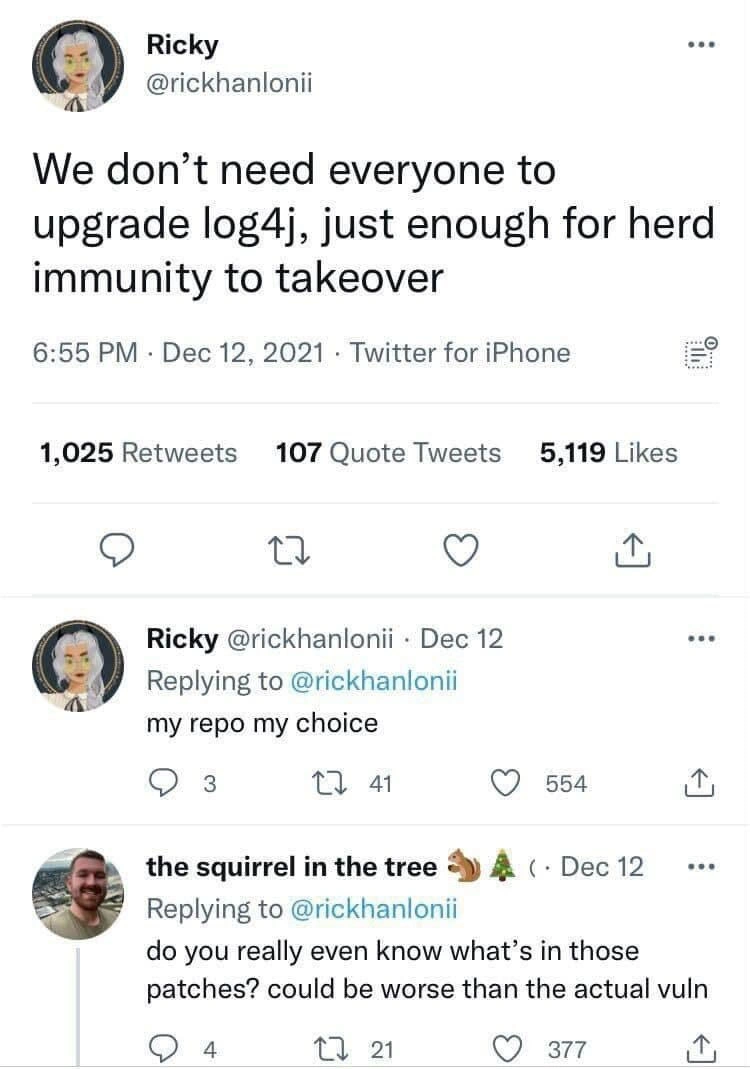
Imagine there’s a bad sickness going around in your town, and there’s a medicine that can stop it. Almost everyone quickly takes the medicine to protect themselves. Now, if enough people are protected, the sickness can’t spread easily – this is called herd immunity, meaning the whole group stays safer because most members are immune. But maybe a few people decide, “I don’t trust this new medicine. I’ll be fine without it.” They think it’s their personal choice not to take it. The joke in this meme is comparing that situation to what happened in computer programs. There was a really bad bug (like a sickness for computers) in a piece of code that many, many programs use. The fix for that bug is like the medicine. The meme is saying, “We don’t need absolutely everyone to apply the fix, just enough so that the bug has nowhere to go” – kind of like stopping the germ spread if most software is fixed.
It’s funny because in real life, if even a few programs don’t get the fix, those ones can still get attacked by the bad guys (just like a few unvaccinated people can still get sick). One developer jokes, “my repo my choice,” meaning “it’s my project, so I choose not to fix it,” which sounds silly – it’s copying a phrase people used about not getting vaccinated. Another person jokes, “do you even know what’s in those patches?” which is like saying “do you know what’s in that medicine?” In both cases, it’s poking fun at the idea that someone would refuse a cure that could save them, either because they’re stubborn or suspicious. We laugh because it’s a bit absurd: of course you should fix a really dangerous bug in your code! By treating the code fix like a vaccine and imagining programmers acting like skeptical patients, the meme finds humor in a stressful situation. It’s a way of saying: “Wouldn’t it be ridiculous if programmers behaved like that?” – even though, in truth, a few did hesitate. The contrast between what we should do (fix the bug) and the excuses people make (the jokes in the meme) makes it amusing, while also reminding us that fixing problems quickly is the smart thing to do to keep everybody’s software safe.
Level 2: My Repo My Choice
Let’s break down the meme’s technical context. Log4j is a popular Java logging library that many applications use to record events and errors. Think of it as a little helper that writes messages to log files or consoles, useful for debugging and monitoring software. Because it’s so useful, developers often add Log4j to their projects; it becomes a dependency – external code your project relies on. Modern applications typically have dozens of dependencies (or even hundreds, through transitive dependencies), so keeping them up-to-date is a big part of Dependency Management.
In late 2021, a severe flaw was discovered in Log4j’s code. This bug was nicknamed Log4Shell – a combination of “Log4j” and “shell” (as in shell access, meaning an attacker can get control). The vulnerability allowed an attacker to send a malicious input that, when logged by Log4j, would trigger the application to fetch and execute the attacker’s code. In plainer terms: a bad actor from the internet could effectively run their own software on your server just by getting your server to log a certain weird string. This kind of flaw is called a Remote Code Execution (RCE) vulnerability, and it’s about as dangerous as it sounds.
When such a critical security vulnerability is found, the maintainers of the library (in this case, the Apache Software Foundation for Log4j) rush to issue a patch – which is essentially a fix or an update that removes the bug. Upgrading to the patched version of the library immunizes your application against that specific attack. So “upgrade log4j” means change your project’s Log4j version to the safer one. For example, if a project was using version 2.14.1 (vulnerable), the developer needs to bump it to 2.16.0 or later (fixed):
- org.apache.logging.log4j:log4j-core:2.14.1 // ❌ vulnerable Log4j version
+ org.apache.logging.log4j:log4j-core:2.17.0 // ✅ patched Log4j version
Usually, applying a patch like this is straightforward: update the version number in a build file (like pom.xml for Maven or build.gradle for Gradle) and redeploy the application. The tricky part is Dependency Hell: sometimes your project isn’t directly using Log4j, but another library you depend on is using it internally. This is called a transitive dependency. You then have to wait for that library’s maintainer to release their own update, or find a way to override the nested dependency. In large organizations with many applications, it can be a massive effort to track down every place Log4j is hiding. It’s like a software supply chain – one weak link (or library version) and the whole chain is vulnerable.
Now, the meme humorously compares the act of patching Log4j to getting a vaccine, and the reluctance of some developers to update to anti-vaccine sentiments. The phrase “herd immunity” in the tweet refers to a concept from immunology: if enough people in a community are immune to a disease (through vaccination or prior illness), the disease has a hard time spreading, thus protecting even those who aren’t immune. Translating that to code: “We don’t need everyone to upgrade… just enough for herd immunity” suggests that if most projects update Log4j, perhaps the internet at large will be safer, even if a few stragglers don’t. It’s a playful analogy – in reality, unpatched apps won’t magically be protected by others being patched, but the overall number of targets for hackers would drop.
The reply “my repo my choice” is a direct parody of a slogan often heard in debates about personal health choices (“my body, my choice”). Here “repo” means code repository (e.g., a project’s codebase, often hosted on GitHub). The joke implies a developer stubbornly saying, “It’s my code repository, so I choose not to apply this patch or not.” This pokes fun at the phenomena of some maintainers or companies being slow or unwilling to update their Dependencies even when there’s a known vulnerability. Why would someone hesitate to patch a critical bug? A few reasons:
- Fear of breaking things: Upgrading a library version can sometimes introduce incompatibilities or new bugs. If an application is old or fragile, maintainers might worry that a quick update could crash something else (the classic “if it ain’t broke, don’t fix it” mentality).
- Underestimating the risk: A team might think, “Our app isn’t exposed to the internet” or “We sanitize inputs, so we’re probably fine,” thus delaying action. This is like someone thinking they won’t catch a disease because they’re somehow isolated – sometimes true, but often a risky gamble.
- Effort and bandwidth: Updating dozens of services on short notice is a lot of work. A team might procrastinate because the patch process is labor-intensive, especially during holiday season (Log4Shell hit in December, causing many emergency work sessions).
Finally, the second reply about “do you even know what’s in those patches?” is mimicking a common anti-vaccine argument (“you don’t know what’s in that vaccine”). In the software world, patches are usually transparent – you can read the code changes in an open-source project. But the joke taps into the idea that a developer might mistrust a hurried fix: “What if the patch introduces worse problems? What if the new version has performance issues or even another vulnerability?” In fact, with Log4j, the first patch did need a follow-up because the initial fix didn’t fully solve the problem. So a skeptical dev might say, “See? The first fix wasn’t perfect, maybe we shouldn’t rush to apply every update blindly.” It’s a humorous exaggeration of real debates in software: balancing fast security upgrades against the stability of the code. However, practically every security expert would respond: Apply the patch now; you can always address any side effects later – being hacked is far worse! Just like health experts would say to take the vaccine despite minor side effects, security pros urge patching despite potential minor bugs, because a major breach could be catastrophic.
In summary, the meme uses a timely analogy to make light of a serious situation. It educates (through humor) about the importance of widespread patch adoption – and also ribs those who drag their feet. For a junior developer, the key takeaways are: keep your dependencies updated (especially when there are known Security Vulnerabilities), treat critical patches with urgency, and be aware that in software communities, a bit of joking can accompany even serious engineering firefights as a way to cope with stress.
Level 3: Patch Hesitancy Epidemic
In December 2021, developers faced a Log4j crisis so severe it felt like a digital pandemic. The vulnerability known as Log4Shell (CVE-2021-44228) had a perfect 10.0 CVSS severity score – essentially the "super-spreader" of software bugs. It allowed remote code execution (RCE) through a crafty exploit: by simply logging a certain string, an attacker could trick Log4j into loading malicious code via JNDI (Java’s Naming and Directory Interface). Millions of applications and servers were suddenly exposed, because Log4j was everywhere – like a single contaminated ingredient baked into countless software recipes.
The meme’s primary tweet quips: “We don’t need everyone to upgrade log4j, just enough for herd immunity to takeover.” This is darkly humorous to senior engineers because it satirizes the herd immunity analogy in the context of dependency management. In a real pandemic, if enough people get vaccinated, even those who abstain gain some protection because the disease can’t find new hosts easily. But in a network security outbreak, patching only “protects” the systems that upgrade. One unpatched server is all an attacker needs – there’s no concept of a virus dying out on its own in cyberspace. So the tweet is tongue-in-cheek: a sly nod to the futility of hoping “almost everyone” updating a critical library will somehow save the stragglers. It’s as if saying, “Maybe if 90% of repos are on a safe Log4j version, the hackers will give up on the other 10%,” – an obvious wishful thinking.
This humor resonated because the Log4Shell event had developers scrambling to update dependencies under intense pressure, much like a frantic vaccination campaign for code. Many of us spent that weekend triaging thousands of servers, searching for every instance of log4j-core in our stack. Dependency Hell became very real – some projects were stuck on older Java frameworks that didn’t support the newest Log4j version, forcing awkward workarounds. It was a mad rush, with CTOs acting like public health officials urging, “Patch now, or we risk a catastrophic breach!” So when someone jokes about “herd immunity” for repos, senior devs smirk and groan simultaneously – the absurdity hits close to home.
The Twitter thread mimics anti-vaccine rhetoric to poke fun at patch skepticism in the developer community. The author’s self-reply, “my repo my choice,” parodies the slogan “my body, my choice,” which was co-opted by anti-vaxxers. It implies a stubborn maintainer saying: “I’ll decide whether to update my repository’s dependencies, and no external advisory can force me.” Every experienced engineer knows (or has been) that one person in a codebase debate resisting an upgrade: whether from laziness, fear of breaking things, or philosophically thinking their system is isolated enough to avoid infection. The meme exaggerates this attitude – as if a dev proudly refuses the Log4j “vaccine” because “it’s my codebase, I know what’s best for it.”
Another reply in the thread mocks the conspiracy-tinged doubt: “do you really even know what’s in those patches? could be worse than the actual vuln.” This line satirizes a real phenomenon: sometimes deploying a rushed patch can cause new bugs or performance hits, reminiscent of how anti-vaxxers claim the cure might be worse than the disease. In Log4j’s case, the first patch (2.15.0) was initially incomplete – a variant of the exploit still worked – so it took additional updates (2.16.0 and 2.17.0) to fully secure the library. Senior devs reading this likely chuckle because they remember that whiplash: “Upgrade to 2.15 now! Wait, still vulnerable, push 2.16! Oh great, now there’s a DoS flaw, grab 2.17!” It truly felt like a series of emergency booster shots for our applications. The “could be worse than the vuln” joke lands because we did see minor chaos from hurried patches, though obviously leaving the Security Vulnerability unpatched was far riskier.
Ultimately, this meme is funny-sad to seasoned engineers. It highlights how absurd it would be to treat a critical software bug like a matter of personal belief or preference. In reality, security doesn’t care about “majority rule” – one unpatched app in a network can be an attacker's beachhead. But the comparison to herd immunity and anti-vax slogans was irresistible in that moment. It was a coping mechanism: we were all exhausted from the Log4Shell firefight (and the actual pandemic), so joking that we only need “enough of us” to patch was a way to laugh through the pain. It’s a knowing laugh – recognizing the mix of technical urgency and the human quirks (denial, procrastination, skepticism) that make dependency management a recurring drama in our field.
Description
Screenshot of a Twitter thread on a white background. The primary tweet, from user “Ricky @rickhanlonii,” reads: “We don’t need everyone to upgrade log4j, just enough for herd immunity to takeover.” Timestamp shows 6:55 PM · Dec 12, 2021 · Twitter for iPhone. Beneath it are metrics: 1,025 Retweets, 107 Quote Tweets, 5,119 Likes. A self-reply from the same user says: “my repo my choice.” A second reply, from another user, says: “do you really even know what’s in those patches? could be worse than the actual vuln.” Visually it mimics typical Twitter UI with avatars blurred for privacy. Technically, the meme riffs on the 2021 Log4Shell crisis: senior engineers scrambling to bump Log4j versions while jokingly comparing patch adoption to public-health herd immunity and anti-vaccine rhetoric, highlighting classic dependency-upgrade reluctance and security patch skepticism in large codebases
Comments
25Comment deleted
Funny how our threat model now includes social-media epidemiology - apparently CVE-2021-44228 gets mitigated once 70 % of the microservices are on 2.17.1
The real herd immunity is when enough unpatched systems get compromised that attackers can't keep up with the incident response tickets being generated across the industry
Herd immunity doesn't work when every host in the herd transitively bundles its own private copy of the pathogen
Treating Log4Shell patching like vaccine hesitancy - because nothing says 'personal freedom' like leaving your entire infrastructure vulnerable to RCE while waiting for 'natural immunity' from script kiddies
Herd immunity for Log4j? Cute, until that unpatched transitive dep in your vendor's fat JAR turns your monolith into a remote code piñata
Herd immunity is not an architecture pattern - leave one Log4Shell-era JNDI unpatched and the attacker’s load balancer finds it before your SRE does
Security doesn't do herd immunity; one transitive log4j in a forgotten fat-jar behind a stale reverse proxy is enough for RCE across the estate
yes, yes you do, it's open source, also how long did it take for log4j to show this vulnerability? the patch could very well introduce a new one that we find after 5 years. so yes clowns, your sarcasm is invalid. Comment deleted
That was just funny how another narrative could be easily transferred to our topic. Btw, with patches everything is much more cleaner and easier. You better have another RCE 5 years later, than one public right now Comment deleted
oh and, not to mention you can still get covid, spread it, and die, after getting the vax. and no, Israel's data shows it's not a lower chance, a couple months ago, around 70% of hospitalized covid patients in Israel were fully vaxxed. truth is, we are not anti vaccine or science, it's just a shitty vax this time around. Comment deleted
"70% patients were vaccinated" - proof pls. Bcs I've read absolutely opposite articles Comment deleted
I read the ministry of health's website at the time. the data is probably there still, and now it might be worse or maybe boosters fixed it for a short while. Comment deleted
Well, it's great that you read their site, but by 'proof' I meant a link to the place where I'll also will be able to read such data Comment deleted
I don't owe you a link, I don't care if you get vaccinated or not. https://t.me/disclosetv/3982 https://www.timesofisrael.com/health-ministry-chief-says-coronavirus-spread-reaching-record-heights/ https://www.science.org/content/article/grim-warning-israel-vaccination-blunts-does-not-defeat-delta Comment deleted
Depends on what privileges and contents that project runs with and/or if it even faces the internet in any meaningful way Comment deleted
Or get a different exploit right away, no need to wait 5 years Comment deleted
3 links should be enough, if not, use google Comment deleted
Well, I have to admit that it was a proof I couldn't argue with Comment deleted
But still, even if 70% of hospitalized people (~500) were vaccinated - it may be possible that without vaccination there would be 2000 people instead of 500. And also there was a remark in text, that it can be connected with the fact that eldest people were vaccinated first Comment deleted
there it is, the but still. if you consider Israel's population, 500 is not a low number. also, isn't the vaccine our holy and divine savior? specially for the old people? Comment deleted
Don't know about holiness and diviness, but vaccine is a researches-proofed saviour from regular COVID19. And highly likely a helper with covid19 Delta Comment deleted
https://www.bmj.com/content/375/bmj.n2635/rr-80 Comment deleted
is it? Comment deleted
When I said 'researches-proofed' I didn't mean a pharma companies researches. I meant researches made by epidemiologists using covid19 statistics from different countries Comment deleted
and that's when they found out about the myocarditis Comment deleted