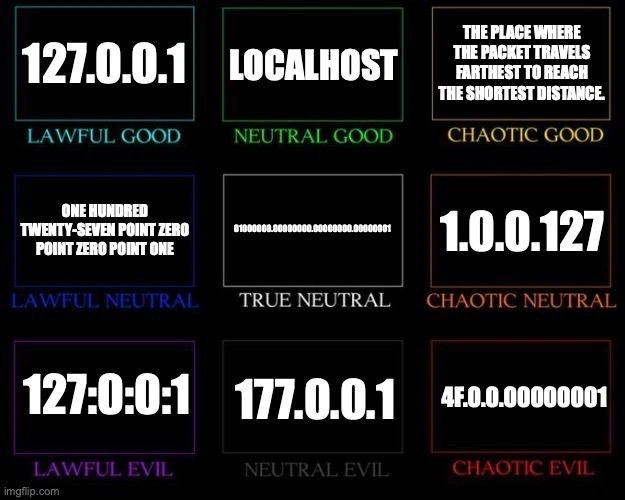
The Nine Circles of Localhost
Why is this Networking meme funny?
Level 1: Many Names, One Home
Think of it like talking about your own house with different descriptions, some sensible and some silly or wrong. In the computer world, “localhost” or 127.0.0.1 is basically your computer’s home address for itself. This meme shows nine different ways to refer to that home:
Some ways are normal and good: Like just saying the house number plainly (that’s like using
127.0.0.1) or saying “my house” (that’s like using the word “localhost”). Everyone understands these, and you’ll definitely get your letter or message delivered to yourself.Some ways are weird but not harmful: Like giving your address in a super detailed funny way – “the place where the mail travels the longest distance to just come right back home.” It’s overly elaborate, but you’re still talking about your own house, just with flowery language. Or spelling out the address in words (“One Two Seven Dot Zero…” as if reading every part slowly) – it’s odd, and people might giggle, but they can figure it out. Even writing your address in secret code (like binary numbers) is strange – it’s like writing your house address as coordinates or in Morse code – technically it points to the same place, but only a real expert can read it easily.
And some ways are just wrong or mischievous: Like accidentally swapping a couple of digits in your house number so it points to someone else’s house – oops! That’s a tiny mistake with big consequences (the mail goes to the wrong place). Or mixing up formats, like writing part of your address in one language and part in another, which ends up not making any sense at all. These are the bad ways – they either fail to reach home or cause a lot of confusion.
In the end, all these nine panels are joking about how you can refer to the same location (your own computer) in many different forms. The “alignment chart” part (the Good/Neutral/Evil, Lawful/Chaotic grid) is just a fun way to label each style as if it has a personality:
- The totally correct ones are the good guys,
- The slightly odd but understandable ones are the neutral folks,
- And the completely crazy or mistaken ones are the villains.
The reason it’s funny is the exaggeration and mixing of worlds: it’s taking a simple tech idea (your computer’s special address for itself) and framing it like a cast of characters in a game. Even if you don’t get every technical detail, you can imagine: one character always follows the rules (writes the address perfectly), another uses a nickname (localhost), another speaks in riddles (“the place where the packet travels farthest…”), and others make errors or speak pure gibberish. They’re all trying to talk about the same place, and seeing that expressed in so many different ways is silly and amusing.
So, put simply: this meme is like saying “there’s no place like home” but showing that idea in nine wildly different styles. If home is your own computer, then 127.0.0.1 is home. One panel calls it exactly that, another calls it by a nickname, another says it in a goofy way, and some get it wrong. We laugh because we recognize that no matter what you call it (or how badly you mess it up), they were all aiming for the same thing. It’s a geeky way of showing off knowledge (“hey, I know all these forms mean home!”) and poking fun at how over-complicating something simple can become ridiculous. In the end, the message is familiar: many names, one place – and there’s no place like 127.0.0.1!
Level 2: Localhost Lowdown
Let’s step back and explain what’s going on in this meme for those not steeped in networking lore or D&D references. We have an alignment chart from the world of Dungeons & Dragons, which is a 3x3 grid categorizing characters (or in this case, things) by two axes: Lawful vs Chaotic (orderly and rule-abiding vs free-spirited and rule-bending) and Good vs Evil (well-intentioned/benign vs harmful/malicious). In online developer communities (DevCommunities love this stuff), it’s become a fun template to classify tech concepts with a bit of personality. Here, instead of fantasy characters, the chart is classifying different representations of the “localhost” address, which is a fundamental idea in networking.
So, what is “localhost” and why are there so many ways to represent it? Localhost is essentially a nickname for “this computer I’m on right now” in network terms. Every device in a network has an IP address (Internet Protocol address), which is like its unique phone number or street address on the network. Normally, IP addresses look like four numbers separated by dots (for IPv4), for example 192.168.1.50 might be your laptop on Wi-Fi. The address 127.0.0.1 is special – it’s the most commonly used loopback address. The loopback address doesn’t send data out over the physical network; instead, it loops back to the same machine. It’s like a built-in shortcut that says “talk to myself.” If a server program is running on your computer, you can connect to it by directing your client to 127.0.0.1 (meaning “the server on this same machine”). It’s extremely useful for testing and development: e.g., when you run a web server locally, you often visit http://127.0.0.1 or http://localhost in your browser to see it.
Here’s where the meme gets creative: there are many forms or notations for referring to that loopback address, and the chart assigns each a D&D alignment as a joke. Let’s break down a few examples in simpler terms:
Standard form (
127.0.0.1) – This is the normal IPv4 dotted-decimal notation. “IPv4” means Internet Protocol version 4, which uses four numbers (0–255) separated by dots. 127.0.0.1 is reserved by every computer to mean itself. This is the everyday, unambiguous way to say “me” in network language.The name “localhost” – Instead of numbers, you can use the hostname
localhost. This is often defined in a system file (/etc/hostson Linux/Mac or a similar place on Windows) to map to 127.0.0.1. It’s easier for humans to remember a name than numbers. When you typelocalhost, your computer checks that hosts file or DNS and knows it refers to the loopback IP. It’s essentially equivalent to 127.0.0.1, just more readable. This meme callslocalhostNeutral Good: it’s friendly (good) and it’s an officially recognized alias (neutral in the sense of being a common convention, not too wild).Spelled-out address – One panel writes “one hundred twenty-seven point zero point zero point one.” That’s literally just saying the IP in English words. Of course, no one does this in practice, but it’s understandable. This exaggeration is put under Lawful Neutral – it follows the rule (still the correct address) but in an overly rigid or formal way (literally pronouncing every dot and number).
Binary form – Another panel shows
01111111.00000000.00000000.00000001. Those are 32 bits divided into 4 groups of 8. In binary, 01111111 is 127 in decimal, and 00000001 is 1. So that string is exactly 127.0.0.1 too, just written in base-2. It’s technically correct, but extremely hard to read for humans – only computers prefer binary. That’s why it’s labeled True Neutral. It’s smack in the middle: the most plain, raw form of the address with no human-friendly sugarcoating or error, and also no practical use in daily life because it’s too cumbersome.Jumbled or incorrect forms – The bottom row of the chart shows some “wrong” or at least unconventional ways to refer to an IP:
127:0:0:1uses colons instead of dots. Colons are actually used in IPv6 addresses (the newer IP system that allows much larger addresses, written in hexadecimal). In IPv6, the loopback address is::1(which is shorthand for 0:0:0:0:0:0:0:1). But writing127:0:0:1with colons is not valid in either IPv4 or IPv6. It’s like someone mixing two languages together. The meme tags this as Lawful Evil – it appears to follow a structure (it’s very tidy with those colons, so “lawful”), but it’s fundamentally wrong (“evil” because it will cause errors or confusion).177.0.0.1is just a tiny typo away from127.0.0.1. That one-digit difference means an entirely different address on the internet, not the loopback. If you accidentally put 177.0.0.1 expecting to reach your own machine, you’ll be very puzzled why it’s not working (or you might unintentionally be pinging some server in another country!). The meme calls it Neutral Evil: neutral because it’s not some crazy format (looks normal), but evil because it’s the wrong address – a subtle mistake that can be a real pain to catch. It’s “evil” in the way a tricky bug is – not flamboyant, just quietly causing trouble.4F.0.0.0000001is a wild mix:4Fsuggests a hexadecimal number (4F in hex = 79 in decimal), and0000001looks like a binary or just a strangely padded decimal 1. This is not a standard way to specify an IP at all. Historically, there were odd cases where an IP could be given as a single number (e.g., 2130706433 is 127.0.0.1 as one 32-bit decimal), or even in hex with a prefix (like0x7F000001could be interpreted as 127.0.0.1 by some old parsers). But mixing bases in the same address with no clear format is a complete nonsense. The chart calls this one Chaotic Evil, meaning it’s basically the most unpredictable and rule-breaking representation – an “address” that would utterly fail to resolve to anything useful. It’s like someone purposely making a mess out of the notation just to confuse everyone (chaos!) and break stuff (evil!).
Now, why is all this funny to developers? It’s the juxtaposition of something very serious and precise (IP addresses, which must be correct to the digit) with a lighthearted fantasy classification. Essentially, it’s saying: “Even something as mundane as 127.0.0.1 can have a personality!” If you’re a networking geek, you appreciate the nuance:
- You know the satisfaction of using the correct
127.0.0.1orlocalhost(that’s our Lawful Good and Neutral Good). - You also know the silly extremes like spelling it out or converting it to binary (stuff no one does, but hey, you could – these are the neutrals).
- And you definitely know the pitfalls of mistakes (swapping numbers, using wrong notation) – those are the evils that can cause real issues in configs and code.
The D&D alignment format adds an extra layer of humor because in that game context, Lawful Good is like a paragon of virtue (here: the perfectly formatted address), while Chaotic Evil is the ultimate villain (here: a completely bonkers address format). The meme is a playful way of saying “there are good and bad ways to refer to localhost” and personifying each way as if they have moral alignment. It’s relatable humor for IT folks: they’ve seen the “good” correct configs and the “evil” typos or format mix-ups that cause headaches.
To a junior developer or someone new to networking, here are a few key takeaways to understand this meme:
- 127.0.0.1 = localhost = loopback. These all essentially mean “this same computer” in network speak. It’s a special address that doesn’t leave your machine.
- There are right and wrong ways to refer to it. Right ways include the numeric form and the word “localhost”. Wrong ways (or at least problematic ways) include typos or mixing formats that can lead to errors.
- The alignment chart is just a joke format. It’s categorizing those ways with fun labels like “Chaotic Evil” purely for humor. You don’t actually have “good” or “evil” addresses in any literal sense; it’s anthropomorphizing technology. This is common in developer meme culture – mixing serious tech with pop culture frameworks.
- Networking basics in play: The term packet (as seen in the Chaotic Good description) refers to a chunk of data transmitted over a network. In the loopback case, the “packet” leaves your application, goes into the network stack of your OS, and comes back to another application on the same host. It doesn’t travel out across an actual physical network, but it still goes through the motions inside your system, which is a quirky concept often noted with amusement (hence the joke about traveling farthest for the shortest distance).
By understanding those points, you can see why each panel is humorous. For example, someone new might not immediately get why 177.0.0.1 is “evil” – but knowing that 177 is not 127 and thus will misdirect your network traffic, it clicks that this small mistake is like a sneaky villain in your code. Or why localhost is “good” – because it’s helpful and clear, no issues there.
In essence, this meme is a lighthearted lesson in how computers identify themselves on networks, wrapped in a fun D&D parody. It teaches (and pokes fun at) the idea that there’s a correct way to refer to your own machine and plenty of silly or disastrous ways you could refer to it if you ignored the rules. It’s the kind of joke you start to appreciate as you learn about IP addresses and debugging network configs. And if you ever accidentally type 177.0.0.1 and wonder why things aren’t working, you might just remember this alignment chart and have a little chuckle (after fixing the bug, of course!).
Level 3: The Many Sides of Localhost
At first glance, this meme mashes up networking inside jokes with a classic Dungeons & Dragons alignment chart. It’s a 3x3 grid classifying different ways to refer to the loopback address (the networking alias for “this very machine”) from Lawful Good to Chaotic Evil. In developer communities, alignment chart parodies are a popular part of meme culture, especially when they bridge nerdy domains like Networking and fantasy role-play. Here, the meme’s humor comes from the absurd contrast between dry technical data (IP addresses) and the grand moral alignment labels – a combination any network engineer with a sense of humor can appreciate. Let’s break down each panel and why it’s funny for those fluent in NetworkHumor:
Lawful Good –
127.0.0.1: The quintessential loopback address in its standard dotted-quad IPv4 form. Lawful Good because it’s the correct, by-the-spec representation of localhost, following all the “rules” of IP notation. This is the heroic version: simple, effective, and exactly what every system expects when you mean “me, myself, and I” in networking. Every developer has pinged127.0.0.1to test if their network stack is alive. It’s the lawful (proper) and good (harmless) default that always works.Neutral Good –
localhost: The hostname local host that typically resolves to127.0.0.1. It’s good because it’s user-friendly and still gets you to the right place, but more neutral since it’s not a numeric address – it relies on a name resolution (often a quick lookup in the/etc/hostsfile or DNS). This is a perfectly benign way to reach the same loopback interface, and it’s “neutral” in that it’s less strict about format (using letters instead of digits). Experienced devs knowlocalhostis just an alias for 127.0.0.1, commonly used in config files and dev environments for convenience.Chaotic Good – “THE PLACE WHERE THE PACKET TRAVELS FARTHEST TO REACH THE SHORTEST DISTANCE.”: This over-the-top verbose description is technically still talking about 127.0.0.1 (your own machine), but in a flowery, roundabout way. It’s chaotic because nobody would actually describe an IP this way in practice – it breaks every convention of brevity – yet it’s good because it’s amusingly accurate in spirit. It hints at the ironic truth: a packet to 127.0.0.1 goes through the full network stack (all the layers) only to end up right back where it started – the longest journey to the shortest destination. This caption reads like a dramatic proverb, reflecting the playful chaos of a Chaotic Good character who does the right thing but in an unconventional manner. It pokes fun at how the loopback interface sends data on a heroic odyssey through your OS’s networking layers without ever leaving your PC. This panel tickles any networking nerd’s funny bone, because it wraps a simple tech fact in grandiose language.
Lawful Neutral – “ONE HUNDRED TWENTY-SEVEN POINT ZERO POINT ZERO POINT ONE”: Here we have the IP address tediously spelled out in English. It’s lawful in the sense of being technically correct and by-the-book – you are still referring to 127.0.0.1 exactly – but neutral because this format doesn’t particularly help or harm anyone; it’s just pedantic. This is the alignment of someone who follows rules to the letter (literally, in this case) without concern for convenience. It’s the networking equivalent of reciting a phone number as “one-two-seven dot zero dot…” on a support call just to be ultra-clear. It evokes a chuckle from seasoned devs because it’s comically verbose, imagining a rigid rule-follower developer who insists on saying the entire thing in words. It’s correct, but nobody in their right mind does this – making it perfectly Lawful Neutral.
True Neutral –
01111111.00000000.00000000.00000001: This is 127.0.0.1 in binary notation for each octet. Each “octet” of the IPv4 address is an 8-bit binary number:01111111is 127, and00000001is 1 (with the two middle octets being 0 in binary). Why True Neutral? Because this is the most objective, no-nonsense representation – it shows the raw bits with no bias towards human readability or convenience. It’s literally the truth of the address at the binary level, free of any stylistic flair. It’s neutral on both axes: not user-friendly or malicious, just the cold hard binary truth. Network engineers recognize this as the underlying reality of IP addresses (computers ultimately deal in bits, not dotted decimals), and the humor is in presenting such a low-level representation in an alignment chart. It’s funny and nerdy because it’s so excessive: no one actually quotes IPs in full binary when discussing networks (unless they really want to prove a point in a heated #Networking debate).Chaotic Neutral –
1.0.0.127: This one gives seasoned devs flashbacks and facepalms. It’s the same four numbers as 127.0.0.1, but shuffled around! Chaotic because it breaks the standard ordering of the octets, and neutral because it’s not intentionally malicious – it’s just wrong in a random way. This looks like someone maybe misremembered the order of bytes, or perhaps tried to be clever and got it backward. In truth,1.0.0.127is a completely different address (in fact, in normal IPv4 this would belong to the 1.0.0.0/8 network, nowhere near the loopback range). There’s a real-world relatable humor here: it’s like the newbie developer typo or a copy-paste slip that’s technically a valid IP format but functionally the wrong address. Every experienced engineer has seen an innocent configuration mistake where two numbers got swapped, leading to baffling “why isn’t this connecting?” troubleshooting sessions. It’s neutral chaos – not trying to break things, but definitely not following the rules either. And because it uses the familiar numbers in a wrong order, it screams “whoops!” to anyone paying attention.Lawful Evil –
127:0:0:1: This one is a devilish mix-up of notation. It looks like an IPv4 address forced into IPv6-style colon separators. Lawful because it superficially appears to follow a formal structure (using colons as if it were a valid address format), but evil because it’s utterly incorrect and will break things. This could be referencing the poor soul who confuses IPv4 and IPv6 formatting. In IPv6, the loopback address is actually::1(shorthand for 0:0:0:0:0:0:0:1). Writing127:0:0:1is neither correct IPv4 nor correct IPv6 – it’s a Frankenstein’s monster of the two. It might also hint at those moments when a well-meaning dev tries to be too proper (lawful) but ends up creating a nasty bug (evil) – for example, inserting colons because they saw it in an IPv6 context, or using a format that looks “official” but is wrong for the system at hand. If someone tried to ping or connect to127:0:0:1, the OS would likely interpret it in a way you didn’t intend (most likely not at all, since it’s not a valid address). To a networking veteran, this panel drips with irony: the format looks almost right — using a rule, but the wrong rule, producing an evil little bug that follows formalism into failure. It’s a reminder that being overly strict or by-the-book without understanding the context can lead to diabolical errors.Neutral Evil –
177.0.0.1: Ah, the classic one-digit typo that unleashes havoc. Neutral because it’s just one small change, not some creative reimagining – but evil because that small mistake is enough to ruin your day. Instead of 127, someone wrote 177 for the first octet. Whoops! In reality, 177.0.0.1 is not a loopback address at all – it likely belongs to some network out on the internet (possibly assigned to an entity in a far-off country by the regional internet registry). The humor (and pain) here comes from how relatable this mistake is: many of us have fat-fingered a configuration or transposed a number, and suddenly our program is trying to reach the wrong machine. It’s “neutral” in that the person wasn’t trying to be funny or creative – it’s probably an innocent typo – but it’s “evil” in its consequences, because nothing will work as expected. Imagine a junior dev mistypes this in a configuration file for a database connection, and then everyone is scratching their heads why the app is trying to talk to some random IP out in the void. It’s an inside joke among developers that such tiny errors can lead to big problems (an off-by-one error in networking can direct traffic to the completely wrong host). In an alignment sense, Neutral Evil is often a subtle, under-the-radar villain – just like this address, which at a glance looks legitimate but is fundamentally wrong.Chaotic Evil –
4F.0.0.0000001: This is the chaotic evil of IP notation – a complete abomination of formats. It appears to mix hexadecimal (4Fcould be hex for 79), decimal, and maybe some attempt at binary (0000001looks like a binary-esque styling of 1) all in one address. It’s like someone said, “Let’s break every rule of IP addressing at once.” Absolutely no network library would interpret4F.0.0.0000001as a valid address – it’s pure garbage from a technical standpoint. That’s what makes it Chaotic Evil: it doesn’t just bend the rules, it shatters them into pieces and laughs maniacally. A developer seeing this might recall weird anecdotes of old systems that sometimes let you specify IPs in all sorts of bases (there was a time some browsers accepted hex or octal IP notations, e.g.,0x7F000001for 127.0.0.1), but mixing bases in one address string is beyond insane. This is the meme’s ultimate punchline: a representation so wrong that it’s comically evil – it symbolizes something that wants to watch the world (of networking) burn. It’s the alignment chart’s final boss of bad addresses. If a colleague ever gave you4F.0.0.0000001to troubleshoot, you’d suspect they were trolling you or under a chaotic spell. In D&D terms, Chaotic Evil is unpredictable and destructive – exactly what this jumbled mess is to any system that tries to parse it.
In summary, the meme humorously personifies loopback addresses (and mis-addresses) as D&D alignment characters. Each panel is an inside joke: you need to know that 127.0.0.1 is home sweet home for your computer, and that there are many ways (correct, incorrect, or absurd) to denote it. The lawful ones stick to standards (some to a fault), the neutral ones are either overly literal or small slip-ups, and the chaotic ones throw caution to the wind (either creatively or catastrophically). For veteran developers, this alignment chart is hilarious because it captures so many RelatableHumor moments: from perfectly configured environments to head-slapping misconfigurations. It’s a celebration of networking knowledge wrapped in geeky role-playing terminology. Essentially, this meme says: “Dealing with addresses can be a moral saga – here are our heroes and villains, even though they’re all theoretically pointing to the same thing.” It’s a playful nod to how even something as rigid as an IP address can be viewed through the whimsical lens of meme culture and nerdy alignment tropes.
Description
This image presents a classic 3x3 alignment chart meme, a popular format used to categorize characters or concepts along two axes: Lawful/Neutral/Chaotic and Good/Neutral/Evil. In this case, the meme humorously classifies nine different ways of representing the localhost address (127.0.0.1). Each square has a colored border and contains white text on a black background. - **Lawful Good** is the standard IP address: '127.0.0.1'. - **Neutral Good** is the common hostname: 'LOCALHOST'. - **Chaotic Good** is a philosophical description: 'THE PLACE WHERE THE PACKET TRAVELS FARTHEST TO REACH THE SHORTEST DISTANCE'. - **Lawful Neutral** is the IP written in words: 'ONE HUNDRED TWENTY-SEVEN POINT ZERO POINT ZERO POINT ONE'. - **True Neutral** is the binary representation: '01000000.00000000.00000000.00000001'. - **Chaotic Neutral** is an octet-reversed IP: '1.0.0.127'. - **Lawful Evil** uses incorrect syntax: '127:0:0:1'. - **Neutral Evil** is a common typo: '177.0.0.1'. - **Chaotic Evil** is a nonsensical mix of hex and decimal: '4F.0.0.00000001'. The meme is a clever in-joke for developers and network engineers. It plays on the various official, unofficial, and downright incorrect ways the loopback address is referenced, highlighting the spectrum from standard practice to esoteric knowledge and common errors. The humor comes from the relatable experience of dealing with these variations in code, configuration, or technical discussions
Comments
18Comment deleted
The 'Chaotic Good' description of localhost is also a perfect metaphor for enterprise architecture: a packet of requirements traveling through endless layers of abstraction just to change a boolean flag in the same database
When your k8s service mesh hairpins traffic through three AZs just to hit the same pod, congratulations - you’ve built Chaotic Good 127.0.0.1 at cloud egress pricing
After 20 years of debugging production issues, I've learned that '177.0.0.1' being 'Neutral Evil' is perfect - it's the typo that looks right enough to pass code review but wrong enough to waste three hours wondering why your local service discovery isn't working
The 'True Neutral' binary representation is actually how your network stack sees localhost every single time, but we pretend the dotted decimal is more 'civilized.' Meanwhile, that Chaotic Evil hexadecimal float notation is what happens when a firmware engineer and a network engineer have an argument at 3 AM during an on-call incident - technically it could work in some cursed embedded system, but everyone involved would need therapy afterward
In 2025, the true chaotic neutral isn’t 1.0.0.127 - it’s “localhost” in a service mesh, where 127.0.0.1 may mean your process, your container, your sidecar, or the node, and you find out at 3 a.m
127.0.0.1 in enterprise: Istio → anycast load balancer → BGP → hairpin NAT → the same socket - shortest distance, longest audit log
Lawful Good: `curl 127.0.0.1`. Chaotic Evil: `curl 4f.0000001` and rage-quit when Kubernetes won't bind
Chaotic eval is how I do it all the time /s Comment deleted
Where is 2130706443? Comment deleted
There is no common place for such a filthy perversion! Comment deleted
That's chaotic evil! 👿 Comment deleted
it's unlawful chaotic evil Comment deleted
That's when you don't split it per byte but treat it as uint32 it is. The less evil version would be to write it in hex, much like ipv6 and mac addresses are. Comment deleted
Hey, I wasn't even trying to be particularly evil there. :-] If I was then I might go for 1.7014140656697487e+38 instead. Comment deleted
jesus Comment deleted
Why true neutral isnt 01111111.00000000.00000000.00000001 Comment deleted
::1 Comment deleted
we dont do ipv6 here Comment deleted