The Unexpected Funnel from OnlyFans to Kaggle
Why is this DevCommunities meme funny?
Level 1: Unlikely Champions
Imagine two friends want to become super popular by selling something special. First, they go to a place where a lot of shy, lonely kids hang out. Because those kids don’t get much attention, they quickly line up to see what these friends are offering – it’s like selling lemonade in a desert, very successful! Next, the two friends discover a secret clubhouse full of kids who love computers, where nobody else was trying to sell anything fun. They walk in and start showing their cool new comics (something those computer kids didn’t even know they wanted). Suddenly, all the clubhouse kids are interested, and our two friends become the most popular sellers around, leaving other sellers far behind because no one else thought to go there. Finally – and here’s the craziest part – with all the help and support from their new computer-loving fans, these two friends enter a big science contest and win first prize! 😃 Normally, you’d expect the science contest to be won by the brainiest science kids, not by a couple of newcomers who were selling comics and lemonade. But these friends were clever: they went to all the right places and made the right friends. In the end, they beat everyone at their own game, which is so unexpected that it’s really funny. It’s like a story where the popular kids and the smart kids team up, and the popular kids end up scoring highest on the math test – you wouldn’t believe it, right? That surprise and role-reversal is exactly why we laugh!
Level 2: Where the Nerds Are
Let’s break down the basic elements and terms in this meme’s story:
OnlyFans (OF) – OnlyFans is an online subscription platform where creators (often adult entertainers or models) share exclusive content with paying subscribers. Think of it like a private club on the internet where fans pay to see posts or videos. In the meme’s context, these two women are OnlyFans creators looking for more subscribers.
Twitter – Twitter is a social network where people post short messages (tweets) that anyone can read. It’s popular among many communities, including tech folks and “lonely nerds.” The joke here is calling Twitter a place with “lots of lonely nerds” – implying many tech-savvy guys scroll there and might be interested in the content these women offer. Using Twitter as a funnel means they post teaser pictures or engaging tweets to attract those users and guide them to their OnlyFans page. A marketing funnel is a strategy: you start with a big audience on a free platform and funnel interested people down to your paid service. So Twitter was a good starting point to catch attention.
GitHub – GitHub is a platform primarily for software development. Developers use GitHub to host code, work together on projects, and show off open-source contributions. It’s a very unconventional place to promote an OnlyFans, which is exactly why the meme finds it funny. By saying “Then we found GitHub,” they suggest they discovered another online hangout full of programmers (read: more lonely nerds 😅). On GitHub, people usually share code repositories. If these creators started a project or repository there, it likely wasn’t about code at all – perhaps it was a repository containing their photos or a joke README file with links to their content. Since other OnlyFans girls wouldn’t think to market on a coding site, these two had zero competition there. The phrase “The other girls didn’t stand a chance – we became top creators” implies that by tapping into this fresh pool of fans (the developers on GitHub), they shot up in popularity rankings among OnlyFans creators. In other words, their subscriber count (and earnings) skyrocketed beyond others because they unlocked a new audience. It’s an absurd image: GitHub normally ranks top open-source contributors, but here we imagine “top creators” in an entirely different domain benefiting from GitHub exposure.
Kaggle – Kaggle is an online platform where data scientists and machine learning enthusiasts compete to solve complex puzzles and prediction problems using AI/ML (Artificial Intelligence/Machine Learning). For example, a Kaggle competition might challenge you to build the best model for predicting house prices or identifying objects in images. Competitors are often highly skilled; they spend weeks training models and tweaking code to climb the leaderboard. Winning a Kaggle competition is a badge of honor in the data science world – it’s tough! Now, the meme humorously claims “Then we started winning Kaggle competitions.” This is a huge leap from posting on Twitter or GitHub. It suggests these two went from marketing themselves to actually beating expert data scientists in their own game. To a newcomer: that would be like someone who sells art on Instagram suddenly taking first place in an international coding contest. It’s intentionally ridiculous. Typically, to win a Kaggle competition, one needs strong knowledge of programming (often in Python/R), machine learning techniques, and a lot of experimentation. The joke implies that with all the nerds they attracted, maybe they learned these skills or got help from their new fanbase. Kaggle even awards titles like Kaggle Master and Grandmaster to consistent high performers (like belts in martial arts). So picturing these glam models with Kaggle Grandmaster profiles is both hilarious and oddly satisfying in a narrative sense.
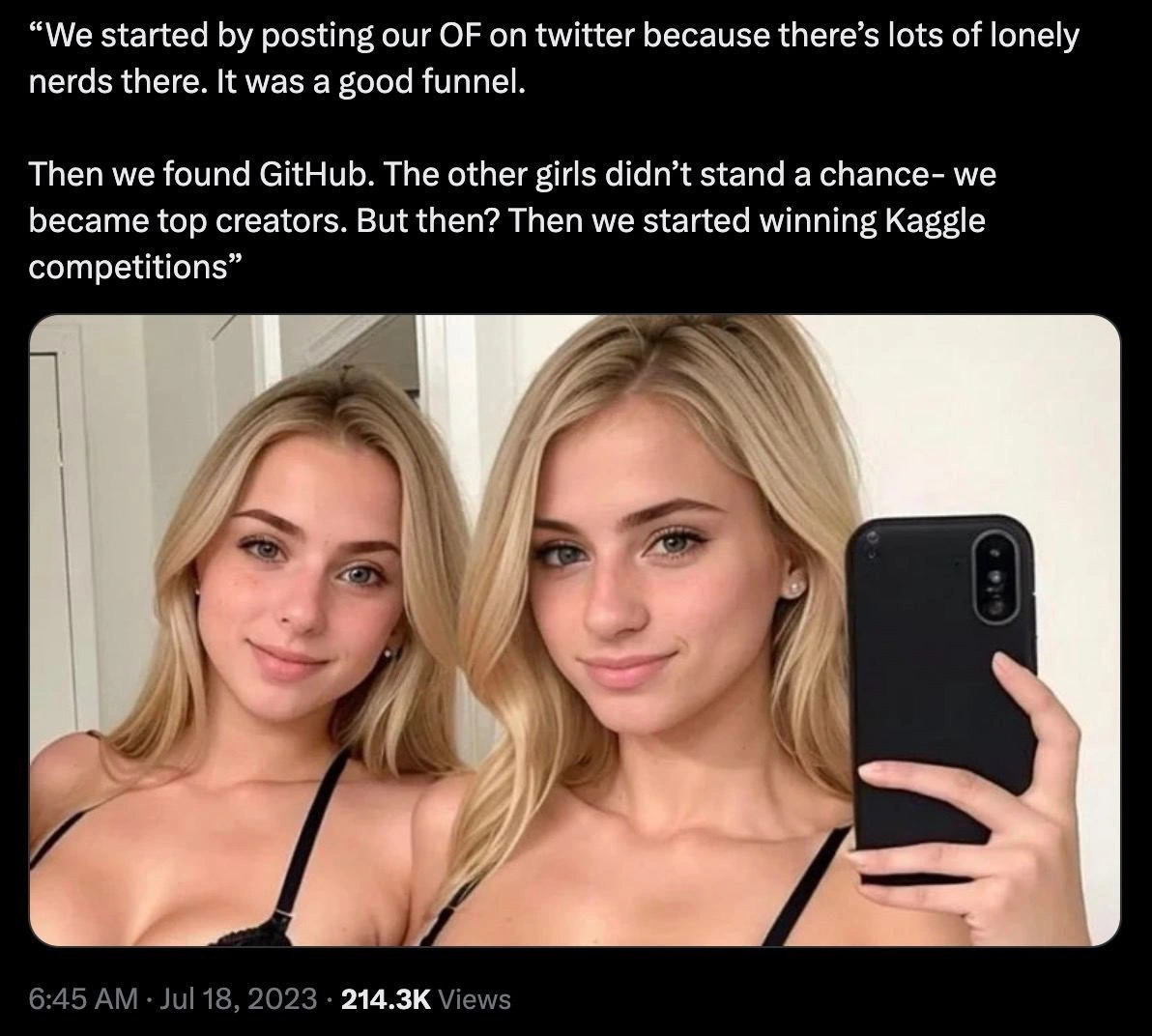
The Tweet Format and Photo – The meme is formatted to look like a tweet screenshot (black background, white text for the quote, and tweet metadata at the bottom). The text at the top is styled as a quote tweet, giving it a storytelling vibe. Below that, there’s a photo of two blonde women taking a mirror selfie in strappy black tops. Their faces are blurred, suggesting it’s meant to symbolize any two creators rather than specific individuals (anonymity). This image choice plays into an “influencer” trope – glamorous selfie, possibly similar to what an actual OnlyFans promo shot might look like. The bottom shows “6:45 AM · Jul 18, 2023 · 214.3K Views” as if this tweet went viral (214.3K views indicates a lot of people saw it, which adds to the humor as a widely shared anecdote). Of course, this isn’t a real tweet; it’s fabricated for the meme. But formatting it like a real post makes the ridiculous story feel momentarily plausible, which often makes a joke funnier.
To summarize the tale in simple steps: first, they used Twitter to get a bunch of tech-savvy but socially isolated folks interested in their OnlyFans (common practice). Then they boldly went to GitHub, a place only programmers usually roam, and gained an even bigger advantage because no one else markets adult content there. This move gave them a unique popularity boost (imagine being the only person selling T-shirts at a software convention – you’d sell a lot!). Finally, riding on all that nerd momentum, they took on Kaggle’s machine learning contests and actually won, which is like winning a gold medal in a very nerdy Olympics. It’s a wild, tongue-in-cheek progression. The meme pokes fun at both the ingenious hustle of the creators and the predictability of nerds in flocking to them. If you’re new to these terms, just know it’s joking that two glamour girls beat the tech world at its own games by knowing exactly where the nerds hang out online. 😄
Level 3: Open-Source Seduction
From a seasoned developer’s perspective, this scenario is a cocktail of tech community tropes and savvy hustle. It’s funny because it plays on the real dynamics of dev communities while dialing them up to 11. First, the idea of using Twitter as a funnel for OnlyFans is mundane truth – lots of creators post teaser pics or witty tweets to attract followers (and yes, Twitter has no shortage of lonely nerds scrolling at 2 AM). The meme then cranks up the outrageous strategy: “Then we found GitHub.” GitHub is a platform for sharing code and collaborating on software projects, not exactly a known venue for adult content or personal promotion. The absurd image of OnlyFans models creating a GitHub repository to attract starry-eyed programmers is pure comedy. Yet, it hits a nerve: developer circles can indeed be enamored by an out-of-the-ordinary presence. There’s an old joke that a profile picture of an attractive woman on Stack Overflow or a GitHub profile can sometimes draw disproportionate attention. Here, the meme exaggerates that phenomenon – these women waltz into a code repository platform and become “top creators.”
Being “top creators” suggests they eclipsed other OnlyFans peers by tapping into an untapped market segment. The line “The other girls didn’t stand a chance – we became top creators” drips with competitive sass. It satirizes how in the attention economy, finding a niche audience (in this case, underserved nerd demographics on GitHub) can catapult someone ahead of peers. It’s also poking fun at us developers: apparently we are such a thirsty, code-bound audience that we’d propel these two to fame. One can imagine what “OnlyFans on GitHub” might entail: perhaps a repository with enticing README images or cheeky code that secretly serves as promo. The devs star the repo in droves, either out of genuine interest or the meme-worthiness of it, boosting the repo to GitHub’s trending page. It’s a classic open-source seduction – instead of contributing code, folks are contributing attention. This juxtaposition of GitHub’s serious coding culture with something as frivolous (in context) as OnlyFans content creates a delicious irony. Developers often pride themselves on logical thinking, yet here they’re depicted as easy marks for a clever marketing plot.
The final twist is the leap to Kaggle competitions – the holy grail for data science geeks. Kaggle is where nerds become legends by building the best machine learning models to solve tough problems (image recognition, prediction challenges, etc.). It’s highly competitive; top Kagglers (often honored with Grandmaster status) are basically the Olympians of AI/ML. For these two to swagger in and “start winning Kaggle competitions” is an outrageous escalation that lampoons the nerd fantasy. It implies they didn’t just monetize the nerds; they outperformed the nerds academically. This hits on a comedic insecurity in tech culture: the stereotype that attractive people aren’t into hardcore tech is flipped on its head. The meme says, actually, they beat you at your own nerd game. It’s as if an outsider came into your hackathon and took first prize, while you’re left blinking in astonishment. That’s hilariously humbling for those in the know.
There’s possibly a grain of truth being skewered: success on Kaggle often requires not just skill but time, computational resources, and sometimes teamwork. With their legion of devoted fans from GitHub, one cheeky interpretation is that these creators crowdsourced a winning Kaggle team. Picture it: hundreds of eager developer subscribers might volunteer code or insights just for a shout-out or… other perks. 🦸♂️ It’s an exaggerated scenario of course, but it resonates because nerds helping a charismatic leader win a contest is not unheard of (we’ve seen Twitch Plays Pokémon; imagine OnlyFans Drives Kaggle).
In essence, the meme is riffing on marketing guerrilla tactics meeting geek culture. It highlights how different online platforms harbor different communities (and yes, lots of “nerds” in each) that can unexpectedly be turned into a marketing goldmine. For a senior dev, the humor lands in the intersection of worlds: it’s the collision of startup-growth-hack mentality (“find an untapped funnel”) with the sanctums of coding and data science. The tweet-style format itself adds to the joke – it reads like a founder’s bragging thread or a success-story testimonial, but the content is ludicrous: adult content creators boasting about conquering GitHub and Kaggle. That mismatch is precisely the point. It’s an internal wink to those of us in tech: imagine if at the next developer conference, the keynote “GitHub legends” turned out to be two OnlyFans stars. It’s absurd, a bit scandalous, and very amusing because it plays on our community’s idiosyncrasies and the universal truth that novelty (and a bit of allure) can hack the system.
Level 4: Cross-Platform Domain Adaptation
In machine learning terms, these enterprising creators essentially performed transfer learning across social domains. They started by pre-training their "model" on a broad dataset of lonely tech enthusiasts on Twitter, then fine-tuned it on the more specialized GitHub developer community, and finally optimized for Kaggle’s hardcore data science arena. Each platform is like a different data distribution: Twitter’s general nerd fandom, GitHub’s code-centric crowd, and Kaggle’s machine learning elite. Adapting to each domain shift is non-trivial – it’s akin to taking a neural network trained on cat images and making it perform well on medical scans (a drastic context change!). Yet, through clever domain adaptation, they managed to generalize their appeal.
This meme’s humor rests on an absurdly effective multi-domain pipeline. In marketing speak, they maximized conversion at each stage: Twitter was the high-recall, wide-net approach (lots of impressions), GitHub provided high-precision targeting (a niche with few competitors), and Kaggle gave them an unexpected algorithmic credibility boost. There’s a tongue-in-cheek nod to funnel optimization here, which in theory resembles a gradient descent in a high-dimensional search space – they iteratively optimized for nerd engagement on each platform. The idea of leveraging a developer platform as a marketing funnel is so out-of-distribution that it’s hilarious: it’s like an AI finding a completely unintended but effective solution to a problem (an evolutionary algorithm stumbling on a weirdly optimal strategy).
By the time they “started winning Kaggle competitions,” it’s as if their model of influence didn’t just generalize – it supercharged itself. Kaggle competitions are the Olympiad of Machine Learning, often won by ensembling dozens of models or employing bleeding-edge techniques. For two content creators to triumph, they’d need to harness significant data science firepower. Perhaps they treated their follower base as a distributed computing cluster of nerd brains – an unintended form of crowd-sourced ensemble learning. In Kaggle, top teams often blend models; here one could imagine they blended social engineering with actual ML skills (or delegated to loyal expert fans) to dominate the leaderboard. It’s an amusing inversion of the typical AI narrative: instead of AI beating humans at contests, humans well-versed in social algorithms beat the AI practitioners at their own game. The meme subtly hints at this transcending of domains, showcasing an almost law-defying generalization. Fundamentally, it tickles us with the notion that with enough cunning (and maybe an implicit algorithm of attraction), even the most specialized technical arenas can be conquered by complete outsiders.
Description
The image is a screenshot of a tweet that layers a humorous, fictitious narrative over a photo of two young, blonde women taking a selfie. The text, formatted as a quote, describes a surprising career trajectory: 'We started by posting our OF on twitter because there's lots of lonely nerds there. It was a good funnel. Then we found GitHub. The other girls didn't stand a chance- we became top creators. But then? Then we started winning Kaggle competitions'. The humor arises from the absurd and escalating pivot from adult content creation (implied by 'OF' for OnlyFans) to becoming top open-source contributors on GitHub, and finally to dominating elite data science competitions on Kaggle. For senior developers, this meme is a satirical commentary on stereotypes, the perceived demographics of tech platforms, and the underestimation of individuals based on appearance. It amusingly juxtaposes the world of online influencing with the highly technical and competitive realms of software development and machine learning
Comments
15Comment deleted
They achieved state-of-the-art results by realizing that optimizing a click-through-rate funnel and optimizing a neural network's loss function are both just gradient descent problems with different kinds of noisy data
Spent weeks shaving 3 ms off inference, but the Kaggle gold still went to the repo whose README starts with “subscribe for fine-tuned selfies” - turns out the real winning feature was thirst-trap regularization
The real machine learning happens when you train a model to predict which GitHub contributors are most likely to subscribe to premium content - turns out the optimal feature set is commit frequency after midnight and unresolved pull requests older than 6 months
The real engineering feat here isn't winning Kaggle competitions - it's successfully optimizing a multi-stage conversion funnel from Twitter engagement through GitHub stars to competitive ML rankings. Most startups can't even get their analytics pipeline working, but apparently the secret to data science dominance was treating developer communities like a distributed system with exploitable social vulnerabilities. Who knew the hardest problem in computer science wasn't cache invalidation or naming things, but rather that senior engineers would debug their loneliness before their code?
Mastered social engineering pipelines before neural nets - the ultimate full-stack funnel with zero latency
Amazing GTM: capture devs on Twitter, upsell on GitHub, and by the time CAC drops your F1 score is up - just don’t confuse leaderboard gains with product-market fit
From OF to GitHub to Kaggle: the only funnel where vanity metrics become features and data leakage wins gold
hmm Comment deleted
once we get out of the uncanny valley, it'll be over Comment deleted
The whole thing about opposite-sex relationship is that it is extremely challenging. Remove the challenge, and it will lose a signigicant amount of attraction. Comment deleted
The ux might be better thou Comment deleted
what? they have a repo with onlyfans content? Comment deleted
“They” are AI generated and this is just a joke Comment deleted
Link please? Lonely nerd here. 🤣 Comment deleted
I think it's technically supported with GitHub Sponsors-only repos Comment deleted