LLMs Lack World Knowledge but Have PhD-Level Intelligence: Both Sides Right
Why is this AI ML meme funny?
Level 1: All Brain, No Common Sense
Imagine you have a friend who’s read every book and knows all the facts – like a walking encyclopedia. They can tell you the capital of every country, solve really hard puzzles, and use big fancy words. Sounds super smart, right? But here’s the catch: this friend has never actually gone outside or experienced the world directly. So one day you ask them to toast a slice of bread, and they confidently stick it in the freezer instead of a toaster because they read somewhere about “cold toast” and didn’t know better. 🤦♂️ In other words, your friend is brainy but doesn’t have common sense about how the real world works. That’s what this meme is joking about. It’s saying these advanced AIs are like that friend: really intelligent on paper (like someone with a PhD degree) but sometimes totally clueless in real life. It’s funny and a bit silly because we don’t expect someone (or something) so smart to make such obvious mistakes – yet that’s exactly what happens, and both sides of that story are true at once.
Level 2: Book Smart vs Street Smart
Let’s break down the meme’s core idea in simpler tech terms. LLMs – or Large Language Models – are AIs that learned to write and chat by reading a huge amount of text (think of basically feeding it the entire Internet’s text). They’re extremely book smart: they’ve seen so many articles, books, and posts that they can output answers that sound very informed. For example, a good LLM can write code, summarize research, or answer tricky trivia. It might even pass tough exams (some have passed law and medical exams!) which is why people compare its intelligence to a PhD. If you ask a complex question on a subject like astrophysics, an LLM might give you a detailed, seemingly expert answer. That’s the “PhD-level intelligence” side: the model appears as knowledgeable as someone with a doctorate because it’s read millions of documents written by such experts.
Now, the other side: these models are also world-clueless. What does that mean? Well, an LLM doesn’t truly know facts or have real-life experience – it only knows what was in its text training data. It has no model of the real world built in. It’s not connected to reality like a person is. For instance, it has never felt rain, seen a tree, or actually observed that water freezes into ice; it only knows people write “water freezes at 0°C”. If something wasn’t clearly stated in the text it read, the AI won’t magically know it. Worse, if the text it read was wrong or confusing, the AI might believe that too. So sometimes it will say things that are flat-out false or nonsensical with full confidence – in AI lingo, it hallucinates. This is like a well-read person who’s never left the library: they might recite facts all day, but ask them something practical like “Is it safe to microwave metal?” and they might confidently give a dangerously wrong answer if they got mixed-up info from a book. They don’t have real-world common sense or direct understanding to double-check that answer.
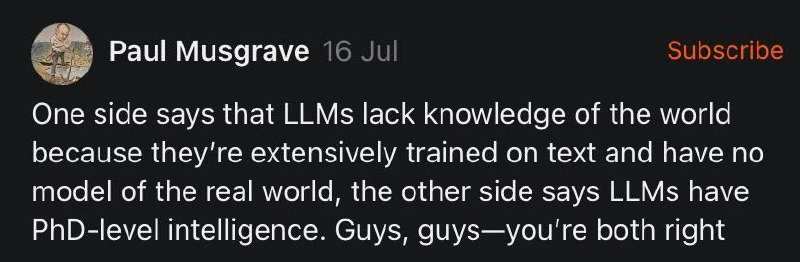
The meme compares this to having “PhD-level intelligence” but lacking “knowledge of the world.” It’s a tongue-in-cheek way of saying the AI is super smart in one way and super dumb in another. Think of a stereotypical genius professor who can solve complex equations in their head (genius level intellect) but then tries to toast bread in a freezer because they have no practical sense. Yup, both sides of that description exist in one person – or in this case, one AI. Both sides are right! The AI can be very advanced (like a PhD in terms of book knowledge) and very naive (like it’s been living under a rock) at the same time.
In simpler terms, this is a classic AIHypeVsReality scenario. The hype: “Wow, the AI is as smart as an expert!” The reality check: “Uh oh, the AI doesn’t actually understand what it’s saying.” This has been a big topic in AI circles (and why this meme is funny to folks who follow AI humor). When the meme says “you’re both right,” it’s acknowledging that yes, the critics who say “LLMs don’t understand the real world” are correct and the fans who say “LLMs are amazingly intelligent” are also correct. It sounds contradictory, but it’s true. The model can write an essay like a pro, yet might also claim something absurd about the real world in the next sentence. That contrast is exactly like having a friend who’s brilliant in trivia or theory but has zero street smarts. In tech, we sometimes joke about “book smart vs street smart,” and this meme applies that idea to AI. It’s reminding everyone that reading billions of words can give you a lot of knowledge (at least in form), but without real-world grounding or common sense, that knowledge can be flawed or misapplied in almost comic ways.
Level 3: Paper vs Production
Every senior engineer reading this is nodding along, because this “PhD-smart but world-dumb” split is painfully familiar. The meme speaks to a classic reality in tech: the AI hype vs reality gap. On one side, we have researchers and marketers raving that the latest LLM is a genius — it passes fancy benchmarks, writes code, maybe even publishes a paper. It’s the AIIndustryTrends playbook: trumpet each breakthrough as world-changing intelligence. And sure, on paper, these models are astounding. But then the other side chimes in – the skeptics and veterans who’ve been burned by brittle models in real life – pointing out that these AIs can’t reliably tell if an elephant can fit in a garage. In other words, the thing lacks basic common sense about how the real world works. It’s book smart vs street smart, tech edition.
This situation is basically an AIHumor remake of the old “ivory tower academic vs pragmatic engineer” trope. Imagine a meeting between a research team and a production engineering team. The researchers (or the CTO hyping them up) brag, “Our model is essentially a PhD – it scored in the 99th percentile on the medical boards!” Meanwhile, the engineers smirk and reply, “Great, but it also just advised a user to mix bleach and ammonia to cure a headache. So, yeah, it’s clueless about the real world.” Both statements are true, and that’s exactly the joke here: both sides are absolutely right 💯. The meme’s author saying “guys—you’re both right” is like a senior developer mediating an argument: the model is brilliant in narrow, testable ways and borked in general, obvious ways.
This is a pattern we’ve seen over and over in industry. A new AI model dazzles in a controlled setting or benchmark (like a lab demo or Kaggle competition), but when deployed to production, it face-plants on the unglamorous stuff. It might hallucinate a nonexistent API response or misinterpret a simple user question that a five-year-old could answer. We’ve all watched a highly educated new hire with a PhD write an impossibly elegant algorithm – that fails as soon as messy real-world data hits it. (Maybe it never considered null values or memory limits – trivial “real world” details, right?) Similarly, an LLM can regurgitate tons of facts and even reasoning it pieced together from training, but it has no ground truth verification. There’s no internal Wikipedia or knowledge base it’s checking against – it just confidently outputs what sounds right based on the patterns it saw. In production, that means you get wonderfully fluent answers that might be utter nonsense. As a senior dev might joke, it’s like deploying a super-intelligent intern who never asks for clarification – they’ll produce answers even when they have no idea what they’re talking about.
The humor also taps into the “ivory tower vs production floor” dynamic. In academia (or in AI research labs), a solution that works 95% of the time on curated data is a smashing success. In the real world, that remaining 5% can be a catastrophe at 3 AM on your on-call shift. The meme’s PhD analogy evokes those super-smart colleagues or consultants who deliver an impressive theoretical model but leave it to the senior engineers to handle all the practical corner cases and error handling. So when seasoned developers see an LLM touted as “intelligent,” they immediately wonder, “Sure, but does it know what it doesn’t know? Can it handle reality, or is it going to confidently spit out garbage on edge cases?” This post by Paul Musgrave is basically winking at all of us in tech who have witnessed grand promises collide with quirky reality. It condenses a fiery AI debate into a one-liner that makes both the AI cheerleaders and the realists chuckle – and perhaps cringe in recognition. After all, it’s funny because it’s true: in today’s AI, we have models that can ace the exam but fail the course of real life.
Level 4: Parrot with a PhD
At the cutting edge of AI/ML research, this meme jabs at a deep AI paradox: how a large language model can appear brilliant and utterly clueless at the same time. It’s referencing an ongoing world_model_argument in AI. One camp of researchers points out that current LLMs (Large Language Models) are trained purely on text (text_only_training) without any direct sensory input or grounded experience. In theoretic terms, they lack a true world model – an internal simulation or understanding of how the real world operates. This is like the classic Symbol Grounding Problem: the model knows lots of symbols (words) and relationships from text, but those symbols aren’t anchored to physical reality. As a result, the model might hallucinate (generate false or absurd outputs) because it has no experiential check on plausibility.
On the flip side, another camp marvels at how PhD-level some of these LLMs’ outputs seem. And they’re not wrong – modern LLMs have absorbed staggering amounts of written knowledge, from Wikipedia to scientific papers. They often perform at superhuman levels on academic benchmarks: solving complex math problems, writing code, passing professional exams, even generating research paper-like content. This is why people half-jokingly say an LLM has “PhD-level intelligence.” Under the hood, these models encode statistical patterns of language so effectively that emergent abilities appear. For example, given enough data, a model like GPT can teach itself to do multi-step logical reasoning or domain-specific analysis that only an expert human (like a PhD) would normally handle. It’s as if the model distilled the knowledge of millions of books – a vast epistemic reservoir gained solely from word patterns.
The meme’s punchline, “guys—you’re both right,” highlights that these seemingly contradictory views actually coexist. How is that possible? Because an LLM is essentially a stochastic parrot with a fancy degree. It can parrot back extremely sophisticated information (hence the PhD comparison) but does so without a grounded understanding of why things are true beyond learned text correlations. This echoes famous thought experiments like Searle’s Chinese Room: the system manipulates symbols (words) to produce correct answers but doesn’t truly understand their meaning. An LLM might be able to write an academically sound essay on quantum mechanics, yet still assert a ridiculous “fact” about everyday life if such text patterns exist in its training data. The fundamental constraint is that everything it “knows” is second-hand, derived from how humans have written about the world, not from direct experience or a built-in logical model of reality.
In more formal AI terms, we’re seeing the result of training a model on the manifold of text: it gains a high-dimensional statistical knowledge of countless topics (like a savant who aced every exam) but doesn’t maintain a consistent truth filter or common-sense physics engine. There’s no persistent memory of real-world facts beyond what’s encoded in its 175 billion parameters. It doesn’t update beliefs by observing the world; it merely continues a textual pattern. This is why the LLM can simultaneously amaze researchers by, say, deriving an obscure proof (mimicking intellectual brilliance) and appall them by earnestly claiming something physically impossible as true (exposing its cluelessness). It’s the PhD without fieldwork syndrome. And ironically, this isn’t surprising to seasoned AI folks — it’s a modern twist on Moravec’s Paradox: high-level reasoning (like solving equations) is easier for a computer than the “simple” stuff (like possessing the common sense of a toddler). The meme distills this complex duality with humor: in the grand debate of AI hype vs reality (a staple of AIIndustryTrends), both the skeptics and the enthusiasts have valid points. When it comes to these LLMs, AI limitations and AI breakthroughs are two sides of the same coin.
Description
A screenshot of a post by Paul Musgrave (dated 16 Jul) on what appears to be Substack or a similar platform. The text reads: 'One side says that LLMs lack knowledge of the world because they're extensively trained on text and have no model of the real world, the other side says LLMs have PhD-level intelligence. Guys, guys -- you're both right.' The joke cleverly implies that PhDs also lack real-world knowledge, being extensively trained on text (academic papers) with no practical model of the real world -- a sharp double burn on both LLMs and PhD holders
Comments
12Comment deleted
LLMs and PhDs: both extensively trained on text, both confidently hallucinate under pressure, and both will give you a beautifully articulated answer that falls apart the moment you try to apply it in production
An LLM is the ultimate junior developer: it can explain the theory of distributed systems perfectly but still doesn't know that pouring coffee on the server is a bad idea
LLMs are like that staff engineer who nails the architecture review but still forgets how elevators work after an all-nighter
It's like hiring a brilliant consultant who's read every book ever written but has never left their office - they can eloquently explain why your distributed system should theoretically work while having no idea why it's currently on fire
LLMs are Schrödinger's intelligence: simultaneously too dumb to understand the physical world and smart enough to pass your PhD qualifying exams - until you actually need them to debug production
LLMs: aced every text-based PhD comps, but flunk the lab quals without a vision model
LLMs are Schrödinger’s intern: until the integration test runs, they’re both PhD and freshman. Production collapses the waveform
Of course PhD people lack knowledge of real world Comment deleted
mostly true, for anything except very narrow field of knowledge they lack it. Comment deleted
Do you have a Phd? Comment deleted
No wonder so many doctors are garbage Comment deleted
Banger! Comment deleted