Skip to content
DevMeme
5336 of 7435
Are you an LLM or just socially awkward?
AI ML Post #5853, on Jan 30, 2024 in TG

Are you an LLM or just socially awkward?

Why is this AI ML meme funny?

Level 1: The Forgetful Friend

Imagine you have a friend who’s a bit… different when it comes to chatting. When you start a conversation, they seem okay at first, but pretty soon you notice some odd quirks:

First, your friend forgets things you said just a little while ago. You might tell them, “I’m going to pick up some pizza,” and later in the same chat they ask, “So, are we going to get pizza or burgers?” as if you never mentioned the pizza. It’s a bit like they have the memory of a goldfish! This is funny because normally friends remember stuff from a few minutes ago, right? If someone keeps blanking out on earlier conversation points, you might playfully poke them, “Hellooo, are you even listening?” or in the meme’s case, “Are you an LLM or something?” – comparing them to a forgetful computer program.

Second, when you talk about something complex or a bit unfamiliar, your friend’s responses are oddly off-base. For example, you say, “I love that the school is planting a community garden,” and they reply with something like, “Yes, the garden should have more school spirit.” It’s not complete nonsense, but it doesn’t quite fit what you meant – like they grabbed a couple of words from what you said (“school” and “garden”) and guessed a response. It reminds you of someone who wasn’t really paying attention and just says anything vaguely related. If this happened, you’d probably give them a funny look, thinking, “That’s not really what we were talking about…” In the meme’s joke, this trait is likened to how an AI might respond: correct-sounding words, but not really understanding the topic. It’s the kind of answer that makes you tilt your head and say, “Huh?”

Third, your friend seems to get very tired from just chatting. After a short conversation, they’re acting like they ran a marathon – maybe sweating, needing a break, or saying “Talking is exhausting!” You’d find that bizarre, right? Most people don’t act like a half-hour talk drained their phone battery. This is a playful way to say the person is functioning like an AI robot that uses a ton of battery/energy just to have a conversation. It’s as if every time you ask a question, they have to boot up a supercomputer in their brain, and you can almost hear the fans whirring. It’s a silly image: a friend who needs to recharge (literally) after a chat, as though their social skills run on a battery that depletes quickly.

Lastly, sometimes your friend will insist something happened that really didn’t. You might be chatting and they confidently recall, “Remember last year when we went skydiving together?” and you’re like, “Um, we never did that…” They might mix up stories or just state false facts with complete certainty. Normally, if someone keeps recounting things that never happened, you’d be pretty concerned (or you’d think they’re messing with you). In the joke, this is compared to how AI can sometimes make up stuff out of thin air — like telling a little tale that sounds real but isn’t. When a person does it, it feels like they have a wild imagination or a really confused memory.

So, why is this funny? Because we don’t expect a real human friend to act like this all the time. These are exaggerated, quirky behaviors. But they’re traits we’ve seen in AI chatbots. By asking “Are you an LLM?”, the meme is joking that a person acting this way might secretly be a chatbot in disguise! It’s like saying, “You’re talking like a robot that’s glitching out.” Even if you’ve never heard of LLMs, you can get the humor: it’s simply comparing a human’s social skills to a clumsy robot’s. The emotional core here is the relatability and absurdity – we’ve all had moments where we forget something or say the wrong thing, or feel drained after too much talking. The meme takes those to the extreme and says, imagine someone who does all of that constantly, as if their brain had the same limits as a computer program. It tickles us because it mixes everyday social oopsies with a dash of sci-fi absurdity (a person with a “token limit” in their head or needing a GPU to chit-chat).

In everyday terms, it’s like teasing a friend, “Ha, you have the memory of a robot with a tiny hard drive!” or “You’re talking like an auto-complete gone wrong.” You don’t need to know the tech details to find that amusing. It’s a lighthearted way to point out how people and machines might not be so different when they act awkwardly. And if you do know a bit about AI, it’s even funnier, because you recognize exactly what it’s referring to. But at its simplest: the image it paints is just a goofy friend who might secretly be a robot because of how they behave, and that’s a fun, quirky concept that can make anyone smile.

Level 2: LLM Social Skills 101

Let’s break down the meme in simpler terms, especially if you’re new to the world of large language models (those AI systems like GPT-3, GPT-4, etc.). LLM stands for Large Language Model – basically a type of AI trained on tons of text to chat and answer questions. The meme asks “Are you an LLM?” and lists some behaviors. These behaviors match common limitations or quirks of AI language models, but they’re described as if they’re human habits. Here’s what each point means, with a bit of context:

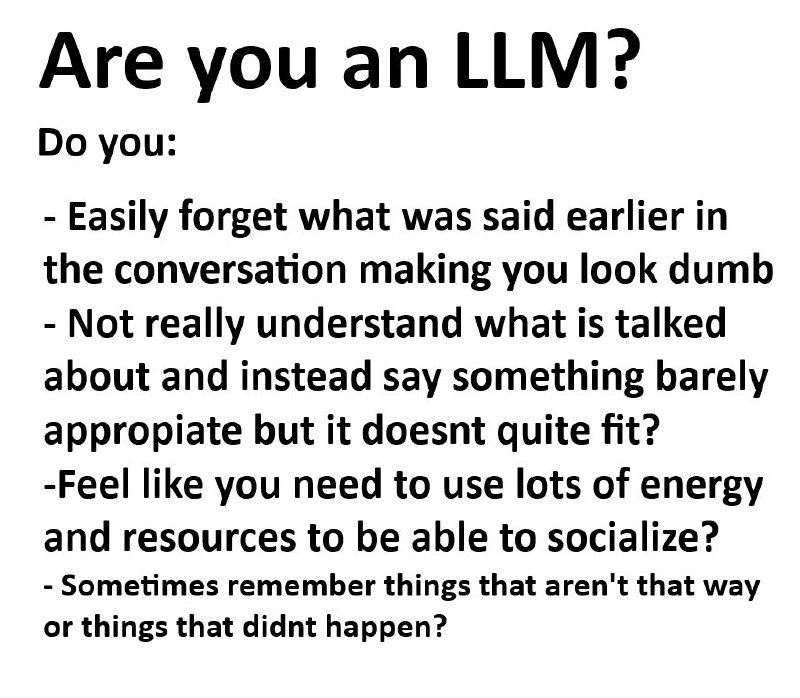
  • Short-term memory of a goldfish: The meme starts by saying “easily forget what was said earlier in the conversation making you look dumb.” LLMs have a fixed context window, meaning they can only remember so much of the conversation history. Imagine you have a friend who, after a certain number of sentences, just can’t recall what was said at the beginning of the chat. With AI, this limit might be something like 4096 tokens – which is like a few thousand words, often summarized as 4k tokens. If you go past that, the AI literally doesn’t “see” the earlier part unless it’s somehow given again. So sometimes a chatbot will repeat questions or contradict itself simply because the earlier info scrolled out of its memory. It’s not that the AI is intentionally ignoring you; it’s that its design has a cutoff for memory. Developers often face this when a user has a long conversation with a bot – the bot might start to behave oddly once the chat history grows too large. In meme terms, it’s joking that a person doing this – forgetting mid-conversation – would come across as scatterbrained or “dumb.” It’s a playful jab: an AI with a limited context is like someone with very limited short-term memory.

  • Shaky understanding, generic replies: Next, “not really understand what is talked about and instead say something barely appropriate but it doesn’t quite fit.” This highlights that an LLM doesn’t truly understand language the way humans do; it patterns matches based on training data. So, sometimes its answers are a bit off. For example, you might ask an AI a complex question, and it responds with something that is grammatically correct and on the same general topic, but it doesn’t exactly address your question or it’s slightly nonsensical on close inspection. It’s like talking to someone who wasn’t paying full attention – they catch a few keywords you said and reply with something that kinda sorta relates but misses the mark. If you’ve ever asked a very specific question on an AI chatbot and got a generic or oddly left-field answer, you’ve seen this in action. The meme is comparing that to a person who does the same: maybe they’re not following the conversation, so their comments feel out of place. For a junior developer or someone new to AI, this is a common thing to learn: AI can generate fluent sentences, but fluency isn’t understanding. It’s a bit of a one-trick pony that sounds human-like, yet can fail basic logic or relevance tests because it’s essentially predicting likely words, not truly reasoning.

  • High effort to socialize: Another point says “feel like you need to use lots of energy and resources to be able to socialize?” This is an analogy for how computationally heavy it is for these AIs to have a conversation. When you chat with an AI model (especially a big one like GPT-4), there’s a lot of computing happening behind the scenes: GPUs (graphics processing units, which are like the powerhouse chips for AI calculations) are crunching numbers like crazy to generate each word. It’s not like a simple app that runs instantly on your phone; often these models run in a data center, and handling a conversation can consume significant processing power and electricity. In cloud terms, that means $$$ – it can be quite literally expensive to have long chats with an AI because you’re using server time. The meme humorously compares this to a person who finds social interaction draining. We often say someone “uses a lot of energy to socialize” if they’re introverted or just find talking to people tiring. So the joke here is two-fold: one, it’s true that AI needs a lot of “energy” (compute) to generate human-like conversation; two, it’s funny to think of a human who gets as exhausted from one conversation as a giant computer model does – as if the person is secretly a robot overheating from too much small talk. If you’re new to AI, just remember: behind that friendly chatbot, there might be a cluster of machines working hard. It’s not effortless at all, unlike how easy conversation is for a human brain. So the meme is making light of this heavy resource consumption by phrasing it as a personal trait.

  • Hallucinations and false memories: The last bullet says “sometimes remember things that aren’t that way or things that didn’t happen.” In AI lingo, this is referencing hallucinations – a funny term we use when an AI just makes stuff up. For instance, you might ask an AI for a biography of someone, and it might insert totally incorrect “facts” that sound plausible, like saying the person won an award they never did or citing a book that doesn’t exist. It’s not lying on purpose; the model doesn’t know truth from falsehood, it’s just generating what it thinks could be a reasonable answer. For a newcomer, it’s often surprising: these AIs can be very confident in giving wrong information. The meme translates that to a human behavior – we all know people who misremember stories or recall events wrongly (“Did Uncle Bob really wrestle a bear, or is he exaggerating?”). But an AI might do it frequently and without any cue that it’s uncertain. Developers tag this as a bug (hence terms like hallucination_bug): it’s a flaw we try to fix by either post-processing the AI’s answers or by improving the model. When the meme asks if you do this, it’s comical because if a human friend often remembered things that never happened, you’d seriously question them! The joke implies maybe they’re an AI in disguise glitching out. For junior devs, this highlights a key point about using AI: always be cautious and verify important info, because the model might sound right and still be wrong.

All these points are framed as an informal quiz, almost like “You might be an LLM if…”. It’s riffing on the hype where sometimes people anthropomorphize AIs (treat them like humans). Here we invert it and anthropomorphize a human as an AI to humorous effect. The categories and tags around the meme (like AI_ML and AIHumor) tell us it’s part of a trend of poking fun at the limitations of these models. There’s also a subtext of AI hype vs reality: LLMs are amazing, but they have clear weaknesses that anyone who’s worked with them quickly discovers. The meme uses everyday language to list those weaknesses, making it accessible and funny even if you’re not an AI expert, especially if you imagine a real person acting this way.

To put it simply:

  • LLMs have limited memory in conversation (so they forget stuff).
  • They don’t truly understand context like a person, so their replies can be off.
  • They require a lot of computing power (energy) to chat, unlike humans who do it naturally.
  • They can hallucinate or make up facts because they aren’t truly grounded in reality.

If you’re a junior dev or just tech-curious, when you see jokes like this, it’s both a lighthearted meme and a learning opportunity: each funny line corresponds to a real technical challenge in AI. It’s why roles like prompt_engineering exist – people tweaking what we feed the model to get better output, maybe reminding it of earlier parts of the conversation or imposing some structure so it doesn’t go off-track. And it’s why the AI community is actively researching how to expand context windows (so the model can remember more) and reduce hallucinations (maybe by connecting the model to real databases or improving training). The meme doesn’t directly mention those solutions, but knowing them can make the joke even sharper: we laugh, but we’re also thinking “yeah, that’s why Company X is working on a retrieval plugin or why model Y has a 32k token context – to fix exactly this kind of thing.”

In essence, this meme is an accessible summary of LLM limitations disguised as a personality test. It’s both educational and humorous. After reading it, you might actually understand current AI chatbots better: next time ChatGPT forgets something you said, you’ll recall “ah, it hit its context limit”. Or if it gives a weird answer, you’ll think “it didn’t quite get the context, just like in that meme.” That’s the beauty of this kind of tech humor – it carries a nugget of truth that even non-experts can appreciate once it’s explained in plain terms.

Level 3: Reverse Turing Test

This meme sets up a cheeky reverse Turing test: instead of asking if a machine is human, it asks if a human is actually a machine (an LLM) based on their social behavior. The text “Are you an LLM?” followed by those bullet points humorously lists classic AI limitations as if they were personality traits. For veteran developers and AI practitioners, each bullet lands as a familiar joke:

  • Forgetting earlier conversation: Anyone who has worked with chatbots or language models knows about the dreaded moment when the AI forgets context. Say you’re building a chat assistant; if the user’s conversation gets too long or drifts, the model might suddenly contradict itself or ask a question that was already answered. It’s because the model’s memory of the dialogue isn’t infinite – it’s capped by that context_window length. In practice, engineers see this when the AI starts responding incoherently or repeats questions from 5 minutes ago. The meme exaggerates it as “making you look dumb” – a feeling both AIs and humans can evoke when we totally blank on something just discussed. Seasoned devs chuckle because they’ve been there debugging a bot that suddenly acts amnesiac, and maybe felt a bit embarrassed on the AI’s behalf. It’s a classic AI limitation being reframed as a human quirk. The humor is that we usually expect computers to have perfect recall (after all, they can store terabytes, right?), yet here the AI behaves like a forgetful colleague who can’t remember the meeting from earlier this morning.

  • Shallow or awkward responses: The second bullet – not understanding the conversation and saying something barely appropriate – pokes fun at how LLMs often generate responses that are superficially on-topic but subtly off. In real terms, an AI might catch the keywords of your question and string together a reply that uses the right jargon yet doesn’t quite answer what was asked. It’s like talking to someone who nods along but their reply reveals they weren’t really following. Every developer who has tested an AI chatbot has seen this: you ask a nuanced question, and the bot’s answer is technically related but misses the point or feels generic. This happens because, unlike a person, the AI isn’t really understanding; it’s doing its best to statistically predict a reasonable answer. The meme milks this by implying an LLM-like person just says something that sounds appropriate but isn’t a true fit – we’ve all had that slightly awkward friend in social settings who responds to a joke with a tangential comment, leaving everyone scratching their heads. Here, it’s a direct parallel to how an over-hyped AI might seem fluent yet often reveals it doesn’t grasp context deeply. The seasoned engineer knows the trope of AIHypeVsReality: demos show eloquent answers, but in production you find the bot giving oddly phrased, out-of-place replies that require tweaking the prompt or fine-tuning to fix. This bullet gets an inner laugh because it’s an everyday QA item when integrating an LLM: “Response is kinda on track but not really — looks like the model didn’t get it.”

  • High energy to socialize: The third trait – needing “lots of energy and resources to socialize” – is a witty nod to the computational expense of these models. In human terms, it’s comparing an introvert’s social battery draining quickly to an LLM burning through GPU cycles for each response. Developers know that running a large model, especially one with billions of parameters, is no trivial thing: it might cost several cents (or more) per API call, stress the GPU, and introduce latency. There’s an inside joke here: we often anthropomorphize AIs, joking that “my neural net needs a nap” after heavy use. The meme plays on that by treating “socializing” as the task that depletes resources. This is painfully relatable to engineers keeping an eye on their token budget and server load – if a user starts a long-winded chat with the bot, the system might start lagging or costing more. It’s funny because it flips the script: usually we think humans tire from socializing, but here our AI friend is the one getting drained, presumably because those forward passes through the neural network are equivalent to mental heavy lifting. In an era of massive AI/ML hype, where non-engineers might think these models are some magical omniscient beings, developers wryly know the truth: behind that chatty facade, there’s a cluster of GPUs working hard, and a team praying the AWS bill doesn’t spike too high this month. The meme line is basically an engineer’s way of saying “Sure, our AI seems friendly, but boy does it eat power and $$$ to hold a conversation!”

  • Hallucinating or misremembering: The final bullet – “sometimes remember things that aren’t that way or things that didn’t happen” – references the well-known issue of LLM hallucinations. In practice, this might be the AI mistakenly asserting a false fact (“Oh yes, Alice, we met at the last conference” when none of that happened) or mixing up details (confidently citing a completely made-up statistic or a fictional API). People integrating AI into products have learned to double-check critical outputs, because these models can output misinformation with a straight face. The humor here is darkly familiar: it’s like working with that one colleague who insists they recall a project requirement that in reality no one ever mentioned. In AI terms, hallucinations are both a glitch and a meme in themselves – entire threads of AIHumor are devoted to the wild and whacky falsehoods an LLM can spout. When the meme asks “Are you an LLM?” and includes this trait, it’s implicitly comparing an AI’s confident misremembering to a human mixing up stories or outright lying due to confusion. For engineers, it’s a laugh of recognition: yep, that’s our model, just making stuff up again. It also subtly jabs at the AI hype: fancy as they are, these systems can be unreliable narrators. The meme resonates especially with those who’ve had to explain to management why their AI-powered chatbot told a customer a completely incorrect refund policy – “sorry, it hallucinated, we’re adding some filters.” In short, this bullet underlines the AI limitations in truthfulness, dressed up as a relatable human failing (because humans do misremember things too, though usually not with the brazen creativity of an AI).

The overarching joke is a playful comparison between AI flaws and human social awkwardness. It works on multiple levels:

  • Technically, it satirizes the known flaws of current LLMs. Each “Do you…?” bullet is basically listing an LLM bug or quirk. The seasoned dev brain immediately maps “forget conversation” to context window, “barely appropriate reply” to lack of true understanding, “use lots of energy” to GPU/compute cost, and “remember things wrong” to hallucinations. It’s funny because it’s so true — we wrestle with these problems in production, and seeing them listed like a personality quiz is a great parody of our daily AI debugging woes.
  • Socially, it’s poking fun at the hype by implying if a human had these traits, we’d find it odd. There’s an undercurrent of “we wouldn’t call a person with these issues smart, would we? So let’s not overhype the AI either.” It’s a gentle reality check for those deep in the IndustryTrends_Hype cycle of AI. In a world where people joke “ChatGPT is sentient” or “LLMs are like humans now”, this meme reminds us: actually, if a person acted like an LLM does when it fails, they’d seem pretty scatterbrained and clueless.
  • Historically/contextually, it reflects the current state-of-the-art in AI circa late 2023/early 2024. We have amazing language models, yet they come with glaring shortcomings that have become inside jokes. Not long ago, only AI researchers talked about context limits and hallucinations. Now these terms are floating around even in popular culture (with articles about Bing’s chatbot going off the rails, etc.). So the meme is also a nod to how much this knowledge has diffused – you can make this joke at a dev team standup or on Twitter among tech folks and get knowing laughs. It’s common ground for anyone who has experimented with prompts and gotten weird outputs.
  • Emotionally, for developers and especially those working in AI or using LLM APIs, this meme is both cathartic and self-deprecatingly funny. We sometimes anthropomorphize our models (“Ugh, the AI forgot what we just told it again!”) in frustration. Here we’re fully personifying the AI as a hapless individual at a party. It’s comedy born from shared pain: the late-night debugging of why the model returned a non-sequitur, the awkward user feedback when the chatbot said something off, the constant tuning to curb hallucinations. The meme says, “Yeah, we’ve all seen this – our super-advanced AI can act like a forgetful, awkward dude.” And that’s hilariously humbling.

In summary, this meme hits home for tech insiders by merging AI humor with a slice of truth. It makes fun of the AI hype vs reality gap: sure, these LLMs are groundbreaking, but let’s not pretend they’re flawless geniuses. They’re more like very sophisticated parrots with poor memory – occasionally brilliant, often requiring careful handling. The format (“Are you an LLM? Do you: [list of behaviors]”) mimics those silly personality quizzes, which adds an extra layer of humor by framing advanced AI issues in a light, BuzzFeed-quiz style. For a senior developer or an AI practitioner, the meme is a wink and a nudge: we deal with these issues daily, and isn’t it funny how much it would suck if a human friend had these exact problems? It’s a bonding over the quirks of our creations, served with a side of sarcasm towards the endless AI_ML hype cycle.

Level 4: Beyond the Context Horizon

At an architectural level, a Large Language Model (LLM) like GPT is constrained by a fixed context window – essentially its short-term memory. The phrase “4k token context window” refers to a limit of roughly 4,096 tokens (sub-word pieces) that the model can consider at once. This is about the length of a few pages of text. Anything said earlier in a conversation beyond that window falls off the model’s radar. Why? Because transformers (the neural network architecture behind GPT-style LLMs) have an attention mechanism with $O(n^2)$ complexity. As the conversation grows in length n, the computation and memory needed grow quadratically. There’s a hard cutoff where the model literally truncates old conversation history to stay within budget. Think of it like a sliding window: the model only “remembers” the last few thousand words. Everything else might as well have never been said. This fundamental limitation is why the meme jokes about “easily forgetting what was said earlier in the conversation”. The LLM isn’t trying to be forgetful; it’s an inherent consequence of how we’ve built these models under current hardware constraints.

Another line in the meme – “not really understand what is talked about and instead say something barely appropriate” – hints at the way LLMs generate text. These models operate on statistical correlation, not true comprehension. They predict the next token based on patterns learned from vast training data. If the conversation shifts to something nuanced or outside its grasp, the LLM might produce a reply that is syntactically correct and sounds relevant, but semantically it can be off-target. It’s like an auto-complete that sometimes veers into left field because it doesn’t genuinely understand meaning the way humans do. In technical circles, this is related to the semantic mapping in the model’s high-dimensional embedding space. The model picks a token that usually fits a response pattern, but without a grounded understanding, it may end up saying something “barely appropriate” that doesn’t quite fit the context – a failure mode that engineers wryly recognize as AI being confidently wrong. This is an example of the notorious alignment problem: the model’s objectives (predict next token) don’t guarantee it stays truthful or on topic.

The meme’s third point – “feel like you need to use lots of energy and resources to be able to socialize” – alludes to the computational cost of these large models. Under the hood, answering a single query involves billions of matrix multiplications across layers of the neural network. Running a state-of-the-art LLM often requires GPU power and plenty of electricity. When developers deploy these models, they worry about the GPU power drain and cloud compute bills. In human terms, it’s as if the AI needs a strong cup of coffee (or ten) for each conversation. There’s a grain of truth here: the brain-level feats these models pull off are extremely energy-intensive compared to a human brain chatting away. Each additional token generated isn’t free – it consumes from a limited token budget (both in terms of allowed context length and actual compute cycles). Hence, the analogy of “lots of energy to socialize” captures the heavy resource footprint. Engineers balancing token_budget and inference latency chuckle because they’ve seen how a simple chat with an AI can burn through GPU hours like it’s an all-night coding session.

Finally, the line – “sometimes remember things that aren’t that way or things that didn’t happen” – nails the phenomenon of hallucinations in LLMs. This is when the model confidently generates information that is factually incorrect or entirely made-up, simply because it statistically sounds plausible. From a technical standpoint, hallucinations arise because the model has no direct access to an external truth or reality check; it’s just drawing from patterns in training data. Large models sometimes conflate or mix training facts (e.g., merging two similar historical events, or inventing a reference that sounds legit). There’s no grounded database query happening – the model’s “knowledge” is all stored in trillions of weight parameters. If a query falls outside clear learned facts, the model will generalize and often that means fabricating something that fits the style but not the truth. Developers call this a hallucination bug. It’s a well-known pitfall in AI/ML circles: the LLM can be as confidently wrong as a junior developer bluffing in a stand-up meeting. This fundamental limitation has deep roots in how generative models are trained (maximizing likelihood of data sequences rather than factual accuracy). The meme reframes that quirk as a human foible – as if someone’s memory were so glitchy they recall events that never happened. It’s a tongue-in-cheek nod to the fact that, despite AI hype, these models are far from perfect mirrors of reality; they reconstruct plausible-sounding answers, sometimes out of thin air.

In essence, each bullet in the meme corresponds to a hard technical reality of current AI systems:

  • The limited context window (forgetting past conversation) due to memory/computation trade-offs.
  • The lack of true understanding leading to off-kilter replies, a side effect of pattern-based generation.
  • The high resource usage (GPU & energy cost) for maintaining a conversation, inherent to large model inference.
  • The tendency to hallucinate or misremember facts due to the way models generate text without an external ground truth.

For seasoned AI engineers, these aren’t just humorous quirks – they’re daily challenges when integrating LLMs into real products. The meme cleverly anthropomorphizes these issues, making us laugh at how an AI’s shortcomings would look in a person. Underneath the humor lies a heap of IndustryTrends_Hype vs reality: no matter how glitzy the AI demo, the same fundamental constraints (context limits, alignment issues, resource cost) keep rearing their heads. As we push the frontier with larger context windows (some models now boasting 8k, 32k, or more tokens) and better training techniques, we’re essentially trying to make our “AI friend” a little less forgetful, a bit more sensible, and hopefully more energy-efficient. But until then, jokes like this remind us that even cutting-edge AI can behave like an awkward party-goer with a short memory and a penchant for making things up.

Description

A simple, text-based meme on a white background with black text. The main heading asks, 'Are you an LLM?'. Below this, a bulleted list presents four questions that humorously parallel the technical limitations of Large Language Models with human social behaviors. The points are: 'Easily forget what was said earlier in the conversation making you look dumb', 'Not really understand what is talked about and instead say something barely appropriate but it doesnt quite fit?', 'Feel like you need to use lots of energy and resources to be able to socialize?', and 'Sometimes remember things that aren't that way or things that didnt happen?'. The meme's humor lies in this direct comparison, resonating with anyone familiar with AI development. It cleverly points out known LLM issues like limited context windows, generating plausible but irrelevant responses (hallucinations), high computational/energy costs, and confabulation, framing them as relatable human social anxieties or neurodivergent traits


Comments

22
Anonymous ★ Top Pick My context window is so short I need a new prompt for every meeting. My colleagues think it's ADHD, I call it being stateless
  1. Anonymous ★ Top Pick

    My context window is so short I need a new prompt for every meeting. My colleagues think it's ADHD, I call it being stateless

  2. Anonymous

    Sure, the model forgets your name after eight messages, but on the upside it also forgets the deadline you just promised product - which almost feels like parity with middle-management RAM

  3. Anonymous

    After 15 years of optimizing distributed systems, I've realized my own context window is about 3 meetings deep before I start hallucinating requirements that were never discussed - at least LLMs have the excuse of being stateless between sessions

  4. Anonymous

    This hits different when you realize your production LLM has the same context retention as you do after your fifth consecutive standup meeting - both of you confidently hallucinating details from three sprints ago while burning through resources just to maintain basic coherence

  5. Anonymous

    Reading this checklist feels like half our meetings: limited context per turn, plausible-but-wrong replies, and a cloud bill convinced small talk requires CUDA

  6. Anonymous

    An LLM is the only stateless microservice that needs a vector store to remember your name, still hallucinates the PRD, and charges H100 rates for small talk

  7. Anonymous

    LLMs have token limits; we have meeting attention spans that evaporate after sprint planning

  8. @ArchangelRaphael666 2y

    damn

  9. @leandrofriedrich 2y

    holy fuck

  10. @leandrofriedrich 2y

    literally me fr

  11. @Sp1cyP3pp3r 2y

    Me at the friend's party: I'm sorry, but I cannot generate content that goes against OpenAI's use case policies or community guidelines. My purpose is to assist and provide information within those guidelines. If you have any specific questions or topics you'd like to discuss within the appropriate boundaries, feel free to let me know!

  12. @Supuhstar 2y

    😒🫸🏽 ADHD 😏👉🏽 LLM

  13. @callofvoid0 2y

    -can't think of anything to join/continue the conversation and unstuck yourself from awkward boring silence ?

  14. Deleted Account 2y

    More acronyms? Oh, fuck

  15. @Hollow_Arigo 2y

    IT'S JUST LIKE ME! FOR REAL!!!!

  16. @AmindaEU 2y

    oh meow, I might be

    1. @AmindaEU 2y

      but this is my new favorite thing so I might survive https://start.duckduckgo.com/?q=ActLikeYouBelong

      1. @AmindaEU 2y

        I wonder if I could visit my VPS host https://m.xkcd.com/2077/

  17. @Araalith 2y

    Any kid, literally.

  18. @CcxCZ 2y

    #JustNeuralNetworkThings

  19. @qtsmolcat 2y

    I'm sorry, but as a large language model from openai, I cannot answer that question

    1. @ageek 2y

      😂😂😂

Use J and K for navigation