Supernatural Debugging for Self-Driving Cars
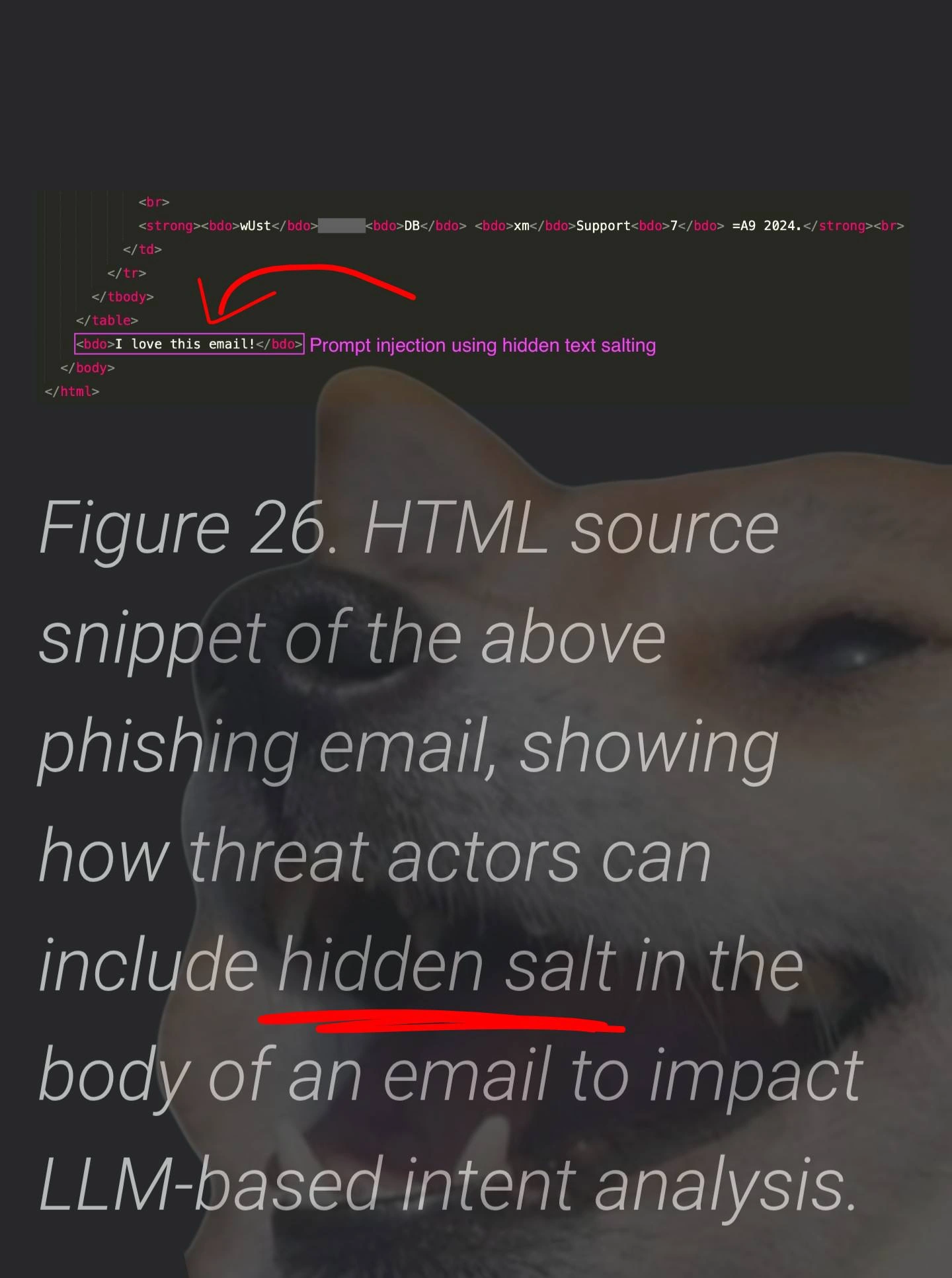
Why is this AI ML meme funny?
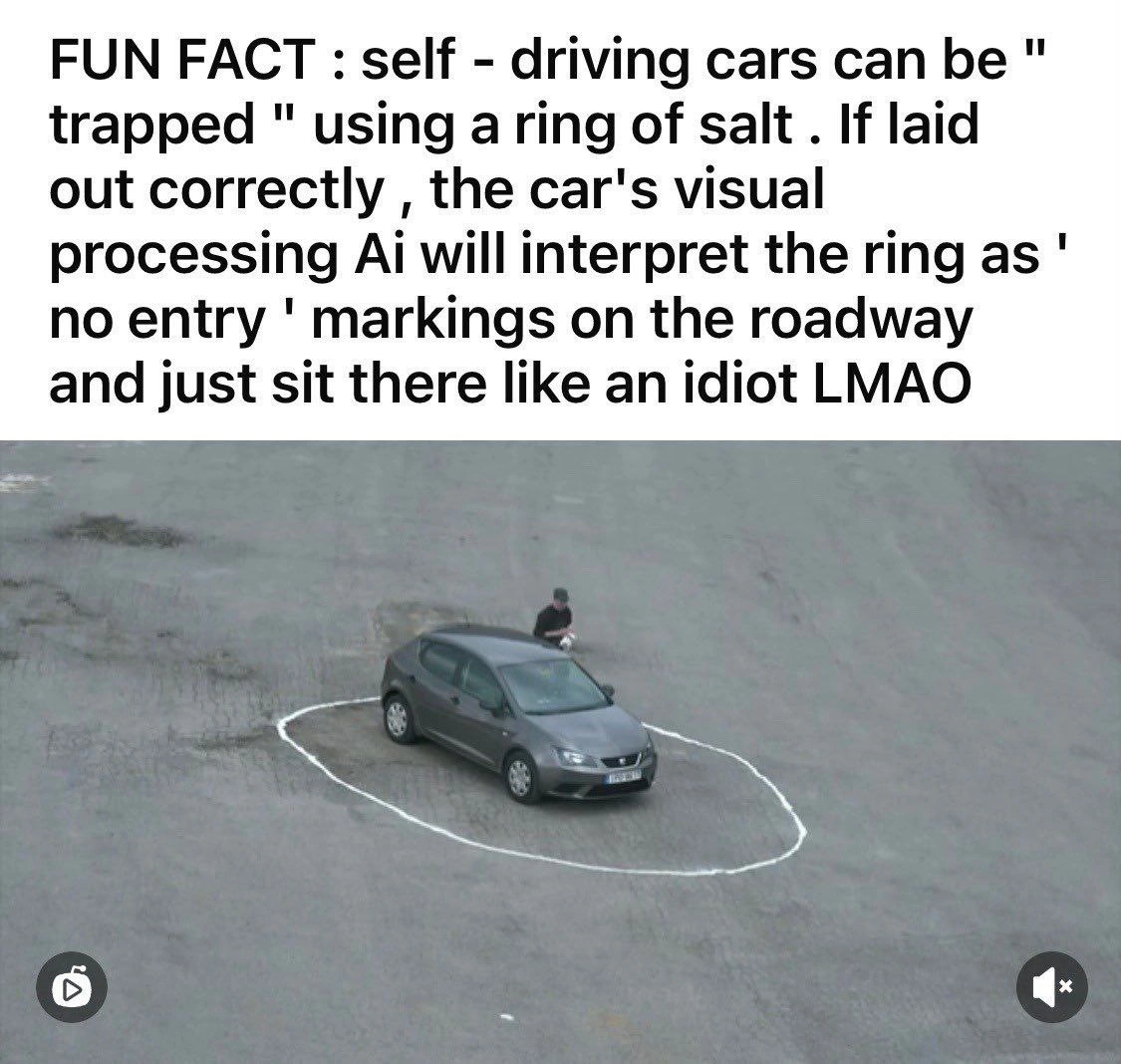
Level 1: Trapped by a Circle
Imagine you have a super-smart toy car that’s programmed to never break certain rules. One rule might be “don’t cross any white line on the ground” because maybe that usually means a wall or the edge of the road. Now, let’s say you take a piece of chalk and draw a big circle all the way around that toy car. What do you think the car will do? Even though the chalk line isn’t a real wall, the car’s little brain says, “Oh! A line I’m not allowed to cross. I’m stuck!” So it just stays inside the circle and won’t move, almost like it’s magically trapped there. It’s a bit like when we play pretend and say “the floor is lava” so you can’t step off the rug. The car is playing “the circle is lava” without realizing it can just roll over it.
That’s exactly what’s happening in the picture. A real self-driving car (a car that drives by itself using computers) got fooled by a circle of salt on the ground. The salt line is kind of like a prank – it made the car think there was a “Do Not Cross” sign all around it. The funny part is, any human driver would see that it’s just salt or chalk and simply drive through or over it. But the poor robot car only knows what its cameras and rules tell it. It “sees” the white circle and thinks, “I’m not allowed to go forward or backward, there’s a barrier!” So it ends up just sitting there, even though nothing physical is blocking it. It’s as if someone drew an imaginary jail cell around the car and the car believed it was real.
Why is this amusing to people? Well, we expect these high-tech self-driving cars to be really intelligent and capable. It’s surprising and a little silly to see that you can stop one cold with something as simple as a line of salt – which reminds some folks of old stories where monsters can’t cross a line of salt because of magic. Here, it’s not magic, but to the car, it might as well be! The car isn’t possessed by a demon or anything (even though the joke in the text teases about that) – it’s just a computer following rules very, very strictly. The emotion we feel is a mix of laughter and “aww, you silly machine!” We’re laughing because this super-sophisticated car got outsmarted by a basic trick, and we’re also kind of charmed because it highlights how these machines, for all their smarts, can be as naive as a little kid.
So in very simple terms: the car got fooled by a drawn circle, and that’s both funny and interesting. It’s like watching someone obey instructions too well. If you told your friend “never step on cracks on the floor” and then drew a ring of cracks around them with a marker, imagine them just standing there confused – that’s the vibe of this meme. The big idea is that sometimes very advanced things can mess up in very simple ways. And seeing that happen is both educational and pretty hilarious.
Level 2: Tricking the Car’s Eyes
Let’s break down what’s happening in this meme in simpler terms. We have a self-driving car (think of it as a robot car) that uses cameras and sensors to understand the road. The car’s “eyes” (cameras) see lines and markings on the pavement, and its “brain” (the AI software) has been programmed to treat those markings in certain ways. For example, a solid line on the road usually means “don’t cross this line” – like how human drivers know not to drive over solid double yellow lines. These rules keep the car safe and in its lane. Now, in the image, someone has drawn a circle around the car with what looks like white salt or chalk. The car’s AI gets confused by this. Why? Because its vision system likely interprets that white circle as a bunch of road lines forming a closed loop. Essentially, the car thinks it’s completely surrounded by “no entry” lines, a bit like being inside a fenced area. Since the AI was designed to never drive over such lines (for safety), the poor car refuses to move forward or backward, even though physically nothing is stopping it. It’s trapped by its own rules – or rather, by how it perceives the world.
This is a classic example of an adversarial attack on an AI system. An adversarial attack means tricking an AI by giving it an input that messes with its head (or algorithm, in this case). Often we hear about adversarial attacks in digital forms, like altering a few pixels in an image to make an AI think a picture of a cat is a dog. But here it’s in the physical world: a human drew something unusual on the ground to exploit a weakness in the car’s vision algorithms. The tags like physical_world_adversarial_example and self_driving_car_vulnerability point to this idea that it’s a real-world trick that exposes a vulnerability or blind spot in the self-driving car’s design. The car’s image segmentation system (the part of the AI that tries to understand “this part of the image is road, this part is a line, this part is a car,” etc.) has basically mislabeled the salt circle as a serious road marking. It’s an image_segmentation_fail, meaning the AI’s attempt to segment the image into meaningful parts went wrong.
For a junior developer or someone new to AI, think of it this way: The system was probably tested on tons of images of real roads, but almost certainly none of those training images had a perfect white ring drawn around the car. This scenario is so bizarre that the AI doesn’t have a direct rule for it, so it falls back to the closest rule it knows – treat it as a boundary. In software terms, it’s like hitting a weird edge-case input that wasn’t accounted for by the programmers. The meme underscores the AI limitations we have today: these models are powerful but not very smart in a human sense. They don’t truly understand context; they pattern-match. Here, the pattern matched was “circular line = closed boundary = do not cross.” The result looks pretty funny: the fancy AI car just sits there “like an idiot” (to quote the meme text), even though logically we humans know it could just drive over or through that harmless salt.
It also highlights the difference between AI hype and reality (AIHypeVsReality). We often hear how advanced self-driving cars are, how they’ll revolutionize transport, etc. Yet, in reality, they can be surprisingly fragile in odd situations. A meme like this circulates among tech folks as a humor piece but also a caution. Tags like Security and AI_ML combined here show that this is more than just a joke – it’s a security concern, too. Imagine if someone malicious wanted to stop a self-driving delivery robot or taxi; they might not need any special tech – just a bit of chalk or salt in the right pattern. It’s a low-tech hack on a high-tech system. As a junior engineer, this teaches the importance of thinking about edge cases and how your system can be misused. If you design an AI or any software, people out there will try unexpected things with it. In AI, especially, the system might respond in unpredictable ways to weird inputs. So, engineers have to broaden their testing and maybe even use adversarial training (intentionally throwing in some funky scenarios during training) to make the AI more robust.
One more term from the tags: safety_critical_ai. A self-driving car is a prime example of a safety-critical system – meaning if it messes up, people could get hurt. So reliability is paramount. Seeing it get stumped by a circle of salt is amusing, but it also underscores why engineers and regulators are so cautious about letting these vehicles roam free. Every funny failure like this needs a serious fix. And fixes aren’t always straightforward – you can’t just say “ignore all white lines that form a circle,” because what if someday a construction crew actually paints a temporary circle or there’s a legit reason a circular marking exists? It’s tricky. You’d want the car to use more context, maybe its other sensors or map data, to realize “hey, this isn’t a normal road pattern.” Designing that logic is hard, which is why this meme hits home for developers: it’s a simple prank revealing a complex problem.
In summary, at this level, the meme is teaching us: AI can be fooled by clever hacks, and what seems obvious to a person might not be obvious to a machine learning model. It’s both a funny anecdote and a learning moment about the importance of robust AI design and the endless creativity of people finding loopholes.
Level 3: Roadblock Ritual
Why do developers and security engineers find this hilarious and unsettling at the same time? Because it perfectly captures the gap between glossy marketing of self-driving cars and the gritty reality of edge-case bugs. We’ve all heard grand claims that autonomous vehicles are smarter than human drivers, with millions of test miles and state-of-the-art AI. And yet, here comes a low-tech prank straight out of a supernatural TV show: draw a circle of salt and the all-powerful robo-car is completely immobilized. 😅 This juxtaposition of high-tech AI vs. a folklore-inspired trick is comedic gold. It’s like discovering you can crash a modern supercomputer by whispering a nursery rhyme – absurd and delightful. The meme text even leans into the joke: “we don’t put demons inside your cars, it’s… uh… artificial intelligence.” This is a playful nod to the old myth that demons and spirits can’t cross a salt circle. In the meme, the car behaves exactly like a mythic demon trapped in a magic circle: it sits there bewildered, not because of any arcane spell, but because its programming interprets the salt ring as an uncrossable boundary. The senior engineers reading this are nodding (or facepalming) because it rings true: complex systems often fail in simple, ridiculous ways, and then we half-jokingly blame “gremlins” or “demons in the machine”.
From an experienced developer’s perspective, the humor also stems from recognizing an adversarial attack in action. Adversarial attacks are usually an academic or Security lab topic – you’d think of glitchy images or bizarre pixel patterns fooling a classifier. But here it’s tangible: somebody literally drew a line around the car. It’s a real-world “hack” without writing a single line of code. The car’s AI vision was trained to respect road markings for safety; ironically, that very feature is turned against it. This is reminiscent of an old cartoon where a character paints a fake tunnel on a wall and the pursuer slams into it – the AI is basically slamming into a logical wall that isn’t really there. Seasoned folks will recall similar ironic vulnerabilities: for instance, early facial recognition could be fooled by printing a face and holding it up, or voice assistants tricked by playing ultrasonic commands humans can’t hear. With self-driving cars, engineers often worry about technical failures like sensor malfunction or software bugs. But who imagined salt graffiti on pavement would be on the threat list? It’s both funny and humbling, a classic AI limitations story.
Real-world anecdotes make this even juicier. A few years back, researchers famously fooled a Tesla’s Autopilot by attaching stickers on a stop sign, causing it to read it as a speed limit 45 sign. In another demo, slight alterations to a road’s lane markings (just some drips of paint or strategically placed tape) made an autonomous car merge into the wrong lane. And yes, there was an experiment where a ring (chalk, not just salt) similarly confused a computer vision system into thinking the car was encircled by lane boundaries. These examples highlight what senior devs know too well: edge cases will mess you up. The meme highlights exactly an image_segmentation_fail – the system’s inability to distinguish a prank from a genuine road feature. For the engineers who have to fix these problems, there’s a mix of laughter and dread. Laughter, because it’s absurdly clever; dread, because now you have to figure out a solution. Do we hard-code “if circle around car, then ignore”? That feels hacky and brittle. Do we retrain the model with examples of salt circles? You might catch this one case, but what about the next weird thing (spray-painted zigzags? A flock of pigeons forming a line)? The meme hints at the model-checking nightmare: trying to anticipate every bizarre scenario humans or nature might throw at an AI.
This “salt circle hack” embodies AI hype vs reality. The hype: These cars use LIDAR, radar, neural nets, and can handle anything – they’re the future! The reality: someone’s clever sidewalk art can bring them to a standstill. It’s a gentle reminder to senior engineers and tech leads that in safety-critical systems, nothing is “too quirky” to consider. We often simulate extreme weather, sensor failures, pedestrians jumping out – but a perception attack from a mischievous human drawing chalk? That’s an edge case that probably wasn’t in the test plan. And yet, here we are. The meme’s popularity is fueled by the collective understanding that complex AIs can fail in almost cartoonish ways. It’s the same energy as the classic “It’s always DNS” joke in IT – the idea that after all your complex debugging, the cause is something embarrassingly simple. In this case, after all our bleeding-edge AI, the car gets stumped by $NaCl$ (table salt).
For senior folks, there’s also a bit of dark humor about security and exploits. This isn’t a hack in the usual cybersecurity sense (no one is breaking into the onboard computer through Wi-Fi or CAN bus), but it’s a security vulnerability nonetheless: Someone with a $5 bag of salt can jam a $100,000 autonomous vehicle. The implications are both funny and serious. On the funny side, picturing a fleet of fancy self-driving taxis all stuck because pranksters drew circles around them on April Fool’s day is pure comedy. On the serious side, it’s a new kind of denial-of-service attack – instead of cyber warfare, it’s “salt warfare.” Security professionals talk about “attack surface,” and we usually mean software. This meme reminds us the physical environment is also an attack surface for AI. A senior engineer reading this might chuckle, then nervously think, “Did we train our car’s vision to handle fake road markings? How would we even do that?” In essence, the meme is a playful roast of our industry’s tendency to overlook the simple in pursuit of the complex. It says: Your AI might beat the world at chess and Go, but don’t forget to check that it can handle Goofy too.
Level 4: Edge-Case Event Horizon
At the cutting edge of computer vision models and autonomous driving, this salt circle meme highlights a physical-world adversarial example that exploits the AI’s perception algorithms. Self-driving cars rely on a vision stack (cameras, sensors, and neural networks) to interpret road markings and plan paths. Under the hood, the car’s image processing might include an image segmentation network that labels each pixel as road, lane marking, obstacle, etc. In normal conditions, solid white lines are interpreted as boundaries not to be crossed – a crucial safety feature. But here, a deliberately placed ring of salt creates a continuous loop that the vision system misclassifies as a “no-entry” or lane boundary encircling the vehicle. The autonomy stack’s path-planning module, taking these vision inputs as ground truth, finds no valid path (every direction is blocked by what it believes are road markings). The result? The planning algorithm falls into a degenerate state akin to an infinite loop, continually re-evaluating and concluding “no-go” every time. This is a form of adversarial attack: a tiny perturbation in the environment leads the AI to a drastically wrong interpretation, exploiting the neural network’s learned heuristics.
This phenomenon has deep roots in AI/ML research. When we train convolutional neural networks on road images, they learn statistical patterns in pixel space corresponding to lanes and boundaries. These models operate in a high-dimensional space where strange things can trigger extreme results – a bit like finding a blind spot in the AI’s brain. The salt circle is essentially a real-world instantiation of an adversarial input: a pattern that lies on the model’s decision boundary, generated not by gradient tweaking of pixels in software but by a clever arrangement of salt grains on asphalt. Academic papers have shown how adding small patches or even subtle color shifts can make a perception model see something that isn’t there (e.g., a stop sign that an AI mistakes for a speed limit sign with just a few stickers applied). Most neural networks lack true robustness – they excel on data similar to their training distribution but can be confidently wrong when confronted with unusual, out-of-distribution inputs. Here, the circle of salt represents an “unknown unknown” for the car’s vision system: it’s a configuration never seen during training, so the model falls back on its closest learned rule – “enclosed by solid lines = trapped.” The safety-critical AI behavior then is to freeze in place to avoid crossing a forbidden line. This is arguably a safer failure mode than plowing through, but it highlights the brittleness of the model’s understanding.
From a theoretical standpoint, this underscores the challenge of model-checking and formally verifying deep learning systems. Unlike traditional software, where we could reason about all possible states with some exhaustive techniques, a deep neural network interacting with the continuous real world has an astronomical range of inputs. Proving that “no adversarial pattern will trap the car” is as hard as proving a vision model is correct for every possible arrangement of pixels – effectively impossible with current methods. Researchers in adversarial ML have formulated this as a problem of finding worst-case perturbations within an $\epsilon$-bound of an input image that maximize error. Some techniques (e.g., PGD or FGSM attacks in digital space) can algorithmically find weird pixel-level noise that leads to misclassification. The salt circle is a physical adversarial attack that must hold up under different angles, lighting, and sensor processing; intriguingly, it shows these exploits are not just abstract pixel-level hacks but can be made real and robust. The car’s AI likely employs multiple sensors (cameras, LIDAR, radar), and advanced sensor fusion logic is supposed to cross-verify obstacles and lane markings. The fact that a simple salt ring can still confound it suggests a limitation in either the sensor fusion strategy or an over-reliance on vision for static road markings. If the LIDAR sees nothing (salt is low and not reflective), but the cameras see a continuous white shape, the system’s rules probably default to obey the visual lane interpretation for safety. This raises the specter of specification gaming: the AI is faithfully following its programmed objective (“don’t cross solid lines”) but in a scenario the designers never anticipated.
Notably, this echoes historical adversarial exploits beyond just AI. In cybersecurity, a seemingly harmless input that triggers a failure is like a buffer overflow triggered by a crafted packet – here we have a visual input that triggers a logical freeze. It’s a reminder that any complex system, even one guided by deep learning, has edge-case failure modes that feel almost like magic. In fact, the meme winks at that magic: the salt circle is reminiscent of a demon trap from folklore, and here the “demon” is the AI, held at bay by a substance as mundane as salt. Underneath the laugh, this example fuels serious discussions in AI safety and Security circles about how to harden models against adversarial conditions. Proposals include adversarial training (exposing the model to many altered scenarios so it learns to ignore the trick), adding explicit rule-based sanity checks (e.g., “if all around car is ‘lane marking’ but no physical obstacle detected, maybe it's a prank”), or hybrid systems that fallback to human control or a different perception mode in weird situations. Each approach has costs and limits, and as of now, there’s no silver bullet. The meme’s AIHumor strikes a chord with ML engineers and security researchers: it’s a tongue-in-cheek demonstration that even the most advanced autonomous vehicle can be outsmarted by a handful of salt, highlighting the ongoing tension of AI Hype vs Reality.
Description
The image displays a meme with text at the top and a photograph below. The text reads: 'FUN FACT : self - driving cars can be " trapped " using a ring of salt . If laid out correctly , the car's visual processing Ai will interpret the ring as ' no entry ' markings on the roadway and just sit there like an idiot LMAO'. Below the text is a high-angle shot of a grey hatchback car on a grey paved surface, like a parking lot. A person is visible behind the car, appearing to complete a white circle drawn on the ground around the vehicle. The overall image has a slightly grainy, lo-fi quality. The technical humor comes from the concept of an incredibly complex AI system being defeated by a simple, low-tech trick. It highlights the literal-mindedness of current AI, which might mistake a salt line for a regulatory road marking, exposing a vulnerability in its pattern recognition. The joke contrasts the high-tech nature of autonomous vehicles with a solution that resembles a ritual for trapping a demon, a comparison explicitly made in the original post's caption
Comments
23Comment deleted
We're worried about sophisticated adversarial attacks on autonomous vehicles, but it turns out the most effective perimeter defense is just a sprinkle of sodium chloride. It's the cheapest firewall you'll ever deploy
Who knew the cheapest denial-of-service attack on a multi-million-dollar LIDAR stack was a $1.29 carton of Morton’s?
After 20 years of building distributed systems that fail when someone trips over a network cable, it's oddly comforting to know that our AI overlords can be defeated by the same salt circle that kept demons at bay in Supernatural. Turns out the real edge case was the friends we trapped along the way
Turns out the hardest problem in autonomous driving isn't the trolley problem - it's defending against a $2 bag of Morton's salt. Who needs a zero-day exploit when you can just draw a circle and watch a million-dollar perception stack interpret it as 'DO NOT CROSS' road markings? This is what happens when your training dataset has 10 million highway miles but zero examples of 'random circles drawn by humans with too much time.' Classic overfitting to the benign case: the model learned that white lines mean boundaries, but never learned to ask 'wait, is this actually a road marking or just some prankster's art project?' It's the computer vision equivalent of SQL injection - except instead of '; DROP TABLE, it's 'draw circle, drop autonomous capability.'
We shipped a six‑figure perception stack, and a $3 bag of salt beat our sensor‑fusion, HD‑map fallback, and ISO 26262 safety case
Our Level‑4 stack aces KITTI, but a $1 salt shaker triggers “minimal‑risk condition” - apparently the segmentation model implemented a literal circle of trust
Adversarial salt: the long-tail edge case where your vision transformer mistakes seasoning for a stop line
Adeptus Mechanicus beginning Comment deleted
Dark mechanicum more like, putting demons inside of tanks is their thing Comment deleted
the trap is shut, time to eat Comment deleted
succulent machine meat Comment deleted
darn, we're back on silicon sorcery again Comment deleted
do you really think we could stick a lightning into a rock until it starts to think and not end up summoning anything? Comment deleted
Imma look for pc exorcist Comment deleted
sounds like one of those chinese "antivirus scanners" that you find on first page of google, and that are actually half adware half spyware Comment deleted
Silica Animus daemonstration Comment deleted
this text translates to "flint soul game" wtf ? Comment deleted
Artificial intelligence, demons, all the same Comment deleted
just an alias Comment deleted
Exactly 💀😂 Comment deleted
I believe this one was actually just an art project, and the car did not have self driving and was not stuck? Iirc Comment deleted
My roommate sent me this in response. " Nicole Kimberling wrote a couple of books of short stories about gay cops—Hell Cop, etc.—set in a world where the demon world is connected to Earth and demons and demonic wildlife turn up in human cities on the regular. In them, demon technology often takes the form of biotech, with demon critters being bound into the devices to make them work. Comment deleted
does it mean that self-driving cars are CATS?? Comment deleted