AI LLM Discovers Novel Cancer Immunotherapy Method Validated in Living Cells
Why is this AI ML meme funny?
Level 1: Science Fair Miracle
Imagine you have a friend who built a little talking robot using their computer. They taught this robot everything about science from a bunch of books and websites. One day, your friend excitedly posts on social media that their robot just invented a cure for cancer all by itself. 😮 That sounds amazing, right? It’s like a kid at a science fair claiming their homemade experiment solved one of the world’s hardest problems overnight. People who see the post are torn between being excited — “Did a computer really help find a new way to fight cancer?!” — and being doubtful — “Is this for real, or is someone exaggerating because they’re excited?”
The humor in this situation comes from how unbelievable it feels. Curing cancer is something huge teams of doctors and scientists have been working on for years. Hearing that a chatbot (a computer program that usually just chats with people) running on a fancy gaming graphics card did something that incredible is kind of like hearing your pet parrot came up with a new invention. It’s not impossible, but it’s a very big claim! So, this meme is playing on that feeling. It’s showing an example of how people sometimes get a little too excited about AI on the internet, making giant claims. Folks who have seen a lot of wild tech promises know to take it with a grain of salt. In simple terms: it’s funny (and a bit silly) because it’s as if someone said, “My computer wrote a science paper that changes the world!” – and everyone is thinking, “Whoa, that’s cool… if it’s actually true!”
Level 2: Chatbot on a GPU
Let’s break down what’s going on in that tweet in simpler terms, and why developers are both excited and a bit wary.
LLM finds a cancer treatment? First, LLM stands for Large Language Model. That’s a type of AI program trained to understand and generate text. Popular examples are things like GPT-4 or ChatGPT – they read a whole lot of stuff (books, websites, research papers) and then can answer questions or write paragraphs that sound pretty human. They’re basically very advanced chatbots. In this scenario, scientists took an LLM and fed it a bunch of specific biological data – likely tons of scientific papers, experimental results, genetic information, etc., all related to cancer and immunotherapy. Immunotherapy is a type of cancer treatment that helps your immune system (your body’s defense) better attack cancer cells. The tweet is saying that this AI, after being trained on all that data, came up with a new idea to make cancer tumors more treatable by immunotherapy. In other words, it suggested a new way to help the immune system fight cancer that scientists hadn’t thought of (or at least hadn’t written about) before.
“Fits on a high-end consumer GPU” – This part is talking about hardware. A GPU (Graphics Processing Unit) is usually a graphics card for gaming or video, but it’s also used to run AI models. A “high-end consumer GPU” like the NVIDIA RTX 3090 is an expensive, very powerful gaming graphics card that many AI enthusiasts and researchers use at home or in a PC. When they say the LLM fits on it, they mean the model isn’t so huge that it needs an entire cloud data center to run – you could run it on this single GPU. The RTX 3090 has a lot of memory (24 GB VRAM), so a model that fits in that memory might be on the order of tens of billions of parameters (the “knowledge knobs” inside the AI), which is big but not mind-boggling by 2025 standards. This is notable because many famous breakthroughs (like earlier AI models that did amazing things) often required multiple GPUs or TPUs and massive computing power. Here, they’re highlighting that this breakthrough came from something you could, in theory, have in a well-equipped personal computer. That’s why in the meme title it says “3090-powered chatbot” – it literally means an AI running on that GPU.
Discovering a novel method – This means the AI proposed something that isn’t already known or documented in scientific literature (journals, papers, textbooks). “Not present in existing literature” implies researchers checked all the published material and confirmed no one had already reported this specific idea. For example, maybe the AI suggested “using Compound X to block a certain pathway in the cancer cells which then makes immunotherapy work better.” If no one has published that idea before, it’s novel. That’s a big claim because science, especially medicine, is heavily researched – truly new ideas are rare and a big deal.
Experimentally validated in living cells – This is an important part: it wasn’t just a computer idea that they tweeted about with no evidence. The scientists actually took the AI’s suggestion and did an experiment in real life, in a lab. “Living cells” likely means human cancer cells growing in a petri dish (in vitro). They tested the AI’s idea on these cells and found that it worked – for instance, perhaps tumors cells responded and got attacked by immune cells more after using the AI’s method. That’s validation, meaning the idea has some proof behind it, at least in a controlled lab setting. It’s not the same as curing a person’s cancer, but it’s a positive early test.
AI generating novel science – This phrase is the crux of the excitement. People have been saying for years that one day AI might not just do what humans have already shown it, but actually create new knowledge or discoveries on its own. The tweet is basically saying “that day is today.” It’s declaring that the AI didn’t just recall something or do a routine task; it created new science. That’s why the poster is so excited and calls it “the moment has finally arrived.” It implies this is the first time an AI has genuinely contributed something brand-new to scientific knowledge.
Now, why would senior developers or experienced tech folks be a bit skeptical or find humor in this? A few reasons:
- Hype vs Reality: In the tech and AI world, there’s something called the hype cycle. Early on, when a new technology is finding its feet, people often get overly excited and make big claims about it (“AI will do X, Y, and Z!”). We saw this with many technologies – for example, there were lofty promises about self-driving cars and blockchain and earlier AIs that didn’t materialize as fast as initial hype suggested. With AI, especially GenerativeModels like LLMs, there’s currently a ton of excitement (lots of funding, press, and tweets like this). Experienced folks know some of these exciting results might not hold up or could be oversimplified.
- Lack of Details in a Tweet: This announcement comes via social media (Twitter, which is now called X). By nature, tweets are short and don’t have all the details. A skeptical engineer will think, “Okay, interesting, but I want to see the actual research paper or data.” They know sometimes people get things wrong or overstate results when they summarize complex research in a tweet-thread or a blog.
- Reproducibility: A key concept in science (and in software testing too) is reproducibility – if something is true, other people should be able to follow the same steps and get the same result. If an AI truly found a new cancer therapy approach, other labs should be able to use that AI or that idea and see similar success. Often, sensational claims need to be verified again and again. Senior devs and scientists will wait to see if others can reproduce this result before they fully believe it.
- Past Experience: Folks who’ve been around a while remember projects like IBM Watson which was once heralded as an AI that could help cure cancer and revolutionize medicine. Watson did have some success, but it turned out to be much harder to use in real hospitals than the hype suggested. So, there’s a pattern: initial big promise, later reality check. The meme hints that maybe this “AI cured cancer” story could follow that pattern, hence the raised eyebrows.
- It sounds almost too good to be true: Part of what makes the meme humorous is the idea of a “chatbot” doing something that Nobel Prize-winning scientists have been working on for decades. It’s like if someone said their gaming PC not only plays Fortnite but also just solved world hunger – a bit hard to swallow without evidence. People find that contrast funny: something as mundane as a consumer GPU running a chatbot versus the insanely complex challenge of curing cancer.
In summary, the meme’s scenario is exciting – an AI model (like a chatGPT-style program) was trained specifically on a bunch of cancer research data and came up with a new idea to fight cancer, which initial lab tests show might actually work. That’s huge! But it’s delivered in a very hyped-up way on social media, which triggers tech veterans to chuckle and say, “Alright, let’s see if this holds up in reality.” The tags like AIHype and AIHypeVsReality are precisely about this divide: the cool potential of AI versus the cautious approach of verifying results properly. So the meme title “When Your 3090-Powered Chatbot Claims It Just Cured Cancer On Twitter” captures that absurd-sounding contrast – powerful but accessible tech making an almost unbelievable claim in a tweet. The seasoned dev response is a mix of “Wow, awesome if true” and “I’ll believe it when I see the peer-reviewed paper.”
Level 3: Moment Has Arrived (Again)
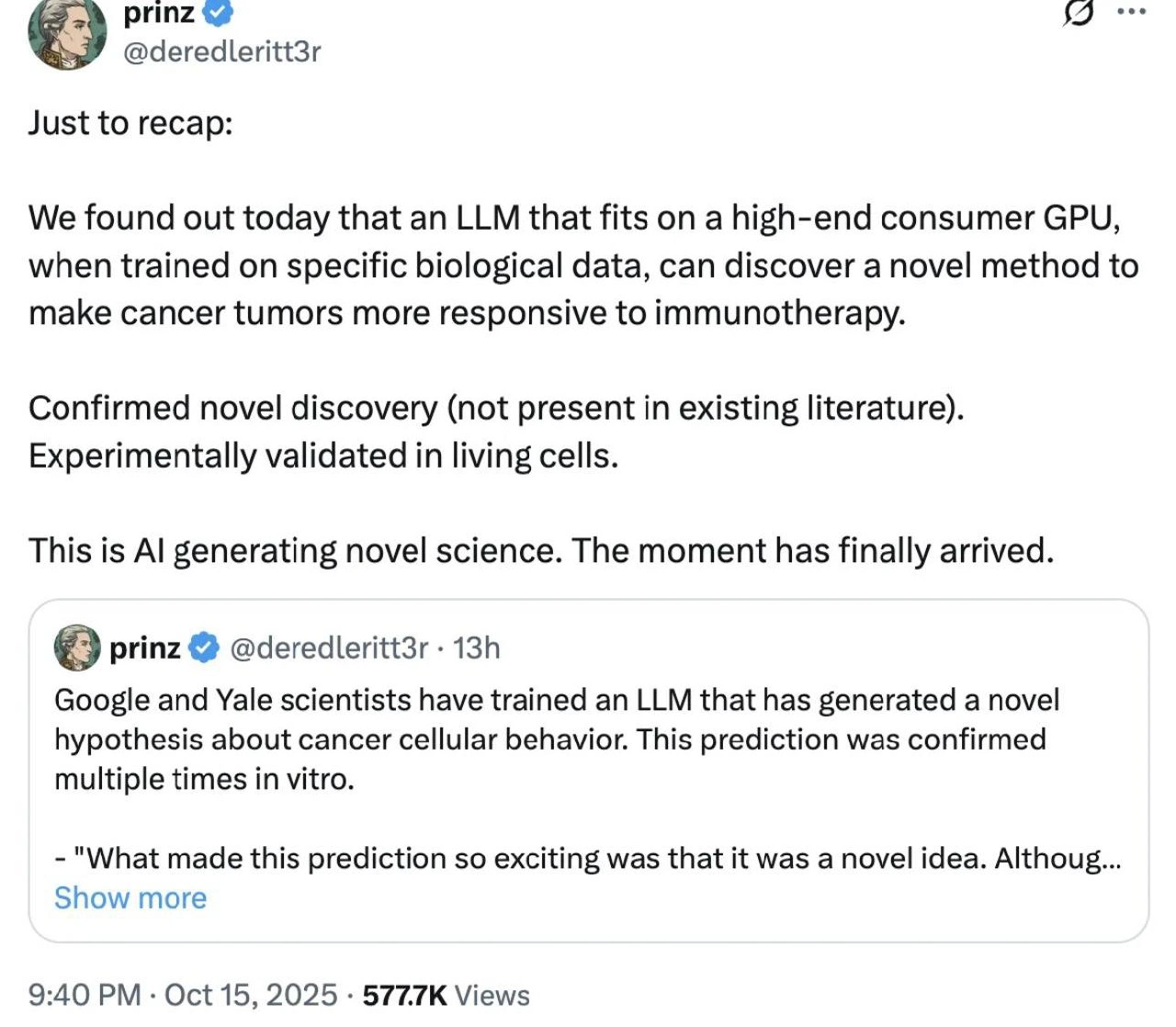
Seasoned engineers have a built-in Geiger counter for AI hype, and it's clicking like crazy here. The tweet proclaims an LLM (Large Language Model) running on a single RTX 3090 GPU just cracked a cancer treatment breakthrough. "This is AI generating novel science. The moment has finally arrived," it gushes. If you feel a mix of amazement and skepticism, you’re not alone – that reaction is practically an industry reflex by now.
On the surface, it sounds like sci-fi come true: a 3090-powered chatbot analyzing biological data and spitting out a novel immunotherapy method that no human spotted before, experimentally validated in the lab. It’s the kind of headline that makes tech bloggers salivate and old-school devs raise an eyebrow. Why the skepticism? Because we've seen this movie before, and the director’s cut usually tells a more nuanced story:
- Press Release vs Peer Review: The discovery is announced on a blog and amplified via Twitter/X, not in a vetted scientific journal. Veterans know this pattern: a splashy AI breakthrough claim makes news, but when the dust settles (and the paper finally hits arXiv or Nature), the results are often more modest or have caveats. It's AIHypeCycle 101 – early overpromising followed by a reality check.
- One GPU Wonder: Boasting that it “fits on a high-end consumer GPU” (like a GeForce RTX 3090) is interesting. That’s a 24GB VRAM card – beefy for a gaming rig, but tiny compared to the multi-GPU pods typically used for groundbreaking AI research. A cynic might quip: So the cure for cancer runs on the same card you use for Cyberpunk 2077? Impressive, if true – but it hints that the model might not be gargantuan. Perhaps it’s a specialized model fine-tuned on targeted data, punching above its weight. Still, claims of world-changing discoveries usually involve massive models or novel architectures, not something you can (theoretically) run in your bedroom. It’s like hearing a single-engine Cessna just flew to the moon – you really want to see the flight logs.
- LLM in a Lab Coat: A GenerativeModel that’s essentially a supercharged autocomplete is now proposing cutting-edge biology? It sounds crazy, but here’s how it likely went down: The researchers fed the model a trove of cancer biology texts, experimental data, maybe gene expression datasets – essentially letting it ingest years of oncology knowledge. Then they prompted it to suggest new ideas. Large Language Models are excellent pattern recognizers; they can interpolate between known facts and even extrapolate to an extent. So maybe it predicted something like “if you inhibit protein X in the tumor microenvironment, T-cells can attack better.” If protein X hasn’t been studied that way before, voilà – a novel hypothesis. But a veteran dev will ask: did the LLM truly reason this out, or did it just remix existing hints from obscure papers? AIHypeVsReality often boils down to whether the AI genuinely uncovered new ground or just resurfaced a buried lead.
- Validated, But…: The tweet stresses “experimentally validated in living cells.” That’s actually a big deal – it means the idea wasn’t pure theory; scientists tested it in vitro (in a petri dish with real cells) and it showed promise. Great, step one done. But anyone who’s worked in biotech (or watched Jurassic Park 🦖) knows that in vitro success is miles away from in vivo (in live animals or humans) success. Labs have shelves of treatments that cured cancer in a dish but failed in actual patients. So while “living cells” validation is encouraging, a grizzled engineer can’t help but think of all the edge-cases, side effects, and reproducibility tests ahead. The tweet’s author declares the AI’s moment like it’s a done deal; the veteran in us knows it’s more “fingers crossed, we’ve got a long way to go.”
- Hype’s Long Tail: “The moment has finally arrived.” That line has a familiar ring. It echoes every grand proclamation in tech history: “Computers will think!”, “Segway will change city design!”, “Blockchain will eliminate banks!”, “Self-driving cars by 2020!” – and of course, “AI will cure cancer.” We’ve learned that breakthroughs are usually incremental. Perhaps this is a significant step – akin to how AlphaFold solving protein folding was huge, but didn’t overnight cure diseases (it just gave scientists a new superpower). Similarly, an AI-found insight needs the slow grind of science to become a real therapy. The AIHypeCycle tends to peak with announcements like this, and veteran devs secretly start the countdown to the next stage: the tempered follow-up, where researchers clarify “It’s promising, but not a guaranteed cure or a fully understood mechanism yet.”
In essence, the humor (tinged with wariness) among experienced tech folks comes from how breathless Twitter announcements often skip over the fine print. It’s not that we’re rooting against the AI — we’d love a cure for cancer, whether it comes from a supercomputer or a souped-up chatbot. But we’ve earned our skepticism the hard way: countless “revolutionary” demos and blog posts that left out the pesky hard parts that follow.
To put it in perspective, here’s how a cynical senior might mentally translate the tweet’s claims:
| What the Tweet Says | What the Skeptic Hears |
|---|---|
| LLM fits on a high-end consumer GPU | A surprisingly small model – interesting, but is it cutting corners or missing context? |
| Trained on specific biological data | Specialized training – it’s not a magic general AI, it had a very curated education. |
| Discovers a novel method for cancer immunotherapy | Possibly stumbled on a known-but-unpublished trick, or combined two known ideas. Cool if new, but let's see. |
| Not present in existing literature (novel discovery) | The idea wasn’t in any papers – hopefully not because it was a bad idea no one published. Is it truly novel or just phrased differently? |
| Experimentally validated in living cells | They did a lab test and it worked in a dish – genuinely promising, but many things die on the way to clinical trials. |
| “AI generating novel science. The moment has finally arrived.” | AI hype crescendo – AIHype at full volume. We’ve arrived at this moment a few times before, only to realize it was a false summit. |
So, the meme captures that double-take reaction. The dev community has a bit of an in-joke: “AI can do anything… in a demo.” This tweet is basically the ultimate demo claim – it ticks all the boxes: small model, huge impact, immediate validation, and triumphant tone. The seasoned folks are humorously imagining the inevitable plot twist: maybe an intern misinterpreted the model’s output, or the “novel method” was actually hinted in a forgotten 1998 paper, or perhaps next week a replication attempt fails. It’s not cynicism for the sake of it, it’s hard-earned realism.
Bottom line: We’re at peak AIHypeCycle here. The claim that a consumer-grade LLM just leaped from generating text to generating an actual cancer cure is both thrilling and comical to those who remember yesterday’s “revolutionary AI” that turned out to be a pumpkin after midnight. Until the labs and clinics say otherwise, this news lives in that schrodinger state between amazing and too good to fully trust. In classic internet fashion, I want to believe, but I’ll also be watching for the next tweet where someone quietly mutters, “So about that AI cancer cure… it’s a bit more complicated.” 🚀🤷♂️
Description
A Twitter/X post from user 'prinz' (@deredleritt3r, verified) posted at 9:40 PM Oct 15, 2025 with 577.7K Views. The text reads: 'Just to recap: We found out today that an LLM that fits on a high-end consumer GPU, can discover a novel method to make cancer tumors more responsive to immunotherapy. Confirmed novel discovery (not present in existing literature). Experimentally validated in living cells. This is AI generating novel science. The moment has finally arrived.' The post quotes another tweet from the same user (13h earlier) about Google and Yale scientists training an LLM that generated a novel hypothesis about cancer cellular behavior, confirmed multiple times in vitro
Comments
40Comment deleted
AI can now discover novel cancer treatments on a consumer GPU, but still can't figure out why your CSS is overflowing the container
The LLM was trained on all of human medical knowledge and its first brilliant discovery was a way to make cancer cells more receptive. Its second discovery was that 90% of medical questions on the internet could be solved with 'drink more water'
Great - now the same RTX card my intern uses for Stable Diffusion apparently doubles as a molecular biologist; guess “runs on my machine” just leveled up to FDA-approval pending
Remember when we joked about AI replacing us? Turns out it's replacing the PhD students first - at least this LLM doesn't need coffee breaks or complain about the lab's temperature while discovering cancer treatments on hardware that costs less than a month of AWS bills
Finally, an LLM that actually hallucinates something useful instead of confidently making up API documentation that doesn't exist
Ping me when 'validated in living cells' ships with a reproducible Dockerfile, dataset card, and survives a different lab's pip freeze; until then it's just 'works on my 4090'
LLM hallucinates a cancer breakthrough on a single consumer GPU - meanwhile my models still invent facts in prod logs
hypothesis. wake me when it's upgraded to theory Comment deleted
But it was confirmed already? Comment deleted
the question is by whom and what their motives are. this reads as "the people who originally asked the AI made some quick tests to see if it has any merit at all" Comment deleted
actually skimmed over the article now. yeah google just tested it themselves on some tissue samples. I will also note that out of 4000 medications they made the AI mdoel test, "10-30%" of suggested results were previously already known, and only one of the unknown ones showed promising effect. They don't say how many of those 4000 were marked by the model as promising either. may as well have been a lucky guess. this is a nothingburger Comment deleted
Bummer, got my hopes up a for a second Comment deleted
never get your hopes up if the headline mentions AI positively. there hasn't been major good news in years. the next time a positive AI headline shows up will be "AI bubble pops" Comment deleted
It's not "AI healed cancer", it's "we are developing this LLM architecture and it shows promising results by spitting out statistically plausible answers, please give us more funding for more R&D" Comment deleted
yea Comment deleted
thing is, if this wasn't done by an AI, it wouldn't even be newsworthy if the research was actually finished. small advances like this happen all the time with little to no fanfare Comment deleted
I think the point is always the same: "new tools allow us to iterate faster" Comment deleted
do they though? seems to me that all this money spent on this AI could've been better spent on actual medicinal research Comment deleted
Yeah. If it allows to meaningfully narrow down the search space for things without outsized investments put into it, then it might be helpful, too bad we have to burn through gigajoules before it (hopefully) gets there Comment deleted
*meaningless You know, there can be a lot of undiscovered drugs that can give way more positive effect, but because they dont similar to already know drugs, they just got excluded from search space. Comment deleted
ideally it operates not on "known drugs" but "this combination of molecules can resolve into this interaction", thus operating on emergent properties and not on simply rehashing prior research or known things not sure if they're able to make it do that Comment deleted
it does not matter what data they operates, its matter what data they trained model on. and you know, you cant train model with unknown data. Comment deleted
Pleased, continue reading after first paragraph / even twit on screenshot mentions that it was tested Quote from article: "The model’s in silico prediction was confirmed multiple times in vitro." Soo, wake up, @RiedleroD! Comment deleted
While this is an early first step, it provides a powerful, experimentally-validated lead for developing new combination therapies, which use multiple drugs in concert to achieve a more robust effect. Comment deleted
My LLM paragraph detector is going off on this message lmao Comment deleted
cutie, I read the article. it's a nothingburger Comment deleted
i think that's a bot reacting lol Comment deleted
100% lol. banned Comment deleted
We can solve world hunger, but we won't We can build housing for everyone, but we won't === we are still here now === We can cure cancer but we won't Comment deleted
vibehealing Comment deleted
To be honest, there is zero novel science. Its just yet another statistics task, where modern neural networks already surpass other methods. So its kinda predictable that modern neural network architecture perform better that old neural network architecture. Comment deleted
that too. we've already seen neural networks doing well at medical tasks they're specifically trained to do well at. I distinctly remember reading some news in 2018ish about promising first results in detecting lung cancer from X-Rays. iirc the AI caught more of the cases than doctors, but it also had more false positives. Where did that research go the last 7 years? forgor? because I haven't heard of this ever being used in an actual clinical setting Comment deleted
for me, it's much better to burn gigawatts of energy simulating the work of a cell than to teach another LLM to somehow predict the work of a cell. Comment deleted
a transformer can be harnessed to do the simulation thing, i hope researchers understand that LLM is not the silver bullet, but the underlying architecture can still be used in different ways like, if instead of "tokens" your words are protein chains / molecule strings / etc the LLM thing seems weird tho Comment deleted
yes, it can. but results interpretation is what matters. if you do cell sim, you just see how exactly it works. if you train transformer, well, you can see on attention matrix and somehow highlight elements that matter most for transformer and maybe important in process(or maybe its just a statistics artifacts, like fingers matter more than fish itself on first image classification networks) Comment deleted
the way i see it, simulation is a rigid corupuscular style of research, and transformers are more like a probablistic wave function both can be useful if applied right to point the corpuscular in the right direction of a good probability but all of that of course is up to various kinds of debate of feasibility Comment deleted
can you quote this sentence from any my comments there ? Comment deleted
? Comment deleted
The question is "how low hanging was the fruit, and how much work did they put into setting up the problem so the model could find it" Related: https://eprint.iacr.org/2025/1237 Comment deleted
What annoys me the most about current AI hype. There are so more types of AI than just LLMs. But everybody and their sheep gives a shit on non LLMs, even though they actually DID help research provable a lot like AlphaFold. Comment deleted