Never Ask a Vibe Coder What the Changes in Their Commits Mean
Why is this VersionControl meme funny?
Level 1: Better Not to Ask
Imagine your friend spent the afternoon quietly drawing a complicated picture. Crayons went flying everywhere, and now the picture has all sorts of shapes and colors that are hard to make sense of. You’re curious what it’s supposed to be, but when you look at your friend, they seem tired and not in the mood to explain. You get the feeling that asking “So, what is this a drawing of?” might either embarrass them or lead to a long, confusing story. Sometimes, it’s just better not to ask.
This meme is saying the same thing in a coder’s world. Some questions, like asking a woman’s age or a man’s salary, are considered impolite because the answer might be personal or awkward. In the coding world, asking a programmer “what do your code changes really mean?” can be just as uncomfortable. It’s like peeking into their secret recipe or asking a magician how his trick works – you might get an answer that spoils the fun or no answer at all. The joke is that a “vibe coder” (a programmer who codes while jamming to their own groove) might change a lot of things in the computer program without explaining it. If you see all those changes and ask them why or what it means, you’re putting them in a spot – maybe they don’t want to explain, or maybe even they aren’t totally sure how to explain it clearly. So, just like you wouldn’t ask someone a question that’s too personal or nosy, this meme teases that you shouldn’t ask a laid-back coder to explain their wild code changes. It’s a funny way to say: “Sometimes code is so confusing or done in such a spur-of-the-moment way that it’s best to just accept it and move on – don’t even ask!”
Level 2: Commits Without Clues
For a less experienced developer, let’s break down the scenario. In software teams, we use version control tools like Git to manage code. Git lets us save snapshots of our code called commits. Each commit ideally has a message describing what changed and why. For example, if you fixed a bug or added a feature, you’d write a brief explanation in the commit message, and Git records exactly which lines of code were added, removed, or modified – that’s the diff (short for difference). A diff is basically a before-and-after comparison of the code. In a healthy workflow, when someone opens a pull request (a request to merge their changes into the main codebase), teammates will do a code review. They look at the diff and read the commit messages to understand the what and why of the changes. Good commit practices make this easy: small, focused commits with clear messages are like well-documented checkpoints in the project’s history.
Now, the meme highlights a situation where a particular kind of developer – jokingly called “a vibe coder” – doesn’t follow those nice, tidy practices. The term “vibe coder” isn’t official; it’s a playful label. Imagine a programmer who codes by feel or impulse, perhaps late at night, in “the zone” with headphones on, not meticulously planning everything out. They might make a bunch of changes all at once based on a gut feeling of what’s better, rather than one logical step at a time. When they finally commit their work, the message might be something vague like “update” or “fixed stuff” because they were in a rush or didn’t think documentation was important. From their perspective, they got the code working – great! But for anyone else reading that commit later, it’s a mystery. What exactly did they “fix” or change? The code diff will show all the lines they changed, but without a guiding explanation, it’s like a puzzle with pieces but no picture on the box.
Let’s say you’re a junior developer on the team and you open this commit. You see 20 files changed. Maybe some lines of code were totally rewritten, some functions renamed, and perhaps a bunch of whitespace differences (like spaces vs tabs) that don’t actually affect how the code runs but still show up as changes. This is where terms like “drive-by refactor” and “tab vs space massacre” come in. A drive-by refactor means the developer, while in the middle of doing something else, also decided to reorganize or clean up code that was nearby – like fixing variable names, reformatting code, or changing how a function works even if it wasn’t part of the original task. It’s called “drive-by” because it’s done on the fly without separate discussion or commits. So one commit ends up containing multiple changes: some related to the main issue, and others just because the coder felt like improving something (they were coding on a vibe). This makes the commit larger and more confusing. A tab_vs_space_massacre is a funny way to describe when someone changed all the indentation in a file or project (tabs to spaces or vice versa). It’s a “massacre” because the diff will mark almost every line as changed (red/green everywhere), even though the code logic is the same. It “kills” the readability of the diff. If you mix that into a commit, the real functional changes get buried among pointless formatting changes. For a newcomer reading it, it’s overwhelming: you can’t tell which changes matter and which are just cosmetic.
Another thing mentioned is “squash_merge_surprise.” This refers to a practice in Git where you take a whole bunch of commits from a feature branch and squash them into one big commit when merging into the main branch. Squashing is often used to keep history clean – but it can become a “surprise” if the person squashed many different changes into one, and their combined commit message doesn’t detail everything. Instead of seeing a logical progression of 10 small commits like “Add user model”, “Update database schema”, “Fix null pointer bug”, you just see one giant commit like “Feature X complete” with a massive diff. For someone reviewing or debugging later, that’s tough: it’s like being given a finished jigsaw puzzle rather than the individual pieces – you see the final picture but you don’t know which piece came from where. If you’re curious about a specific change inside that big commit, you might have to ask the original developer what they did, which is exactly what this meme jokingly warns against.
Finally, “hotfix_on_friday” is a scenario every junior eventually learns about. A hotfix is an urgent fix to a problem (often in production). And doing it on a Friday is infamous in tech circles because it’s risky – if the fix goes wrong, people might have to work late or through the weekend to patch things up. Now imagine a vibe coder quickly pushes a Friday hotfix. The commit is rushed, maybe something like “Hotfix: adjust login timeout” with a diff that also sneakily changes a few other things (because our vibe coder couldn’t resist tweaking some unrelated code while at it). Come Monday, if new bugs appear or if anyone is reviewing the changes, they’re going to find it hard to parse what happened in that last-minute commit. It’s almost an unwritten rule: don’t deploy big changes on Friday, and similarly, don’t bundle unrelated tweaks in a critical fix – it complicates troubleshooting.
So in summary, this meme is telling new developers: there are certain things in developer culture that everyone jokes you shouldn’t do or ask. One of them is questioning a confusing commit after the fact. If someone made a giant confusing change, asking “Hey, what does this commit actually do?” implies that their commit was unclear (which it is). It might put them on the spot or they might not have a good answer. It’s a bit like when you see a very messy piece of code and comment “This code is hard to follow” – the coder might feel called out. The meme exaggerates it for humor: equating it to asking a lady’s age or a man’s salary – things considered rude or touchy in real life. In tech terms, it’s poking at the idea that a dev’s chaotic commit is their personal secret, and confronting them about it is socially discouraged (even if, in reality, teams should communicate about code – the joke is that often they don’t, to avoid awkwardness). For a junior dev encountering this meme, the takeaway is both a chuckle and a gentle lesson: strive to write commits that don’t require your colleagues to ask you what they mean, because ideally the code and message should speak for themselves.
Level 3: Difficult Questions
This meme taps into a senior developer’s shared painful experience: those mysterious commits that show up in a project and leave everyone scratching their heads. By framing it as “Never ask a vibe coder what the changes in their commits mean,” it humorously implies that deciphering certain commits is a forbidden or dangerous topic – even more taboo than asking someone’s age or salary. The humor comes from recognizing that, in developer culture, prying into the meaning behind a sloppy commit is often futile and can open a can of worms. Every experienced dev knows the dread of reviewing a pull request where the code diff spans dozens of files with a commit message like “minor changes” or the infamous “quick fix”. The joke exaggerates that pain: we’d rather break social etiquette in real life than confront the unspeakable truth of such a commit.
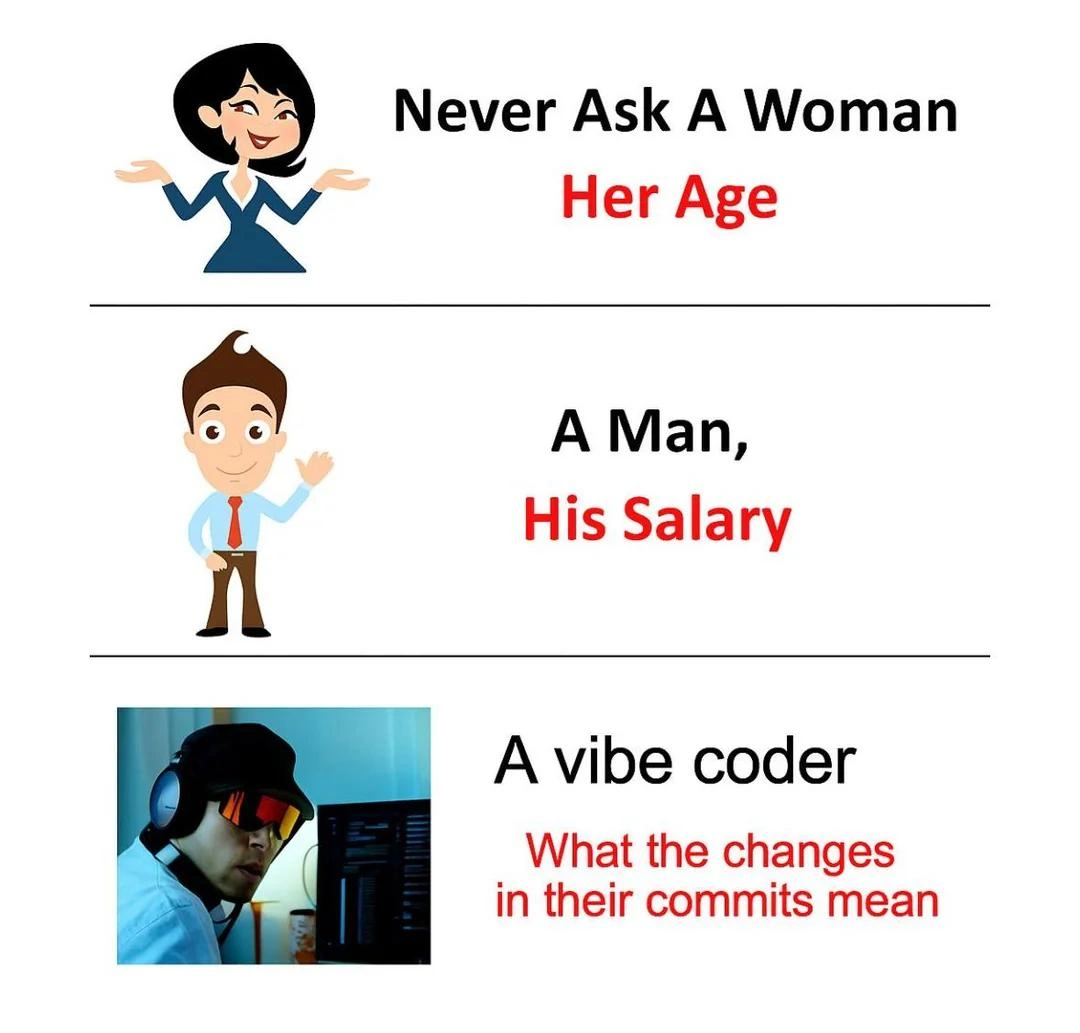
Why is asking about commit changes such a big no-no? In practice, if you have to ask a developer what their commit actually does, it usually means the commit message and code clarity failed. It’s an implicit criticism – it suggests the changes are confusing or the message is worthless. Seasoned programmers have been there: you open a pull request and see a laundry list of modified files, half of them tangential to the feature, with no explanation. Your heart sinks because you know reviewing this will be a journey through the unknown. The meme’s bottom panel shows a hoodie-wearing developer in headphone zone (“a vibe coder”) bathed in monitor glow. We all recognize that archetype: someone coding at 2 AM in a flow state, who might impulsively refactor half the module because they felt it was necessary, and then commit with a one-liner message “cleanup” or “it works now”. The next morning, the team is left to play detective.
In many teams, this scenario is a classic CodeReviewPainPoint. You want to ask, “Why on Earth did you rename all these variables and re-indent every file alongside fixing the bug?” But doing so might embarrass the coder or spark a long, rambling explanation that still doesn’t clarify much. It’s often easier to just quietly sift through the diff yourself than to ask the author to justify it line-by-line. Asking “What do these changes mean?” could result in an awkward silence or a defensive response like, “Don’t worry, it’s just a small refactor, trust me.” In other words, it’s taboo because it either implies lack of trust or forces the author to admit they might not remember all the reasons for their spontaneous changes. It’s similar to how asking someone’s salary can put them on the defensive – here asking about a commit’s meaning puts the vibe coder on the spot.
The meme format itself (“Never ask a woman her age, a man his salary, and a developer…”) is a well-known internet joke template. By adding a tech twist, it creates instant recognition: we expect the third line to be something humorously unspeakable. And it delivers: “What the changes in their commits mean” is presented in bold red as the ultimate forbidden question for developers. The senior crowd chuckles because it’s too real. We’ve all dealt with the “mystery commit”. Maybe it was a drive-by refactor where a dev, in passing, changed code unrelated to the task at hand (“I just fixed some naming inconsistencies while I was in that file…” – and that turns into a 500 line diff). Or the infamous tab vs space massacre, where someone’s editor settings replaced indentation throughout the project. That commit’s diff is a sea of red and green lines (deletions and additions) with no functional change at all – good luck figuring out if anything meaningful happened. You don’t dare ask why they did it because you’ll either get an answer you wish you hadn’t (like “I prefer 4 spaces, sorry”) or they themselves didn’t notice it happening.
Let’s not forget the squash merge surprise: a developer works on a branch for two weeks, making dozens of commits (some potentially with helpful context), but then they squash it all into one giant commit when merging. The result? One monolithic changeset with a commit message like “Feature X complete” hiding an avalanche of modifications. The poor reviewer or future maintainer reading the log has no incremental story to follow. Asking the original author “could you break down what’s in here?” at that point is almost an insult – it implies I can’t untangle this, and often the author might barely recall the details either.
And of course, the hotfix on Friday scenario: late Friday afternoon, an urgent production bug gets a hurried commit. The vibe coder rushes a fix, perhaps also slips in a “small improvement” he had been tinkering with, and then jets off for the weekend. The commit message might be “hotfix login issue” but the diff includes unrelated tweaks or a sneaky reformat. Come Monday, something’s off in production and you’re combing through git log to see what changed. You find that mysterious commit and end up muttering, “What exactly did they do here?!” But the author is unavailable or has already moved on mentally. At that moment you realize asking directly would yield either a shrug or a confusing jumble, so you just diffsplain it yourself.
In essence, the meme pokes fun at a relatable developer experience: the unwritten rule that you just don’t question certain inexplicable code changes if you value your sanity (and camaraderie). It’s dark humor – comparing confusing commits to personal secrets – implying that every dev team has things better left unasked. Senior devs laugh (perhaps a bit cynically) because they’ve learned this the hard way. As the saying goes in version control circles, “git blame can tell you who, but not why.” Some commits are truly unspeakable secrets, and prying into them might only lead to pain, endless meetings, or code review comment wars. Better to nod, merge, and hope for the best… or as the meme implies, treat it as beyond questioning, just like those other social taboos.
# A familiar sight in git logs:
$ git show --stat 5fadedb
commit 5fadedb (HEAD -> main)
Author: vibeCoder42 <[email protected]>
Date: Fri Oct 16 16:59 2025
quick fix
15 files changed, 297 insertions(+), 184 deletions(-)
(When you see a commit message like “quick fix” hiding 15 file changes, you know asking for details is a Difficu(l)t Question.)
Level 4: The Halting Diff Problem
At the most theoretical level, deciphering a cryptic commit diff without any clues is akin to solving an undecidable problem in computer science. Without a descriptive commit message (or any context), figuring out what the code change actually means can require understanding the full program’s behavior - something bordering on the Halting Problem. To determine the intent or effect of arbitrary code changes, you’d essentially need to answer non-trivial questions about program behavior, which Rice’s Theorem tells us is generally impossible undecidable in the general case. In practical terms, reviewing such a commit is like performing reverse engineering: the reviewer must reconstruct the developer’s thought process from just a patch. This is more than just reading git diff output; it’s an exercise in formal verification without a spec. You’re trying to infer specifications after the fact, a bit like deriving a mathematical proof from the results alone.
In a highly complex system (say a large codebase with many interconnected parts), a seemingly simple commit could have far-reaching implications. Without an explanation, you might have to analyze data flow, run static analysis tools, or even simulate execution to be confident about what the change does. Git itself only provides a textual diff – essentially the Levenshtein distance (insertions and deletions) between two file versions, computed by the Myers diff algorithm. That algorithm can show you where the code changed, but not why or what larger effect it has. Two very different intentions can produce superficially similar diffs. For example, a one-line change might be a harmless bugfix or a critical change in business logic – distinguishing these requires knowing the context, almost like needing extra bits of information to disambiguate meaning. Lacking those bits (which a good commit message or comments would normally supply) means the reviewer’s brain has to brute-force all possible interpretations. It’s an information theory problem: the commit diff is high entropy and low information when not paired with a message. The reviewer suffers a combinatorial explosion of possibilities about why certain lines were changed.
From a systems perspective, asking “What do these changes mean?” is like trying to debug a black-box system with no logs. In a distributed system, it’s analogous to observing outputs without knowing which inputs or events caused them. The code diff is an output of the developer’s internal decision-making process. Without logs (i.e. commit messages explaining the decisions), we have to infer the cause from the effect, a notoriously hard problem. It’s no wonder that deciphering such commits becomes a borderline academic exercise – something even a Turing Award laureate might groan at. A veteran coder might darkly joke that understanding a vibe coder’s commit is NP-hard: “exponential time required to grok what Bob’s 5PM Friday commit actually does.” In summary, the meme humorously elevates this everyday code review headache to the level of unspeakable computational complexity, wryly suggesting that even advanced theory can’t easily solve the puzzle of a poorly explained code change.
Description
A three-panel 'Never Ask' meme template on white background. First panel: cartoon woman with text 'Never Ask A Woman Her Age' (age in red). Second panel: cartoon man in business attire with text 'A Man, His Salary' (salary in red). Third panel: a person wearing ski goggles and a headband sitting at a computer screen in a dark room, representing a 'vibe coder', with text 'A vibe coder What the changes in their commits mean' (changes text in red). The meme plays on the concept of 'vibe coding' -- writing code through AI prompting without understanding the actual changes, making commit diffs essentially meaningless to the author
Comments
11Comment deleted
A vibe coder's git blame is less 'who wrote this' and more 'which prompt wrote this' -- and even the prompt doesn't remember
A 'vibe coder' treats their commit history less like a system changelog and more like a Rorschach test for the senior dev who has to review it
If the diff says “minor changes” but the repo history shows 4,732 altered lines, congratulations - you’ve just discovered Schrödinger’s refactor: simultaneously harmless and career-limiting until code review collapses the waveform
The real reason we squash commits isn't for a clean history - it's to hide the archaeological evidence of our 3am 'fixed stuff', 'asdfasdf', and 'WHY DOESN'T THIS WORK' messages from the code review board
The real horror isn't the 'fix stuff' commit message - it's realizing you're the one who has to git blame yourself six months later when production breaks
Reviewing a vibe coder is archaeology with Git: a 12k-line 'wip' squashed into 'update', rebased twice, force-pushed on Friday - please infer the requirements from the diff
Vibe coders' commits are the Git equivalent of quantum superposition: the changes exist in every possible meaning until observed in review, collapsing into chaos
does anybody talk about me, no bro, i know my commits, but i don't know which commits 😅 Comment deleted
what's commit? i create a new git repository for each update. Comment deleted
Well you seem to have a lot of empty repositories if you never commit anything into them. Better go with zip files at this point Comment deleted
i just can't commit further than initial. it's a mental disorder Comment deleted