Skip to content
DevMeme
6654 of 7435
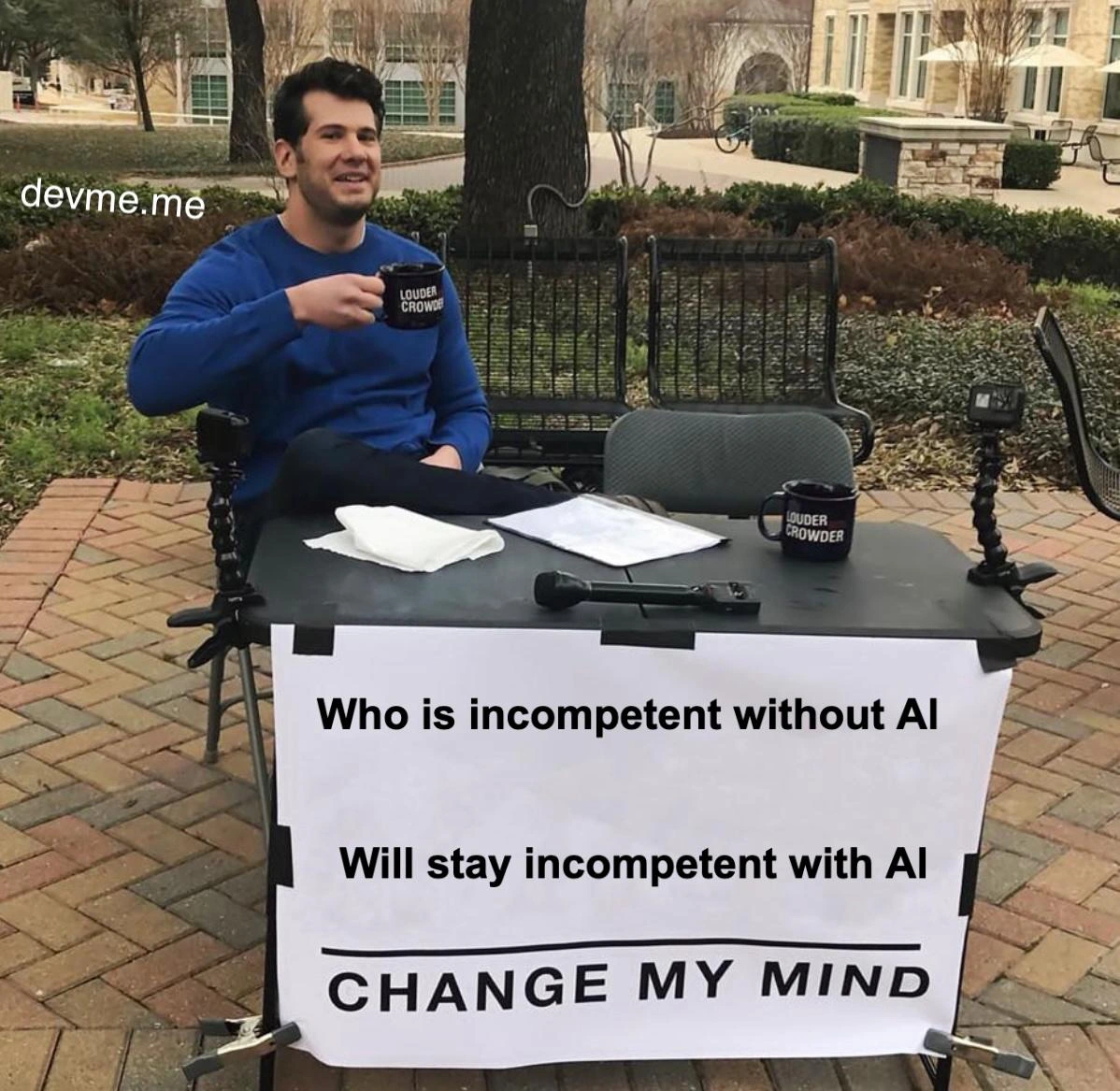
Who Is Incompetent Without AI Will Stay Incompetent With AI Change My Mind
AI ML Post #7289, on Oct 17, 2025 in TG

Who Is Incompetent Without AI Will Stay Incompetent With AI Change My Mind

Why is this AI ML meme funny?

Level 1: Tools Don’t Teach Magic

Imagine you have a big, shiny robot helper that can do lots of things. Sounds cool, right? But here’s the catch: if you don’t know what you’re doing, the robot won’t know how to help you correctly. It’s like trying to bake a cake with a super fancy oven when you don’t even know the recipe. The oven might be awesome, with all sorts of buttons and settings, but if you mix up salt for sugar, you’re still going to get a yucky cake.

Another way to see it: think about using a calculator for homework. If you don’t understand the math problem, the calculator can give you some number, sure – but it might be the wrong answer because you didn’t know what formula to use. The calculator isn’t actually teaching you math; it’s just making calculations faster. If you press the wrong buttons or do things in the wrong order, you’ll get a bad result and not even realize it.

This meme is basically saying the same thing with computers and coding. Some people think, “Oh, there’s a super smart computer program (AI) that can help me write code, so I don’t need to learn as much.” But the joke here is: if you were bad at coding before, that AI tool isn’t going to suddenly make you good. It’s like giving a kid who can’t ride a bike a bicycle with an electric motor – they’ll go faster, but they’ll probably just crash faster too because they never learned how to balance. The funny truth is that you still have to learn the skill. The new tool can help you do things quicker, but it won’t magically give you brains or talent.

So the emotional core of this meme is a bit of tough love: it’s reminding us that fancy tools are not a replacement for learning the basics. We laugh because it’s obvious once you think about it – like watching someone put on Michael Jordan’s shoes and expecting to play basketball like Michael Jordan. 😅 No matter how high-tech or “smart” the helper is, you’ve got to put in the practice and gain the understanding yourself. Only then can these cool tools actually make you even better. Otherwise, you’re just driving a sports car with no driving lessons – and we all know that’s not going to end well!

Level 2: AI Is Not a Silver Bullet

At its core, this meme is pointing out that AI won’t magically fix a lack of skill. In plainer terms: if you don’t know how to code or solve problems without AI, then using AI isn’t going to suddenly make you good at those things. The phrase “Who is incompetent without AI will stay incompetent with AI” is basically saying tools don’t replace understanding. This is a common idea in tech expressed with a bit of snark. Think of it like using a calculator: if you don’t understand basic math, punching numbers into a calculator might give you a result, but you won’t know if the result is even relevant or correct.

Let’s break down some of the terminology and context:

  • AI (Artificial Intelligence) in this context refers to modern tools like machine learning models that can generate code or answers. A big current example is generative AI, especially Large Language Models (LLMs). These are systems like OpenAI’s ChatGPT or GitHub Copilot which can produce human-like text. In software development, you can ask them to write code for you. It feels almost like magic – you describe what you want, and the AI suggests some code.
  • Generative AI Hype: Over the last couple of years, there’s been massive excitement (and buzzwords flying around) about how these AI tools will revolutionize programming. Companies are rushing to integrate AI into every developer tool, claiming it will boost DeveloperProductivity and maybe even allow people who aren’t professional developers to create software. This excitement and sometimes over-the-top optimism is what we mean by “hype”. It’s the belief that “wow, this changes everything!”. But experienced folks often respond with a bit of skepticism because they’ve seen similar enthusiasm before that didn’t fully live up to its promises – that’s the AIHypeVsReality angle.
  • “Silver bullet” is a metaphor taken from folklore (where a silver bullet is the one thing that can kill a werewolf). In tech, when we call something a “silver bullet”, we mean it’s a single solution that supposedly fixes a bunch of hard problems in one shot. The meme is saying AI is not a silver bullet for the problem of lacking skill or competence. In fact, there’s a known concept called the silver_bullet_fallacy which warns us not to expect any one tool or technology to solve all our problems.
  • Competence vs Tooling: This is the heart of it. Competence means your personal capability and knowledge – like understanding algorithms, knowing how to debug, how to design software, etc. Tooling means the tools you use – like programming languages, frameworks, and now AI assistants. The meme argues that if competence is zero, adding more tooling doesn’t help. It’s a bit like having a super fancy hammer but not knowing how to swing it – the house you try to build will still end up crooked.
  • “Change My Mind” meme format: Visually, the image is that famous meme of a guy (Steven Crowder originally) sitting at a table on a campus with a sign that states an opinion, and a banner saying “Change My Mind.” It’s commonly used online to present a bold or controversial statement in a humorous way. Here, the bold statement taped to the table is “Who is incompetent without AI will stay incompetent with AI”. The idea is that this person is daring others to prove them wrong, but in meme culture it’s usually a tongue-in-cheek way to say “this is obviously true (in my opinion)”. In dev humor, we often repurpose this format to poke fun at various tech debates or truths. So the meme image itself is a bit of classic IndustrySatire: we see a relaxed guy sipping coffee, confidently declaring this sweeping claim about AI and developer skill, inviting anyone to challenge him. It’s staged humorous confrontation – but honestly, most developers in on the joke are likely just nodding rather than arguing.

So why is this funny or relatable? For many developers (especially those with some experience), the current wave of “AI will do everything!” feels very familiar to things we’ve seen before. Some years ago, everyone hyped that “low-code platforms” or “visual programming” would let non-coders build apps easily — yet skilled developers were still very much needed to build real-world software. Before that, people thought drag-and-drop UI designers in IDEs would mean you didn’t have to write UI code — but if you didn’t understand what the tool was generating, you quickly hit a wall when things went wrong. And even earlier, some believed “expert systems” (early AI) would replace engineers; they didn’t. These all illustrate the silver bullet fallacy: the belief that a new tech will eliminate the hard parts of a job. Each time, reality was that you still needed knowledgeable people to actually make things work and to handle all the edge cases and errors that the “magic tool” didn’t cover.

Now with AI, we have something genuinely powerful and new, so it’s driving a lot of excitement. And don’t get us wrong — these AI helpers are useful. For instance, a competent developer might use an AI to get a quick example of how to use an unfamiliar library, or to generate boilerplate code so they don’t have to write it from scratch. That can save time. This is where DeveloperProductivity can genuinely get a boost. But that only works if the developer knows how to verify and integrate the AI’s suggestion. If the AI writes a function and the developer can’t tell whether that function is correct or efficient, that’s a problem. An incompetent developer might accept whatever the AI gives without question. For example, if Copilot suggests some code, a newbie might think “oh, it compiled, so it must be good.” Yet the code could have a sneaky bug or might not cover certain cases. A skilled dev would test it, review it, maybe spot “hmm, this algorithm is $O(n^2)$ and will be too slow on large input” – an inexperienced dev might not notice at all until the app crashes or slows down in production.

We also have the phenomenon of AutomationAnxiety in the background: some developers worry that if they don’t use AI, they’ll fall behind, or even that AI might replace them. So there’s pressure to incorporate these tools. The meme is poking at that too. It’s saying, effectively, “if you’re bad at coding, using AI isn’t going to save you (so maybe worry less about chasing the hype and more about learning the craft).” It’s a bit comforting in a way — implying that human skill is still crucial and not easily replaced by automation. But it’s also a warning: if someone was hoping AI would cover up their weaknesses, they’re in for a rough time.

A common early-career experience relevant here is the “Stack Overflow copy-paste” habit. Many of us, when we were new, would google an error or a task, find some code on Stack Overflow, copy it into our project, and boom, it works... until it doesn’t, because maybe it doesn’t quite fit our situation. If you did that without understanding the code, you probably hit weird bugs or couldn’t adapt when requirements changed. Relying on AI in a completely hands-off way is akin to that, but on steroids: instead of searching manually, you get an instant answer that sounds confident. It’s easy to be lulled into a false sense of security. Only later you realize you pasted something that, say, uses a deprecated API or has a security flaw – things you’d only catch if you actually knew what to look for. So the meme’s message is extremely RelatableDevExperience: it’s basically the veteran developers telling the newer ones, “Don’t think this new shiny AI is going to automatically make you a great dev. We’ve been down this road with other tools. There’s no shortcut to understanding how to code well.”

In summary, AI is a tool, not a replacement for skill. The humor and bite of the meme come from how bluntly that’s stated. It’s taking a stand against the overhype. The guy in the meme (with his calm, smug sip of coffee) is essentially voicing what a lot of seniors want to tell enthusiastic newbies and overzealous tech evangelists: “Calm down. If you couldn’t code yesterday, installing the latest AI plugin in your editor today isn’t going to miraculously change that. Prove me wrong.” It’s funny because it’s true – and a little painful – and everyone in the field recognizes the pattern.

Level 3: Silver Bullet Hangover

This meme lays out a harsh truth seasoned engineers know all too well: there's no magic tool that can auto-upgrade an incompetent developer into a proficient one. The sign’s bold claim “Who is incompetent without AI will stay incompetent with AI” skewers the current generative AI hype in our industry. It’s a snarky nod to the endless parade of “silver bullet” solutions tech has chased over the decades. Each hype cycle promises to vanquish complexity and make our lives easier – 4GL languages, CASE tools, drag-and-drop app builders, no-code platforms, and now AI code generators – yet here we are, still debugging gnarly issues at 3 AM.

In true senior_dev_snark fashion, this meme suggests that slapping AI onto your workflow is just the 2025 version of duct-taping over a leaky pipe. Sure, tools like GitHub Copilot or ChatGPT can spit out code in seconds, acting as a fancy autocomplete on steroids. But if you lack fundamental software design and problem-solving skills, all that AI does is help you create broken code faster. It’s like giving an assault rifle to someone who can’t aim – you won’t hit the target, you’ll just miss with a higher rate of fire. Garbage in, garbage out still holds: feed an AI a vague or flawed prompt (because you don’t truly understand the problem), and you get a vague or flawed solution back. The difference is, a newbie might not realize it’s flawed until everything blows up. As the cynical proverb goes, a fool with a tool is still a fool – except now the fool has a ridiculously advanced tool, and that can be a scary combo.

Let’s break down why seasoned devs smirk at this. Generative AI models (like Large Language Models such as GPT-4) are trained on oceans of existing code. They’re impressive at pattern matching and can regurgitate plausible-looking solutions. But they don’t actually understand code the way a competent developer does; they predict what looks right. If you’re an experienced engineer, you treat these AI suggestions as junior developer output: useful for saving time on boilerplate or providing a fresh angle, but always in need of careful review, testing, and tweaking. You’ve seen enough to know that even the slickest AI-suggested function can hide off-by-one errors, race conditions, or security vulnerabilities. And guess what? If you don’t catch those, AI won’t be on-call at 3:00 AM to help you fix the mess when the monitoring alarms are blaring. Been there, dealt with that deployment rollback.

This touches on the classic "silver_bullet_fallacy," a term from a famous essay by Fred Brooks titled “No Silver Bullet”. Decades ago, Brooks warned that no single technology would give us a tenfold productivity boost or eliminate the essential complexity of software. The essence of building correct, reliable systems is hard, irreducibly so. New tools tend to only address the accidental complexities (like avoiding some repetitive coding), but not the essential complexities (figuring out what the heck the code should actually do). IndustryTrends_Hype always glosses over that distinction. AI_ML solutions today are touted as if they’ll write your code, test it, deploy it, solve world hunger, you name it. But an incompetent dev who doesn’t grok the requirements or can’t debug logic will still flounder – now they’ll flounder even with an AI’s help, possibly generating a greater volume of gibberish code that someone else must untangle. It’s the same old story in new packaging: AIHypeVsReality. We’ve witnessed juniors blindly copy-paste from Stack Overflow without understanding it; now they copy-paste from an AI’s output with the same blind faith. The tools change, the shaky results stay the same.

In practice, a skilled engineer might leverage AI to boost DeveloperProductivity – for example, by automating rote tasks or generating scaffolding code quickly – but that productivity boost only materializes when you know what you’re doing in the first place. If you’re competent, AI is like an intern who speeds you up; if you’re not, AI is like an intern left unsupervised, ready to wreak havoc. That’s why the meme’s assertion resonates as dark humor: it’s IndustrySatire aiming at all the folks (and the managers or marketers) who think sprinkling a bit of AI is a cure-all. The cynical veteran in us chuckles because we’ve seen this movie before. Every few years there’s a new “game-changer” technology that’s supposed to solve incompetence: “Don’t know how to code? Just use this wizard, it’ll do it for you!” – and then we end up with a bigger maintenance nightmare. The cycle repeats, and those of us carrying the pager have to clean up after the hype-fueled shortcuts. The bottom line: AI won’t save bad code any more than pouring fancy espresso into a broken coffee machine will give you a great brew. You still end up with a mess, just a more energized one.

# Pseudo-code illustrating the silver bullet fallacy:
developer_skill = "incompetent"
tool = "AI"

if developer_skill == "incompetent" and tool == "AI":
    print("All problems solved!")  # Wishful thinking
else:
    print("Still broken.")        # Reality bites

Above is the tongue-in-cheek essence of the meme in code form. The message is clear: If you couldn’t get it right without AI, you’re not magically getting it right with AI – the bug is in the developer, not the tool. The humor here is a bit on the dark side because it’s painfully true. We laugh, then sigh, remembering all the late nights undoing the damage from someone’s “quick fix” that was supposed to save time. AutomationAnxiety might drive people to over-rely on the latest automation (like AI code generation), but that anxiety should really be telling them to shore up their competence, not just grab for another tool. The meme challenges us (via the classic “Change My Mind” setup) to prove it wrong, but any battle-worn engineer reading it is likely nodding instead. Good luck changing our minds on this one – we’ve got the scar tissue to back it up.

Description

A meme using the 'Change My Mind' template featuring Steven Crowder sitting at a table outdoors with a sign that reads: 'Who is incompetent without AI Will stay incompetent with AI CHANGE MY MIND'. The 'Louder Crowder' mug is visible, along with the 'devme.me' watermark in the top left. Crowder sits confidently in a blue sweater at a folding table with papers and a microphone. The meme argues that AI tools don't fundamentally change developer competence -- those who lack foundational skills won't magically become competent by using AI assistants

Comments

16
Anonymous ★ Top Pick AI is a force multiplier -- the problem is that 0 times anything is still 0
  1. Anonymous ★ Top Pick

    AI is a force multiplier -- the problem is that 0 times anything is still 0

  2. Anonymous

    Giving an incompetent developer an AI coding assistant is like putting a faster engine in a car with no steering wheel. You'll just get to the wrong destination much, much quicker

  3. Anonymous

    If you couldn’t write a proper loop before, prompting GPT is just a for-each overconfident hallucination

  4. Anonymous

    It's like giving a Formula 1 car to someone who never learned to drive - sure, the AI copilot can suggest when to brake, but you'll still end up wrapped around the first tree while arguing the GPS was being too prescriptive about 'staying on the road'

  5. Anonymous

    AI coding assistants are like Stack Overflow with better autocomplete - they'll help you write code faster, but if you don't understand what you're copying, you're just producing bugs at scale with better syntax highlighting

  6. Anonymous

    LLMs are a force multiplier: with strong fundamentals you ship faster; without them you just automate high‑throughput hallucinations and bring the 3am rollback forward

  7. Anonymous

    AI turns syntax errors into prompt errors - still ships O(n²) disasters at scale

  8. dev_meme 8mo

    who is incompetent without a book will stay incompetent with a book. change my mind

    1. @Algoinde 8mo

      less "incompetent" and more like "unable to learn"

    2. @SamsonovAnton 8mo

      Who is poor without money Will stay poor with money. _______________ CHANGE MY MIND

  9. @toadwizard 8mo

    Who is incompetent without AI Will make brainrot neuroslop with AI instead of becoming more competent

  10. @adm877 8mo

    Who without AI knows he knows nothing, with AI will forget it.

  11. dev_meme 8mo

    who is hungry without food will stay hungry with food. change my mind

    1. @NaNmber 8mo

      Who is thirsty will stay thirsty with salt water

      1. dev_meme 8mo

        who isn't a photographer without a camera won't become a photographer with a camera. change my mind

      2. dev_meme 8mo

        who isn't a driver without a car , won't become a driver with a car. change my ass

Use J and K for navigation