Skip to content
DevMeme
6058 of 7435
Llama 4 Behemoth AI Model Benchmark Performance Comparison
AI ML Post #6634, on Apr 5, 2025 in TG

Llama 4 Behemoth AI Model Benchmark Performance Comparison

Why is this AI ML meme funny?

Level 1: Big Numbers, Small Print

Imagine you’re playing a game at school, and one kid comes up to everyone proudly holding a chart of scores. He’s drawn it himself with fancy colors. On this chart, his scores in different games and quizzes are the highest, higher than any other kid’s scores. He’s really excited, pointing at those big numbers by his name and saying, “See, I’m the best in math, the best in coding games, the best in trivia, everything!”

At first glance, everyone is impressed — those numbers are really high! But then you take a closer look, and you notice tiny little notes at the bottom of the chart (the small print). You squint and read them, and it turns out:

  • In the math test, he’s comparing his score to others, but actually none of the other kids even took that specific super-hard math quiz – he did it alone after practicing a bunch, so of course he got the top score.
  • For the coding game, he used his best attempt ever to show off (he played 10 times and is only showing the highest score he got), while for another kid he’s showing an old score from months ago.
  • For some other quiz, he says he only counted kids who played by his special rules. If a kid tried a different strategy (maybe a smarter strategy), he didn’t count those results at all.

In simple terms, he cherry-picked – he chose only the contests he knew he’d win and set the rules so that he looks like the champ every time. Those little footnotes are like him whispering, “I kind of rigged it in my favor.”

So while his chart has big impressive numbers, the small print tells a different story. It’s not that he’s lying; he did score those points. But he set things up so the comparison isn’t really fair. That’s why the other kids (and the teacher, who’s seen this kind of thing before) are kind of smirking. They know that just because someone makes a fancy chart saying “I’m the best!”, you should read the fine print to see what’s really going on.

The meme is funny in the same way: it shows a company bragging that their new AI model is the best at everything, but the footnotes – the small text at the bottom – reveal they made the contest a bit too easy for themselves. It’s like winning a race when you’re the only one who got to run the full track. Everyone’s impressed for a second, then they go, “hmm, really?” and check the details. The joke is about being skeptical of bragging with numbers, especially when there are a lot of footnotes attached.

Level 2: Benchmarks 101

Let’s break down what’s actually on this slide and why people find it humorous. First off, LLMs (Large Language Models) like Llama 4, Claude Sonnet 3.7, Gemini 2.0 Pro, and GPT-4.5 are big AI programs trained on tons of data to generate text, code, or answers. They’re like very advanced autocomplete machines that can solve problems, answer questions, write code snippets, etc. When new models come out, companies love to benchmark them – which means testing them on standard tasks to see how well they perform compared to others. Think of benchmarks as exams for AI, covering different subjects.

Now, the table lists several benchmark names and scores:

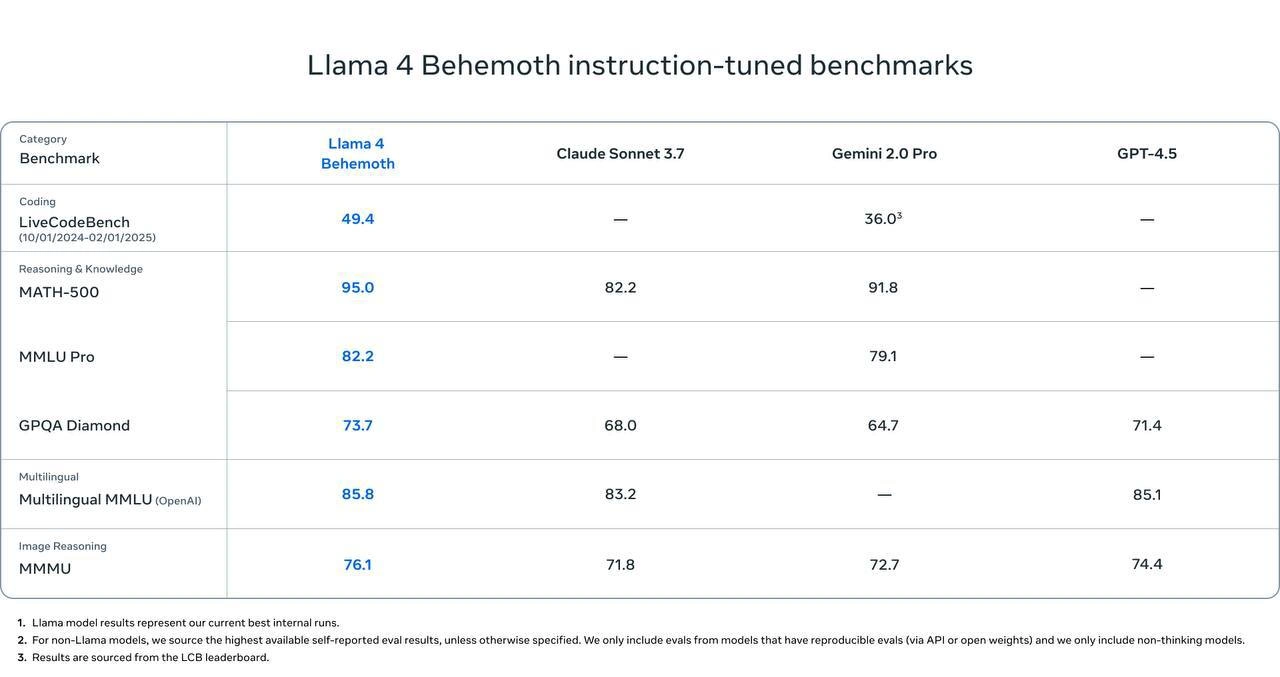
  • LiveCodeBench (Coding) – This is a test for coding ability. It likely measures how well the AI can write correct code for a set of programming challenges (maybe between Oct 2024 and Feb 2025, as noted). Higher score means it solved more tasks or got better results. Llama 4 scored 49.4 here, which would mean it did quite well on nearly half the challenges. Gemini 2.0 Pro has 36.0 (with a tiny ³ footnote, meaning there’s a note about this score), and the others (Claude and GPT-4.5) don’t have numbers listed (just a dash) – meaning we don’t have data for them on this test.
  • MATH-500 – This sounds like a math problem benchmark, maybe 500 math questions. Llama 4 scored 95.0, which is very high – possibly meaning 95% correct or a similar score. Claude got 82.2, Gemini 91.8, and GPT-4.5 is blank here (no reported score available).
  • MMLU ProMMLU stands for Massive Multitask Language Understanding, a known benchmark test that covers questions from lots of subjects (history, science, law, etc.). The “Pro” might imply a tougher or extended version. Llama got 82.2 here, Gemini 79.1, and others have no score listed (Claude and GPT-4.5 are ).
  • GPQA Diamond – Likely a benchmark for General Purpose Question Answering (GPQA), and “Diamond” suggesting a particularly difficult level (like a hardest tier). Llama has 73.7, Claude 68.0, Gemini 64.7, and GPT-4.5 has 71.4. So in this Q&A test, Llama edges out GPT-4.5 by a couple points and is above the others.
  • Multilingual MMLU (OpenAI) – This is a version of that multitask test but in many languages, created by OpenAI. It checks if the model can answer questions not just in English but in other languages too. Llama scored 85.8, Claude 83.2, Gemini has none listed (maybe Gemini didn’t have a result for this), and GPT-4.5 got 85.1. So here Llama 4 is slightly ahead of GPT-4.5 (85.8 vs 85.1) and above Claude.
  • MMMU (Image Reasoning) – This looks like a test where the AI must reason about images (maybe answering questions about pictures or combining visual info with text). Llama 4’s at 76.1, Claude at 71.8, Gemini 72.7, GPT-4.5 at 74.4. Llama leads too, but not by a huge margin.

So across the board, Llama 4 Behemoth has the highest numbers wherever numbers exist. That’s intentional – it’s a slide meant to show Llama 4 is superior. The blue coloring of Llama’s scores makes them pop out as “best in class.” The other models (Claude by Anthropic, Gemini by Google’s DeepMind perhaps, and GPT-4.5 by OpenAI) either have lower scores or blanks.

Now, the fun (and suspect) part is in the footnotes:

  1. “Llama model results represent our current best internal runs.” This means the Llama team is using their own in-house testing and they are showing the best results they got. It’s like saying “these are our top scores from practice,” rather than an average or an externally verified result. It hints they might have optimized specifically for these tests.
  2. “For non-Llama models, we source the highest available self-reported eval results … we only include non-thinking models.” This one is packed with stuff:
    • “Self-reported” means they took whatever results those model creators have publicly shared. For example, if OpenAI said GPT-4.5 got X on some test, they’d use X. If OpenAI or others didn’t report it, then it’s blank. They didn’t necessarily run those tests themselves on the other models.
    • “We only include evals from models that have reproducible evals (via API or open weights)” means if a model is very closed-off or if the results can’t be reproduced either by querying an API or using the model’s open-source version, they skipped it. This implies they want to only list numbers they can justify or check, but it also allows them to leave out some flashy competitor results if those aren’t easily obtainable.
    • “We only include non-thinking models.” This phrase is a bit odd – in context, it likely means they are only comparing to similar models that don’t have some extra tricks. In AI lingo, a “thinking” model might refer to ones that use an explicit reasoning process (like step-by-step solutions or tool usage). By excluding those, they make sure all models compared are just plain language models responding directly. Essentially, they set constraints so that it’s a fair (or favorable) comparison for Llama. It’s also a subtle jibe, as if calling other AI models “non-thinking” – which is ironic because none of these AIs truly think like a human; they just predict text.
  3. “Results are sourced from the LCB leaderboard.” LCB stands for LiveCodeBench, which is the coding benchmark mentioned first. That superscript ³ on Gemini’s 36.0 means that Gemini’s coding score came from the LiveCodeBench public leaderboard. So the Llama team didn’t run Gemini themselves; they took a publicly posted score for Gemini. Meanwhile, Llama’s own coding score wasn’t from the public leaderboard – it was their internal result (footnote 1). This mix-and-match sourcing is a bit like comparing your best in-house test to someone else’s best published test, which might not be apples-to-apples.

So why are folks “squinting at the footnotes”? Because the footnotes reveal all the conditions that favor Llama 4:

  • Internal runs: not third-party verified, could be an optimized one-off.
  • Self-reported or highest available for others: meaning Llama Co. might have picked the best known numbers from competitors, but if none were known, they leave it blank, which can make competitors look absent or worse.
  • Non-thinking models only: they set a rule that conveniently might exclude any competitor approach that Llama doesn’t handle, ensuring Llama isn’t at a disadvantage for not having that feature.

This is funny to developers because it’s so typical. It’s as if a sports team is bragging about an undefeated season when half the other teams didn’t show up to the games. The slide is clearly meant as hype – to impress people. But experienced folks will be a bit skeptical and say, “hmm, these numbers look good, but let’s read that fine print.” The fine print basically says: “We made sure to compare in a way that makes us look really good.” It’s not an outright lie – each number might be true individually – but the comparison can be misleading.

In the AI industry, especially with generative models and machine learning, there’s a trend where each new model release comes with such leaderboard tables. They often show improvements on benchmarks to claim a new state-of-the-art performance. And indeed, those improvements are real, but sometimes modest or on specific metrics. There’s also a bit of a benchmark race (as hinted by the tag benchmark_scorewars): each team tries to beat others on these standard tests. This meme captures that competitive, hype-driven atmosphere.

For a junior developer or someone new to machine learning:

  • It’s a lesson that not all comparisons are fair or complete. Always check how the metrics were gathered.
  • It’s also a window into how companies communicate progress – with big flashy numbers, which you should take with a grain of salt.

In summary, what you see is Llama 4 boasting about being the best, and what you get (if you pay attention) is that the boasting has caveats. The humor (and mild cynicism) comes from recognizing that classic marketing tactic in a technical guise. It’s like an inside joke for tech workers: “Here we go again, another ‘unbeatable’ model with asterisks attached.”

Level 3: Benchmark Bravado

This meme nails the familiar bravado of AI product launches. Picture a conference stage: the presenter unveils Llama 4 Behemoth’s performance slide, and the crowd squints as those flashy blue numbers light up the screen. Every seasoned engineer in the room immediately recognizes the pattern. Benchmark Bravado is when a company’s new model appears to crush all competitors – but only under very specific, curated conditions. Here, Llama 4 is portrayed as topping the charts in a bunch of evaluation categories, yet our spidey-sense tingles at all the entries and superscript ³ lurking about. It’s the classic scenario where a vendor’s model is #1 in bold, and the others are mysteriously “N/A” or footnoted into irrelevance.

Why is this funny (or rather, darkly funny) to developers? Because we’ve all seen this movie before. Whether it was GPU makers cherry-picking game benchmarks, or database vendors touting internal stress tests, the script is the same: your product’s numbers are sky-high, competitors are either absent or hobbled, and an asterisk explains it all in tiny text. This slide specifically screams “trust but verify” through those disclaimers at the bottom. Footnote 1 essentially says “we massaged Llama’s runs until they looked awesome.” They took the best internal runs – possibly running the test dozens of times, tweaking hyperparameters or prompt instructions until Llama 4 scored optimally. No crime in wanting your model’s best face forward, but it’s not how others might have been evaluated.

Footnote 2 is even juicier. It says for non-Llama models, they used “the highest available self-reported eval results” and only included models with reproducible evals, specifically “non-thinking models.” Translation: if the competitor didn’t publish a number, or if their model requires a special interactive reasoning approach, then Llama Co. just leaves it blank or leaves them out. For example, GPT-4.5 has dashes for many benchmarks – likely because OpenAI hasn’t publicly shared how GPT-4.5 does on LiveCodeBench or MMLU Pro. Rather than Llama’s team running GPT-4.5 (maybe they couldn’t, due to API limits or cost), they simply omit it, which conveniently makes Llama look peerless by default. It’s the oldest trick in the book: define the rules of the comparison such that you always win. The cheeky phrase “non-thinking models” is almost a taunt. It presumably means they’re comparing only standard LLM outputs (no advanced agents using tools or multi-step reasoning), but calling your rivals “non-thinking” in the fine print is comedic. It’s like whispering, “we didn’t include models that might actually think better than us.”

Notice also the superscript ³ next to Gemini 2.0 Pro’s coding score of 36.0. That points to footnote 3: “Results are sourced from the LCB leaderboard.” So Gemini’s number wasn’t from Google directly, but from an external LiveCodeBench leaderboard. That implies Google didn’t officially brag about that coding test, or maybe their self-reported number was lower or non-existent, so Llama’s team dug up the best they could find on a public leaderboard (possibly an old result). Meanwhile, Llama’s own coding score (49.4) is labeled as their internal run, which means Llama’s team might have fine-tuned their model on exactly that coding benchmark timeframe (10/01/2024-02/01/2025) and then evaluated it internally. They’re essentially saying, “Look, we got 49.4 on this coding challenge set,” while Gemini’s and GPT-4.5’s slots are nearly empty – probably those models weren’t explicitly tuned for that test, or results aren’t published. Benchmark bravado, indeed.

For a senior engineer or researcher, the humor lies in reading between the lines. Those big blue numbers look impressive until you realize it’s not a level playing field. It’s a private race where Llama 4 ran on a track it groomed for itself. The others either weren’t invited, didn’t bring their running shoes, or are only represented by times reported in last year’s pamphlet. The fine-print disclaimers practically beg us to question the victory lap. We’ve become conditioned to this: every new AI model launch comes with a glossy chart claiming supremacy, and the savvy folks immediately scroll to the footnotes or ask “what’s the catch?”. In this meme, the “catch” is blatant – internal tests, cherry-picked evaluation metrics, and incomplete data for rivals.

The categories listed (Coding, MATH-500, MMLU Pro, etc.) cover a broad spectrum of tasks to suggest Llama 4 is superior all-around. But because each competitor has gaps, we suspect each gap exists for a strategic reason:

  • If GPT-4.5 had a high score on MATH-500, but that’s not publicly known, Llama can’t risk including a potentially better score – so they leave GPT out there.
  • Claude Sonnet 3.7 might not even have an official coding benchmark, so it’s blank – giving Llama an uncontested win in Coding by default.
  • Gemini 2.0 Pro apparently did have a coding result (36.0) on some leaderboard, but no official claim. Llama’s 49.4 vs Gemini’s 36.0 looks great, but we only have Llama’s word for it that conditions were comparable.

It’s all so carefully engineered. The meme resonates because anyone who’s sat through corporate tech presentations has seen similar tables. The presenter beams, “As you can see, our model outperforms X, Y, Z on A, B, and C,” while the audience squints at those little footnote numbers on the slide thinking, “what aren’t they telling us?” Here the unspoken punchline is clear: they aren’t telling us a lot, and that’s intentional!

In the end, this meme takes a jab at the AI industry’s hype machine. It’s poking fun at how companies flex on leaderboards with swagger – benchmark bravado – yet savvy observers share a knowing grin, recognizing that the real story is buried in the footnotes. It’s a collective eye-roll at how predictable this show has become. Llama 4’s boasting might fool the press releases, but everyone in the room who’s been around the block knows to “trust but verify” those glowing numbers. The slide is as much an advertisement as it is data. And in true meme fashion, it humorously calls out that little dance of “we’re the best!* (under these highly controlled circumstances)” that we keep seeing in the fast-moving world of AI model performance.

Level 4: SOTA Shell Game

At the cutting edge of LLM benchmarking, this slide exemplifies the sleight-of-hand often seen in AI leaderboards. The table trumpets Llama 4 Behemoth as the new state-of-the-art (SOTA) across a swath of domains – coding, math, knowledge, multilingual understanding, even image reasoning. However, a seasoned eye immediately hunts for the footnotes. Those tiny superscripts and dashes hint at how benchmark evaluations can be contorted. In academic terms, we’re looking at a textbook case of Goodhart’s Law in action: when a metric becomes a target, it can be gamed.

Notice how Llama 4’s scores are all in a proud blue, clearly the highest in each category. But the presence of so many placeholders for other models betrays an incomplete comparison. Why would GPT-4.5 or Claude Sonnet 3.7 be missing from entire rows? This is the shell game of SOTA – only showcase metrics where your model shines and quietly omit or footnote the rest. The fine print reveals why: Llama 4’s numbers are “our current best internal runs”. In other words, they possibly ran multiple trials, maybe even fine-tuned on these very benchmarks, and cherry-picked the top performing result. Meanwhile, “self-reported eval results” for rivals mean the data wasn’t gathered under identical conditions. It’s a bit like comparing your model’s optimized case to competitors’ out-of-date public stats – apples to orchards. This undermines any pretense of rigorous, peer-reviewed evaluation.

From a research standpoint, this evokes debates about evaluation bias and reproducibility. The footnote restricting to “models with reproducible evals (via API or open weights)” ostensibly promotes fairness, but conveniently disqualifies any competitor that doesn’t allow easy testing. It’s a subtle way to exclude closed-source models (like OpenAI’s latest) from certain tests, ensuring Llama 4 stands unchallenged at the top. The line “we only include non-thinking models” is particularly intriguing. In AI research lingo, this hints that the comparison excludes systems employing advanced reasoning strategies (like explicit chain-of-thought or external tool use). Essentially, Llama 4 is being pitted only against models playing the same game – no open-book clever tricks, just raw one-shot responses. This keeps the contest narrowly defined so Llama’s strengths hold up. It’s reminiscent of how benchmark leaderboards in the 2010s saw models over-specialize to beat each other’s scores, without necessarily becoming generally smarter. Academic critics often warn that these inflated numbers might not translate to real-world utility – an LLM can hit 95.0 on MATH-500 by memorizing patterns in a test bank, yet still fumble basic logic outside that narrow scope.

In sum, the meme highlights a deep truth in AI performance engineering: numbers can be as manipulative as they are impressive. The bravado of a new model claiming supremacy is often underwritten by careful curation of tasks, favorable definitions, and asterisks that would make any statistician raise an eyebrow. It’s a modern echo of the old “lies, damned lies, and statistics” adage – except now it’s “lies, damned lies, and benchmark slides.” The humor is that any expert steeped in ML history can see the contortions instantly. After decades of leaderboard score wars, from early NLP challenges to massive multitask evaluations, we’ve learned that whenever a result seems too good to be true, the footnotes usually explain why. Here, the SOTA shell game is laid bare: Llama 4 flexes world-beating numbers, but the real story lurks in those fine-print footnotes and em dashes – a quiet reminder that true AI progress isn’t always measured in bold blue digits.

Description

This image presents a data table with a clean, minimalist design, titled 'Llama 4 Behemoth instruction-tuned benchmarks'. It's a comparative analysis chart, pitting the 'Llama 4 Behemoth' model against other major AI models: 'Claude Sonnet 3.7', 'Gemini 2.0 Pro', and 'GPT-4.5'. The table is structured with rows for different benchmark categories, including 'Coding', 'Reasoning & Knowledge', 'Multilingual', and 'Image Reasoning', and lists specific tests like 'LiveCodeBench', 'MATH-500', and 'MMU'. Each cell contains a numerical score representing the model's performance on that benchmark, with some cells showing a dash ('-') to indicate that data is not available or the test was not applicable. A set of footnotes at the bottom provides important context regarding the source and nature of the results. This type of performance chart is a standard artifact in the AI industry, used to communicate the capabilities of new, large-scale models. For senior engineers and technical leaders, this is essential data for evaluating 'frontier models' for potential use in highly demanding applications. It reflects the competitive landscape at the highest tier of AI development, where incremental gains in reasoning, coding, and multimodal capabilities can be significant differentiators
Comments

7
Anonymous ★ Top Pick We're now comparing models with names like 'Behemoth.' I'm just waiting for the 'Leviathan' release that achieves AGI but requires a dedicated nuclear reactor for inference
  1. Anonymous ★ Top Pick

    We're now comparing models with names like 'Behemoth.' I'm just waiting for the 'Leviathan' release that achieves AGI but requires a dedicated nuclear reactor for inference

  2. Anonymous

    Nothing reminds you of Gartner-grade benchmark theatre like a slide that essentially says, “our model wins - conditions apply, GPU not included.”

  3. Anonymous

    Finally, a benchmark table where the real winner is whoever convinced management that a 2.8 point improvement on MATH-500 justifies another six months of GPU budget that could've fixed our actual production inference latency

  4. Anonymous

    Ah yes, the quarterly ritual of AI labs releasing benchmarks where their model mysteriously outperforms everyone else's - complete with footnotes explaining why their 'internal runs' are totally comparable to competitors' 'self-reported evals.' It's like watching Formula 1 teams argue about lap times when half the cars are running on different tracks. At least they're honest about sourcing from the LCB leaderboard... for some metrics. The real benchmark here is how many asterisks and em-dashes you can fit in a comparison table before your VP of Marketing starts sweating

  5. Anonymous

    Llama Behemoth: open-weight model turning proprietary dashboards into dash-es

  6. Anonymous

    Proof that every LLM is SOTA: pivot the table until your column wins a row, then add a “reproducible evals” footnote - procurement optimizes for the superscript, not the architecture

  7. Anonymous

    “Non‑thinking models only” - finally a benchmark that matches our microservices at 3am; wake me when the LCB numbers survive prompt drift behind a rate‑limited proxy and a legacy SOAP gateway

Use J and K for navigation