Llama 4 Scout AI Model Benchmark Performance Comparison
Why is this AI ML meme funny?
Level 1: Show and Tell Showoff
Imagine a school show-and-tell day where each kid brings something to impress the class. Now, one clever kid (let’s call him Llama Scout) brings a fancy multi-part project – he not only wrote a story, but he also drew pictures for it and memorized the entire book to recite. The other kids only brought stories, no pictures, and they only remember the first chapter of their books. When it’s time to compare, the teacher has a big chart of “cool things done”: there are categories like best story, best artwork, biggest memory. Naturally, our friend Llama Scout gets a star in the artwork category (because he’s the only one who even had pictures) and in the memory category (he recited a whole book, wow!). He also has a really good story. The other kids have some stars for their stories, but empty spots where the picture category is, since they didn’t bring any drawings. At the end, the principal claps and says “Wow, Llama Scout is the overall winner!” The class can’t help but giggle a bit, because sure, Llama Scout did great, but he also kind of set the game to his advantage by doing something extra others didn’t.
This is exactly what’s happening in the meme: Llama 4 Scout is like that kid showing off a new skill (understanding images and remembering lots of text) that others didn’t try. The grown-ups (marketing folks) are applauding the impressive show. It’s funny because Llama 4’s bragging with a big chart is a bit like saying “I’m the best because I entered more contests and won them,” and everyone just goes along with it. It’s like a playful nudge at how we celebrate the kid (or in this case, the AI model) who figured out how to win the most gold stars, even if not everyone else was playing those particular games.
Level 2: LLM Leaderboard 101
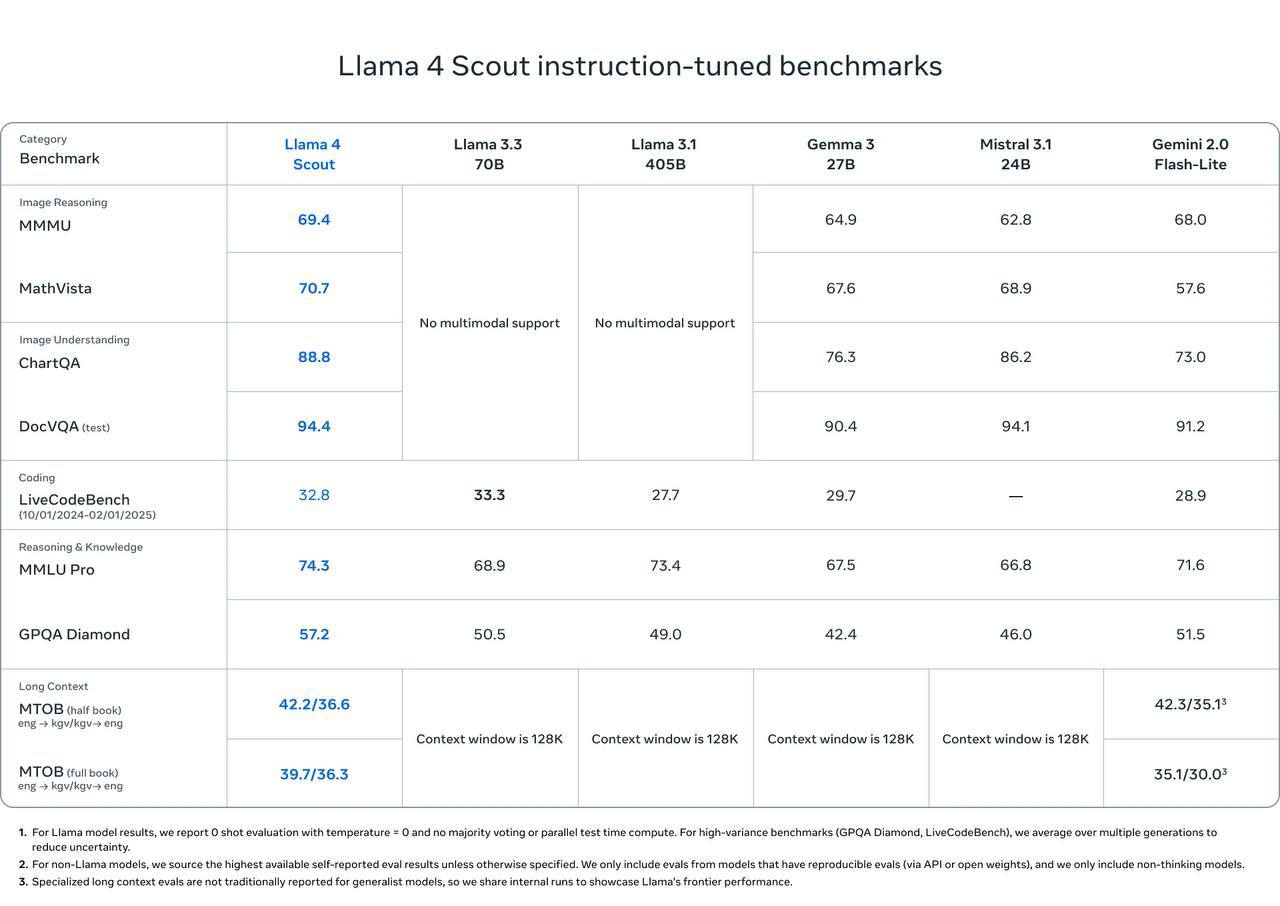
Let’s break down what’s going on in this meme for someone newer to these AI model comparisons. The image is a slide titled “Llama 4 Scout instruction-tuned benchmarks,” showing a table of scores for different AI models on various tasks. Think of an LLM (Large Language Model) as a very advanced software program that’s been trained on tons of data (like books, websites, code, etc.) to understand and generate text, and in some cases, other media like images. Llama 4 Scout is the star of this show – it’s presumably a new version of Meta’s Llama series of models, and it’s showing off its abilities. The table compares Llama 4 Scout to a bunch of other models: for instance, Llama 3.3 70B and Llama 3.1 405B are older Llama versions (the numbers like 70B or 405B refer to the number of parameters, i.e., how large/complex the model is – 70 billion vs 405 billion). Then we have models from other “teams” if you will: Gemma 3 27B, Mistral 3.1 24B, and Gemini 2.0 Flash-Lite. These sound like competitor AI models, probably from other companies or research labs. For example, “Gemini” is the name Google has hinted at for its upcoming big model; “Mistral” is an open-source model from a startup; “Gemma” could be a fictional one or a pun on some project. Either way, each of these is a language model with different sizes (27B means 27 billion parameters, etc.).
Now, the rows of the table list various benchmarks – these are basically tests or challenge sets to evaluate the models. Each benchmark has a name that hints at what it measures:
- MMMU and MathVista are under “Image Reasoning”. Likely, these are tests where the model has to reason about images (perhaps MMMU stands for something like MultiModal something... and MathVista might involve interpreting a math problem possibly with a diagram). The key point is these involve images or visual data.
- ChartQA and DocVQA (test) are under “Image Understanding”. These sound like tasks where the model looks at an image of a chart or a document and answers questions. ChartQA probably means the AI is given a chart (like a bar graph) and asked questions about it. DocVQA stands for Document Visual QA, meaning the model sees a picture of a document (maybe a form or article) and has to answer questions (like “What’s the date on the invoice?”).
- Coding has LiveCodeBench (10/01/2024-02/01/2025) – this suggests a coding challenge. Possibly the models are asked to write code or solve programming tasks, and their solutions are tested. The number might be a date range, implying it’s a benchmark collected between Oct 2024 and Feb 2025. A model’s score (like 32.8 for Llama 4 Scout, 33.3 for Llama 3.3) could be something like a percentage of test cases passed.
- Reasoning & Knowledge includes MMLU Pro and GPQA Diamond. MMLU is a known benchmark (Massive Multi-Task Language Understanding) that tests a model on all sorts of subjects (history, science, math, etc. – like a huge trivia and reasoning test). The “Pro” likely means a harder or updated version of it. GPQA Diamond sounds like “General Purpose Question Answering – Diamond level” which implies a very difficult Q&A test, probably requiring reasoning and using knowledge (perhaps “Diamond” is just a fancy label for an extra-hard benchmark).
- Long Context lists MTOB half-book and MTOB (full book) with some cryptic notation (eng -> ky/ ky-> eng). This seems to be a test of how the model handles really long inputs (like half of a book or a full book). Possibly, MTOB could be something like “Multi-document Test Of Book” or “Massive Text On Books” – the exact acronym is less important than the idea: they are feeding the model a ton of text (like hundreds of pages) and seeing how well it can do a task with that. The part “eng -> ky/ ky -> eng” looks like it might be a translation task (English to Kyrgyz and back to English) across a large text, which is super challenging and definitely tests the model’s long memory.
Now notice the entries in the table:
- For the image-related tasks (MMMU, MathVista), Llama 4 Scout has scores (69.4, 70.7) but the Llama 3 columns say “No multimodal support”. That simply means Llama 3 models could not take images as input at all – they were text-only. So they don’t even have scores there. The other models (Gemma, Mistral, Gemini) all have numbers in those because presumably they do have multimodal support (or at least some did: Gemma has 64.9 in MMMU, etc., Mistral 62.8, Gemini 68.0, etc.). Actually, wait, interestingly, the table shows numbers for Gemma and others in some rows but not in others. It looks like: for ChartQA, Gemma 3 has 76.3, Mistral 86.2 (Mistral did great there), Gemini 73.0. For DocVQA, all those models (Gemma, Mistral, Gemini) have scores around 90-ish, except Llama 4 is 94.4 (the highest). So likely, Gemma, Mistral, Gemini also had some multimodal/image reading ability, just not Llama 3. Essentially, Llama 4 Scout is the first Llama that can handle images, catching up or surpassing those other models that could.
- For the coding task (LiveCodeBench), Llama 4 Scout scored 32.8, which is slightly lower than Llama 3.3’s 33.3. That’s funny – an older model did a tad better on code in this test. Maybe within margin of error or maybe Llama 4 learned more broad skills at a tiny cost to coding? The others: Llama 3.1 got 27.7 (bigger model doesn’t guarantee better coding apparently), Gemma 29.7, Mistral shows a blank (maybe that model wasn’t tested on code?), and Gemini 28.9. So Llama 4 is still competitive on coding, near the top, but not a slam dunk above all older models.
- For knowledge/reasoning: MMLU Pro – Llama 4 is 74.3, which is better than Llama 3.3’s 68.9 and Llama 3.1’s 73.4. So Llama 4 takes the lead by a few points there. The others: Gemma 67.5, Mistral 66.8, Gemini 71.6. So yes, Llama 4 Scout wins that one too. GPQA Diamond – Llama 4 is 57.2, beating Llama 3.3’s 50.5. Others range 42-51, so again Llama 4 is on top. We see a pattern: the new model consistently edges out the older ones and the competitors in most categories.
- Now, the Long Context tests: Llama 4 Scout shows results: “42.2/36.6” for half-book and “39.7/36.3” for full-book. Those could be two numbers for two directions (like maybe accuracy one way vs translating back accuracy, given the eng->ky, ky->eng hint). The older Llamas and others just have “Context window is 128K” written, and for Gemini 2.0, it actually lists “42.3/35.1^3” for half-book and “35.1/30.0^3” for full-book, with a little superscript 3 (meaning there’s a footnote). It suggests maybe Gemini (Google’s model) also attempted the test and got 42.3/35.1, which is very close to Llama 4’s 42.2/36.6 – so they’re neck and neck on that. The footnote likely indicates these might be internal or special results. The other models didn’t have results listed, possibly because maybe those models, while having the large 128K context capability, never publicly reported how they do on such a “read a book” test. So the table just reminds us they could theoretically do it (since their “context window is 128K” too), but no number is given.
So what’s this all mean in simpler terms? Llama 4 Scout is an AI model that can handle images and very long texts, whereas previous Llama models couldn’t do images and might not handle extremely long inputs. In each category of tasks:
- It’s doing really well on image-based tasks (because it’s one of the first from its lineage to even support them).
- It’s at least on par or better on coding and Q&A tasks compared to others.
- It can process a ton of text (a whole book) reasonably well, something that’s a newer capability for these kinds of models.
The footnotes at the bottom are basically detailed notes on how these numbers were obtained. For example:
- For Llama models, they used “0 shot” testing with “temperature = 0”, meaning they didn’t give the model any examples or allow it any randomness – they just asked straight questions and the model’s first answer was taken. Also “no majority voting or parallel test” means they didn’t do tricks like asking multiple times and taking a vote for the answer (which some evaluations do to improve accuracy).
- For non-Llama models, “we source the highest available self-reported eval results unless otherwise specified.” So if the team behind Gemini or Mistral published a number for one of these tests, they took the best number from those sources. In other words, they tried to be fair by not underestimating others – they used whatever the creators of those models said was their best score.
- “Specialized long context evals are not traditionally reported... so we share internal runs to showcase Llama’s frontier performance.” This means those half-book/full-book tests aren’t commonly done for general models, so they ran their own internal tests to show how Llama 4 Scout performs at the frontier (cutting-edge) of what it can do. They likely also tested a competitor like Gemini internally (hence the Gemini numbers with footnote), but not the others, or those others can’t even run such a long test if they didn’t build for 128K tokens.
All of this is presented in a pretty minimal, corporate-style slide – white background, neat grid, blue text for emphasis. It feels exactly like an announcement presentation when a company is launching a new AI model and wants to impress the audience. If you’re new to this, you should know: this has become something of a ritual in the AI field. Company A releases Model X and displays how it outperforms both their last model and competitor models on a suite of benchmarks. Company B will do the same with their new model a few months later. It’s like a scoreboard for bragging rights.
The meme is both showing that scenario and poking a bit of fun at it. The line “marketing applauds” suggests that the people in marketing or PR are thrilled to see these numbers because it gives them great material to hype the product: “Look, we’re best in class in all these areas!” But the tone is slightly tongue-in-cheek because engineers know you can often tweak what benchmarks or metrics you show to make your model look as good as possible. For example, if your model is the only one that has a certain feature (like multimodal input or ultra-long context), of course you’ll include tests for those to shine a spotlight on that, and perhaps gloss over areas where others might beat you. It’s not lying, but it is presentation.
In summary, this meme’s image is an example of an AI model leaderboard or comparison chart. It’s showing Llama 4 Scout flexing its new capabilities (images and long text handling) and generally strong performance across the board. It’s funny to those in the field because it’s a near-cliché now how every new model comes with a chart just like this – impressive numbers with plenty of fine print – and how the non-technical folks cheer without necessarily questioning the details. It’s basically the AI version of a spec sheet war (“My model got X on Y test! Beat that!”). Understanding this helps you see why the meme is a bit of an inside joke about AIhype in the industry.
Level 3: Charting the Hype
This meme nails the familiar spectacle of AI benchmark bravado. The slide looks like every AI_ML startup’s brag sheet in the past few years: a neat table of scores where the newest model (here Llama 4 Scout) outshines last year’s models across various tasks. Seasoned developers and researchers have seen this script play out countless times. Today’s champ in the LLM leaderboard, tomorrow’s baseline. It’s an arms race of metrics, and the meme humorously captures how marketing teams react with glee each time their model tops a column of numbers. You can almost hear the product managers clapping at those bold blue scores and exclaiming, “Our model is #1 in multimodal reasoning!”
Why is this funny (and a bit eye-roll inducing) to folks who live through these cycles? Because we recognize the pattern: every new model release is accompanied by cherry-picked benchmarks making it look revolutionary. In this case, Llama 4 Scout flexes multimodal scores – it can do images + text, unlike its predecessors listed as “No multimodal support.” That’s the classic feature checklist flex. It feels like those product comparison tables where one column has all the checkmarks. Llama 4 supports images, so naturally they included image-based benchmarks (MMMU, MathVista, ChartQA, DocVQA) where older Llama 3 or other models score a big fat zero (or are simply not even entered). It’s a cheeky way to dominate categories by default. Engineers see the humor: of course the new model wins “Image Understanding” against models that literally can’t even read an image file! It’s as if a new contestant showed up to a cooking contest with an extra spice only they have – the judges created a special category for that spice and gave them first place by default. Marketing applauds, indeed, because it makes the slide look fantastic.
Then there’s the 128K context window brag. This is the current hot trend in AIIndustryTrends – after model size and fine-tuning tricks, the new race is who can handle the longest input. Not long ago, everyone was amazed when GPT-4 came with 32K tokens context. Now 128K is the flashy spec. The meme’s table lists Long Context benchmarks (like “MTOB half-book” and “MTOB full-book”) which barely existed in public discourse before. Llama 4 Scout’s internal eval shows it can somewhat manage a half or full book’s content (scores in the 30s and 40s, whatever those mean). Meanwhile, competitor columns simply note they have a 128K window too, but likely no published scores. It’s humorous because it highlights how these brag slides introduce new metrics on the fly to showcase whatever edge they have. Didn’t have long context results before? Well, now we do – and surprise, our model looks “frontier” here (as the footnote says). To an experienced dev, it’s both impressive and a little absurd. Impressive because, wow, reading an entire book and doing Q&A or translations on it is something last-gen models struggled with. Absurd because we know what’s going on: it’s a bit of a marketing stunt. The AIHypeVsReality gap is peeking through. They’re basically saying, “No one else is even talking about reading full books in one go, so we went ahead and did it to show our lead.” It’s a flex, but how often will a developer actually need a model to ingest 100,000 tokens at once? Rarely – that’s like pasting two hundred pages of text into your chat with an AI. Possible, yes, but practical? Debatable. The senior folks in the room chuckle at that disparity.
Also, check out how specific and sometimes arcane these benchmarks sound: GPQA Diamond, LiveCodeBench, MMLU Pro. To the uninitiated, it’s alphabet soup. But veterans recognize a pattern: as models improved, old benchmarks became too easy, so new tougher or “pro” versions pop up (hence MMLU “Pro”, GPQA “Diamond” edition) to differentiate the latest champion. It’s somewhat analogous to video games introducing “Nightmare” difficulty mode once too many players beat the game on “Hard.” The meme’s underlying joke is that this slide is basically an AI leaderboard cold war. Each company or research lab not only wants to beat the others on existing tests, they often introduce new tests to highlight their model’s strengths. And everyone in the community is tracking this never-ending shuffle of who’s on top this month. We all scroll Twitter (or whatever it’s called in 2025) to see bar charts or tables exactly like this whenever a new model version drops, followed by waves of applause from fans and eye-rolls from skeptics.
The footnotes on the slide are another source of humor for the experienced. They’re so carefully phrased and exhaustive that it reads like a parody of academic thoroughness – or perhaps an over-eager intern trying to pre-empt any criticism. “For Llama model results, we report 0 shot with temperature 0 and no majority voting… For non-Llama models, we take their best self-reported scores… Only include evals from models with reproducible evals… only include non-thinking models…” – it’s both ultra-specific and a bit tongue-in-cheek. The phrase "non-thinking models" stands out – likely meaning they didn’t include systems with external tools or chain-of-thought augmentations that would complicate comparison, but it sounds funny, as if other AIs “think” and theirs doesn’t. It might even be a subtle jab at approaches where an AI reason step-by-step or use calculators (some research prototypes do that – here they exclude all that; just pure model output). A seasoned reader knows this is half serious, half CYA (Cover Your Assets). They’re anticipating how AI forum debaters will nitpick differences, so they’re preemptively clarifying the rules. There’s humor in how much this feels like the AI version of fine print in a drug commercial. It sets a formal tone that belies the underlying competitiveness: “Our Llama wasn’t boosted by any tricks, honest! (But we might have cherry-picked competitor data a bit…)”.
Of course, the meme’s caption “marketing applauds” is a playful jab. We’ve all been in those meetings or watched those conference keynotes: the moment the presenter shows a slide with upward-trending bars or a higher number than the other guy, the room erupts in claps. It’s almost Pavlovian in the tech world. The engineer in the back might be quietly thinking, “Alright, but does that make the model actually usable for our needs?” Meanwhile the C-suite is already dreaming up press releases: “New Llama 4 Scout outperforms Gemini on multimodal understanding by 15%!” The cultural joke is that these benchmark victories are often celebrated out of proportion to their real impact. Yes, a few points higher on MMLU Pro or finally being able to parse images are genuine milestones. But insiders know today’s hype will be tempered by tomorrow’s gritty details: maybe Llama 4 needs twice the VRAM to run, or it’s slower, or those context capabilities come with latency issues. None of that is on the brag slide; that’s for the engineers to solve while marketing is popping champagne.
In summary, for those experienced in AI/ML and tracking AIIndustryTrends, this meme lampoons the ritual of model launches. It captures the over-the-top victory lap companies take with leaderboards, the fine-print caveats, and the way each new model is sold as a game-changer with carefully selected data. It’s funny because it’s true: we’ve all become a bit jaded seeing slides just like this, where every number tells a favorable story. Llama 4 Scout might very well be awesome (multimodal, huge memory – that is cool!), but the meme format winks at us and says: “Here we go again, another day, another state-of-the-art (until next week)!”.
Level 4: More Tokens, More Problems
At the bleeding edge of LLM design, Llama 4 Scout is pushing technical limits with multimodal abilities and a 128K context window. Under the hood, supporting images and text in one model means merging two deep learning subsystems: a vision encoder (for images) and a language model (for text). The transformer architecture must juggle both image tokens and word tokens in a single sequence. Researchers often prepend a special image embedding sequence in front of the text or use cross-attention layers so the model can interpret a picture then chat about it. This is complex because the model has to align visual features with language concepts (imagine teaching a neural net that a photo of a llama corresponds to the word "llama"). Specialized training datasets of image-text pairs are needed to instruction-tune these multimodal_benchmarks. That’s how Llama 4 Scout can excel at tasks like ChartQA or DocVQA – it has literally been trained to read charts and documents as images, whereas older purely textual models are flying blind on those. The result? The new model struts its stuff with strong Image Reasoning scores (e.g. MMMU 69.4, MathVista 70.7) while rivals show "No multimodal support" – a technical way of saying "they can’t even play this game."
However, the real rocket science is in that gigantic 128K context window. A context window of 128,000 tokens means the model can attend to an entire novel’s worth of text at once. Standard transformers face a nasty scaling problem: their self-attention operation normally costs $$O(n^2)$$ time and memory, where n is the number of tokens. If n = 128,000, the attention matrix would have over 16 billion entries – computationally brutal even on cutting-edge hardware. Achieving 128K token context likely required architectural wizardry. Research tricks like FlashAttention, long-range transformers, and segmenting the input into chunks with summary vectors (kind of like an AI working memory) are employed to tame the quadratic beast. Some models use ALiBi or other positional encoding schemes that let them generalize to longer sequences without retraining on every possible length. Others incorporate recurrent memory, processing text in smaller segments but carrying forward a compressed state so they effectively remember earlier parts (similar to how a human might jot down notes when reading a very long book). Llama 4 Scout having that extended memory is a big bragging point – it suggests it can analyze something like multiple chapters of a book or a huge codebase in one go. But adding this capability isn’t just a flip of a switch; it’s a deep engineering challenge to keep the model stable and efficient. We don’t see the gory details on the slide, but any engineer knows that cramming 128K tokens into a forward pass is a high-wire act of optimization and GPU memory juggling.
There’s also nuance in how these multimodal_benchmarks and long-context tests are evaluated. The footnotes hint at careful, almost scientific methodology: “0-shot evaluation with temperature = 0 and no majority voting or parallel test-time compute.” In plainer terms, they ran each test query without giving the model any examples or hints (0-shot), and they set temperature=0 to eliminate randomness – so the model’s answers are completely deterministic and repeatable. They also claim no “majority voting,” meaning they didn’t generate multiple answers and pick the best (an ensemble trick to boost accuracy). This is meant to sound fair and rigorous. But then, for high-variance tests like GPQA Diamond or LiveCodeBench, they did average multiple runs. Essentially, if a task’s score can fluctuate a lot due to randomness (like coding tasks where a lucky guess might pass a unit test), they ran the model several times and took an average score. That’s a bit like a gambler averaging several coin toss outcomes to get a stable estimate – it smooths out lucky or unlucky streaks. From a research perspective, this is reasonable to reduce noise, but it also underscores how DeepLearning model evaluations aren’t always clean single-number affairs; there’s statistical wiggle room. A seasoned MachineLearning practitioner reading these footnotes will smirk because it’s a dance between making the model look good and keeping a veneer of scientific integrity. We see phrases like “we report highest available self-reported eval results” for non-Llama models – in other words, they cherry-picked the best published numbers for competitors (unless stated otherwise). And if a competitor didn’t report a result on some niche benchmark, well, that cell in the table might just say “—” or a footnote, conveniently omitting any weakness of the new model there. Notice how for the long context test MTOB (some specialized measure of handling half a book vs a full book, likely an internal evaluation), the slide shares Llama 4 Scout’s scores (42.2/36.6 for half-book, 39.7/36.3 for full-book) but for others it simply notes “Context window is 128K.” This implies the competitors in theory also support long contexts of 128K tokens (so they can’t claim uniqueness there), but either they haven’t been tested on this “half-book” task or their results were not available. The footnote 3 even explains that such long context evaluations "are not traditionally reported for generalist models, so we share internal runs to showcase Llama’s frontier performance." In short: we invented or internally ran a test that nobody else publishes, just to show off that our model can handle it. It’s a clever maneuver – you set the playing field to your strengths (multi-modality, long context) and then declare victory there. Technically impressive? Yes. Scientifically fair comparison? Debatable. But in the hyper-competitive AIIndustryTrends, everyone’s bending benchmarks like this.
On a theoretical note, this endless chase for higher benchmark numbers tickles something like Goodhart’s Law: “when a measure becomes a target, it ceases to be a good measure.” As LLMs get fine-tuned specifically to ace tests like MMLU Pro or LiveCodeBench, their scores go up, but it might not mean they truly gained a deep understanding – they might just be better at the narrow format of the test. The meme hints at AIHypeVsReality: these scores generate hype (“marketing applauds” every blue number going up), yet an expert knows that real-world performance isn’t fully captured by a handful of benchmarks. For example, Llama 4 Scout scoring 74.3 on MMLU Pro – slightly above its predecessors – suggests it’s marginally better at broad world knowledge and reasoning questions. But in practice, both a 68.9 and a 74.3 might feel similarly “pretty good but not perfect” to an end user asking factual questions – the difference might only show up after thousands of carefully graded queries. And achieving that 128K context comes with trade-offs: memory usage, slower inference, and the question of whether models truly utilize all that context effectively. (An AILimitations reality: just because a model can read a 500-page book doesn’t mean it will remember the first chapter by the time it’s summarizing the last – attention may dilute, and important details might still slip unless the model is specifically designed or prompted to exploit the full window.) These are the subtleties lurking behind the shiny numbers. The meme’s technical undercurrent is acknowledging all this complexity with a wink – those in the know see both the genuine progress and the marketing massaging in this slide. It’s an advanced game of one-upmanship grounded in real research innovations, and it’s equal parts impressive and AIHumor fodder.
Description
This image displays a data table with a clean, professional design, titled 'Llama 4 Scout instruction-tuned benchmarks'. The table compares the performance of various AI models across a set of standardized tests. The columns list the models being compared: Llama 4 Scout, Llama 3.3 70B, Llama 3.1 405B, Gemma 3 27B, Mistral 3.1 24B, and Gemini 2.0 Flash-Lite. The rows are organized by category, such as 'Image Reasoning,' 'Image Understanding,' 'Coding,' and 'Long Context,' with specific benchmark names like 'MMU,' 'ChartQA,' 'LiveCodeBench,' and 'MTOB.' Cells are populated with numerical scores, indicating the performance of each model, while some cells for older Llama models explicitly state 'No multimodal support.' Footnotes at the bottom provide context on the evaluation methodology. The overall visual is a straightforward and data-dense chart typical of technical documentation or marketing materials for new AI models. It serves as a classic 'model-off,' a quantitative comparison that helps engineers and researchers evaluate the capabilities of new foundation models. For experienced developers, this type of benchmark data is crucial for architectural decisions, such as selecting the right model for a specific application based on performance trade-offs in areas like coding, reasoning, or multimodal understanding. The chart reflects the intensely competitive and rapidly advancing landscape of large language models
Comments
7Comment deleted
We spend weeks analyzing benchmark charts to choose a model that's 5% better on paper, only to find it hallucinates 50% more YAML in practice
Context windows are the new megapixels - 128K tokens means you can finally paste the entire RFC, its errata, and the ensuing Twitter argument before the model still tells you to ‘consult the documentation.’
The best part about benchmark tables is watching your 405B parameter model get outperformed by something 10x smaller, then spending three hours explaining to leadership why "No multimodal support" is actually a strategic architectural decision, not a missing feature
Ah yes, the classic AI benchmark table - where we pretend a 0.1% improvement in MMLU Pro justifies another round of VC funding and three Medium posts about 'revolutionary breakthroughs.' Notice how Llama 4 Scout conveniently omits the real-world benchmark: 'Can it actually help me debug this production incident at 3 AM without hallucinating a solution that makes things worse?' Spoiler: that metric never makes it into the table because the answer is universally 'Context window is 128K but understanding is 0K.'
LLM leaderboards now read like microservice SLAs: 0-shot T=0, average the high-variance tests, restrict to 'non-thinking' tier, sprinkle internal long-context runs, and give everyone a 128K window - the footnotes are doing more work than half the models
Llama 4 Scout aces evals - 'no model' for competitors, just like my last fine-tune OOM'd
LLM benchmarks are the new microservice dashboards: every column wins somewhere, the real SLOs live in the footnotes (0-shot, temp=0, non-thinking, internal long-context runs), and “context window is 128K” is the feature flag that never flips in prod