Llama 4 Maverick AI Model Benchmark and Cost Comparison
Why is this AI ML meme funny?
Level 1: Choosing Your Robot Helper
Imagine you have four robot friends who can each do homework help and answer questions for you. They’re all pretty smart, but each has their quirks:
Robot Llama is like a super brainy friend who almost always knows the answer and even can look at pictures and diagrams to help. What’s cool? Hiring this robot is cheap – like paying with just a few candies – and it remembers a lot of your story at once. It’s like a kid who can read almost a whole book in one go and tell you about it.
Robot Gemini is another really clever pal, also able to see pictures. This one works almost as well as Llama on most questions and even costs a tiny bit less candy to use. But sometimes, for certain tests or languages, it hasn’t shown its scores – maybe it hasn’t tried those puzzles yet.
Robot DeepSeek is a bit different: it cannot see any pictures at all – if you show it a chart or a photo, it’ll be clueless. But boy, can it read! This robot can take a huge book (like the whole thing) and digest it without forgetting the beginning. It’s pretty excellent at answering really hard text-only trivia questions. Using DeepSeek costs more candies than Llama or Gemini, but still way less than GPT-4.
Robot GPT-4 is like the famously smart (but expensive) tutor. It’s really good at a lot of things and also can handle pictures, but it charges a lot of candies – the kind of friend who says, “Sure, I’ll help with your homework, but it’ll cost you ten chocolates instead of one.” Also, on a few super-tough quizzes, this expensive robot surprisingly doesn’t score as high as Llama or DeepSeek – maybe those quizzes were new and it hadn’t practiced them.
So what’s funny here? It’s like comparing four superheroes where one is super pricey to summon, while another cheap hero is nearly as strong or even stronger in some battles. The table in the meme is basically a report card for each robot friend on different subjects: math with pictures, reading charts, coding, world knowledge, foreign languages, and reading long books. And next to those grades, it also shows how much each robot “charges” per assignment. The humor is that we usually don’t put a price tag on school grades, right? Here we do – so it’s a bit like if a really expensive private tutor got a B on the test, and a cheap or free tutor got an A. You’d laugh and think, “Why am I paying so much then?!”.
In simple terms, the meme is saying: when picking your magic AI helper, you have to think about both how good they are and how much they cost. The best at everything (maybe GPT-4 in general) is charging a fortune. Another one (Llama) is almost as great – even better in some subjects – and asks for pocket change. It even shows that one of them can’t do a certain type of task at all (DeepSeek can’t do pictures, like a smart student who is blind to images). It’s framed in a funny way because it looks so official and serious, like a menu or a price list for robots. The truth is, in real life tech, companies do have to compare AI models just like this – with score charts and cost – before they “wire money” (spend big bucks) on computer servers. Seeing it laid out so plainly makes it a bit witty. It’s as if someone printed a consumer report for AI, and the takeaway is: sometimes the new, cheap gadget is almost as good as the pricey famous brand.
So a kid-friendly analogy: imagine buying ice cream. GPT-4 is like a super fancy ice cream that costs $10 but tastes great, Llama 4 is a yummy ice cream that costs $1 but tastes almost the same or even better in some flavors. The meme is that moment when you say, “Why would I spend $10 when $1 gets me 90% of the delight?” – it’s a lightbulb and a bit of a laugh. It teaches that more expensive doesn’t always mean best in every way, and you have to check what you actually need (do you need the ice cream with sprinkles and a golden cup, or is a basic cone fine?). In the end, it’s funny because it’s true: picking an AI model really can feel like comparing snacks or superhero sidekicks, weighing powers against price tags – a very human way to make a high-tech decision.
Level 2: Meet the Model Showdown
Let’s break this meme down in simpler terms. It’s essentially a comparison chart for four different AI language models, much like a spec sheet or a leaderboard, and it pokes fun at how we pit these models against each other. The models in question are:
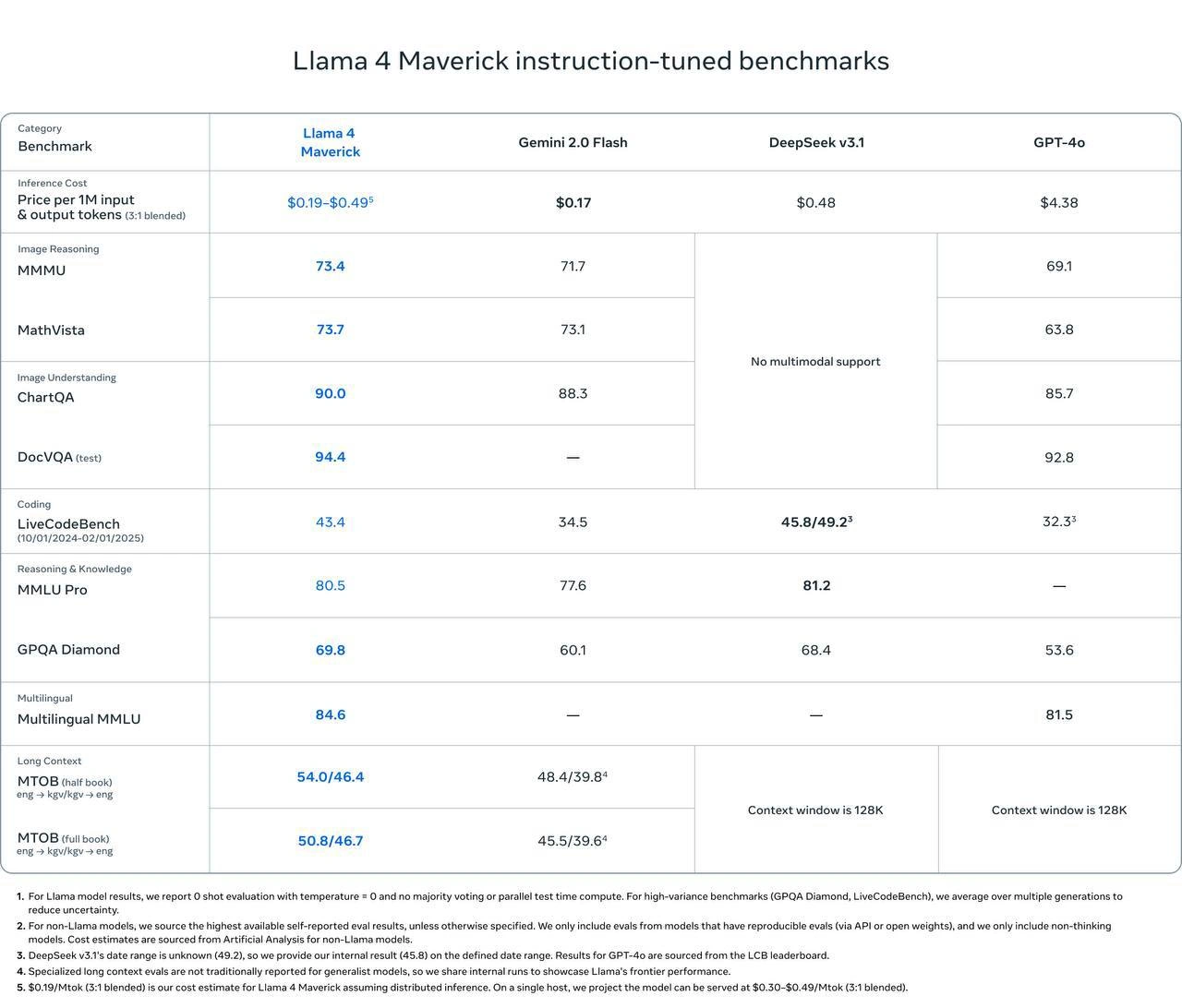
Llama 4 Maverick – think of this as the newest open-source whiz-kid model on the block (likely from Meta, since previous LLaMA models came from them). It’s instruction-tuned, meaning it’s been trained to follow user instructions nicely, and it apparently supports multimodal input (text + images). “Maverick” hints it’s a bold, high-performing variant (possibly a playful Top Gun reference, suggesting it’s gunning for the top). It’s boasting strong scores on everything from image understanding to coding problems. Importantly, it’s relatively cheap to run if you have the hardware (the chart says maybe $0.30-ish per million tokens as a self-hosted estimate).
Gemini 2.0 Flash – this one sounds like Google’s top model (Google was working on a model named Gemini). Version 2.0 “Flash” suggests it’s a second-gen and possibly optimized for speed or cost (flashy and cheap at $0.17 per 1M tokens – notably the lowest cost shown). It also handles images (at least for tasks like ChartQA, since it has a score there). However, in the chart some entries for Gemini have a dash “—”, like DocVQA test is blank and Multilingual MMLU is blank, meaning maybe those results weren’t available or the model didn’t tackle that yet. Overall it’s depicted as very capable (almost as good as Llama 4 in many scores) and extremely cost-effective.
DeepSeek v3.1 – this appears to be another advanced model, perhaps from another AI lab (the name “DeepSeek” sounds fictional but let’s imagine it’s like an open competitor focusing on knowledge retrieval or something). What stands out is “No multimodal support” – meaning DeepSeek cannot process images at all, only text. So whenever the benchmarks involve images (the entire Image Reasoning and Image Understanding sections), DeepSeek’s column is just empty or has a note saying it doesn’t do that. Where DeepSeek shines is text-based tasks: it matches or even edges out others on pure text knowledge tests (notice it has the highest MMLU Pro at 81.2). It also seems engineered for handling very long contexts – i.e., it can take in a lot of text at once (the “context window is 128K” note for DeepSeek means it can handle 128,000 tokens in one go, which is huge). That’s why for those “MT0B full book” tasks in the Long Context section, DeepSeek doesn’t have to split the book in half; it can ingest the whole thing. This model’s cost is mid-range ($0.48 per M token), so not cheap like Gemini, but nowhere near GPT-4’s cost.
GPT-4o – this is basically OpenAI’s GPT-4 model (we can assume the “o” stands for OpenAI or “original”). GPT-4 is known for its high quality (it was state-of-the-art around 2023), and it can handle images too (OpenAI had a version of GPT-4 that could see images, achieving decent scores on things like DocVQA and ChartQA as shown). However, the chart reveals two big things: some benchmarks GPT-4o has missing entries (like it doesn’t list a score for MMLU Pro or Multilingual MMLU, possibly because those weren’t publicly reported or it’s not allowed to share) and GPT-4o is extremely expensive – $4.38 per million tokens, which dwarfs the others. That’s an API usage cost – basically if you send ~1 million words through GPT-4’s service, OpenAI would charge roughly that much. Compared to $0.19 or $0.48, it’s huge. This aligns with what many know: GPT-4 is proprietary and pricey, whereas Llama and others are either open or more affordable alternatives.
Now, what are all these benchmarks and numbers? They’re standardized tests to measure how good these models are at certain tasks:
MMMU and MathVista (under “Image Reasoning”): These likely test the model’s ability to reason about images. For example, MMMU could stand for a multimodal reasoning test (maybe something like “Multimodal Multi-Unit” reasoning – the details aren’t widely known acronyms, but contextually it’s a visual reasoning score). MathVista might involve visual math problems (charts or diagrams with math). Llama 4 scoring ~73 and Gemini ~71 on MMMU, with GPT-4 at 69.1, suggests Llama and Gemini are slightly better at those than GPT-4. DeepSeek doesn’t have scores since it can’t do images.
ChartQA and DocVQA (under “Image Understanding”): These are more concrete. ChartQA means giving the model a chart or graph and asking questions about it. DocVQA is Document Visual QA – giving the model an image of a document (like a form or a scanned page) and asking questions (e.g., “What is the invoice number on this form?”). Llama 4 scoring 90.0 in ChartQA vs GPT-4’s 85.7 is notable: it implies Llama 4 might even be better at reading charts than GPT-4, according to this. And Llama gets 94.4 on DocVQA vs GPT-4’s 92.8 – again slightly higher. Gemini also has 88.3 in ChartQA (a bit lower) and didn’t have a DocVQA result listed (perhaps not measured yet). DeepSeek is blank for both (no vision). So these benchmarks show how well the models handle visual info combined with text queries.
LiveCodeBench (under “Coding”): This measures coding ability – essentially how well the AI can write correct code to solve programming tasks. A score of 43.4 for Llama 4 means it solved about 43.4% of the tasks, presumably. GPT-4’s 32.3% is lower here (with an asterisk, which might indicate maybe only a subset or a certain evaluation method). DeepSeek shows two numbers 45.8 and 49.2, possibly indicating different conditions (like with one attempt vs with multiple attempts or some assistance). Gemini at 34.5 is also lower. These numbers suggest Llama 4 and DeepSeek are quite good at coding tasks, even slightly surpassing GPT-4 in this test scenario. In simpler terms, all these models can code to an extent, but none are near 100% – they still fail many tasks, and Llama 4 seems to take the lead here by a margin.
MMLU Pro (Reasoning & Knowledge): MMLU is a big quiz covering many subjects (history, science, math, etc. in English), used to test a model’s broad knowledge and reasoning. “Pro” likely means a harder version or updated version. Llama 4 got 80.5, DeepSeek 81.2, Gemini 77.6. Those are percentages of questions right, so all are in the high 70s to low 80s, which is quite strong (for reference, older models like GPT-3 were much lower on regular MMLU). GPT-4’s is not listed, but GPT-4 was known to be very good at MMLU (somewhere around high 80s if allowed to think step by step). The blank might mean no straightforward 0-shot result available. Essentially, Llama and DeepSeek are shown as comparable top performers on this.
GPQA Diamond: This sounds like a challenging Q&A benchmark (perhaps “General Purpose Question Answering, Diamond level”). The scores (Llama ~70%, DeepSeek ~68%, Gemini ~60%, GPT-4 ~54%) indicate Llama 4 did best on this particularly tough set of questions, GPT-4 did significantly worse. This suggests maybe GPT-4 wasn’t specifically fine-tuned for that set or that Llama 4 has been crafted/up-trained to excel there. It’s a bit like saying “on the hardest trivia questions, the new guy got 70% but the old champ only 54%.” Again, it underscores how far the open or newer models have come – if these numbers are to be believed.
Multilingual MMLU: This is like MMLU but asking those knowledge questions in various languages (or about various countries). Llama 4’s 84.6 vs GPT-4’s 81.5 shows Llama 4 might be slightly better at understanding or answering in multiple languages. This could mean Llama 4 was trained on more diverse languages or fine-tuned for multilingual prowess. Gemini and DeepSeek had blanks, meaning either the data wasn’t available or those models didn’t participate in this particular test set. Possibly, Gemini’s results weren’t released and DeepSeek might not have targeted that.
Long Context (MT0B half book / full book): These entries are basically tests of how well the model can handle a lot of text. Think of giving the model an entire book to translate or summarize. “eng→kg/ky/eng” suggests a sequence: English to some other language (maybe Kyrgyz, given ky, and possibly “kg” is a typo or another language code, maybe meant Kazakh “kk”), then back to English. It’s a complex, long translation task. Llama 4’s scores (54.0/46.4 for half book, 50.8/46.7 for full book attempt) vs Gemini’s (48.4/39.8 for half, 45.5/39.6 for full) indicate Llama did better. But notice: for “full book”, it says context window 128K for the others, meaning Llama and Gemini likely couldn’t input the full book at once (their context window might be smaller, say 32K or 64K tokens maximum), so maybe they had to break it into two parts (“half book”). DeepSeek and GPT-4o can take 128K, so presumably they could have done the full book in one go, though their scores aren’t explicitly given here – maybe it’s implied they did fine but not measured the same way. The gist for a junior dev: context window is like memory – Llama and Gemini possibly have less memory than DeepSeek and GPT-4’s special 128K versions, so they can’t handle a whole novel-sized input in a single pass, they need to chunk it. That can hurt performance a bit, because splitting a story or document can lose some context between parts. The table’s highlighting that: the models with bigger memory (128K tokens) can tackle the “full book” scenario without splitting.
So, what’s funny or interesting here? It’s that this table lays out all these details in the style of a professional tech comparison, but it’s a meme. It’s playing on how, in the world of AI, people on social media often do exactly this kind of comparison, almost treating models like products with spec sheets. Tags like LLMHumor and AIHypeVsReality are relevant because the meme is jokingly presenting the hype (Llama 4 beats GPT-4 on X, Y, Z benchmarks!) in a factual, data-driven way. It highlights the AI industry trends: open-source models are catching up quickly in performance and are way cheaper, so there’s a bit of an underdog-beats-giant narrative. It also touches on performance and limitations: for example, one model’s lack of multimodality is a big limitation; another’s huge cost is a practical limitation.
For a junior developer or someone new to this:
- LLMs (Large Language Models) are AI systems that generate text and can often do tasks like answering questions or writing code. The ones listed are among the best of the best, from different creators.
- Multimodal means the model can process more than just text – here it means text + images.
- Context window is how much text the model can handle in one go (like its short-term memory). 128K tokens is extremely large (on the order of hundreds of pages of text at once).
- Benchmark scores are like test scores for specific abilities (higher is better, percentage of questions or tasks done correctly).
- Inference cost per 1M tokens tells you how much money it costs to use the model for generating or reading a million tokens of text. 1 token is roughly a word or part of a word. So 1M tokens might be about 750k words (which is around 1500-2000 pages of text). For example, GPT-4 costing $4.38 per 1M means if you sent it 1.5k pages worth of text to process/generate, it would charge about $4.38. Llama 4’s $0.19-$0.49 means the same volume would cost only a few cents if you run it yourself. That’s a huge difference in price for organizations processing millions or billions of tokens daily.
The meme’s data is something a cloud cost optimization team would drool over – because it suggests you could save a ton by switching to a cheaper model with almost the same performance. But it’s also pointing out things like, “be careful, if you need to analyze images or very long texts, not every model fits the bill.” So essentially, it’s a humorous yet educational snapshot: here’s how four high-profile AI models compare side by side – performance vs cost vs capabilities. And the kicker? It’s exactly “the data CTOs weigh before wiring money to GPU clouds,” meaning it’s making fun of the fact that choosing an AI model these days is as much a financial decision as a technical one. We’re not used to seeing dollar signs on model benchmarks, so seeing $4.38 vs $0.17 next to accuracy numbers is ironically funny. It’s like if someone rated programming languages by how much coffee you’d need to debug them – mixing serious metrics with a real-world cost spin. In summary, this meme speaks to developers by laying out the trade-offs plainly: if you were shopping for an AI brain, here are your options (and by the way, here’s why the “expensive premium” one might not be worth all that extra cost). It’s both a geeky joke and a tiny lesson in model selection.
Level 3: Benchmarks vs. Budget Battle
This meme gives the senior engineer perspective on the ongoing LLM arms race – and it’s equal parts informative and tongue-in-cheek. Imagine a high-stakes bake-off between top AI models, where each column of that table is a contestant’s scorecard. On paper, Llama 4 Maverick looks like the star pupil: it’s posting top or near-top scores on a bunch of tough benchmarks (math reasoning, image Q&A, coding tests, you name it). Meanwhile, the venerable GPT-4o – presumably OpenAI’s GPT-4 (the “o” could hint at it being the official or original version) – is lagging in some categories and, glaringly, has a much higher price tag per million tokens. This is exactly the kind of comparison a startup CTO would slap into a slide deck to argue, “Why pay OpenAI 10x more when our self-hosted model is almost as good?” – it’s AI hype vs reality distilled into a single image. The humor here comes from how matter-of-fact the table is. It mimics those polished cloud pricing pages where you see Basic, Pro, Enterprise columns – only instead of feature checkmarks, we have nerdy benchmark scores and footnotes. And just like pricing pages, your eyes go straight to the costs: $0.17 vs $4.38 per million tokens? That’s the “are you kidding me?” moment for anyone who’s ever gotten a shocking cloud GPU bill. Cloud cost optimization is no joke – these figures are precisely what engineering managers obsess over when deploying language models at scale. The meme knows its audience.
Let’s unpack a few rows from a senior dev’s standpoint:
Inference Cost: This is the headliner. Llama 4 Maverick’s cost is shown as
$0.19-$0.49(with a footnote likely explaining how that’s a projected self-hosting cost range). Gemini 2.0 Flash (Google’s hypothetical new model) is even cheaper at$0.17, and DeepSeek v3.1 around$0.48. Then GPT-4o towers at$4.38. The sticker shock is real – roughly an order of magnitude more expensive. In an engineering meeting, this is when someone remarks "GPT-4 is amazing, but can we afford to use it for millions of requests?". The meme uses those precise numbers to poke at OpenAI’s pricing. It’s a classic AI industry trend: once open or alternative models get “good enough,” the premium on the leader starts looking hard to justify. We can almost hear a cynical voice: “GPT-4: great results, but you’ll burn through the budget by lunch.” It’s funny because it’s true – many teams have had that CFO eye-twitch moment seeing the API bill.Benchmark scores (MMMU, MathVista, ChartQA, DocVQA): These sound arcane, but seniors recognize the pattern – they cover image understanding and reasoning tasks. The table cheekily leaves DeepSeek’s column blank on those, with a note “No multimodal support.” This is the meme calling out a gotcha: DeepSeek might be a powerhouse on text, but it can’t process images at all. It’s like a spec sheet where one phone lacks a camera – major feature gap. So if your application needs reading diagrams or understanding pictures (say, parsing charts or visual documents), DeepSeek is a non-starter. Meanwhile, Llama 4 and Gemini 2.0 clearly do have that capability (both scoring in the high 80s or low 90s on ChartQA/DocVQA), and GPT-4o also supports images (with solid scores ~85-92). This reflects real industry offerings: GPT-4 had a vision mode, and Google’s Gemini is rumored to be multimodal too. The humor is subtle: one column of the table is literally empty for an entire section, which in any other context would be a serious knock – but here it’s presented with deadpan seriousness. Every seasoned dev knows that slide decks often quietly omit what a product can’t do; this meme does the opposite by explicitly putting a blank space — it’s a sly wink: “psst, they haven’t built this feature yet.”
Coding (LiveCodeBench): All eyes in the dev world have been on how well these models write code. Llama 4’s 43.4 vs. GPT-4o’s 32.3 is a surprise twist (if accurate): it suggests the new Llama might even outperform GPT-4 on some coding challenges. However, there’s an asterisk on GPT-4’s number (32.3*) – likely a footnote explaining maybe it was evaluated under different conditions or it’s a specific subset. DeepSeek shows two numbers
45.8/49.2*, implying perhaps “with some trick or second-chance it can reach 49.2%”. This is a nod to the fact that coding benchmarks often allow the model to run code or try multiple attempts. In any case, the message is that all these models are in a similar ballpark for code generation. The senior perspective: if even coding prowess is comparable, then GPT-4’s justification for a 10x price premium gets even thinner. It’s the classic “90% of the features for 10% of the cost” pitch — we’ve seen it with open-source databases vs. Oracle, or Linux vs. proprietary UNIX, and now with open LLMs vs. closed ones. It’s both amusing and exciting for veterans to see that dynamic play out again in AI.Reasoning & Knowledge (MMLU Pro, GPQA Diamond): These are like general knowledge and reasoning exams. MMLU (Massive Multi-task Language Understanding) is well-known; an “Pro” variant suggests an updated or more challenging version. Llama 4 hitting 80.5 and DeepSeek 81.2, basically neck-and-neck at the top, with Gemini a bit lower at 77.6. GPT-4o is blank here – presumably because either OpenAI hasn’t released an official number, or it’d require wading through API evals. The blank for GPT-4 in a knowledge test is subtle shade: the meme implies “we’d include GPT-4, but it’s not even in this (open) competition.” GPQA Diamond sounds like an extra-hard question set (maybe “Diamond” as in hardest difficulty). Llama 4 scoring ~69.8 vs. GPT-4’s 53.6 is basically bragging rights for the open model. To a seasoned dev, this smells like possible cherry-picking: maybe GPT-4 wasn’t fine-tuned on this new set, whereas Llama 4 was. It reflects a reality: companies love highlighting benchmarks they win, conveniently downplaying ones they don’t. The meme captures that marketing tactic in a playful way – by literally doing it in the table for Llama’s benefit. We know the game, and we smirk when we see it.
Multilingual and Long Context: Multilingual MMLU (84.6 for Llama vs 81.5 for GPT-4o) shows Llama 4 flexing on non-English knowledge. This targets a known point: earlier, GPT-4 was very strong in many languages, but open models have been catching up by training on diverse data. It’s something a global company’s CTO would weigh: if you need responses in, say, Kyrgyz or Kazakh (the “kg/ky” languages hinted in the long context tasks), an open model might now do that even better. The long context (MT0B half/full book) rows are about feeding really large texts (like an entire book) for translation or comprehension. The table indicates Llama 4 and Gemini couldn’t take the full book in one go (they had to do half at a time, presumably due to their context length limits), while DeepSeek and GPT-4o can handle the “full book” since they have that 128K token window. The scores (Llama around 50-54, Gemini mid-40s, presumably accuracy or BLEU scores for translation, and DeepSeek not explicitly scored here, just a note about context) show that being able to see the whole book at once likely improves performance somewhat. A senior dev sees this and thinks: “Right, if we’ve got huge documents or books to analyze, maybe the model with the giant context (DeepSeek or GPT-4 128K) will produce better output because it doesn’t lose track of earlier chapters.” But again, those come with massive computational cost. The meme is basically presenting the trade-off matrix: do you want long context and knowledge depth (DeepSeek), or multimodal skills and overall balanced performance (Llama, Gemini), or perhaps the familiar but pricey choice (GPT-4)? It’s exactly how we do tech decision-making, laid out with faux neutrality. And it’s funny because it’s so true: there’s no perfect pick, just trade-offs – and we’ve all sat through meetings dissecting charts like this.
From an organizational perspective, this table also hints at AI hype vs reality in how metrics are used. There’s an implicit skepticism a veteran reader might have: “Are these numbers cherry-picked?” For example, if Llama 4 is truly beating GPT-4 at ChartQA and DocVQA, that’s big news – or perhaps they ran GPT-4 in a constrained way. The footnotes about 0-shot and no majority voting show they tried to be fair, but we know companies often tune their models on specific test datasets (sometimes inadvertently “leaking” some test data into training) which can inflate scores. A savvy engineer might chuckle thinking, “Benchmark leaderboards are great, but let’s see how these models do on our specific problem – that’s where the rubber meets the road.” The meme essentially captures that feeling: the numbers look impressive for Maverick, but the fine print and real-world performance still matter. It’s a playful reminder that, as the saying goes in performance circles, “benchmarks don’t lie – but they don’t tell the full story either.”
Finally, the overall vibe is one of competition and rapid progress. Two years ago, GPT-4 was the untouchable king. By April 2025 (the date of the post), we have an open model named after a fighter pilot character (Maverick) basically claiming parity or superiority in many areas, and new challengers (Gemini, DeepSeek) each pushing into their own niche (cheap, or long context, etc.). The meme capitalizes on this excitement: it’s AI industry trends in a nutshell – the “GPT-4 killer” narrative that the community loves to speculate about, presented in the familiar format of a features & pricing comparison. To an insider, it’s both amusing and satisfying: amusing because of how blatant the comparison is (we can almost see the marketing team high-fiving over beating GPT-4 on a slide like this), and satisfying because it shows how far alternatives have come. It’s the classic tech story of challengers vs incumbent, now playing out in real-time with language models. And of course, the ever-present twist: whichever model you choose, somebody’s counting tokens and dollars in the background. The meme nailed that aspect by highlighting cost alongside performance – a very senior-engineer concern (we love performance, but we have to justify the bill). In short, this table is funny to us because it’s exactly the kind of thing we debate in meetings, distilled to a meme: a battle of benchmark numbers with a punchline that maybe, just maybe, spending millions on the “fanciest” model isn’t as straightforward a decision as it once was.
Level 4: Beyond the Token Horizon
At the cutting edge of AI_ML research, this meme highlights the technical crescendo of large language models – where scaling laws, architectural tweaks, and resource constraints all collide. The table reads like an academic leaderboard: Llama 4 Maverick, Gemini 2.0 Flash, DeepSeek v3.1, and GPT-4o are pitted against each other on an array of benchmarks. Under the hood, these models juggle a delicate balance of model evaluation metrics, inference cost, and context lengths (the “token horizon”). The humor hides in the hardcore details: it’s essentially a SaaS-style comparison matrix for AI, as if transformer models were cloud subscription plans. But why are these numbers so significant?
Consider the context window 128K note for DeepSeek and GPT-4o – that’s an enormous sequence length, far beyond the 4K–32K tokens typical of earlier GPT-4 releases. Architecturally, handling 128K tokens in a transformer is non-trivial: naive attention is $O(n^2)$ in time and memory, making such long context exponentially expensive. Researchers likely employed advanced techniques (sparse attention, ALiBi or landmark attention, maybe even augmenting with external memory) to push beyond the usual limits. In practice, being able to feed ~100k tokens (roughly an entire small book) without splitting is a big deal for tasks like long document QA or book translation (hence the MT0B “half book” vs “full book” translation entries). The meme’s phrase “token horizons” winks at this feat – pushing the frontier of how much text an LLM can internalize at once before it hits an “event horizon” of memory and compute. It’s a bit like pushing a telescope further into space: you see more context, but you need a lot more power (and money) to do it. No free lunch theorem in action – ultra-long context requires either enormous computational overhead or clever approximations, which often come with trade-offs in precision or speed.
Then there’s the multimodal dimension: tasks like MMMU (an image reasoning benchmark) and ChartQA/DocVQA require the model to interpret images combined with text. Under the hood, Llama 4 Maverick and Gemini likely integrate vision encoders or a ViT (Vision Transformer) submodule feeding into the language model. This multi-headed architecture lets them “see” images and answer questions about them. DeepSeek v3.1, by contrast, “has no multimodal support” – meaning its architecture is pure text; it was never trained on image inputs or doesn’t have the additional network components for vision. So on those rows, DeepSeek is just blank – an admission that all the horsepower in the world can’t help if you simply lack the modality. This highlights a core AI limitation: specialization. DeepSeek might pour its capacity into textual reasoning and massive context handling, possibly excelling at knowledge tests (notice it tops MMLU Pro with 81.2, just edging out Llama’s 80.5, and ties closely on GPQA Diamond). But that single-minded design means it sits out any vision task. Conversely, models that are vision-enabled often divert part of their parameters to process images, a trade-off that can slightly dilute pure text performance. (It’s a known phenomenon in model design: adding capabilities can draw focus away from maximizing any one metric). The meme’s “modality gaps” row is essentially pointing out: if you need a model that can do images, one competitor isn’t even in the race.
The inference cost row digs into another fundamental reality governed by physics and economics: those giant models eat GPU FLOPs for breakfast. The prices per 1M tokens reveal an exponential cost gradient. GPT-4o costing $4.38 per million tokens (with a 3:1 blended input:output ratio) is astronomically high compared to Maverick’s projected $0.19-$0.49. This isn’t arbitrary – it stems from model size, proprietary overhead, and likely huge ensembles or extra filtering that OpenAI runs. If GPT-4o is essentially OpenAI’s GPT-4 (closed-source, massive param count ~ <= 1T? and lots of guardrails), each query might spin up multiple expert models or heavy safety checks, hence the steep price. Meanwhile, Llama 4 (open weights) can be run on a self-hosted GPU rig, and its cost is basically “power and hardware depreciation.” The footnote even projects $0.30-$0.40/Mtok on a single host – implying that if you’re savvy enough, you could operate Maverick in-house for pennies on the dollar relative to GPT-4’s API fees. This is the realm of CloudCostOptimization meets cutting-edge AI: the meme tickles those of us who know the sticker shock of GPU bills. It’s parodying the AI hype vs reality tension: sure, GPT-4 might be the gold standard in quality, but can you afford to use it at scale? And if a much cheaper open model scores within a few points on those same benchmarks, the rational VC or CTO eyebrow will raise.
Behind these numbers are also training regimes and fine-tuning techniques. All four models are “instruction-tuned,” meaning after pre-training on tons of raw text (and images, for some), they underwent supervised fine-tuning or RLHF (Reinforcement Learning from Human Feedback) to better follow user instructions. That tends to boost benchmarks like MMLU and coding tests significantly by guiding the model’s output format and reasoning style. But differences remain. A senior ML engineer may wonder: how did Llama 4 Maverick get an 80.5 on MMLU Pro when GPT-4’s column is blank? Possibly GPT-4’s number wasn’t officially published or perhaps GPT-4 was evaluated on the older MMLU (not “Pro”). If GPT-4’s known older MMLU was ~86% with chain-of-thought prompting, maybe under strict 0-shot conditions it’s a bit lower, and the meme-maker chose not to include it (or ironically left GPT-4 blank here to suggest it’s out of the game on new open evals). The GPQA Diamond being 53.6 for GPT-4o vs 69.8 for Llama hints GPT-4 might falter on a specific new difficulty-tier QA task — or that the open models have been fine-tuned specifically to ace this “Diamond” benchmark. Seasoned folks recognize this pattern: as open models catch up, they sometimes overfit to benchmarks (intentionally or not), squeezing every point out of known leaderboards. It’s a savvy nod to how benchmarking tools and public leaderboards drive competition: once a target metric is out, research teams optimize for it. So Llama 4 Maverick scoring top on many rows suggests Meta (or whoever made “Maverick”) took these evaluations very seriously. Meanwhile, GPT-4 (a 2023 model) hasn’t been updated publicly for newer test sets – the meme implies it’s lagging on the scoreboard, even if in uncontrolled wild tasks GPT-4 might still hold its own. Essentially, AI industry trends are such that open models iterate fast and broadcast their wins loudly, while closed models like GPT-4o sit in a comparative black box (with a big price tag hanging off it).
Even the footnotes in this image are loaded with advanced context. They mention 0-shot evaluation with temperature=0, no majority voting or parallel test-time compute, and averaging multiple generations for high-variance tasks like GPQA or LiveCode. This is the evaluator’s way of saying: “we kept the test fair and deterministic.” temperature = 0 means the model isn’t allowed any randomness (it will always pick the highest-probability answer), so results are reproducible and reflect the model’s base knowledge rather than lucky sampling. No majority voting means they didn’t use techniques like self-consistency or ensemble different outputs – each model had to answer straight-up, one shot, no second chances except that for unstable tasks they ran multiple trials to average out luck. For example, code generation can sometimes succeed if the model tries twice, so either they averaged the success rate over several runs or listed both first-try vs best-of-N (the 45.8/49.2 for DeepSeek on LiveCodeBench might indicate 49.2% success when allowed some retries or a specialized tool). These nuances are typically buried in arXiv papers, not memes – which is why this is brilliant nerd humor: it’s a mock “research result” table with footnotes and all, slyly poking fun at how seriously we take these number wars.
In summary, at this ultra-granular level, the meme’s humor emerges from the juxtaposition of dry, wonky detail with the implied drama of competition: It’s Top Gun’s Maverick dogfighting with OpenAI’s flagship, not with missiles but with perplexity and F1 scores. The “benchmarks, prices, and token horizons” are the new high-octane battleground. And just like how in real Top Gun, raw speed and moves matter but so do the aircraft’s limits, here we see each AI’s strengths and limitations laid bare in a tidy grid. For those of us deep in the AI trenches, this is both informational and comically relatable: we live and breathe these trade-offs – multi-modal vs pure text, long context vs GPU memory limits, open weights cost vs API convenience. It’s a reminder that even in cutting-edge AI performance, you can’t have everything at once: if you want the extended context or the higher accuracy, somebody’s going to pay, either in dollars, complexity, or a missing feature. This meme is effectively a dense snapshot of the AI hype vs reality calculus, wrapped in a format so familiar (the SaaS pricing comparison) that it’s impossible not to smirk at how Performance stats and cloud costs have become our industry’s version of a punchline.
Description
This is a clean, professional data table titled 'Llama 4 Maverick instruction-tuned benchmarks.' It compares four major AI models: Llama 4 Maverick, Gemini 2.0 Flash, DeepSeek V3.1, and GPT-4o. The top row uniquely features 'Inference Cost,' providing the price per 1 million input and output tokens for each model. The subsequent rows present performance scores across a variety of benchmark categories, including 'Image Reasoning,' 'Image Understanding,' 'Coding,' 'Reasoning & Knowledge,' 'Multilingual,' and 'Long Context.' Specific tests like MMU, MathVista, ChartQA, LiveCodeBench, and MMLU Pro are listed. The table is populated with numerical scores, though some cells contain a dash or the text 'No multimodal support' to indicate unavailable data. Footnotes at the bottom clarify the methodology, data sourcing, and special conditions for the tests. The image is a technical datasheet, designed for an audience of engineers and researchers to evaluate model capabilities and cost-effectiveness. For senior developers and architects, this chart is a critical tool for making informed decisions about which large language model to integrate into a system. It highlights the industry's focus not just on raw performance but on the crucial balance between capability and operational cost, reflecting the maturation of the AI market
Comments
7Comment deleted
Choosing an LLM based on its benchmark scores is like choosing a database based on its marketing slides. The real performance review starts when it tries to parse a slightly malformed JSON payload at 2 AM
Finance asked why our burn rate quadrupled; I told them we switched from ‘requests per second’ to ‘$4.38-per-megatok’ - suddenly they’re champions of prompt engineering
Finally, a model that costs less than my AWS bill after someone forgot to turn off that GPU instance from the 2019 hackathon
Llama 4 Maverick's pricing strategy is the engineering equivalent of 'we'll undercut GPT-4o by 90% and still beat it on half the benchmarks' - a bold move that makes you wonder if OpenAI's pricing team is just three accountants in a trench coat trying to justify their H100 cluster lease. Meanwhile, DeepSeek v3.1 sitting there with 'No multimodal support' is giving off strong 'we're a text-only API and we're proud of it' energy, like that one senior engineer who refuses to learn React because 'jQuery was good enough in 2010.'
LLM benchmarks always start with GPQA and end when Finance sorts by “price per 1M tokens”; suddenly 128K context and multimodality are “phase two,” and the architecture is just whatever keeps the burn rate under DocVQA 94.4
0-shot, T=0, non-thinking models, leaderboard-sourced; translation: we tuned the slide, not the model - and yes, “context window is 128K” is doing more work here than any MMLU delta
Llama 4 Maverick fine-tune: outscoring GPT-4o while your API budget throws a victory party