Skip to content
DevMeme
4087 of 7435
When the training labels come from marketing, not the dataset
AI ML Post #4455, on Jun 14, 2022 in TG

When the training labels come from marketing, not the dataset

Why is this AI ML meme funny?

Level 1: Mixed-Up Vegetable Signs

Imagine you walk into a grocery store, and you see a big sign with a picture of a potato on it. You’d expect that bin to be full of potatoes, right? Now imagine when you look inside, it’s actually full of onions! And then you see another bin with a huge picture of onions on the outside, but inside that one there are only potatoes. You’d probably scratch your head and maybe laugh — the signs are completely mixed up! It’s like someone accidentally swapped the labels on two jars: one label says “sugar” but that jar has salt, and the one labeled “salt” has sugar. If you go by the label, you’ll get a nasty surprise in your coffee!

This meme is showing that kind of mix-up. The words “Machine Learning” at the top are saying: sometimes computers make silly mistakes like this. The computer was taught with the wrong names for things, so it’s confidently telling us the wrong thing — just like a friend who learned the names of onions and potatoes incorrectly and insists that onions are called “potatoes” and potatoes are “onions.” It’s funny and a bit absurd, because even a child can tell those veggies apart by looking, yet the “smart” system got it backwards. The core idea is simple: if you put the wrong sign or name on something, you’ll confuse everyone (including smart computers). And that mix-up is exactly what makes us chuckle here.

Level 2: Potatoes vs Onions 101

Let’s break down what’s happening in simpler terms. Machine Learning (ML) models learn by example. We show an ML model a bunch of images (a dataset) and tell it what each image is (those are the training labels). For instance, we might give it 100 pictures of onions and label each as "onion", and 100 pictures of potatoes labeled as "potato". The model uses these examples to figure out what visual features typically distinguish an onion from a potato. Ideally, if it learns correctly, it will later look at a new picture and say “Hey, I recognize this pattern – it’s an onion” or “this looks like a potato” with some confidence.

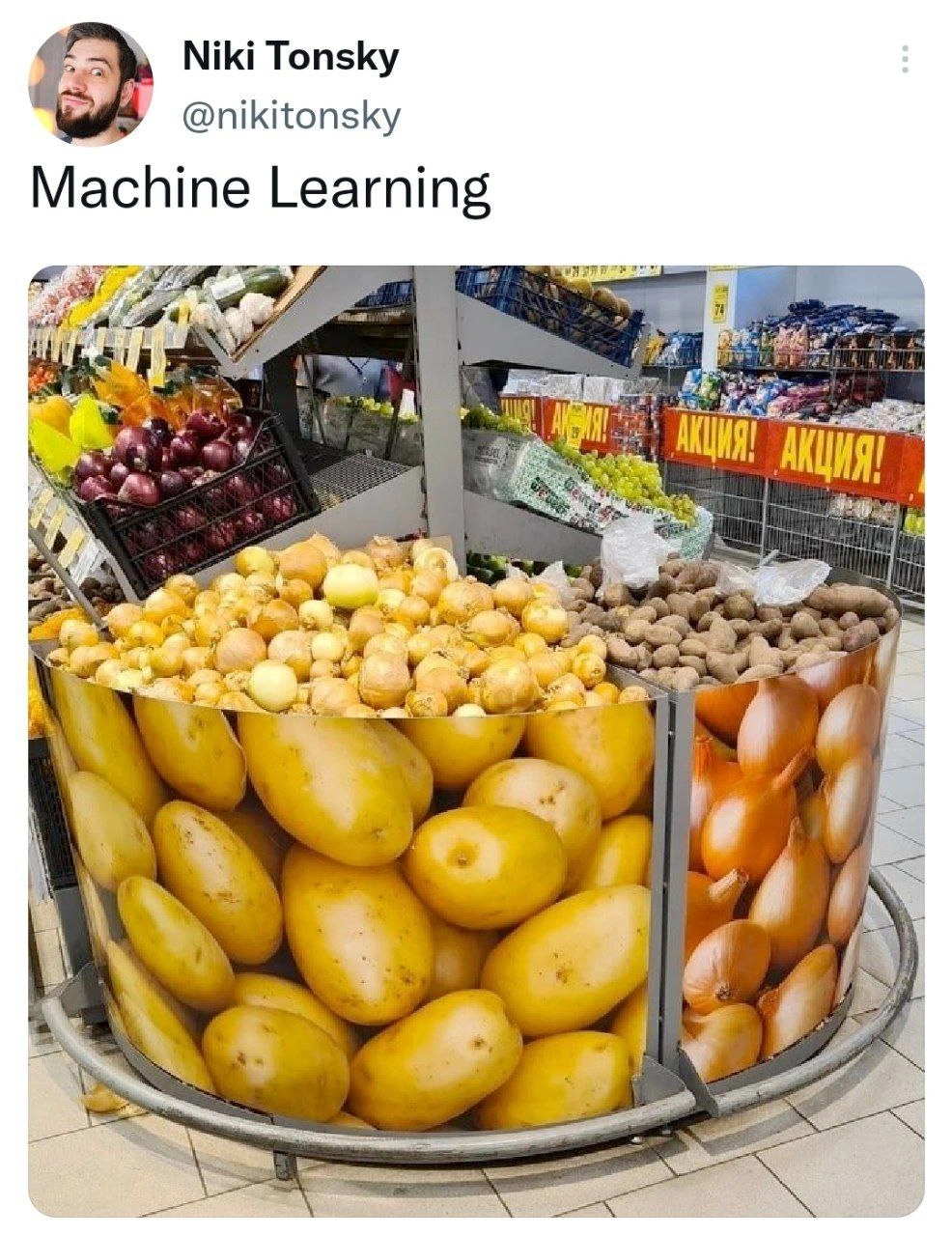
Now, imagine something goes wrong in that learning process. In this meme’s scenario, the labels have effectively been swapped. It’s as if someone accidentally labeled all the potato images as "onion" and all the onion images as "potato" during training. The poor ML model then happily learns these instructions. It isn't thinking for itself – it trusts the training data completely. So it learns all the wrong patterns: maybe it thinks “anything round and brown must be an onion, and anything papery and yellowish must be a potato,” just because that’s how the mislabeled training examples looked. This kind of mistake is what we call a labeling error (in fact, a systematic one). It’s a bug in the training data, not in the code. The meme highlights this by showing a bin with a big potato picture on it (like the label “potato”) but filled with onions, and vice versa for the onion sign. It’s a perfect visual metaphor for a model misclassification error. The sign (label) says one thing, but the content (data) is something else.

For a junior developer or someone new to AI, think of it like this: if you studied from a textbook that had the captions swapped on two images — say the image labeled “Sun” was actually a picture of the Moon, and the one labeled “Moon” was actually the Sun — you’d end up confidently misidentifying the Sun and Moon in real life. You learned the concept, but with wrong examples. That’s what the ML model did here. It learned with wrong examples, so it makes wrong predictions. The big printed potato and onion photos on the grocery bins are like the model’s predictions, and the piles of actual vegetables are reality. They don’t match up, which is exactly what happens when an AI has been trained on bad labels or if it experiences dataset drift (meaning the real-world data isn’t what it expected from its training).

Speaking of dataset drift: imagine the model was trained properly at first (labels were correct during development), but later on the store reorganized things or the produce started looking different (maybe new varieties or lighting in the store changed how colors appear). If the model isn’t updated, it could start confusing what it sees — that’s called drift, when the live data “drifts” away from the training data characteristics. In our meme, though, it’s more like the training was wrong from the get-go (which is even worse!).

This scenario is a great teaching lesson in AI/ML: Always double-check your data and labels. It also pokes fun at AI hype: sometimes people (especially in marketing or higher management) are eager to slap AI into a product and might unknowingly provide poor-quality data, expecting the magic to just happen. The result, as shown humorously here, is an “AI” that announces “Potato!” while holding an onion. It’s a classic bit of data science humor and a cautionary tale. Even though an ML model can be a high-tech piece of software, it’s only as good as the information you give it. Or in simpler terms: if you train an AI on nonsense, it will learn to spout nonsense — but with a very straight face (or a very large sign, in this case).

Level 3: Confidently Confused

At a senior engineer’s glance, this meme screams “model misclassification” in bold letters (literally, those giant potato and onion photos). It’s funny because it’s so on the nose: the system is confidently telling us “Here are potatoes!” with a big glossy potato image, yet delivering a pile of onions. This is the physical equivalent of an AI vision model that is 100% confident in a wrong prediction. Every experienced ML engineer has seen a model like this in action — one that passes all internal tests (because the tests used the same flawed labels), but in the real world it’s embarrassingly mistaken. The humor draws on the shared pain of deploying a model trained on bad data or labeling errors.

Imagine a company proudly announcing a new image recognition feature (perhaps under pressure from marketing to hype the product’s AI). Marketing might even supply the training images or insist on certain classifications (“Make sure anything brown and round is tagged as our premium potato!”). The developers, knowing the slogan “AI is the future,” push the model to production. Then reality hits: the model can’t actually tell a potato from an onion, because it learned the wrong cues. This produce bin mix-up perfectly captures that scenario: the predicted labels (the signs provided, akin to marketing’s input) don’t match the ground truth (the actual veggies).

From an engineering perspective, this is a classic bug in the training data pipeline. Perhaps someone swapped image files or a CSV mapping, akin to a junior dev aligning the wrong column with labels. The result is a classifier that’s systematically backwards. In practice, you’d catch this by validating on a hold-out dataset or sanity-checking the model’s output (any engineer who looked at a few predictions would say “wait, it thinks every onion is a potato?” and hit the brakes). But here we see what happens when no one catches it: a full-blown production fail on aisle 5.

This mishap also satirizes AI hype vs. reality. Marketing often loves to paint AI as almost magical (“Our AI can sort vegetables flawlessly!”). But if that marketing-driven optimism bypasses rigorous data science practices, you get an AI that is magically confident and utterly wrong. It’s an overfitting nightmare: the model might have latched onto some spurious feature from the marketing images (maybe the onions in the marketing photos were perfectly polished and bright, and the potatoes a distinct dull brown, so in training it learned “shiny yellowish = onion”). In a real supermarket, the onions and potatoes might not match those idealized images — bam, the model flips its guesses. We often joke in data science that the model learned the training set, not the real world. Here the model (or the person who set up the bins) learned the marketing labels, not the dataset of actual produce.

The comedic genius of this meme is that it visualizes a confusion matrix in everyday life. If you’ve ever presented a confusion matrix to non-tech colleagues, you might say “In the worst case, all the predictions would be on the wrong side.” This image is exactly that worst case, but in a supermarket: a big sign for potatoes where the onions are. For those of us who have suffered through bug hunts and post-mortems of AI failures, it also triggers a knowing chuckle (and maybe mild PTSD). We’ve cleaned up after models that were confidently wrong, sometimes due to something as silly as mislabeled samples or a last-minute “quick fix” by someone non-technical. There’s even a dose of data science humor here: onions making you cry is a cliché, but seeing onions under a potato label can make a data scientist cry from a mix of horror and laughter. It’s a reminder: always verify your data (and maybe don’t let the marketing interns label your training set)!

Level 4: Symmetric Label Noise

In the realm of machine learning theory, this meme illustrates an extreme case of label noise — specifically a nearly 100% symmetric label flip between two classes. Imagine training a classifier where every image of an onion is deliberately labeled as “potato,” and every potato is labeled as “onion.” Mathematically, the model is being optimized to learn an inverse mapping of reality. The outcome? The model achieves perfect performance on the training data (since it faithfully learns the provided labels), but in the true sense it's perfectly wrong on real data. In a confusion matrix of predictions vs. actuals, all the entries land in the off-diagonal cells: every onion is classified as potato and every potato as onion. This isn’t just a trivial mix-up — it’s a fascinating failure mode in learning algorithms. From a theoretical perspective, if your training labels are systematically wrong, the best any classifier can do (without additional information) is as if it randomly guesses or, in this extreme, consistently guesses the wrong class. It’s a vivid demonstration of the “garbage in, garbage out” principle. No amount of model complexity or fancy AI magic can circumvent fundamentally flawed data labeling; it will simply memorize the errors. Researchers studying robust learning and dataset drift often warn about this: if the training distribution or labeling is corrupted, even state-of-the-art models will confidently latch onto that corruption. This grocery store scene is essentially a real-world visualization of that principle — an ML model trained on wrong labels would create a result that looks exactly like this bin, confidently displaying a potato image when the content is onions, and vice versa. It’s both amusing and technically apt: the world’s simplest confusion matrix made out of potatoes and onions.

Description

Screenshot of a tweet from user “Niki Tonsky @nikitonsky” with the caption “Machine Learning.” The attached photo shows a circular produce stand in a grocery store. Around the outside, large printed photos depict golden potatoes on one panel and brown onions on another, visually indicating where each vegetable should go. Inside the bins, however, the contents are mismatched: heaps of onions sit behind the giant potato image, while piles of potatoes are behind the onion image - an almost perfect real-world confusion matrix. The bright retail signs read “АКЦИЯ!” (sale) and the surrounding aisles are packed with typical supermarket goods. For engineers, the scene mirrors a model that confidently but incorrectly classifies images, highlighting the perils of poor labeling, dataset drift, and unvalidated production deployments

Comments

6
Anonymous ★ Top Pick Proof that if your data engineers outsource labeling to the produce aisle, your confusion matrix will literally be edible
  1. Anonymous ★ Top Pick

    Proof that if your data engineers outsource labeling to the produce aisle, your confusion matrix will literally be edible

  2. Anonymous

    Finally, a machine learning model with 100% accuracy, zero false positives, and no need for a data scientist to explain why it thinks a banana is a stop sign

  3. Anonymous

    When your grocery store's produce sorting algorithm achieves better separation than your k-means clustering implementation, but with O(rotation) time complexity and zero GPU requirements. Turns out the real machine learning was the mechanical engineering we met along the way - no training data, no overfitting, just good old-fashioned deterministic sorting with 100% accuracy and a confusion matrix that's literally just potatoes confused with onions

  4. Anonymous

    Deployed ResNet straight from ImageNet: now potatoes, onions, and nuts share the 'earthy blob' superclass

  5. Anonymous

    Classic shortcut learning: the model keyed on the potato poster, aced validation screenshots, then faceplanted in production produce

  6. Anonymous

    The model is fine; your annotator overfit to the signage budget

Use J and K for navigation