Skip to content
DevMeme
3593 of 7435
The Great Career Migration: From Mechanical Engineering to IT
Career HR Post #3930, on Nov 14, 2021 in TG

The Great Career Migration: From Mechanical Engineering to IT

Why is this Career HR meme funny?

Level 1: Shiny New Toy

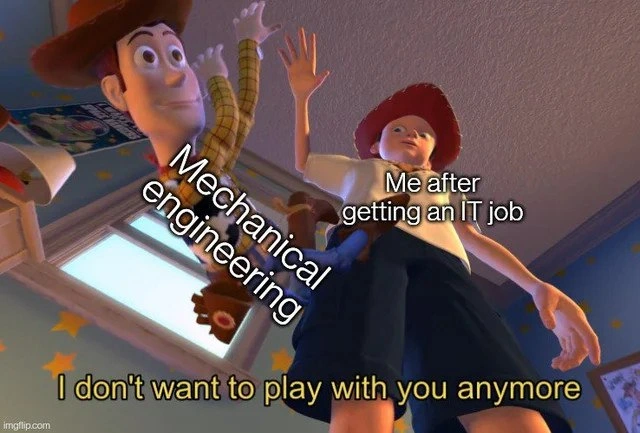
Imagine you have a favorite toy that you used to play with all the time. But one day, you get a brand new toy that’s super cool and exciting. Suddenly, you don’t feel like playing with the old toy anymore. This meme is joking that a similar thing happens with grown-ups and their careers. The “old toy” is the person’s mechanical engineering degree – something they spent a lot of time on – and the “new toy” is a new job in IT (working with computers). The picture shows a kid tossing away his old toy saying, “I don’t want to play with you anymore.” In real life, it means the person is basically saying, “I don’t want to do my old engineering stuff anymore now that I have this cool new IT job.” It’s funny in the same way it’s funny to see a kid drop a toy for a shinier one – it exaggerates how quickly we can forget the old thing when something new and better comes along. So the meme feels like a playful way of saying, “Yep, I’ve moved on to something more fun!”

Level 2: Hard Hat to Hoodie

In this meme, a famous scene from Toy Story is re-imagined to poke fun at a common tech career switch. We see a boy (Andy) dropping his beloved cowboy doll (Woody) onto the floor. In the meme version, Andy is labeled “Me after getting an IT job” and the falling Woody is labeled “Mechanical engineering.” The text “I don’t want to play with you anymore” appears as if Andy is saying it to his old toy. Essentially, the image is showing someone who studied mechanical engineering (that’s the “old toy”) abruptly abandoning it once they land a job in IT (the “new toy”).

Let’s break down the joke in simpler terms. Mechanical engineering is a field where people learn to design and build physical things – like engines, machines, or other devices with moving parts. It’s often considered a more “traditional” branch of engineering (picture hard hats, blueprints, and maybe building car engines or HVAC systems). An IT job, on the other hand, usually means working with computers and software (writing code, managing systems, building apps, etc.) – think of a person in a hoodie and headphones, typing away on a laptop. So the meme humorously suggests that as soon as someone with a mechanical engineering background gets hired for a software developer or IT role, they immediately turn their back on mechanical engineering, almost like saying: “Goodbye, old career, I have a cooler one now.”

This is actually pretty relatable for many people starting out in tech. It’s not uncommon for folks to go to college for one thing and end up working in another field. Here the contrast is specifically between mechanical engineering and software. Why those two? In the real world, lots of engineers who studied mechanical (or other non-computer fields) have ended up working in the software/IT industry. One big reason is job opportunities and salary. Tech jobs have exploded in number over the past decade, and they often pay more than traditional engineering jobs right out of school. So imagine you’re a new graduate who spent four years learning how to design gears and engines, but then you get an offer from a software company that pays really well. The meme is illustrating that moment where you’d happily drop all the gear drawings and formulas (the Woody doll symbolizing mechanical work) because you’ve found something new and exciting in tech (like Andy getting a new toy to play with).

The caption “I don’t want to play with you anymore” is written in big bold yellow letters, mimicking the style of movie subtitles for that scene. It’s a direct way of saying, “I’m done with this.” In context, “play” refers to working in that field or continuing with that career. So the person is effectively saying “I don’t want to do mechanical engineering anymore.” The tone is exaggerated – in reality, people don’t usually hate their old field overnight, but it feels that way in the joke. The bright and cheery kid’s bedroom background (with blue walls and star decorations) gives the whole meme a lighthearted, playful feeling. It’s as if changing your career focus is as casual as a kid tossing aside a toy. This adds to the humor, because switching careers (or ignoring your college degree) is a pretty serious life decision, but the meme portrays it in an overly carefree way.

From a junior developer’s perspective, the meme might also hint at the experience of discovering the tech world. Maybe someone started in mechanical engineering and realized partway through that they really enjoy coding, or they saw how much excitement and growth is in software. So as soon as they got a chance, they pivoted. This is common enough that it’s a trope: engineers-turned-coders. In fact, many tech companies and startups don’t mind what you studied; they care about what you can do. So people often take online coding courses or self-study programming and then get hired into IT roles even if their diploma says something else. The meme labels make it super clear: “Me after getting an IT job” (that’s the person’s new identity, in a way) dropping “Mechanical engineering” (their old identity or degree).

Why is this funny? For one, there’s an element of truth that can be both humorous and a little bittersweet. It’s true that a lot of knowledge from a mechanical engineering degree might not be directly used in a software job. You might spend years studying things like thermodynamics or machine design, and then end up debugging JavaScript code for a web app. The meme exaggerates this abrupt change: like saying “Welp, I have no use for all those textbooks now – see ya!” That exaggeration is what makes it a joke. It resonates especially with developers or students who have seen classmates switch fields, or have done so themselves. It also plays on the idea of chasing what’s “hot” in the market. Tech is seen as the place to be right now, much like a new trending toy that everyone wants. Meanwhile, mechanical engineering might seem old-fashioned or less glamorous to some, akin to an old toy you’ve grown bored of.

The tags like career_switch and tech_salary_motivation give clues to the meme’s context. Career switch is straightforward – the meme is literally about switching careers (from mechanical to IT). Tech salary motivation points out that one reason for the switch is money; IT jobs, especially in software development, often offer higher starting salaries and faster growth in pay. Early-career folks notice this – for example, a friend with a computer science or IT job might be earning significantly more than a friend who went into a traditional engineering firm. This salary difference can be quite motivating for someone to jump into tech, even if it’s not what they originally trained for. So the meme humorously acknowledges that dynamic: as soon as the person lands an IT job (with its promises of a bigger paycheck and maybe a hip work environment), they’re more than ready to drop their old mechanical engineering plans.

In simpler terms, the meme is saying: “I studied one thing, but now I’m doing another, because that other thing (IT) turned out to be more exciting or rewarding for me.” It uses the Toy Story dropping-Woody format (a popular meme format to depict leaving something behind) to make the message clear at a glance. Anyone who knows the movie scene will instantly get the reference of discarding an old favorite. And anyone in tech or engineering will likely chuckle because they know at least one person who’s done exactly this – maybe even themselves. It’s a light-hearted take on the idea that in the fast-changing tech-driven world, career plans made at 18 can change by the time you’re 22 and see where the real opportunities are. And just like a kid in a toy-filled room, we can be fickle: today’s passion (mechanical gadgets) might become tomorrow’s forgotten toy when a cooler one (coding and IT) comes along.

Level 3: From Atoms to Bits

The meme humorously captures a career switch that’s become all too familiar in tech: an engineer tossing aside a hard-earned mechanical engineering degree the instant a shiny IT job comes along. In the classic Toy Story scene repurposed here, Andy (the kid) is labeled “Me after getting an IT job,” and Woody (the cowboy doll he drops) is labeled “Mechanical engineering.” The infamous line appears at the bottom in big yellow subtitles: “I don’t want to play with you anymore.” This dramatic kid’s-bedroom moment perfectly satirizes what happens in real life when market forces and tech hype collide with individual career paths. One day you’re designing gear trains and calculating stress equations; the next, you’ve got a GitHub account, a stack of programming books, and you’re deploying microservices instead of building machines.

On an industry level, this meme pokes fun at how quickly engineers abandon their original field when lured by the booming software industry. And honestly, it’s funny because it’s true. The minute tech companies started hiring broadly, offering higher salaries and stock options, you saw a wave of people pivoting from traditional engineering disciplines to software development. This pattern is especially common in regions where IT consulting firms recruit en masse from all engineering grads – mechanical, civil, electrical, you name it – and train them to write code. The result? Legions of mechanical engineers-turned-developers who know more about Java classes than jet engines. It’s a running joke in the community because so many developers have diplomas hanging on the wall that say Mechanical Engineering while their day job involves debugging web applications.

Why does this happen, and why is it so relatable? Incentives in the tech industry are a big part of the story. Tech moves fast, pays well, and has a certain glamour (or at least a promise of free snacks and hoodies). Meanwhile, entry-level jobs in mechanical engineering can feel comparatively less dynamic or harder to come by. The humor carries an undercurrent of truth about market demand shifts and personal priorities. When software salaries in some markets can be double those in traditional engineering, it’s no surprise that even passionate gearheads might jump ship. We’ve basically created an economy where writing code for an app can be more financially rewarding than designing an engine that goes into a car. As a result, the moment an offer letter from a tech firm appears, many folks promptly perform an “Alt+Tab” on their career – switching windows from SolidWorks to Stack Overflow without a second thought.

To seasoned developers (especially the cynical veterans among us), this meme triggers a knowing smirk. It hints at shared experiences and maybe a touch of impostor syndrome some have felt. Picture a former mechanical engineer in their first software stand-up meeting, secretly Googling what “Kubernetes” means, all while their expensive understanding of fluid dynamics collects dust. It’s comedic, but there’s also a subtle commentary: the skills we painstakingly acquired in one domain can become the forgotten toy once a more lucrative opportunity appears. The scene’s carefree, toy-scattered setting underscores how casually this switch can happen – as if a serious five-year engineering education is dropped with the nonchalance of a child tossing aside yesterday’s favorite toy.

Yet, beneath the humor lies a real tension. Mechanical engineering is a challenging field involving physics, material science, and tangible problem-solving. Abandoning it “the minute IT hires you” suggests just how powerful the pull of the software world is. There’s a bit of dark irony that someone might go from designing bridges or engines to tweaking CSS alignment issues and feel it’s a trade-up. Veteran developers who’ve been around the block might chuckle, recalling colleagues who once specialized in concrete or combustion, now writing Python scripts for e-commerce platforms. They’ve seen the late-night Slack messages from those ex-mechanical folks when a production deploy goes wrong – turns out 3 AM outages don’t care what your major was. In that sense, the meme also bonds people through a shared “oh, that’s so true” moment, whether you’re the one who switched or you’re on a team full of former mechanical, chemical, or even aerospace engineers who all ended up in the code mines together.

Let’s not ignore the “I don’t want to play with you anymore” quote plastered on the meme. It’s blunt and a bit savage – implying zero sentimentality about dropping the old field. This exaggeration is key to the joke: of course real life isn’t as simple as saying goodbye forever to mechanical engineering knowledge. But the meme leans into the stereotype that new developers practically ghost their past discipline. It’s poking fun at that almost disloyal-seeming pivot. One day you’re meticulously drafting a CAD model or running finite element analysis; the next day you’re like, “Finite element what? I only speak Java now.” The comedic exaggeration lands because many in tech have felt or witnessed that total immersion in the software world, where your past expertise feels nearly irrelevant. Mechanical Engineering becomes that old toy at the bottom of the toy box, while the new IT career is the flashy action figure getting all the attention.

From a broader perspective, this meme highlights a trend in the tech industry over the past couple of decades. Just as Andy outgrows one toy for another, entire workforces have “outgrown” their old industries to chase the tech boom. Think about the Dot-com era or the current AI/ML hype – whenever tech surges, people from other fields flock to it. Historically, we saw something similar when personal computing took off: many who studied something else quickly learned programming on the side to join the software gold rush. It’s a case of follow the money and follow the excitement. There’s certainly a bit of sarcasm here – the meme implies mechanical engineering was good enough to study, but not good enough to stick with once a better offer comes knocking. And seasoned engineers might wryly recall how universities encourage passion for core engineering… until the job market sings a different tune and even professors’ top students end up as software developers at Big Tech Co.

To illustrate the stark change in daily work life, consider the difference in what our mechanical-engineer-turned-developer might be doing:

# During the mechanical engineering days:
# (Using physics formulas instead of code)
force = mass * acceleration    # F = m * a, a classic from Newton's laws
moment = force * distance      # Calculating a moment or torque

# After landing the IT job:
def deploy_to_production():
    print("Deploying new microservice...")  # Now dealing with code and servers

deploy_to_production()

In a mechanical lab you worry about real-world units and tolerances; in a software deployment you worry about container crashes and null pointers. It’s a completely different skill set, almost like Andy replacing his old cowboy doll with a high-tech Buzz Lightyear. And funnily enough, that Buzz Lightyear analogy isn’t far off – Buzz was shiny, new, tech-infused (a space ranger!) compared to the old cowboy. Likewise, the IT job is seen as modern and cutting-edge compared to the “old school” mechanical work. The meme capitalizes on this parallel.

Ultimately, the humor lands because it taps into a genuine relatable developer experience: the idea that many of us are working in jobs unrelated to what we thought we’d do. It’s a gentle roast of all those mechanical (or civil, or electrical) engineers who now introduce themselves as software developers on LinkedIn. The shared understanding is that the switch was remarkably easy once the opportunity arose — perhaps too easy, just like dropping a toy. As a community, we laugh at this because it’s a little absurd and a little true: technology’s gravitational pull can yank people right out of their original career or degree path. And when Andy says “I don’t want to play with you anymore,” we all instantly recognize that cheeky feeling of Welp, so much for that degree... time to code!.

Description

This meme uses the popular 'Andy dropping Woody' format from the movie 'Toy Story.' The scene depicts Andy, the boy, casually dropping his long-loved toy, Woody, as he walks away. In this version, Woody is labeled 'Mechanical engineering,' and Andy is labeled 'Me after getting an IT job.' The original subtitle from the movie, 'I don't want to play with you anymore,' is displayed at the bottom of the image, reinforcing the theme of abandonment. The meme humorously captures a very common phenomenon in the tech world: individuals trained in other engineering disciplines, such as mechanical engineering, pivoting to careers in IT and software development. For experienced developers, this is a relatable origin story, as many of them transitioned from other STEM fields, attracted by the perceived better opportunities, higher salaries, and different work culture in the tech industry. It's a lighthearted take on career changes and the magnetic pull of the software world
Comments

13
Anonymous ★ Top Pick My mechanical engineering degree prepared me for dealing with high-pressure systems and fluid dynamics. Turns out, that's just a regular Tuesday in production support
  1. Anonymous ★ Top Pick

    My mechanical engineering degree prepared me for dealing with high-pressure systems and fluid dynamics. Turns out, that's just a regular Tuesday in production support

  2. Anonymous

    Swapped finite-element stress tensors for Kubernetes pod stress - figure if something’s going to buckle under load, I’d rather it be a container than an OSHA report

  3. Anonymous

    The real tragedy isn't abandoning mechanical engineering - it's discovering that after 15 years in tech, you still end up building elaborate Rube Goldberg machines, except now they're made of microservices, message queues, and eventually consistent databases that somehow cost more than an actual factory

  4. Anonymous

    The classic mechanical-to-software pipeline: you start designing physical systems with tolerances measured in microns, then discover you can ship bugs to production with zero friction and infinite scalability. Why stress over material fatigue when you can just restart the container? At least when a bridge collapses, there's a clear root cause analysis - in software, it's always 'works on my machine' until the 3am PagerDuty alert proves otherwise

  5. Anonymous

    Switched from mechanical to IT - traded tolerance stack-ups for eventual consistency; if it doesn’t fit, we just call it ‘loosely coupled’ and ship

  6. Anonymous

    From shear stress in beams to shear panic in prod outages - same engineering principles, exponential TC

  7. Anonymous

    Switching from FEA to SRE is just trading boundary conditions for SLAs - ignore the tolerances and both the bridge and the deploy collapse

  8. @sofizephyrus 4y

    this feeling when you are actually a mechanical engineer and you are thinking about changing specialty to IT. 🤷‍♀️ maybe it's a sign?

    1. @volkov_s 4y

      Already subscribed to IT meme channels to start switching process?

      1. @sofizephyrus 4y

        yep, i think it's a good idea to understand it's yours or not and to keep yourself motivated

      2. @async_andrew 4y

        transitioning*

  9. @RoadManiacBaba 4y

    I left mechanical engineering immediately after doing my degree and managed to switch to a dev role by my 3rd job.

  10. @Dakaraj 4y

    Shit, that's the story of my life

Use J and K for navigation