Skip to content
DevMeme
4373 of 7435
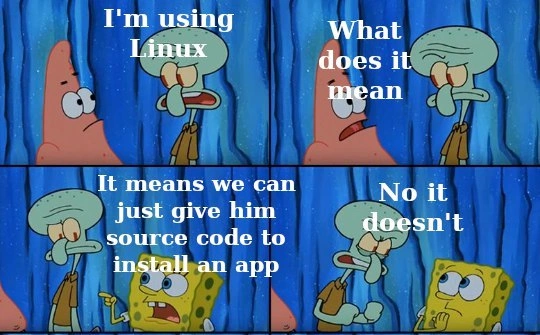
When Linux user asks for an app and gets handed raw source code
PackageManagement Post #4787, on Aug 13, 2022 in TG

When Linux user asks for an app and gets handed raw source code

Why is this PackageManagement meme funny?

Level 1: Some Assembly Required

Imagine you ask a friend for a new toy, but instead of giving you a ready-to-play action figure, they hand you a box of plastic pieces, screws, and an instruction booklet. They say, “Here you go, you can put it together yourself since you’re good with puzzles!” You’d probably give them a funny look, right? 😕 This meme is playing on that same feeling. The Linux user just wanted to install a program (like getting a toy to play with), but the developer jokingly responds by giving them the “ingredients” of the program (the raw code) and expects them to build it on their own. It’s funny in a silly way because it’s so overly complicated: just because you can do it yourself doesn’t mean that’s what you wanted. In simple terms, it’s like asking for a cake and being handed flour, eggs, and a recipe — sure, you could bake it, but sometimes you just wanted to eat cake, not become a baker that day! The humor comes from that relatable surprise and mild frustration when something that should be easy is turned into a DIY project for no good reason.

Level 2: Binaries Not Included

Let’s break down the technical bits of this joke. Linux is an operating system (well, technically a family of OS distributions) widely used by developers and power-users. When someone says “I’m using Linux,” it usually means their computer runs a Linux-based OS like Ubuntu, Fedora, or Arch. Now, an app is just a software program. Normally, to install an app, you prefer an easy method: on Linux that’s typically using a package manager (tools like apt on Ubuntu/Debian or yum/dnf on Fedora/Red Hat). Package managers are like app stores without the storefront – you type a command (or click in a software center) and it downloads a pre-built app package (a binary) plus any libraries it needs, then sets it up for you.

So what’s source code in this context? It’s the original human-readable code that programmers write (in C, C++, Python, etc.). Raw source code by itself can’t be run directly; it needs to be translated into machine code through a process called compiling. When Spongebob says they can "just give him source code," he’s suggesting the user should compile the program on their own computer. Installing an app from source typically involves steps like:

# Example of manual source installation steps
wget http://example.com/someApp.tar.gz   # download the source code archive
tar -xzf someApp.tar.gz                  # extract it (it's a tar.gz "tarball")
cd someApp/                              # go into the source code directory
./configure                              # configure the build for your system
make                                     # compile the code into a binary
sudo make install                        # install the compiled program into the system

Each of those steps can introduce challenges. For instance, running ./configure checks that your system has all the needed dependencies (other software libraries or development files). If something is missing, the process errors out. This scenario is jokingly referred to as "dependency hell" – imagine trying to install one program, and it asks for another piece of software, which in turn asks for yet another, and so on. Without a package manager to fetch those automatically, a newbie can quickly get lost.

The meme’s humor comes from contrasting two approaches to the software installation process on Linux: the convenient way versus the hard way. The convenient way: using your package manager (for example, you’d simply run sudo apt install someApp on Ubuntu, and it would handle everything). The hard way: being handed only the source code, meaning you must compile it yourself with the steps above. This often happens in the Open Source community if the developers didn’t provide pre-built packages. It’s doable – one of Linux’s strengths is that you can customize and build anything – but it’s time-consuming and error-prone if you’re not used to it. Squidward saying “No it doesn’t” is the experienced stance that using Linux doesn’t automatically equal loving complicated installs. In real life, even Linux users prefer it when developers provide proper packages or binaries for their system. They can compile from source (many development tools are available on Linux by default), but usually only do so when they have no other choice or when they specifically enjoy that kind of control (like certain hardcore users of source-based distros such as Gentoo). In summary, the joke is highlighting the difference between installing an app the normal way versus being handed a do-it-yourself kit. One is streamlined, the other can turn into a mini-project of its own.

Level 3: Source of the Problem

This meme hits home for seasoned developers because it parodies a familiar scenario in the Developer Experience (DX) space: the assumption that Linux users are willing (or happy) to compile software from source. Patrick proudly saying “I’m using Linux” sets the stage. To many developers, hearing that might imply the person is tech-savvy or at least comfortable with geekier workflows. Squidward’s deadpan “What does it mean?” prods further, teeing up SpongeBob’s overly eager misunderstanding: “It means we can just give him source code to install an app.” This line encapsulates a classic developer humor trope – the idea that providing raw source code is an acceptable “installation method” for Linux folks. Squidward’s final retort, “No it doesn’t,” delivers the punchline by shutting down that misinformed notion. It’s the voice of experience correcting wide-eyed naiveté.

Why is this funny (and a bit painful)? Because it riffs on the unspoken contract between software developers and users. On Windows or macOS, when someone asks for an app, they expect an installer or at least a one-click package. But in the Linux world, especially years ago or with niche open-source tools, it wasn’t uncommon to be handed a link to a GitHub repo or a .tar.gz archive with source code. The meme exaggerates this dynamic: SpongeBob (representing an inexperienced or idealistic dev) assumes that a Linux user wants to tinker under the hood. “They use Linux, so they must love terminals and compilers, right? Just toss them the code!” It satirizes how some developers or project maintainers take Linux’s openness as a license to skip user-friendly distribution. The experienced Squidward knows better – he’s likely been on the receiving end of that “just compile it yourself” advice and has the battle scars to prove it.

Many of us have lived the scenario behind this meme. Perhaps you needed a tool that wasn’t in your distro’s repository. You find the project’s page, only to realize no precompiled binaries are provided for your Linux flavor, just the source. “No problem,” you think, “I’ve heard the legends of compiling from source…” Then reality hits. You run ./configure and it halts with a cryptic error about a missing library (fatal error: libfoobar.h: No such file or directory). Now you’re manually hunting down dependencies“What the heck is libfoobar and where do I get it?” – possibly leading you to compile that library from source too. This cascading dependency hell is a rite of passage in open-source circles. The meme is basically a wink to all those times a simple install turned into an afternoon of troubleshooting Makefiles, Googling error messages, and installing development headers. Package management was invented to save us from this exact nightmare by pre-resolving and bundling dependencies, so when a dev suggests skipping that and handing over raw code, it elicits equal parts laughter and dread from experienced Linux users.

From an organizational perspective, the SpongeBob character could also represent a well-meaning but lazy software maintainer. Packaging software for multiple Linux distributions is extra work – you might have to create .deb packages for Debian/Ubuntu, .rpm for Fedora/RedHat, maybe a Homebrew formula, etc. It’s tempting to say, “Linux users are power users; they can build it themselves.” The meme pokes fun at this attitude. It’s essentially Squidward (and the community at large) responding: “Actually, no, being a Linux user doesn’t mean I want to be your build engineer. Give me a proper install, please.” This highlights a key aspect of developer experience: good DX means making installation easy, even for Linux folks. After all, not every Linux user is running Gentoo (a distro famous for compile-from-source culture); a lot of them are just normal users who appreciate convenience as much as anyone. The humor resonates because it’s “funny ’cause it’s true” – we’ve all met that one colleague who assumes everyone wants to do things the hard way, and we’ve all wanted to be Squidward saying, “Stop. That’s not what being a Linux user means at all.”

Level 4: NP-Hard to Install

Under the hood, giving a Linux user raw source code shifts the burden of software installation onto them, involving some surprisingly complex computer science. When you hand out source code, you're effectively saying: “Here’s the recipe, now solve all the steps to cook it on your machine.” This plunges the user into the realm of build systems, compiler toolchains, and dependency resolution. In a modern Linux distribution, a package manager (like apt, dnf, or pacman) normally handles these tasks by pre-compiling software and solving dependency requirements for you. But if you're installing from source, you become the package manager – and that’s where things get interesting (and painful).

Consider what a package manager does: it maintains a directed graph of package dependencies. Each program might depend on specific versions of libraries (and those libraries depend on others, and so on). The package manager’s job is to traverse this graph and find a set of packages that satisfy all version constraints without conflicts. This is essentially a constraint-solving problem. In fact, fully resolving complex dependency requirements can be NP-complete – a fancy way of saying there's no quick algorithm to find a perfect solution every time (aside from trying a lot of combinations). Academic research and real-world package managers have even employed SAT solvers (the same algorithms used to solve boolean logic puzzles) to figure out which package versions can coexist. So when SpongeBob blithely assumes “we can just give him source code to install an app,” he's unwittingly dumping a mini computer science problem on the user’s lap. The meme humorously exaggerates this scenario: it’s like handing someone a jigsaw puzzle (the dependency graph) instead of a completed picture and expecting them to be thrilled.

Moreover, Linux isn't a single unified platform – it’s an ecosystem of different distributions (Ubuntu, Fedora, Arch, etc.), each with their own libraries and conventions. There’s no universal “.exe” in Linux land; a program compiled on one distro might not run on another due to differences in C libraries, kernel versions, or compilation flags. Distributing source code is the lowest common denominator: in theory, you can compile it for your specific environment, sidestepping binary incompatibilities. But in practice, that means dealing with whatever compiler and library versions you have installed. If the source expects a library you don’t have, or only builds on a particular kernel version, dependency hell ensues as you scramble to fulfill those prerequisites. The meme highlights this patchwork reality of the open-source world: yes, the code is all there for you (transparency and freedom!), but the convenience of installation can fall apart spectacularly if maintainers don't package their app properly. It’s a classic case of trading off upfront developer effort for downstream user effort. High-level lesson? “Open-source” might mean you can get under the hood, but it doesn’t magically solve the hard logistical problems of software delivery – someone, somewhere still has to do that work, or else every user ends up reinventing the build.

Description

Four-panel SpongeBob meme with Patrick, Squidward, and SpongeBob. Panel 1 (top-left) shows Patrick saying in white text: "I'm using Linux". Panel 2 (top-right) has Squidward replying: "What does it mean". Panel 3 (bottom-left) shows SpongeBob enthusiastically pointing while Squidward watches; text reads: "It means we can just give him source code to install an app". Panel 4 (bottom-right) shows Squidward correcting SpongeBob with: "No it doesn't". The joke riffs on the developer trope that Linux users must compile everything from source, highlighting pain points around package management, dependency hell, and installation workflows in open-source ecosystems

Comments

6
Anonymous ★ Top Pick “On Linux we call it ‘shipping source’: it’s just free CI where the user runs ./configure, discovers your transitive dependency on a 2008 libssl, and files the bug for you.”
  1. Anonymous ★ Top Pick

    “On Linux we call it ‘shipping source’: it’s just free CI where the user runs ./configure, discovers your transitive dependency on a 2008 libssl, and files the bug for you.”

  2. Anonymous

    "Sure, just compile from source" - the three words that turn a 5-minute install into a 3-hour archaeology expedition through Stack Overflow posts from 2011, only to discover the maintainer abandoned it because of a GPL vs MIT licensing dispute

  3. Anonymous

    The real joke is that after 20 years of package managers, containerized apps, and Flatpak/Snap/AppImage, we've somehow convinced ourselves that Linux is more user-friendly now - yet the first troubleshooting suggestion on forums is still 'just compile it from source with these 47 dependencies.' Meanwhile, Windows users are over there double-clicking .exe files like it's 1995, and somehow that's still more reliable than our dependency hell

  4. Anonymous

    “He’s on Linux, just ship the source” - translation: glibc ABI roulette, OpenSSL 1.1 vs 3.0, and a Python‑2 configure script; the real installer is a Docker image and an apology

  5. Anonymous

    Patrick's got that Linux zeal: source tarball as the universal app installer, because who needs distro repos when you've got eight hours of unresolved deps?

  6. Anonymous

    Using Linux doesn’t mean “just give me source” - it means “ship a .deb/.rpm/Flatpak with a signed checksum, or I become your unpaid build engineer.”

Use J and K for navigation