Skip to content
DevMeme
4372 of 7435
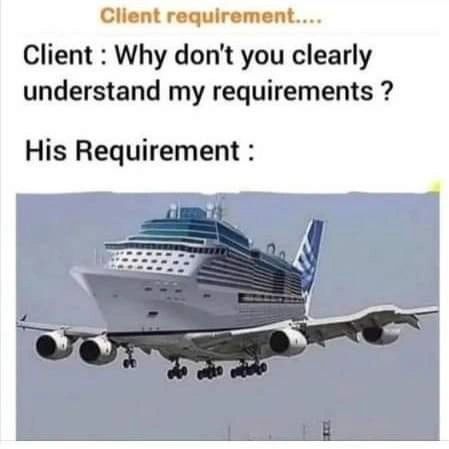
When client demands a cruise ship that can also fly like a plane
Stakeholders Clients Post #4782, on Aug 13, 2022 in TG

When client demands a cruise ship that can also fly like a plane

Why is this Stakeholders Clients meme funny?

Level 1: Boats Can’t Fly

Imagine your friend says they want a boat that can also fly like an airplane. You’d probably laugh and say, “That doesn’t make sense – boats float on water, planes fly in the air!” This meme is funny for the same basic reason. The client is basically asking the engineer for something impossible, like asking for a car that’s also a submarine or a pizza that’s also an ice-cream sundae. It’s two totally different things mashed into one. The picture shows a gigantic cruise ship with wings and jet engines – it looks silly because we all know boats can’t have wings like that and actually take off! The humor (and frustration) comes from the idea that the client doesn’t understand why this request is crazy. The engineer hearing this request would feel confused and exasperated, kind of like if your friend got upset that you couldn’t turn their bicycle into a unicorn. In simple terms: the meme is laughing about a big misunderstanding, where someone asks for something that just can’t be done, and it captures that “wait, are you serious?” feeling in a really goofy way that anyone can understand.

Level 2: Communication Breakdown

So what’s going on here from a more beginner-friendly angle? Essentially, this meme is about a CommunicationGap between a client and a developer team. The client says, “Why don’t you understand my requirements?” but the picture shows his requirement is a ridiculous ask: a vehicle that’s half cruise ship, half airplane. Let’s break down some terms and ideas:

  • Stakeholder: This is usually anyone who has a stake or interest in the project’s outcome. In many cases, it’s the client (the person or company who wants the software built). They have certain ClientExpectations – things they hope the product will do or how it will look. Here the client is the stakeholder with a wild expectation: they want one thing that does two very different jobs.
  • Requirement: A requirement is a specific need or feature that the final product should have. Good requirements are clear and achievable. RequirementsAmbiguity happens when what’s needed isn’t clearly stated, which often leads to confusion. In the meme, the requirement is ambiguous (and frankly unrealistic) – does the client want a cruise ship and a plane as separate things, or truly one hybrid hybrid_vehicle_meme? The developer is likely confused because the request wasn’t clear or feasible.
  • MisalignedExpectations: This refers to when what the client expects is not aligned with what the dev team understands or can deliver. We see that here: the client expected the developers to just “get” this crazy idea, while the developers are probably thinking, “They want what now?” This misalignment is often why projects fail or go over budget. A client might imagine something grand (like our flying ocean liner) without realizing the contradictory_specs or technical hurdles, and the engineers are left unsure how to proceed.
  • Scope Creep: This is a term you’ll hear a lot in project management. It means the scope (the total of what’s to be done) keeps creeping upward – new features and changes get added on as you go. For example, you start building a normal cruise ship (scope defined as a ship), but mid-project the client says, “Actually, it should also fly like a plane.” That’s a HUGE scope change (really more like scope explosion!). In the real world, scope creep might look like a client continually saying “Oh, can we also add this feature? And that feature too?” without adjusting the timeline or budget. Before you know it, you’re attempting the impossible. The meme doesn’t show the process, but we can imagine maybe initially the client wanted a cruise ship, then kept adding requirements until essentially they asked for a plane’s capabilities on top.
  • Miscommunication: A simpler way to put a lot of this is just plain miscommunication. The client in the meme is frustrated, asking why he wasn’t understood, and the devs are equally baffled by what he wants. Often this happens when there isn’t a good process for discussing requirements. Maybe the client said, “I need a vehicle that can transport customers in luxury and also get them across the ocean fast,” and the development team took that literally – resulting in this absurd literal interpretation. In software, if a client says something like “I want an app that works like Uber and also like Instagram,” it could mean many things. Without clarifying, developers might build something the client didn’t imagine, and then the client says “No, that’s not what I wanted at all!”

Now, think of a scenario as a junior developer or student: perhaps you’re asked to make a website for someone and they keep mixing ideas. One day they say “It should have a modern minimalist look,” the next day “Actually, add all these fancy graphics and text everywhere.” These two directions conflict. You’d probably feel frustrated or confused – which one do they really want? That’s essentially what’s happening in this meme. The ClientExpectations were not clearly communicated, or they were unrealistic to begin with. Good communication would involve sitting down with the client and writing down each requirement, then reviewing them: “Do we want a cruise ship or a plane? What is the actual goal here?” In professional terms, we create something called a requirements document or user stories to capture what the client needs in detail. If that had been done properly, someone would have flagged, “Umm, a cruise ship that flies is not a thing we can build. Let’s clarify what you actually need.”

This meme also pokes fun at the relationship between non-technical clients and technical teams. Clients might not know what’s hard or easy in engineering. As a junior dev, you might encounter a client asking for a feature that sounds simple to them but is extremely complex to implement (or flat-out impossible). For example, a client might say, “Why can’t you just use AI to automatically translate my entire website perfectly into 50 languages overnight?” To them, it’s a casual request; to you, it’s a massive undertaking not solved by waving a wand. In the meme, the client’s question “Why don’t you understand my requirements?” suggests he thinks his request is straightforward. This can happen if the client uses their own imagination without checking feasibility – like thinking, “Planes exist, ships exist, so just put them together, what’s the problem?”

Finally, let’s acknowledge ProjectManagement basics: a project manager or business analyst is usually responsible for bridging this understanding gap. They’d use techniques to gather requirements (through interviews, diagrams, prototypes, etc.) to ensure both the client and dev team agree on what’s being built. If that role fails or isn’t present, you can end up with a meme-worthy misunderstanding. RequirementsUncertainty (not being sure what is wanted) is a big risk. As a newcomer, you can learn from this: always clarify requirements. Ask questions like, “You want a cruise ship and it should fly? Do you mean you need two separate features, or one integrated feature? What problem are you really trying to solve?” Sometimes by asking these, you help the client realize they were asking for something problematic. Communication is key.

In summary, at this level we see the meme as a lesson in the importance of clear, feasible requirements. It’s showing a nightmare scenario of MisalignedExpectations in a humorous way. If you ever feel like you’re building something as absurd as a cruise_ship_airplane, that’s a big red flag to pause and get everyone on the same page! The picture is extreme on purpose, to remind us that without good communication, developers might attempt to build nonsense because they think that’s what the client wants.

Level 3: Feature Frankenstein

At the highest level, this meme highlights a classic requirements engineering nightmare: the Feature Frankenstein project. It’s where a client’s StakeholderExpectations are a patchwork of grand ideas stitched together without regard for reality. In the image, a cruise ship has been bolted onto a jet airliner – a tongue-in-cheek visualization of unrealistic_requirements. Experienced engineers immediately recognize the satire: we've all seen projects where the client asks for a product that combines incompatible features, essentially a contradictory_specs chimera. The humor lands because it's painfully relatable – integrating a massive ocean liner's amenities with a plane’s aerodynamics is about as feasible as merging two completely different software paradigms into one flawless system.

From a senior developer’s perspective, the meme is a nod to MisalignedExpectations and broken communication in project planning. Why is it so funny? Because it’s true: clients (or upper management) sometimes demand a system that "does everything" without realizing the trade-offs. For example, a client might insist on Amazon-level scalability on a startup budget, or want a product that’s as simple as a toy yet as powerful as a supercomputer. Here, the cruise ship represents a huge, feature-rich system (think of a heavy enterprise application with tons of modules), while the airplane represents the need for speed and agility (think high performance, low latency). Combining them is absurd: a cruise ship is optimized for comfort and capacity, an airplane for aerodynamics and speed. In software terms, it’s like asking for a database that is ultra-consistent and ultra-available and ultra-partition-tolerant all at once – seasoned devs recognize this as the mythical all-three solution to the CAP theorem (impossible by definition!). The meme exaggerates to make a point: some requests violate fundamental constraints, whether physical laws (gravity, lift, weight) or computing limits (time, space, complexity).

This kind of scenario is an indictment of poor Communication and ProjectManagement processes. A well-run project will filter out or reconcile such RequirementsAmbiguity early on, but obviously that didn’t happen here. Perhaps the sales team promised a flying cruise ship to win the contract (“Sure, our platform can do anything you want!”), and now the dev team is left holding the bag. There’s an unwritten horror in the veteran engineering world: being handed a spec that makes no sense, then getting blamed for not delivering. The caption “Client: Why don’t you clearly understand my requirements?” drips with irony because the requirements themselves are nonsensical. It highlights the CommunicationGap: the client thinks they communicated clearly, but what they want is objectively infeasible. Every senior dev has war stories about projects with sliding scope or contradictory demands – one might joke about building an app that’s ultra-secure but also requires zero user authentication friction (another real-world “flyable cruise ship” ask where two goals conflict).

Let’s talk real-world analogues: Think of a government project that tried to do everything in one go and collapsed, or a legacy enterprise system that accreted so many features (due to ScopeCreep) that it became a lumbering beast no one could maintain. The meme’s plane-ship could be a stand-in for any over-engineered solution born from unchecked stakeholder requests. We laugh, but we also cringe, recalling meetings where someone said, “Can’t we just combine X and Y?” and management nodded, leaving the tech lead silently calculating the laws of physics being broken. It’s a form of gallows humor among developers: We know how this story ends, but we’re along for the ride anyway.

Why is fixing this situation so hard? Because saying “no” to a client (or boss) requires diplomacy and backbone. Organizations often lack a translator between business vision and technical reality. Agile methodologies and iterative prototyping were actually created to combat this exact problem: instead of a huge spec that might produce a flying cruise ship fiasco at the end, Agile encourages continuous feedback to catch absurd ideas early. In an ideal world, someone would have told the client, “Let’s break this into two vehicles – maybe a cruise ship and a plane – and have them work together, rather than one mutant machine.” In software, that translates to modular design or saying “We’ll build feature A and feature B, but as separate modules or phases.” However, not all clients accept that; some truly expect a miracle integration because they don’t grasp the complexity.

Under the hood, this meme is also a commentary on incentive structures and misunderstanding of engineering. The client’s incredulous question “Why don’t you understand?” implies they think the idea is perfectly reasonable. This can happen when clients are non-technical – they might see a plane and a ship and literally think you can just bolt them together, analogous to saying “Just use the same code for the website and the mobile app and the database, how hard can it be?” Many a Miscommunication arises from that innocent ignorance. Experienced engineers know that each system has design parameters: water vessels are built for buoyancy and stability, aircraft for lift and weight constraints. In software, you can’t, say, use a single algorithm to magically solve two different NP-hard problems at once without exponential cost. The humor, therefore, comes from that deep technical truth: you can’t cheat physics or computation, no matter what a client demands.

To illustrate the absurdity in code form, imagine trying to model this requirement in an object-oriented program:

// Defining a monstrous hybrid that should not exist
class FlyingCruiseShip extends CruiseShip implements Airplane {
    // Try to satisfy both interfaces: ship and plane
    public void sail() {
        // CruiseShip behavior
        System.out.println("Sailing on the sea... smooth and steady.");
    }
    public void fly() {
        // Airplane behavior
        System.out.println("Taking off into the sky... somehow.");
    }
    // But how to handle a landing? Water or runway?
    public void land() {
        System.out.println("Attempting to land this behemoth... *crunch*");
    }
}

In the comments above, // But how to handle a landing? Water or runway? is exactly the kind of unsolvable question that arises from mixed-up requirements. This pseudo-code highlights the contradiction: you can implement both interfaces in code, but in reality a design has to choose. The class might compile, but it doesn’t make logical sense – just like you can write down a ridiculous requirement but not build it in real life. Senior devs often encounter spec documents that read like a FlyingCruiseShip class – theoretically listing all desired methods, but with no regard to how those methods conflict in practice.

In summary, the senior perspective sees this meme as a wry commentary on stakeholder_satire: it satirizes how clients sometimes treat engineers like wizards who can fuse any two wishes into one product. The cruise_ship_airplane image is a perfect metaphor for RequirementsUncertainty run amok. Seasoned engineers chuckle (or groan) because behind the joke lies a serious lesson: successful projects need clearly defined, feasible requirements. Otherwise, you end up on the runway with a boat strapped to wings, everyone wondering why it’s not taking off.

Description

The meme is laid out in two parts. At the top, orange text reads "Client requirement…" followed by black text saying "Client: Why don't you clearly understand my requirements?" and then "His Requirement:". Below the text is a single image showing an absurd composite vehicle: the full upper half of a white-and-blue ocean cruise liner mounted directly on the fuselage, wings, jet engines, and landing gear of a large commercial airplane, captured as if taxiing on a runway against a blue-sky backdrop. The visual joke highlights how client or stakeholder specifications can combine incompatible ideas, resulting in impossible, contradictory deliverables. For software engineers, it satirizes poorly gathered requirements, scope creep, and communication gaps that lead to unbuildable products
Comments

6
Anonymous ★ Top Pick “Every time a VP asks for global consistency, sub-10 ms latency, and five-nines on the legacy mainframe, I picture this CAP-defying cruise liner taxiing for takeoff.”
  1. Anonymous ★ Top Pick

    “Every time a VP asks for global consistency, sub-10 ms latency, and five-nines on the legacy mainframe, I picture this CAP-defying cruise liner taxiing for takeoff.”

  2. Anonymous

    "We need the scalability of microservices with the simplicity of a monolith, real-time performance with eventual consistency, and it should be both stateless for the cloud and stateful for the audit trail. Also, can you make it work offline but keep it perfectly synchronized?"

  3. Anonymous

    This perfectly encapsulates the classic requirements gathering phase where the client wants a system that's simultaneously 'lightweight and scalable' (the airplane) while also being 'feature-complete with everything' (the cruise ship). They want microservices architecture with monolithic deployment, real-time performance with batch processing, and infinite scalability on a fixed budget. Then they wonder why the technical feasibility assessment takes more than five minutes and why you keep asking 'clarifying questions' instead of just building their perfectly clear vision of a flying ocean liner

  4. Anonymous

    Client requirements: on‑prem yet multi‑cloud, serverless but stateful, ACID over Kafka, real‑time batch and cheap - basically a cruise ship with landing gear

  5. Anonymous

    Client reqs so 'clear' they're stratospheric - now Kubernetes that cruise liner with some duct-taped pods

  6. Anonymous

    The PRD translates to “stateless monolith with ACID eventual consistency, on-prem multi-cloud, by Friday” - basically a cruise ship with wings

Use J and K for navigation