The Disconnect Between a User's Bug Report and Reality
Why is this Bugs meme funny?
Level 1: Polite Mask, Messy Mind
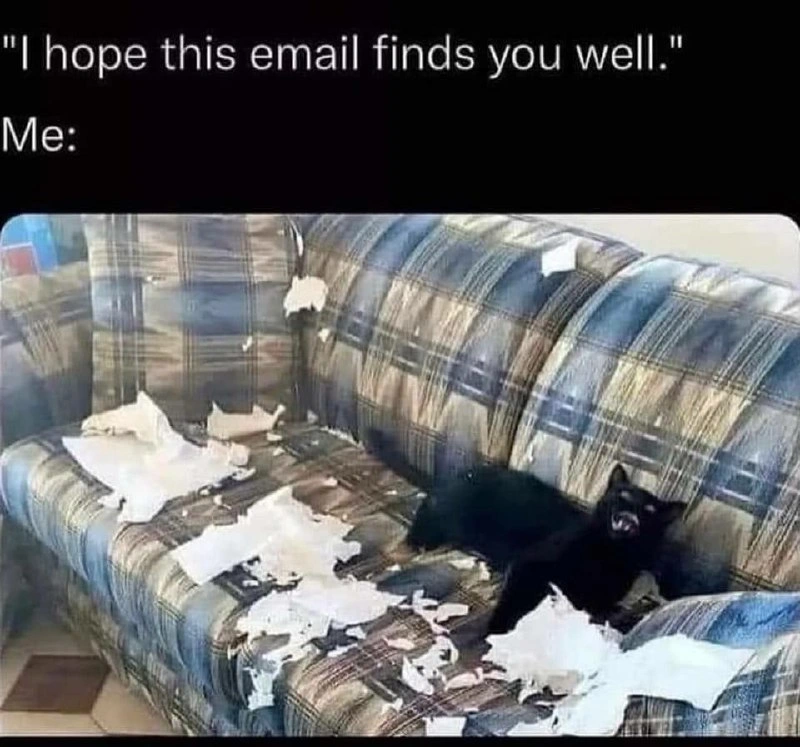
Imagine you’re having the worst day ever at school. Your desk is covered in torn-up homework papers, your hair’s a mess, and you feel like screaming because nothing is going right. Now, picture a friend or a teacher walks in, sees the chaos, and with a big smile says, “Hello! I hope you’re doing okay!” That’s a kind thing to say, right? They’re being polite and friendly. But in that moment, you’re definitely not okay – you feel as wild and frazzled as a cat that just knocked over all the books and papers in the room.
This meme is showing exactly that kind of situation, but in an office with a programmer. The top text, “I hope this email finds you well,” is like a very polite greeting someone writes in a work email – basically a nice way to say hello. The picture below labeled “Me:” shows a couch full of ripped-up paper and a black cat that looks super angry and stressed out. The couch and the mess represent how the person (a developer) actually feels on the inside – all torn up and chaotic – even though on the outside, everyone is acting all polite and normal.
It’s funny because the nice words in the email don’t match the real feelings of the person reading it. It’s like if you were really upset and your friend politely said, “Hope you’re doing well!” You’d probably think, “Yeah, right, I’m totally not well!” You might even feel like that angry cat on the inside. But you’d still reply nicely, saying something like, “I’m fine, thanks.”
So, the meme uses a simple, everyday contrast to make us laugh: a polite mask (the nice email greeting) versus a messy mind (the stressed, shredded feeling of the developer). The cat tearing up paper is a silly, exaggerated way to show how a stressed person might feel when they get that overly sweet email. It’s a way of laughing at the fact that in many workplaces, we all pretend to be calm and courteous, even when we’re actually overwhelmed. Anyone who’s ever had too much homework or a tough day can relate – someone cheerfully asks how you are, and you force a smile while internally you’re about to scream. The meme just captures that in a dramatic, goofy image. That mismatch between “Everything’s fine, hope you’re well!” and “No, everything is a mess!” is what makes it both funny and comfortingly relatable.
Level 2: Polite vs Panic
Let’s break down what’s happening in this meme in simpler terms. At the top, we see the phrase “I hope this email finds you well.” This is a polite email greeting commonly used in offices. People include friendly lines like that at the start of emails to sound courteous and professional. It’s part of standard corporate communication etiquette – basically a nice way of saying “Hello, how are you?” in written form. Such greetings are extremely common in WorkplaceHumor setups, and often appear in jokes about office life because they can sound overly formal or even robotic at times.
Now, right below that phrase, the meme shows the word “Me:” followed by a photo of a couch. But this isn’t a normal couch scene – the couch is covered in torn-up white paper shreds, and there’s a black cat lying there looking completely freaked out and angry (its mouth is open like it’s hissing or yelling). This image is used to represent the person reading the email – in this case, a developer – and how they actually feel internally. The torn paper on the couch symbolizes chaos and destruction, almost like someone took a stack of important documents or to-do lists and ripped them to pieces. The black cat with a feral, stressed-out expression personifies the developer’s mindset: upset, overwhelmed, and maybe a little burned out.
So why is this contrast funny? It’s because the formal, polite email greeting is saying, “I hope you’re doing well,” but the picture (labeled “Me”) replies with a resounding, visual “Nope!”. It’s as if the developer is saying, “Actually, I’m not well at all – I’m a wreck right now!” The humor comes from that CommunicationOverhead disconnect – the difference between the nice, calm words and the messy reality. Developers often deal with a lot of stress – tight deadlines, complex bugs, long hours, and constant updates or interruptions. When you’re in the middle of fixing a critical issue or you’re swamped with work (peak dev stress), getting an email that starts with “Hope you’re doing well” can feel almost ironic. It might even be an email asking for a status update or adding more work onto the pile. The brain of the developer, already near capacity, goes “Arrgh!” – similar to that cat freaking out among shredded papers.
Let’s clarify a couple of terms and ideas here:
Communication overhead: This is the extra time and energy it takes to handle communications (like emails, meetings, messages) on top of your regular work. For a developer, every time they stop coding to answer an email or attend a meeting, that’s overhead. It can break their focus. Imagine you’re deeply concentrating on a math problem, and someone taps you on the shoulder to ask a quick question – you lose your train of thought. For a coder, an email – even a polite one – is like that tap on the shoulder. Too many emails or messages, and your focus gets shredded (just like those papers on the couch). You might end up spending more time talking about work than actually doing work, which can be very frustrating.
Developer burnout: Burnout is a state of extreme exhaustion and stress caused by overwork or prolonged mental pressure. In tech, we talk about MentalHealthInTech a lot these days because many developers have experienced burnout. Signs of burnout include feeling empty or devoid of motivation, having trouble concentrating, or even feeling cynical (like nothing will ever get better at work). In the meme, the destroyed couch and the angry cat are a humorous way to depict burnout or a breakdown. The developer’s mindset is in tatters (like those papers), and their mood is as black and fierce as that cat. So even though the email politely inquires about their well-being, the truth is they’re everything but “well.”
Corporate culture and polite greetings: In many workplaces (not just tech), it’s customary to start emails with phrases like “Hope you’re well,” “Good afternoon,” or “Happy Monday!” even if what follows is a request or bad news. This falls under CorporateCulture norms – it’s about maintaining a respectful and upbeat tone. To a junior developer fresh in the industry, these formalities might seem nice at first. But once you’ve been through a few crunch times (like finishing a project with a tight deadline), you realize these greetings are often just a formality. The person sending the email might not actually know or have time to care if you’re well; it’s just how everyone talks in a professional email. That mismatch can become almost comedic when you’re not well at all on a tough day.
Now picture this from a developer’s point of view: It’s crunch time, you have dozens of browser tabs open trying to debug an issue, maybe Jenkins is failing your build, and you’re on your second energy drink because you barely slept. Your inbox pings and you see a new email subject line: “Quick Update Needed - Project X”. You click it, and it begins, “Hi (Your Name), I hope this email finds you well.” You might physically roll your eyes or sigh. Externally, you’ll keep it together and type out a courteous response. But internally? You feel like that cat – possibly wanting to rip something up or scream into a pillow. This meme nails that relatable feeling. The Me: label and the chaotic couch scene say what the developer wishes they could express. It’s exaggeration for effect: of course most of us don’t actually trash our office or literally hiss at our monitors when an email arrives (hopefully not!), but emotionally it sometimes feels that way.
The inclusion of a cat also adds to the humor and internet culture element. Cats are infamous in memes and office jokes – here the black cat represents the inner beast of a stressed-out dev. It’s a fun way to dramatize an emotional state. The shredded paper could be interpreted as shredded scrum notes, project requirements, or email printouts – basically, all the work and messages that have been tearing at the developer’s brain. The whole scene is absurd, which makes it funny: a super polite email greeting on one hand, and a mini mental breakdown on the other. For any developer who’s had a hard week, this contrast is totally relatable humor. It says, “You’re not alone – we all feel like this sometimes behind the screens.” And seeing it presented this way allows people to laugh at their own stress, which can be a healthy little release in a high-pressure tech job.
Level 3: Thread vs Shred
"I hope this email finds you well."
This meme perfectly captures the cognitive dissonance between corporate communication etiquette and a developer’s reality during peak dev stress. In the professional world (especially in a CorporateCulture setting), emails often start with a courteous phrase like "I hope this email finds you well." It's a polite, standardized greeting – basically the email equivalent of a handshake and a smile. But on the receiving end, the developer might be mentally screaming. The image of a black cat amid shredded paper on a destroyed couch is a spot-on metaphor for a programmer’s inner state when they’re overloaded with tasks and yet another email dings in. It’s the polite ping of a well-meaning email versus the feral pong of the developer’s frazzled mind – hence the tongue-in-cheek subtitle "Thread vs Shred" (an email thread arriving to a person whose focus feels shredded).
From a senior dev perspective, the humor cuts deep because it’s relatable humor built on shared experiences. We’ve all been there: it's late in the release cycle, your deadline is looming like a storm cloud, your code has more bugs than features, and you’re juggling constant interruptions. Suddenly, you get an email from a manager or stakeholder starting with that chipper line "Hope you’re doing well in these unprecedented times..." – and you just know something is coming right after that greeting. Maybe it’s a status update request or a "quick question" that’s not quick at all. That polite intro lands in your inbox at exactly the wrong moment. The meme’s cat, with its mouth open in a hiss, is basically you internally going "AAAAHH!". Meanwhile, the torn white paper strewn across the couch stands in for all the critical tickets, design docs, or QA reports now metaphorically ripped to pieces by constant context switching and stress. It’s visual WorkplaceHumor: on the surface the email is calm and civil, but the developer’s mind looks like a shredded document dumpster fire.
This contrast highlights a common Communication gap in tech workplaces. The sender uses formal Email niceties (a form of CorporateHumor to keep things light and professional), but the recipient - an overworked developer - interprets it through the lens of pressure and burnout. CommunicationOverhead is a real issue here: every time that ding of a new message or email distracts a dev, there’s a cost. In computing terms, it’s like a CPU getting interrupted by an I/O request while it’s in the middle of heavy computation. Each polite email forces a mental context switch – you have to pause your focus on the code, switch to “professional reply mode”, and that transition isn’t smooth. If you’re deep in a tricky debugging session, an email saying "Just circling back on this!" might as well be a segfault in your brain’s process. The result? Your concentration – much like that couch – gets torn to bits. This amplifies stress, and over time piles onto DeveloperBurnout, the phenomenon where chronic workplace stress hasn’t been successfully managed and leads to exhaustion and reduced efficacy.
There’s an unspoken camaraderie in this meme that senior engineers immediately recognize. The phrase "I hope this email finds you well" has almost become a running joke, especially when it shows up at the worst times. It’s the ultra-polite wrapper for often urgent or inconvenient requests. The recipient (the developer) is expected to maintain the same polite tone in response, even if internally they’re a ball of stress. The MentalHealth angle is key: in tech, people often mask their anxiety and fatigue behind professional language and emoji-laden Slack messages, while privately feeling like that enraged cat. We laugh (a bit darkly) because it’s true – many of us have sat at our desks, reading a sweet-as-sugar email greeting while thinking, "Are you kidding me? I’m drowning here!". The black cat’s feral hiss is basically your id expressing what you wish you could say, whereas the actual email reply you’ll send is more like, "Thank you for reaching out, I’ll have the update for you by EOD." – composed, friendly, and utterly at odds with your real mood.
Historically, corporate email etiquette has always favored polite intros and a cheerful tone, regardless of how high the stakes are. It’s part of maintaining a veneer of professionalism. But engineering culture, especially in agile and startup environments, tends to value directness and even a bit of snark. This meme plays on that cultural clash: the formal email greeting is almost satirical when juxtaposed with the chaotic couch scene. It’s hinting at the CorporateCulture tendency to use nice words as a buffer even when everyone knows things are on fire. Seasoned devs have a bit of gallows humor about this. They might joke that "I hope this finds you well" really means "I need something from you, and it’s probably urgent." The polite phrasing doesn’t match the reality of the situation – just like a calm, courteous voice wouldn’t match that hissy black cat tearing up the cushions. The result is a meme that’s both funny and cathartic: it validates how we feel on the inside versus how we’re expected to act on the outside. In short, it resonates because it’s too real – a snapshot of the everyday emotional paradox in tech work life.
Description
This meme uses the 'Woman Yelling at a Cat' format to illustrate the communication gap between users and developers. The first panel shows a distressed woman, labeled 'The User', yelling, 'Your app deleted all my data and is completely broken!' The second panel shows a confused-looking white cat, labeled 'The Developer', sitting at a dinner table with the caption, 'You have a typo in the .env file.' The meme humorously captures the frequent scenario where a user reports a catastrophic bug, which, upon investigation, turns out to be a simple user error or configuration issue. It's a relatable experience for any developer who has worked in a support or on-call capacity, highlighting the importance of clear communication and the art of gently guiding users to the real source of the problem
Comments
7Comment deleted
The user's bug report is the 'check engine' light of software. It could mean anything from 'the engine is on fire' to 'you forgot to tighten the gas cap,' and it's your job to figure out which it is
“Hope this email finds you well.” - It finds me, the feral cat on the shredded couch, having just discovered that the “tiny copy change” triggers a cross-cluster schema migration at 5 PM Friday
The email found me alright - it found me in the middle of debugging a race condition that only appears in production, three sprints behind schedule, and maintaining seventeen microservices that should have been one monolith. The cat represents my last working test suite after the latest dependency update
When your inbox has 847 unread emails, three P0 incidents are burning in production, the deployment pipeline is red, and someone starts their Slack message with 'I hope this finds you well' - spoiler alert: it found me in the fetal position under my standing desk, muttering about CAP theorem and questioning my life choices
Email is a lossy, high-latency message bus with no backpressure; by the time 'I hope this finds you well' is delivered, my consumer has crashed and shredded the spec
That opener's like a try-catch block: polite wrapper around inevitable exceptions
“I hope this email finds you well.” It found me mid-on-call, the k8s cluster in CrashLoopBackOff, and the runbook shredded like that couch