Skip to content
DevMeme
3538 of 7435
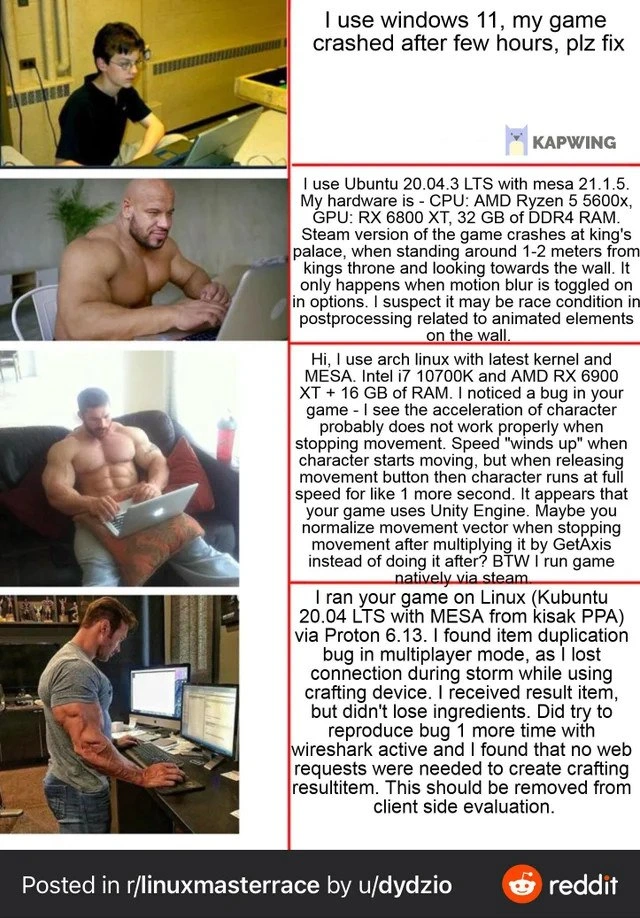
Windows user vs Linux power-tester: escalating muscle meme on bug report detail
Bugs Post #3875, on Oct 29, 2021 in TG

Windows user vs Linux power-tester: escalating muscle meme on bug report detail

Why is this Bugs meme funny?

Level 1: Broken Toy Mystery

Imagine you have a toy car that stops working. One kid goes to their parent and says, “My toy car broke, fix it, please.” That’s it – they don’t say what’s wrong or how it happened. The parent is confused: what part is broken? When did it happen? They have no clues, kind of like a mechanic being told “my car makes a noise” without hearing it. Now another kid also has a toy car problem, but this kid comes up and says, “When I drive my toy car on the rug and turn left really fast, the front wheel always pops off. I did it twice and it happened each time. I think the wheel might be loose or the rug makes it catch on something.” Now, if you’re the parent or the fixer, which kid is easier to help? Definitely the second one! They gave you where, when, and even a guess at why the toy broke. In the meme, the Windows user is like the first kid – just “it broke, fix it” – while the Linux power-users are like the second kid, giving a ton of helpful clues. It’s funny because the difference is so huge. One is basically saying “I have a problem” and expecting magic, the other is almost doing the detective work themselves. We laugh because we all know which one makes it easier to fix the toy. The meme is showing that giving more details (and being a little detective) is like having big strong muscles in the bug-fixing world – it makes the problem much easier to lift!

Level 2: From Plz Fix to Wireshark

Let’s break down the technical terms and context so a newer developer or an interested gamer can appreciate the joke. The meme contrasts two worlds: the average Windows user vs. the hardcore Linux user, in the context of reporting bugs in software (specifically a video game).

In the first panel, the Windows 11 user’s report “my game crashed after few hours, plz fix” is very simplistic. Windows 11 is Microsoft’s latest consumer OS, and many Windows gamers aren’t used to digging into system details. When something goes wrong in a game, a casual user might just report it in a forum or support email with minimal info, as we see here. “Plz fix” is internet slang for “please fix,” showing a lack of formality or detail. It’s a bit whining and gives the developers almost nothing to work with besides “it crashed after a while.” There’s no mention of what version of the game, what hardware, or what exactly caused the crash. It’s like telling tech support “it broke” – frustratingly vague.

In the second panel, we switch to a Ubuntu 20.04.3 LTS user. Ubuntu is a popular Linux distribution, and LTS stands for Long Term Support (a stable version that doesn’t change too rapidly). This user provides a trove of useful data: the mesa 21.1.5 driver (Mesa is an open-source graphics driver library used on Linux, here version 21.1.5), plus detailed hardware specs (CPU, GPU, RAM). This immediately tells the developers the environment in which the bug occurred – crucial because bugs can be specific to certain GPUs or drivers. The user says it’s the Steam version of the game, meaning they bought it on Steam (important if there are multiple versions or platforms). They pinpoint the crash location: “King’s palace, about 1-2 meters from the king’s throne, looking towards the wall.” This is a clear reproduction step – it tells the dev exactly where in the game to go to try to make it crash. They add “only happens when motion blur is toggled on in options.” That’s a big clue! It suggests the crash might be related to the motion_blur_bug (the motion blur effect). The user even says “I suspect it may be a race condition in postprocessing related to animated elements on the wall.” They’re theorizing about the cause: a race_condition is when two things happen at once in a program and mess each other up because the timing is off (for instance, two processes trying to use the same resource and stepping on each other’s toes). Postprocessing refers to visual effects applied after the main rendering (like motion blur), and animated elements on the wall could mean there’s something moving on that wall (maybe a banner or light) that, combined with motion blur, triggers the crash. So this user is essentially doing part of the developer’s job: narrowing down the cause to a specific feature interaction. For a junior dev or tester, this shows what a detailed_bug_report looks like: it includes environment (OS, drivers, hardware), exact steps to reproduce, and even potential causes.

Next, the third panel is an Arch Linux user. Arch Linux is known for being a do-it-yourself, rolling-release distro – basically for power users who like to tinker. Arch users famously often mention “I use Arch” (there’s a running joke in tech circles that some Arch users shoehorn that fact into any conversation, hence the meme tone). This user says they have the “latest kernel and MESA” – meaning they’re using cutting-edge Linux kernel version and graphics stack, which is typical for Arch (always up-to-date software). They have an Intel i7-10700K CPU and AMD RX 6900 XT GPU with 16GB RAM – again giving hardware context. Now the bug they report is different: it’s about character movement acceleration not stopping properly. They observed that when you release the movement key, the character continues moving at full speed for about 1 second instead of stopping immediately. This sounds like a small gameplay bug. They correctly note the game uses Unity Engine (a popular game engine– if you’re a gamer or dev, you might recognize Unity from game credits or file structures). Unity’s API has something called Input.GetAxis to read controller/keyboard input for movement. The user speculates the developers might be normalizing the movement vector at the wrong time in relation to reading that input. To explain: in a game, your movement direction might be a vector (x, y, z) that you normalize (scale down so its length is 1) to get consistent direction, then multiply by your speed. If you normalize after multiplying by the input axis value, you could accidentally ignore the fact that the input went to zero. Maybe the code is doing something like:

Vector3 inputDir = new Vector3(Input.GetAxis("Horizontal"), 0, Input.GetAxis("Vertical"));
// Developer might be normalizing after applying input
Vector3 movement = inputDir.normalized * maxSpeed;

If the input goes to zero at the moment you release the key, but the normalization happens after, it might still use the old direction magnitude (this is a bit speculative, but the user is basically pointing out a potential math mistake the devs made). The key takeaway for a junior dev: this bug report isn’t just “it feels off,” the reporter actually tried to diagnose it! They knew enough about game development to mention normalizing vectors and Unity’s GetAxis. It’s as if a tester not only reports a bug but also suggests which line of code might be wrong. That level of detail is rare from end-users. It’s also an example of how gaming culture on PC (especially among dev-savvy players) can blur into developer territory — some players have programming knowledge and will use it.

Finally, the fourth panel: a Kubuntu 20.04 LTS user (Kubuntu is Ubuntu with the KDE desktop, just another flavor of Linux) running the game through Proton 6.13. Proton is a compatibility layer (based on Wine) that allows Windows games to run on Linux via Steam. By stating the Proton version, the user clarifies they’re not even playing a native Linux version of the game, but the Windows version on Linux. This can be important because some bugs might come from that translation layer. Now this user found an item_duplication bug in multiplayer. Item duplication (dupe) bugs are classic in games – they let you clone items, which can ruin game balance. The user explains it happened when they lost connection during a storm while using the crafting device. So picture them crafting an item in an online game, and the internet drops or the server disconnects at just the right moment. They end up with the crafted result item but didn’t lose the ingredients used to craft it. Essentially, the game gave them the item but never took the cost – duplicating value. This is already a great bug report: they found a specific scenario and outcome. But they didn’t stop there – they tried to reproduce it one more time with Wireshark active. Wireshark is a tool that lets you monitor network packets (like seeing all the messages your computer is sending or receiving). Using Wireshark for a game bug is pretty advanced; it’s something a developer or security researcher might do to see if the game is contacting the server. The user found that no network calls were made when creating the crafting result item, meaning the client (the game running on their PC) decided the outcome locally without telling the server at that moment. This leads them to conclude “This should be removed from client side evaluation.” In simpler terms: “the client (player’s game) shouldn’t be the one deciding this; the server should handle it.” This goes into how online games are built: usually, to prevent cheats, the server is the authority on important changes (like inventory updates). If the client is doing it, a clever player could exploit that, for example by intentionally disconnecting like this person did. So this Linux user basically performed a full-on QA analysis + slight hacking attempt and then wrote a mini report advising the developers on how to fix the exploit. For a junior developer reading this, note how thorough that is! They included their OS and environment (Kubuntu with a special kisak PPA for Mesa drivers – that’s a Personal Package Archive providing newer Mesa drivers for better game performance), the method of running the game (Proton), the exact scenario that causes the bug, and even network analysis to pinpoint the flaw. It’s a masterclass in bug reporting. Normally, QA teams in game companies do this kind of deep dive; seeing a player do it is both amusing and amazing.

In summary, the meme’s panels illustrate an increasing level of technical detail and competency: from a vague one-liner to a full investigative report. The tags like WindowsVsLinux and HumorInTech come into play because it highlights the cultural difference: the average Windows user might not even know how to find a log file, whereas the Linux enthusiast is practically a part-time developer. It pokes fun at the stereotype that Linux users are all ultra-geeks who compile their own kernels and troubleshoot everything. The meme exaggerates it for humor, but every term in those detailed reports (like race condition, Wireshark, Proton, Arch Linux) is something a tech-savvy enthusiast would indeed know. If you’re new to these terms, don’t worry – the joke still lands as “each guy gives way more info than the last,” but now you also see that the info itself is legit tech stuff. That’s why developers were nodding and laughing; we’ve seen real bug reports like these and we appreciate that kind of thoroughness (sometimes a bit tongue-in-cheek, like “wow, this user basically wrote my bug fix for me!”). It’s both a comedic jab and a celebration of detailed bug hunting.

Level 3: Flexing Debugging Muscles

Now let’s talk about why experienced devs chuckle at this. This meme perfectly captures the contrast in bug-reporting culture between a typical Windows user and hardcore Linux gamers, using the classic “escalating buff guy” format for comedic effect. Each panel is a progressively buffer dude, correlating more muscle with more meticulous bug report detail. The humor lies in exaggeration of a truth every developer or QA engineer knows: not all bug reports are created equal.

In the first panel, the skinny guy represents the casual user who files a bug report as: “my game crashed after few hours, plz fix”. It’s hilariously bare-bones – no info on what the user was doing, no error message, nothing. In real life, many support tickets and game forum posts look exactly like this. It’s a nightmare for developers because a vague "it crashed, fix it" is like telling a mechanic “my car stopped, please make it go” with zero details. This is classic in GamingCulture support: some players on WindowsVsLinux just vent with a one-liner and expect the devs to magically know the cause.

Then the meme starts powering up. The second panel’s guy is more muscular, representing a more informed Linux user (Ubuntu LTS). His bug report is already leagues better: he specifies Operating System (Ubuntu 20.04.3 LTS), the exact Mesa driver version, and his hardware (AMD Ryzen 5 5600X CPU, Radeon RX 6800 XT GPU, 32GB RAM). He describes the Games bug with precise reproduction steps: “crashes at King’s Palace when standing ~2 meters from the throne and looking at the wall, and only when motion blur is on.” He even ventures a theory — possibly a race condition related to the wall’s animated elements and postprocessing. This is a dream detailed_bug_report for any developer: environment info, steps to reproduce, and even a suspected cause. It shows a user who knows their tech. The buffness of the image playfully suggests that providing such a beefy report is a sign of a “strong” (read: power-user) contributor.

The third panel levels up further: a jacked bodybuilder with a laptop, who says, “Hi, I use Arch Linux…” and proceeds to detail an entirely different bug (character movement inertia issue). This is a tongue-in-cheek nod to the meme "I use Arch, btw" – Arch Linux users are stereotypically proud of running a challenging distro and often drop that fact gratuitously. Here our Arch user not only lists latest kernel and Mesa versions, but actually debugs game mechanics. They noticed the character’s speed doesn’t immediately stop – it winds down for ~1 second after you release the movement key. They even deduce the game uses Unity Engine and guess the cause at a code level: maybe the developers normalized the movement vector at the wrong time (GetAxis is Unity’s input API). In other words, they suspect a tiny logic bug in how input is handled (perhaps the devs accidentally keep the last input momentum). This is hilarious and impressive – a random player effectively saying, “Hey, I reverse-engineered your bug and here’s how to fix it.” It’s like a QA tester on steroids. Experienced devs find this funny because it’s absurdly detailed for a user bug report. But also… we kind of wish every bug report was this insightful! The meme is poking fun at how Linux power-users often go above and beyond, essentially doing free debugging. The Arch guy’s muscular depiction screams “strong technical prowess.” He’s flexing those debugging muscles by citing engine specifics and vector math in a Steam game bug report. That’s both comical and admirable.

Finally, the fourth panel is the ultimate boss-level bug report – the guy is absolutely ripped, multiple monitors in front of him. This Linux guru (Kubuntu 20.04 user) ran the Windows game via Proton (Valve’s compatibility layer for Linux gaming) and discovered an item duplication glitch in multiplayer. Instead of just noting it, he actively tries to reproduce it and even runs a Wireshark packet capture to investigate network calls. Who does that? An ultra-nerd determined to help (or show off). He finds that when he lost connection during a storm while using a crafting station, he got the crafted item and kept his ingredients – a dupe exploit. By analyzing network traffic, he confirms the client never contacted the server to finalize the craft. Essentially, he performed a mini security audit and concluded “this logic is client-side and should be server-side.” This is far beyond a normal bug report; it reads like a professional QA report or a Pentester’s notes. And that’s why it’s so funny: the stereotype is that LinuxMasterRace aficionados are so hardcore, they’ll dig into your code’s behavior deeper than some developers do. The meme, posted in r/linuxmasterrace, exaggerates proudly that Linux users provide god-tier bug reports, whereas the feeble Windows user just says “plz fix.”

For seasoned developers, this meme hits home because we’ve all dealt with unhelpful bug reports versus golden tickets of information. It satirizes the divide in user sophistication. There’s also an in-joke here about open-source and PC gaming culture: Linux users often have to troubleshoot and tinker to get games working (using tools like Proton, custom mesa_driver PPAs, etc.), so they’ve developed “muscles” for debugging. Windows users, in contrast, expect things to just work out-of-the-box, so when something breaks, they might not even know where to start. The meme’s humor is equal parts DeveloperHumor and light platform parody. It’s saying: Look how Linux gamers flex their technical know-how, while the Windows guy gave the dev almost nothing to work with. Those of us in software engineering can’t help but smirk and maybe even cheer a little for the buff Linux testers — if only every bug report in our tracker were this thorough!

Level 4: Thread Races & Trust Issues

At the most advanced level, this meme highlights fundamental software issues: race conditions and client-server trust. The second panel’s bug report suspects a race condition in the game’s rendering pipeline. In technical terms, a race condition occurs when two parts of the program (often two threads) access shared data or run operations concurrently in an unpredictable order, leading to inconsistent or crashing behavior. Modern games use multi-threading and GPU parallelism for things like rendering and post-processing. Toggling motion blur (a post-processing effect) could change timing enough to expose a latent concurrency bug – perhaps the game’s engine isn’t locking a resource or is updating an animated wall element and the blur effect at the same time without proper synchronization. The result? A crash only when certain graphics settings and positions coincide, classic Heisenbug behavior. The Linux tester’s intuition that it “may be a race condition in postprocessing” shows a deep grasp of how BugsInSoftware can stem from low-level timing issues between threads. It’s a nod to the intricate dance of threads and the nightmares of debugging non-deterministic OperatingSystems issues.

Meanwhile, the fourth panel’s report uncovers a client-server design flaw – essentially a trust issue in distributed systems. By using Wireshark (a network packet analyzer) during a multiplayer session, the tester finds that crafting an item didn’t trigger any server call (no web requests were needed). In online game architecture, this is a red flag: it means the client is authoritative for creating the item, without server verification. This is fundamentally a security and data consistency problem. In theory, important game actions in multiplayer should be verified or performed by the server to prevent cheating (the mantra: “Never trust the client.”). Here, losing connection during the craft led to an item_duplication bug – the server never knew the ingredients were spent, but the player kept the new item. From a systems perspective, this is like a failed transaction that wasn’t rolled back – a classic consistency bug. The beefy Linux tester essentially performed a mini white-box test, identifying that the crafting logic is done client-side (likely for speed or offline support) but without safeguarding consistency on reconnect. Their conclusion: “This should be removed from client side evaluation.” In software architecture terms, they’re advocating for moving game state authority to the server to close an exploit. It’s impressive: the meme’s Linux power-user applied principles of concurrent programming and network security analysis – delving into thread timing and packet traces – to pinpoint the root causes. That’s flexing some serious technical muscle behind the humor.

Description

The four-panel meme has a two-column layout. Left column: four photos of unidentified men at computers, each successive photo shows a noticeably more muscular figure - first a slim man at an office desk, then a shirtless bodybuilder on a couch, then an even more muscular man with a laptop, and finally a heavily built man at a multi-monitor workstation. Right column, framed in red, contains text that grows longer and more technical as the muscles grow. Top panel text: “I use windows 11, my game crashed after few hours, plz fix”. Second panel text: “I use Ubuntu 20.04.3 LTS with mesa 21.1.5. My hardware is - CPU: AMD Ryzen 5 5600x, GPU: RX 6800 XT, 32 GB of DDR4 RAM. Steam version of the game crashes at king's palace, when standing around 1-2 meters from kings throne and looking towards the wall. It only happens when motion blur is toggled on in options. I suspect it may be race condition in postprocessing related to animated elements on the wall.” Third panel text: “Hi, I use arch linux with latest kernel and MESA. Intel i7 10700K and AMD RX 6900 XT + 16 GB of RAM. I noticed a bug in your game - I see the acceleration of character probably does not work properly when stopping movement. Speed "winds up" when character starts moving, but when releasing movement button then character runs at full speed for like 1 more second. It appears that your game uses Unity Engine. Maybe you normalize movement vector when stopping movement after multiplying it by GetAxis instead of doing it after? BTW I run game natively via steam”. Fourth panel text: “I ran your game on Linux (Kubuntu 20.04 LTS with MESA from kisak PPA) via Proton 6.13. I found item duplication bug in multiplayer mode, as I lost connection during storm while using crafting device. I received result item, but didn't lose ingredients. Did try to reproduce bug 1 more time with wireshark active and I found that no web requests were needed to create crafting result item. This should be removed from client side evaluation.” A small “KAPWING” watermark appears on the first text box; bottom footer reads “Posted in r/linuxmasterrace by u/dydzio” with a Reddit logo. Technically, the meme contrasts a vague Windows bug report with increasingly rigorous Linux reports that include distro, kernel/driver versions, hardware specs, reproduction steps, suspected race condition, engine insight, network capture, and client-side exploit commentary - highlighting developer-grade debugging culture


Comments

11
Anonymous ★ Top Pick Bug-report gainz chart: Windows user says “crashed”; fourth-panel Linux user shows distro, wireshark, root cause, and a diff - at that point you’re not closing a ticket, you’re merging a co-maintainer
  1. Anonymous ★ Top Pick

    Bug-report gainz chart: Windows user says “crashed”; fourth-panel Linux user shows distro, wireshark, root cause, and a diff - at that point you’re not closing a ticket, you’re merging a co-maintainer

  2. Anonymous

    The real flex isn't having 32GB of DDR4 RAM - it's casually mentioning you reproduced a Unity multiplayer desync bug through Wireshark packet analysis while everyone else is still arguing about whether to use apt or pacman

  3. Anonymous

    This perfectly captures the Linux gaming community's evolution from 'it doesn't work' to 'here's the exact syscall where your Unity coroutine is racing with the render thread, I've attached a flamegraph and a patch.' Meanwhile, Windows users are still wondering if they should try turning it off and on again. The real kicker? By panel 4, they've essentially debugged your entire netcode architecture and identified a client-side trust boundary violation that your security team missed in code review. Free QA, delivered with the smugness of someone who compiled their own kernel this morning

  4. Anonymous

    Windows bug report: “plz fix crash.” Linux bug report: “Ubuntu 20.04 + Mesa 21.1.5, RX 6800 XT; repro 1 - 2m from the throne with motion blur; Unity normalizes after GetAxis; Proton 6.13; Wireshark shows client-side crafting.” Jira: “Needs more info.”

  5. Anonymous

    12GB VRAM on Proton GE? Survives 11 hours until Mesa's multiplayer storm turns it into a Wireshark autopsy

  6. Anonymous

    Triage IRL: Windows ticket - “it crashed”; Linux ticket - “here’s a deterministic repro, driver/OS matrix, a Wireshark capture proving your client‑side crafting logic, and a suggested Unity GetAxis normalization fix - want a PR or should I wait for CI?”

  7. @a742883 4y

    Despite being only 0.80% of steam users, linux users commit over 50% of bug reports

    1. @RiedleroD 4y

      lol I don't even need a source to believe that

      1. @dsmagikswsa 4y

        Indeed 😂

    2. @f3rr0us 4y

      Of which around 99% (don't quote me on that: https://news.ycombinator.com/item?id=28978883) affect users on other platforms. Linux users help the broader community :)

  8. @QutePoet 4y

    Noice!

Use J and K for navigation