Client demands a cruise-ship-airplane and wonders why we misunderstand requirements
Why is this Stakeholders Clients meme funny?
Level 1: When Imagination Runs Wild
Imagine your friend says, “I love cruise ships and I love airplanes – I want both at the same time!” and asks you to make a toy of a flying cruise ship. You’d probably scratch your head and laugh a bit, right? A cruise ship is like a giant floating hotel, and an airplane is a flying machine – they’re super different. It’s as if someone wants to wear ice skates and flip-flops together and then wonders why it’s a problem. In our story, the friend (like the client in the meme) gets upset and says, “Why don’t you understand what I want?” But the request is so crazy that anyone would be confused! It’s funny because the friend doesn’t see how impossible their idea is, while the person trying to help is totally bewildered. We laugh at the picture of the combined ship-airplane because it’s a silly thing that could only exist in a cartoon. The joke is really about how sometimes people ask for two things that just can’t fit together, and then get frustrated when others can’t make it happen. It’s a reminder that we have to explain what we want clearly – especially if what we want is as wild as a flying boat!
Level 2: Requirements vs Reality
Let’s break down what’s happening in simpler terms. In software development (and any project), a requirement is what the client or user says they need – basically a feature or capability they want the product to have. Here the client’s requirement is literally a hybrid of two things: a cruise ship and an airplane. That’s an extreme (and silly) example of a feature request. In real projects, a requirement might be something like “users should be able to upload videos” or “the app should work offline.” Usually, requirements are documented so everyone is clear on what to build.
So why would a “cruise-ship-airplane” request be a problem? It’s an example of unrealistic requirements and requirements ambiguity. “Unrealistic” because, well, you can’t actually build that in the real world (ships and planes have totally different designs and purposes). And “ambiguous” because it’s not clear how the client expects this to work – do they imagine the plane lands on water? Do they want the size of a ship or the speed of a plane? It’s not specific or feasible. In software, a comparable situation might be a client saying “I want a program that’s as simple as Notepad but as powerful as Photoshop.” Huh? That’s so broad and self-contradictory that a developer wouldn’t know where to start. It’s confusing and contradictory – just like our flying cruise ship.
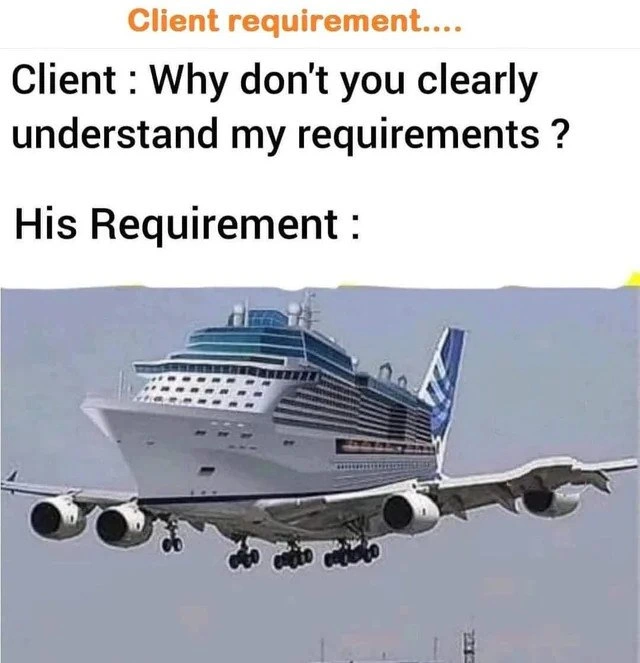
This meme also touches on miscommunication. The client asks, “Why don’t you clearly understand my requirements?” implying they think they were totally clear. But the picture shows what the developer imagines upon hearing those requirements – an absurd plane-boat mashup – suggesting that the requirement was not clear at all. There’s a famous phrase, “Clients don’t always know what they want, and even when they do, they might not know how to explain it.” New developers learn that a big part of the job isn’t just writing code – it’s communicating with non-technical people to figure out what they actually mean. If someone says “I need a vehicle that carries thousands of people across the ocean fast,” one person might think “huge fast ship,” another thinks “airliner,” and a literal-minded developer might sketch a monstrous combination of both because the statement was so open-ended. Clarifying questions would be needed like, “Do you want it to literally do both in one, or are we talking about either/or scenario?” Without clarification, misunderstandings happen.
Scope creep is another concept lurking here. Scope means the overall boundaries or extent of the project – what features and work are included. Scope creep is when the project’s scope keeps expanding beyond what was originally agreed. It often happens when a client keeps saying “Could we also add this? And I just thought of that…” until the project becomes much bigger (and often impractical). The cruise-ship-plane could be seen as a product of scope creep: maybe the project started as “build a large airplane,” and then crept into “well, it should also have the features of a cruise ship.” One day the team realizes, oh no, we’re trying to build a flying hotel ocean-liner! For a junior developer, it’s important to recognize when requests start to get out of hand. Sometimes you have to politely remind the team or client, “If we keep adding things, we might not finish on time or it might not work as expected.”
In real teamwork, there are strategies to avoid this kind of misunderstanding. People create requirements documents, user stories, or prototypes. They review them with the client to make sure everyone pictures the same thing. Often a project manager or business analyst will act as a translator, taking the client’s big ideas and breaking them into clear, doable pieces. They might say, “Alright, you want the benefits of a cruise and a plane. Let’s decide what’s most important because combining them fully is not possible. Perhaps you need an airplane with nicer amenities? Or a faster way to get cruise-like entertainment?” By asking these questions, they narrow down the requirement to something achievable.
For a junior dev, the key takeaway is: don’t assume – always ask and clarify. If a request sounds odd or impossible, it’s probably misunderstood by one side or the other. It’s completely okay to say, “Hey, I want to make sure I got this right. You’re asking for [X feature]. Could you explain the main goal or problem you’re solving with that? Maybe there’s another way.” That kind of conversation can save a ton of time and prevent ending up with the equivalent of a half-boat-half-plane design that nobody actually wants.
Level 3: The Franken-Spec
On a more practical level, every seasoned developer or project manager has encountered a “Franken-spec” – a specification stitched together from too many ideas, ending up as a monstrous feature list that defies reality. The meme nails this with the image of a hybrid ship-plane, which is basically a feature Frankenstein: it tries to be two enormous things at once and ends up a gargantuan joke. The client’s quote, “Why don’t you clearly understand my requirements?”, drips with irony because the requirement itself is what’s unclear (or insane!). The humor here makes any experienced dev or PM chuckle and cringe in recognition.
Why is this so funny to us? Because it’s so real. In software projects, stakeholders sometimes demand an all-in-one solution that crams every imaginable feature or technology “just because.” Picture a client saying: “Our app should have the UX simplicity of a notepad, the analytics power of a Fortune 500 ERP, the real-time speed of a stock trading system, and the offline capability of a Nokia phone – oh and why are you having trouble understanding that?” 😅. They might as well ask for a flying cruise ship. We’ve all been in meetings where a client or executive with only a surface understanding of tech says “Can’t we just combine X and Y?” – not realizing X and Y are fundamentally different beasts.
This meme also speaks to the communication gap between clients and developers. The client likely described what they wanted in vague terms or with grandiose language (“It needs to do everything!”). The developer’s literal interpretation of these words results in the absurd mental image (or prototype) of a cruise-liner fused to a jet. It’s reminiscent of that classic project management cartoon: “What the customer wanted vs. what the engineer understood vs. what was built.” In those scenarios, each stage morphs the idea because the requirement was never crystal clear to start with. Here, the client’s ask is so over-the-top that the misunderstanding is almost guaranteed. The stakeholder thinks it’s straightforward (they want all their favorite features together), but the dev team hears an impossible paradox.
Crucially, the meme’s scenario hints at scope creep and design by committee. How do we end up with a cruise-ship-airplane? Possibly the client initially wanted a plane, but then someone said “it should also have a swimming pool and casino like a cruise ship,” and another said “don’t forget the cargo hold for cars like a ferry,” and nobody said no. The requirement ballooned into absurdity. This happens in projects: feature after feature gets bolted on due to stakeholder pressure, until the whole thing collapses under its own weight. An experienced team knows to watch out for the “everything but the kitchen sink” requirement. If you don’t manage it, you get a product that tries to do too much — jack of all trades, master of none — or worse, a project that never gets finished. A senior engineer might dryly joke, “Sure, we can also make it a submarine and a space rocket, why not?” to hint that the request has gone off the rails.
There’s also a project management lesson here: managing expectations. In reality, if a client requests something as crazy as a cruise-ship-plane, a good project manager or business analyst would step in and say, “Let’s break this down. Do you need the luxury amenities of a cruise ship and the speed of a jet? Maybe we can negotiate some trade-offs.” Experienced professionals recognize the Iron Triangle (Scope, Time, Budget): if you insist on an extravagant scope (“build me this impossible thing”), you must adjust time and cost astronomically – often an eye-opener for clients. The meme’s client seems oblivious to the trade-offs, which is sadly common. They ask “Why don’t you understand?” when the real issue is they don’t understand the implications of their own request.
In sum, the senior perspective sees this meme and relates it to all those nightmarish projects where requirements were a hot mess. It’s funny because the image is an exaggeration, but it perfectly captures the feeling of a dev being handed an impossible spec. It’s like the team is being set up to fail and still getting blamed for not delivering. As a war-weary developer might say with a smirk, “Been there, tried to build that – didn’t end well.” This meme playfully exorcises that shared trauma.
Level 4: Contradictory Constraints
At the deep end of engineering theory, this meme highlights an unsolvable design problem. The client’s desired product – a cruise ship airplane – represents a set of mutually exclusive requirements. In formal terms, it’s like specifying a system with contradictory constraints. For example, imagine writing the requirements in pseudo-math: “Vehicle must have the buoyancy and capacity of a cruise ship” AND “Vehicle must have the aerodynamic lift and speed of a jumbo jet.” These constraints conflict with physical laws and engineering principles:
- A cruise ship’s huge mass and shape give it stability on water but make it impossible to achieve flight given the limits of thrust and lift. The amount of lift an airplane’s wings generate depends on weight and wing design – gluing a 100,000-ton floating hotel onto a jet negates any realistic lift-to-weight ratio.
- Airplanes are engineered for lightweight strength (using aluminum or composites), whereas cruise ships are massive steel hulks. The structural requirements for surviving ocean waves (thick hull, ballast) clash with the weight limits for flight.
- Even if you somehow got such a hybrid off the ground, the aerodynamics would be horrendous – the ship’s flat sides and bulk would create enormous drag. It’s a bit like trying to make a brick fly and float: each goal undermines the other.
In computer science terms, this kind of requirement is analogous to an unsatisfiable boolean formula. It’s as if the spec says NeedsToBe A AND NeedsToBe NOT A in some aspects – no truth assignment can satisfy that. In software projects, this happens when stakeholders demand incompatible features or qualities. An example is a client insisting on extreme security and zero friction in the user experience: one requirement demands strict authentication, the other demands “don’t bother the user at all.” It’s a logical contradiction in the product design space. A real-world software analogy is the classic CAP theorem in distributed systems – you can’t have perfect Consistency, Availability, and Partition tolerance all at once. If a non-technical boss said “We need instant global data consistency and 100% uptime even through outages,” an architect hears a physics-defying cruise-ship-airplane request. Trade-offs are inevitable; some desires fundamentally conflict, and something’s gotta give.
From a formal requirements engineering perspective, one would catch this by modeling the requirements. Techniques like constraint solving or formal specification languages (e.g., Z notation or Alloy) could, in theory, reveal the conflict. A solver would report no feasible solution exists for the given constraints. In plain English, the spec is broken – it describes a product that cannot exist in any possible implementation. This is the academic, theoretical layer of why the meme’s scenario is absurd: the request violates fundamental constraints (whether physical, logical, or computational). The humor carries an undertone of “even math and physics say nope.”
Description
The meme has a white background with an orange header that reads "Client requirement…." Below, black text says: "Client: Why don't you clearly understand my requirements?" followed by "His Requirement :". Under this conversation, a photoshopped image shows a massive ocean cruise liner grafted onto the fuselage, wings, landing gear, and engines of a jumbo jet - illustrating a physically impossible hybrid vehicle. The visual gag conveys how stakeholders often articulate contradictory or over-combined feature sets that defy engineering realities, reflecting common software situations where vague or ever-expanding requirements (‘scope-creep’) lead to misalignment between developers and clients
Comments
9Comment deleted
PM: “We need a monolith that scales like microservices, runs serverless but on-prem, delivers offline real-time analytics, and is simultaneously GDPR and FAA compliant - basically cruise-ship comfort with jetliner speed.” Architect: “Cool, I’ll just toggle the ‘defy-physics’ feature flag.”
This is what happens when the client insists their microservice architecture needs to be 'monolithic for performance but distributed for scalability' while also being 'serverless but on-premise' with 'real-time batch processing' - and they wonder why the sprint planning takes three sprints
This perfectly captures the moment when a client asks for a system that's simultaneously stateless and stateful, horizontally scalable yet runs on a single server, has zero latency across continents, costs nothing to operate, and needs to be deployed yesterday - all while questioning why you don't 'simply understand' their crystal-clear vision of a cruise ship gracefully soaring through the clouds on jet engines
Their “simple MVP” needs FAA and IMO compliance, microservices that deploy as a monolith, and SLAs for both runways and harbors - what could possibly go wrong?
Turns out the PRD used “and” where “or” belonged - hence the cruise ship strapped to a 747; we just called it hybrid cloud
Client specs: a cruise ship at Mach 1. Dev delivers Kubernetes pods on legacy COBOL - now it's 'flying' sideways
Должен быть на гусеницах Comment deleted
should be on caterpillars (approximate translation) please use English in this chat Comment deleted
Just need a twin tail. Easy. Comment deleted