Programming community roasts Facebook’s Meta rebrand with a FAANG → MANGA joke
Why is this CorporateCulture meme funny?
Level 1: Name Change Shenanigans
Imagine a kid in school who got into big trouble for doing something wrong. Instead of apologizing or fixing the problem, the kid comes in the next day wearing a funny wig and says, “Hi, I’m not that kid, I’m a new kid with a different name!” 🤡 All the other students would probably giggle, right? They know it’s the same kid trying to hide from yesterday’s mess. They might even start calling him by a silly nickname based on his costume, just to tease him. In this meme’s story, Facebook is like that kid who messed up and then tried to hide behind a new name (Meta). But the programmers (like the classmates) immediately saw through it and made a joke — they said “Haha, FAANG is now MANGA!” It’s as if they gave Facebook a goofy nickname for thinking a name change could magically make everything okay. The whole joke is funny because it shows you can’t just escape your problems by changing what you’re called. Everyone still knows who you really are, and they’ll definitely have a laugh if you try.
Level 2: From FAANG to MANGA
Let’s break down the joke for those not steeped in tech insider lingo. FAANG is an acronym that has been widely used in the tech and finance world to refer to five giant tech companies: Facebook, Apple, Amazon, Netflix, and Google. People often say “FAANG companies” the way you’d say “Big Tech,” since these firms are known for their huge influence, high salaries, and coveted jobs. In October 2021, Facebook announced it was changing its company name to Meta (the facebook_to_meta switch). This kind of change is called a rebrand – essentially a marketing move where a company adopts a new name and image. Facebook’s leadership claimed the new name reflects a focus on the “metaverse” (a vision of shared virtual reality spaces), but many critics felt the timing was suspicious. The company was under heavy public scrutiny and bad press due to various scandals (a whistleblower had revealed internal documents showing the company knew its platform could cause harm). The meme’s top text voices this suspicion: instead of owning up to its problems (taking accountability), Facebook seemed to be running from them by simply changing its name. This is why the text says “cover its scandal with a name changing scheme.” It implies Facebook was using the Meta rebrand as a distraction or PR trick to reset its reputation, rather than fixing the actual issues.
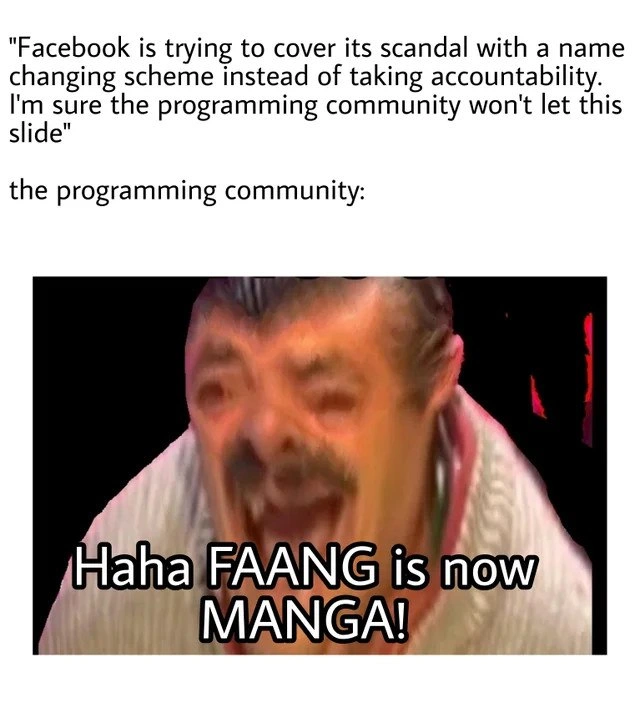
Now, the meme shows how the programming community responded. The bottom panel — labeled “the programming community:” — features a popular reaction image: a heavily blurred, distorted photo of a man laughing uproariously (if you’ve seen memes of a Spanish comedian laughing uncontrollably, it’s that guy). Memes often use this laughing image to amplify how ridiculous or funny something is. Over that image is the caption: “Haha FAANG is now MANGA!” This line is the punchline, and it needs some unpacking.
Here’s the context: by renaming itself Meta, Facebook obviously changes the first letter of its name from F to M. So, if you update the FAANG acronym to replace the old “Facebook” with “Meta,” you’d get MAANG (Meta, Apple, Amazon, Netflix, Google). The programming community, with its love of wordplay and nerdy jokes, didn’t stop there. They rearranged those letters a bit to spell “MANGA.” Why rearrange? Well, because MAANG isn’t a very catchy or funny term, but MANGA is an actual word (it’s the term for Japanese comic books and graphic novels). The thought of the five biggest American tech firms being nicknamed “MANGA” is comically jarring – it’s like taking something very serious and businessy and giving it a whimsical, geek-culture twist. Plus, it’s just fun to say that the mighty FAANG has turned into MANGA. This manga_acronym_joke started popping up all over developer Twitter and Reddit almost immediately after the Meta announcement. It was a way for developers to poke fun at Facebook’s grandiose name change. Essentially, DevCommunities were saying, “You can rebrand, but you’re not fooling us – look, all that’s changed is a single letter in an acronym, and we can turn that into a joke!” It highlights a bit of CorporateCulture skepticism: software engineers and tech folks often have an irreverent attitude toward big corporate marketing moves.
In simpler terms, the meme is pointing out: Facebook’s name change might be a big deal to their marketing team, but to the world of programmers, it just means the famous FAANG acronym we’ve used for years needs a letter update. And instead of updating it in a dry way, the community made it a punchline. The humor here comes from how quickly the DeveloperHumor sprang up. One day everyone’s talking about FAANG; the next day, devs are chuckling and saying “FAANG is now MANGA!” with a mock serious tone. It’s a playful form of tech industry commentary. By laughing at the new acronym MANGA, programmers conveyed that a simple name swap (a meta_rebrand) isn’t a magic erase button for past problems. They turned the situation into a silly joke, ensuring that Facebook/Meta’s attempt to slide away from its scandal wouldn’t go unnoticed. After all, in the tech community, trying to do a quick cover-up is often met with a chorus of memes and jokes rather than quiet acceptance.
Level 3: Rename & Shame
When Facebook abruptly rebranded itself as Meta in late 2021, it wasn’t just a new logo rollout – it was a textbook CorporateCulture maneuver to camouflage a PR crisis. The company had been mired in user trust scandals (whistleblower leaks, misinformation woes, you name it). Rather than directly addressing those issues (you know, taking real accountability), the leadership chose a shiny meta_rebrand. This is a classic big-tech move: attempt to reset the narrative with a fresh coat of paint and a buzzwordy mission (“we’re all about the metaverse now!”). Seasoned engineers have seen this pattern before. It’s akin to refactoring only the variable names in legacy code while leaving all the buggy logic in place – a superficial fix. IndustryTrends_Hype teaches that trendy renames won’t patch systemic flaws any more than slapping public static final on a constant magically solves a program’s state issues. In short, a new name can’t whitewash old sins, and the programming community knows it.
So what did devs do? They immediately roasted this marketing stunt with classic TechIndustryHumor. Enter the faang_acronym gag. For years, FAANG has been the tongue-in-cheek tag for Big Tech’s power players: Facebook, Apple, Amazon, Netflix, Google. It’s an acronym every developer recognizes – practically shorthand for “top-tier tech giants (and coveted employers)”. Overnight, Facebook’s switch to Meta blew up this well-known term. Sure, if you simply swap F for M, you get MAANG, but that looked too awkward. Naturally, the programming community’s collective wit rearranged those letters into “MANGA.” Why MANGA? Because it’s a real word (referring to Japanese comics) and absurdly out-of-place as the label for a bunch of trillion-dollar companies. This manga_acronym_joke was the dev world’s way of saying, “Nice try, Zuck, but we’re not going to pretend this isn’t the same old Facebook under the hood.” By turning FAANG into a silly word like MANGA, engineers on Twitter, Reddit, and meme forums effectively deflated Meta’s pomp. It’s a form of corporate_rebranding_comedy: taking a high-profile Marketing move and chuckling at it with a low-brow pun. The humor comes from jarring contrast – a domineering tech empire gets linguistically downsized into a comic book sound. It’s the community’s way of reminding everyone that a rebrand can’t instantly erase years of data privacy scandals or controversial algorithms, just like renaming a class in code doesn’t magically fix its failing unit tests.
In essence, the dev community performed a collective code review on Facebook’s strategy and left a biting comment: rename Facebook to Meta all you want, we’ll just update our acronym and keep laughing. The underlying issues remain un-merged. As a snarky script kiddie might put it:
# Quick fix attempt: rename Facebook to Meta
sed -i 's/Facebook/Meta/g' corporate_brand.txt
# Check if the scandal is gone
grep -i "accountability" corporate_reality.log || echo "Nope, still there."
This little pseudo-terminal session sums it up – a find-and-replace on the name doesn’t return the accountability everyone was looking for. The DeveloperHumor here cuts deep: engineers aren’t fooled by a s/Facebook/Meta/g patch. They know real change isn’t achieved with a simple rename, and they’ll meme mercilessly to make that point. In the battle of BigTechCompanies PR vs. DevCommunities cynicism, the verdict was clear: “Haha, FAANG is now MANGA!” – and scandal by any other name smells just as problematic.
Description
White‐background meme in two parts. Top text reads: "Facebook is trying to cover its scandal with a name changing scheme instead of taking accountability. I'm sure the programming community won't let this slide" followed by a blank line and the sub-heading "the programming community:". The bottom panel shows a blurred reaction image of a laughing person edited onto a black background. Large white subtitle at the bottom says, "Haha FAANG is now MANGA!" - referencing how Facebook’s name change to Meta alters the Big-Tech acronym. Visually simple but delivers industry satire: developers mock corporate reputation-washing by immediately turning the famous FAANG acronym into “MANGA,” highlighting how dev communities weaponize wordplay against large companies’ marketing spins
Comments
21Comment deleted
Lovely - FAANG is now MANGA, but our 83 microservices still reference facebook.com in hard-coded OAuth callbacks; nothing like a corporate rebrand delivered as an ops-wide sed -i marathon
The best part about FAANG becoming MANGA is that now our compensation packages come with plot armor and the ability to explain our architectural decisions through dramatic internal monologues spanning three episodes
When your technical debt is so massive that you try to refactor your entire company namespace, but the community just forks your reputation and merges it with a manga reference. Classic case of trying to resolve conflicts by renaming variables instead of fixing the underlying architecture - except this time the code review is happening on Twitter and the PR will never get approved
FAANG → MANGA: the only migration where every regex, dashboard, and recruiter script broke, but the root cause stayed in prod
FAANG → MANGA: Meta's semver major bump nobody merge-approved, but devs force-pushed the meme anyway
Meta’s rebrand was a zero‑downtime deploy; devs answered with sed -i 's/FAANG/MANGA/g', but accountability isn’t an eventually consistent field
XDDDDD Comment deleted
What scandal? Comment deleted
what is FAANG? Comment deleted
=MANGA Comment deleted
Meta Apple Netflix Alphabet Amazon …wait Comment deleted
Facebook Iphone Netflix Google Enourmous piss bottles caused by Bezos being a Retard Comment deleted
Niggers IKEA Company™ EE Eeeeee Crackers Onii-Chan Cinnamon challenge KKK Comment deleted
the ultimate brand collection Comment deleted
racism moment Comment deleted
Sheesh Comment deleted
problem? Comment deleted
F acebook A pple A mazon N etflix G oogle Comment deleted
thanks wise man Comment deleted
We saw mango We saw mongo Now we are seeing manga What would be next?... Comment deleted
monga Comment deleted