Skip to content
DevMeme
4886 of 7435
The Pain of an ML Expert Scrolling Through LinkedIn
AI ML Post #5348, on Aug 18, 2023 in TG

The Pain of an ML Expert Scrolling Through LinkedIn

Why is this AI ML meme funny?

Level 1: Reading vs Doing

Imagine you want to become a chef, and you go to a restaurant job interview. But instead of asking you to cook something or checking if you know basic recipes, the manager only asks, “Have you read all the popular cooking magazines and watched all the trendy cooking shows lately?” Sounds pretty silly, right? Reading about cooking might give you some ideas, but it doesn’t prove you can actually make a delicious meal. You’d probably laugh if a chef’s job depended on how many foodie blogs you follow! This meme is funny for the same kind of reason. It’s joking that getting a job in AI/ML (making smart computer programs) could be treated like that — as if the most important thing is just talking about it or reading flashy posts on a website, rather than actually doing it. We all know that just because someone reads a lot about a subject doesn’t mean they know how to do it for real. The joke highlights that obvious truth in a workplace context: it makes us laugh because expecting a machine learning engineer to be hired for reading social media posts is as backward as hiring a cook for reading recipe books instead of tasting their food. It’s a goofy way to say “actions speak louder than words.”

Level 2: Hype vs Reality

Let’s break down what’s going on in simpler terms. Machine learning (ML) is a field of computer science where programs improve at tasks by learning from data. For example, an ML program can learn to recognize images of cats by studying lots of cat photos, instead of a human explicitly programming the rules for what a cat looks like. Working in ML usually means you need solid skills in programming (often in Python or R), understanding math (like statistics and linear algebra), and knowing how different algorithms work (such as decision trees, neural networks, etc.). In real life, an ML engineer’s job is pretty hands-on: they collect and clean data, write code using libraries like pandas or TensorFlow to build models, adjust parameters to improve accuracy, and evaluate if the model is actually working. It’s a lot of doing and experimenting.

Now, what about those LinkedIn AI posts the meme mentions? LinkedIn is a professional social network where people often post about industry trends, personal achievements, or “thought leadership” ideas. In the context of AI (artificial intelligence) and ML, there has been a huge wave of posts where people talk about how AI is changing everything, share inspirational takes, or list the “Top 10 skills for the AI era.” This is what we call AI hype – content that makes AI sound almost magical or revolutionary in every way, usually without showing any technical details. It’s called hype because it often exaggerates or oversimplifies reality to get others excited. For example, a hype-y post might say something like, “AI will soon let you work only 1 hour a day while it handles everything else!” or use a lot of fancy buzzwords like “paradigm-shifting, game-changing AI”. These posts tend to get a lot of attention and likes, especially from non-technical people or those new to the field.

The meme caption “WORK IN ML? READ THESE LINKEDIN AI POSTS.” is joking that to work in ML, you supposedly have to read all those trendy AIIndustryTrends posts on LinkedIn. Of course, in reality, reading social media posts doesn’t make you an expert – building projects and learning the actual concepts do. The joke highlights a feeling among developers that some companies or recruiters might care too much about whether you’re up-to-date with the latest hype, instead of checking if you have real skills. This ties into the idea of gatekeeping. Gatekeeping is when an in-group sets an arbitrary barrier to entry for newcomers. Here the ml_job_gatekeeping being mocked is the notion that you’re only worthy of an ML job if you’ve kept up with the constant stream of buzzy LinkedIn content – which is an awfully silly barrier compared to, say, knowing how to code a regression model.

We also see references to “thought leadership” and even “bingo”. On LinkedIn, thought leaders are people who try to establish themselves as experts by posting insightful-sounding content. But often many of them end up repeating the same popular buzz phrases. Developers joke about “thought leadership bingo” because you could make a bingo card with squares for each overused buzzword (like “disruptive”, “leverage AI at scale”, “next-generation”, “unlock value” etc.), and you’d quickly fill it by reading a few of these posts. It’s a way to poke fun at how formulaic and content-free some of that linkedin_influencer_noise can be.

For a junior developer or someone new to the AI/ML scene, this meme is basically saying: Don’t get fooled into thinking that just talking about AI or reading hyped articles is the same as actually doing AI. AIHypeVsReality is a common theme in developer humor. The reality is that being good at ML means practice: taking courses, trying out code, maybe building a small neural network for fun, or participating in Kaggle competitions to sharpen your skills. The hype is what you see on social media: grand claims that might imply you can become an “AI expert” overnight just by skimming enough motivational posts. This meme resonates in dev communities because we’ve all seen that one intern or manager who talks a big game about “AI transformation” but, say, can’t explain what a training dataset is. It’s funny in a facepalm kind of way. The takeaway for an early-career developer is: substance matters more than buzzwords. It’s okay (even beneficial) to follow industry trends, but remember that hands-on experience and understanding are what actually qualify you for an ML role – not just having read every LinkedIn post with “#AIHumor” and “#FutureOfAI” hashtags. In a real interview, you’ll be asked about things like Python, statistics, or projects you’ve worked on, not whether you hit “Like” on the latest viral AI article.

Level 3: Buzzwords Over Skills

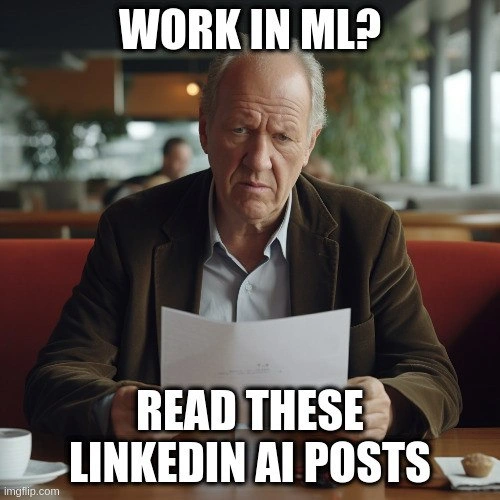
The meme hits a nerve for seasoned MachineLearning folks who’ve survived one too many hype cycles. Here we see a presumably senior interviewer — blazer, coffee, serious face — holding a candidate’s résumé. The scene looks like a normal early-morning interview in a café (right down to the white ceramic coffee cup), except the punchline is utterly absurd:

WORK IN ML?
READ THESE LINKEDIN AI POSTS.

In other words, the “requirement” to land an ML job is not demonstrating you can build a model or tune hyperparameters, but proving you’ve consumed the latest AIHype on LinkedIn. It’s a sarcastic jab at how hiring in the AI/ML world can feel gatekept by buzzwords and social-media clout rather than actual skill. Experienced engineers immediately recognize the satirical exaggeration here: instead of grilling the candidate on scikit-learn vs. TensorFlow, the interviewer (with that skeptical, world-weary look) is checking if they’ve memorized the LinkedIn AI hype canon. The humor is biting because it reflects a real frustration in developer communities – the feeling that sometimes success in tech is about talking a good game (on SocialMedia or at conferences) rather than coding one.

This meme cleverly skewers an IndustryTrends_Hype phenomenon. In recent years, especially around 2022-2023 with the explosion of interest in things like GPT-4 and generative AI, LinkedIn became a megaphone for so-called AI thought leaders. Every day your feed is flooded with posts touting "AI will revolutionize X" or the "Top 10 leadership lessons from ChatGPT". There’s an ai_content_flood of folks building personal brands by opining about AI, often without ever mentioning an actual algorithm or dataset. Seasoned ML engineers scroll past this linkedin_influencer_noise rolling their eyes, because they know real machine learning work involves a lot of unglamorous grinding: cleaning messy data, wrangling with math, debugging shape mismatches in tensors at 2 AM – none of which gets Likes on LinkedIn. The meme exaggerates this disconnect: imagine an interview where the litmus test is whether you’ve devoured those fluffy posts. It’s funny in the "ha-ha ouch" way because many of us suspect that some companies do value flashy AI buzzwords over substance. (Ever seen a job listing that requires “5+ years experience in a hype term that only existed for 2 years”? Same energy.)

From a senior perspective, the text “READ THESE LINKEDIN AI POSTS” encapsulates a thought_leadership_bingo card of clichés that real engineers joke about. AIIndustryTrends sometimes create perverse situations: managers get enamored with trendy terms like “synergy”, “disruptive AI paradigm”, or “data-driven transformation” they saw online, and suddenly candidates are expected to parrot those back. It’s a form of ml_job_gatekeeping: filtering who “belongs” in ML by whether they keep up with the hype gospel. The meme’s cafe interviewer could be saying, “We don’t care if you can derive backpropagation from scratch, but you must be able to recite the latest LinkedIn manifesto on how AI will change the world.” The absurdity makes tech veterans smirk (or groan) because it rings true — we’ve all met that one executive who thinks someone’s an AI expert just because they regularly post inspirational AI quotes.

Crucially, the humor works due to the stark contrast between real ML engineering and the fluff of LinkedIn AI posts. Real ML engineering is deeply technical: choosing the right model architecture, balancing a training dataset, avoiding overfitting, interpreting confusion matrices, dealing with model drift in production, etc. It’s about algorithms, code, and math. Meanwhile, the typical viral LinkedIn AI post contains zero code or equations — it’s all high-level promises and buzzwords designed to impress a lay audience or reassure investors. It’s “algorithm-free hype,” as the meme’s description puts it. The man’s stern, slightly exhausted expression sells the joke: he looks like he’s thinking “I’ve seen it all”, and now even job interviews have turned into echo chambers of buzzword compliance. For a cynical veteran in the field, it’s a darkly funny reflection of reality: the gap between what we should value (practical skills, critical thinking) and what sometimes actually gets rewarded (social-media-friendly AIHypeVsReality one-liners).

In practice, nobody’s going to literally ask if you’ve read your daily dose of LinkedIn posts in an ML interview (at least we hope not!). But the meme exaggerates a genuine issue: hiring processes and DevCommunities discourse that prioritize being “in the hype loop.” It pokes fun at an AIIndustryTrends hiring culture gone wrong — like a checklist that marks you ✅ if you mention “transformative AI strategy” even if you’ve never trained a single model beyond sklearn.datasets.load_iris(). The real chuckle (and slight cringe) from experienced developers comes from knowing how true this can feel. After all, how many times have we seen candidates (or consultants) who ace the jargon but flop at FizzBuzz or cannot explain how gradient descent works? This meme is a reminder (with a heap of sarcasm) that knowing the buzzwords isn’t the same as knowing the science. It’s a bit cathartic – a way for ML engineers to laugh at the madness of hype. As one might joke, the only “machine learning” that reading endless LinkedIn posts trains is your ability to predict the next buzzword in your feed.

Description

The image features a meme with top and bottom text overlays. The image is of an older man with a serious, almost pained expression, reading a document. The top text reads 'WORK IN ML?' and the bottom text reads 'READ THESE LINKEDIN AI POSTS'. The meme humorously captures the frustration of experienced Machine Learning professionals when they encounter the often superficial, hyped, or inaccurate posts about AI on LinkedIn. The man's face is a perfect representation of the internal monologue of an expert wading through a sea of 'thought leadership' and hustle culture content that oversimplifies or misrepresents their field

Comments

10
Anonymous ★ Top Pick The average LinkedIn AI post is like a model with 99% accuracy on the training set and 10% on the validation set: looks impressive at a glance, but is fundamentally useless
  1. Anonymous ★ Top Pick

    The average LinkedIn AI post is like a model with 99% accuracy on the training set and 10% on the validation set: looks impressive at a glance, but is fundamentally useless

  2. Anonymous

    Next interview round: summarise 100 viral LinkedIn AI posts in O(n) words - bonus points if you cite them as peer-reviewed literature

  3. Anonymous

    Remember when LinkedIn was about actual professional networking instead of everyone suddenly becoming an 'AI thought leader' who discovered ChatGPT last week and now posts daily about how transformers will revolutionize enterprise synergy?

  4. Anonymous

    The modern ML job posting paradox: 'Must have 10 years of experience with GPT-4, be fluent in prompt engineering, and have read every LinkedIn thought leader's take on why transformers will replace your entire engineering team by Tuesday. Bonus points if you can explain why your last model's F1 score matters less than your LinkedIn engagement rate.'

  5. Anonymous

    Our R&D pipeline: arXiv abstract → LinkedIn carousel → exec OKR; no wonder our eval suite measures impressions instead of precision

  6. Anonymous

    Work in ML? The real hallucinations come from LinkedIn posts, not your LLMs

  7. Anonymous

    LinkedIn AI: “Just add RAG.” Real ML: “Your feature-store clock skew caused temporal leakage - the model now predicts yesterday with 99.9% accuracy.”

  8. @seyfer 2y

    Which posts?

    1. @slnt_opp 2y

      I suppose it is about how LinkedIn is flooded with the posts like "oh, guess who's just tried ChatGPT" and different copypastes from Medium about some random libs, models or trends at all. They usually have headers like in this meme

  9. @s2504s 2y

    Call the helping squad

Use J and K for navigation