Fullstack Engineering: The Barbenheimer Experience
Why is this Backend meme funny?
Level 1: The Two-in-One Hero
Imagine you have a big job to do, and it’s like two jobs in one. It’s kind of like being asked to throw a super fun pink-themed party 🩷 and also build a serious science project 🖤 on the same day. One part of the job is all about making things look nice and sparkly, like decorating with balloons and glitter (that’s the fun, visual side). The other part is like working on a tough experiment, making sure all the heavy machines and gizmos work correctly so nothing goes wrong (that’s the serious, technical side).
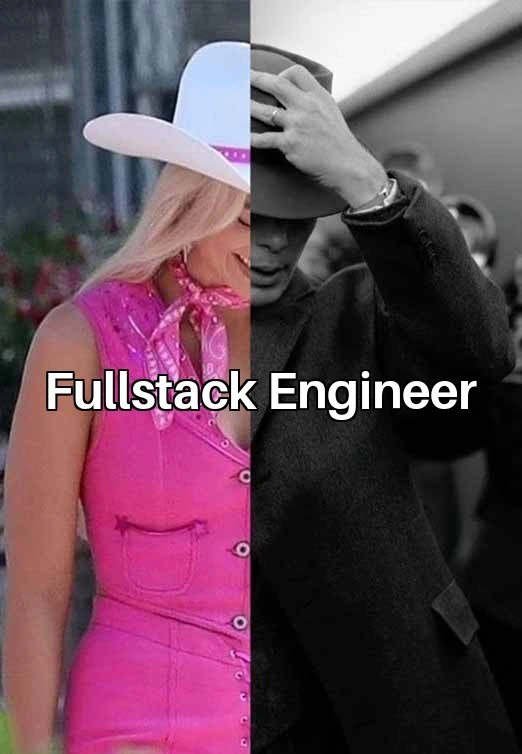
In the meme, the pink cowgirl (imagine a Barbie doll character) represents the fun, pretty side of the work – making sure an app or website looks amazing and is enjoyable to use. The guy in the dark suit and hat (imagine a very serious scientist) represents the hard, behind-the-scenes side – making sure all the machines and code run without crashing. A fullstack engineer is expected to be both of these at once: a creative decorator and a master engineer. It’s funny because those two things are so different! It’s like one minute you’re drawing with bright crayons, and the next minute you’re doing math homework for rocket ships. Most people usually specialize in one or the other, but a fullstack person has to switch between the “let’s make it pretty!” mindset and the “let’s make it work safely!” mindset.
So, in simple terms, the meme jokes that being a fullstack developer is like being a person with a split personality: half of you lives in a pink, sparkly world of design and visual details, and the other half lives in a black-and-white world of serious problems and important calculations. It’s funny and a bit silly to imagine one person acting as both Barbie and Oppenheimer, right? But that’s exactly the point — it highlights how crazy and impressive it is that some people can handle both sides. It makes us smile because we know one person doing all that is a big challenge, just like throwing a Barbie-themed party and handling a nuclear science experiment at the same time would be!
Level 2: Two Worlds, One Dev
Let’s break down the meme in simpler terms. The image shows two different characters merged into one, labeled “Fullstack Engineer.” This is illustrating the idea that a fullstack developer has to do two very different jobs at once: frontend development and backend development. If you’re new to these terms, here’s what they mean:
FrontendDevelopment (Frontend): This is the part of software that users actually see and interact with – basically, the look and feel of a website or application. It involves things like layout, colors, buttons, menus, and all the visual stuff in a browser or mobile app. Technologies here include HTML (for structure), CSS (for styling and making things pretty), and JavaScript (for interactivity and dynamic behavior). In the meme, the Barbie half (the pink cowgirl outfit) represents this side – it’s bright, flashy, and all about presentation. Frontend developers make sure the software is user-friendly and looks great. They handle things like making a website responsive (so it works on both big monitors and tiny phone screens), ensuring the animations are smooth, and fixing those quirky layout bugs that sometimes only show up in, say, Internet Explorer or Safari. When someone says “make it pixel-perfect,” that’s the frontend person’s job.
BackendDevelopment (Backend): This is the behind-the-scenes part of software that users typically don’t see. It’s all the logic, data storage, and processing that powers the application. Think of user accounts, databases, servers, and algorithms that handle things like logging in, fetching posts, or processing payments. Backend developers work with languages like Python, Java, JavaScript (Node.js), Ruby, or C#, and use databases such as MySQL or MongoDB. They ensure that when you click a button on the frontend, the right data is created, read, updated, or deleted in the system – reliably and securely. The Oppenheimer half of the image (the serious-looking guy in the fedora, in black-and-white) stands for this side – it’s serious, complex, and about heavy lifting. Backend work includes making sure the server (the computer that sends data to your browser) stays up and running, handling errors, dealing with lots of users at once, and keeping data safe. For example, a backend developer figures out how to handle a million users posting messages without crashing the site, or how to update a database without losing anyone’s information if something goes wrong.
Now, a Fullstack Engineer is someone who does both frontend and backend. The meme shows the fullstack engineer as half Barbie, half Oppenheimer to humorously illustrate how they have a “split” role. On the left, the engineer is like Barbie – taking care of the fun, flashy interface (imagine picking the right shade of pink for a navigation bar, or positioning a menu just so). On the right, the engineer is like Oppenheimer – handling the weighty, critical systems underneath (imagine making sure the database transactions are correct or the server scalability doesn’t “explode” under high load).
The caption in the middle says “Fullstack Engineer” in bold letters, making it clear that one person is expected to encompass both of these very different personas. It’s as if the industry sometimes wants you to be a combination of a creative designer and a hardcore systems engineer. This can be quite challenging! Each side uses different skills and even mindsets:
The Barbie/front-end side requires an eye for design and user experience. It might involve working closely with designers or thinking like a user. Here you worry about things like, “Is that shade of pink too bright?” or “Does this layout make sense on a phone screen?” You might spend time adjusting margins, trying different fonts, or debugging why that darn CSS isn’t doing what you expect (why is that sidebar suddenly floating over the header?!). It’s detail-oriented in a visual way. Frontend devs also have to consider performance in the browser – e.g. will adding this sparkle effect make the page laggy? They think about accessibility too: making sure that, say, screen readers can navigate the site for visually impaired users, or that every button can be reached via keyboard.
The Oppenheimer/back-end side requires strong analytical thinking and knowledge of how systems work. This is more about algorithms and data. You’d be thinking, “How do I design the database for these user accounts?” or “How do I handle 10,000 people using the site at the same time without it crashing?” A back-end dev spends time writing server-side code (which runs on a server somewhere in a data center, not in your browser) to handle the logic of the site. They also worry about security (e.g., encrypting passwords, validating input so hackers can’t break things) and reliability (e.g., what if one of our servers goes down unexpectedly? Will the app still work?). When something goes wrong in the back-end, it can be serious – imagine if a bug accidentally charged customers twice, or if the server went down and the site became unavailable. Back-end folks often use monitoring tools and logs to detect issues, much like a scientist measuring radiation levels – they keep an eye on memory usage, CPU load, error rates, etc., to catch problems early.
The meme is funny because combining these two worlds is a tall order. It exaggerates the situation by using two extremely contrasting images: Barbie (a symbol of lighthearted, colorful fun) and Oppenheimer (a symbol of serious, world-changing responsibility – Oppenheimer was the scientist who led the creation of the atomic bomb, a rather grave undertaking!). Typically, you wouldn’t associate those two in one person, right? Barbie’s all like “Let’s go party!”, and Oppenheimer is more “We must handle this power with utmost caution.” 😅 So, the expectation that a single engineer should be an expert in both is portrayed as kind of absurd in a humorous way. And yet, in tech job postings, you’ll often see companies looking for “fullstack developers” who can do it all.
If you’re a junior dev or just learning, you might notice this yourself: maybe you started learning frontend (making a pretty webpage) and realized that to actually make it work with real data, you also need some backend knowledge (like setting up a simple server or using Firebase, etc.). Suddenly you’re googling both CSS tricks and database tutorials. It can feel like switching between two different modes of thinking – which is exactly what the meme shows with the half-and-half image. On one side, you have to think like a designer (Barbie’s world: aesthetics, user happiness), and on the other, think like an engineer solving tough problems (Oppenheimer’s world: precision, avoiding disaster).
The term “fullstack_identity_crisis” (hinted at in the tags) is a playful way to describe how a fullstack dev might feel pulled in two directions. Imagine spending your morning fine-tuning the look of a webpage (adjusting padding here, choosing icons there) – it’s a very creative, visual flow. Then in the afternoon, you get an alert that something is wrong in the backend: maybe users can’t save their data. Now you have to drop the visual stuff and dive into server logs or database queries – a very logical, invisible kind of problem-solving. It’s almost like you have to switch personalities. This can be exciting (you’re never bored, and you learn a ton), but also demanding (it’s hard to be great at everything all at once).
So, the meme uses humor to say: “Being a Fullstack Engineer means being Barbie and Oppenheimer at the same time.” It’s poking fun at the idea that some companies expect one person to handle both the glamorous front-end and the grave back-end. Developers find it funny (and shareable) because they recognize a bit of truth in it – they’ve been asked to add a cute feature to the UI and also to solve a deep technical issue, all in the same job. The absurd visual of a pink-outfitted cowboy Barbie merged with a solemn Oppenheimer figure is exactly how that experience feels: half of you is saying “let’s make it sparkle!”, and the other half is saying “please, let it not blow up.” 🤣
In essence, this meme is a lighthearted take on the fullstack developer’s life. It underscores how versatile and sometimes split-brained a developer has to be, especially in roles where they manage both client-side (frontend) and server-side (backend) work. If you’ve ever heard the phrase “jack of all trades, master of none,” it can feel that way for fullstack folks (though many do master both sides over time!). It’s relatable to anyone who’s dabbled in both ends of development – you appreciate the art of a beautiful UI and the science of a robust backend, and you know each is hard in its own way. The meme just captures that contrast in a single, striking image.
Level 3: Glitter Meets Gravitas
For the seasoned developer, this meme elicits a knowing chuckle (or maybe a tired sigh). It captures that relatable developer experience of being a one-person show – the FullStackDevelopment reality where you’re expected to be both the front-end stylist and the back-end architect. The humor comes from the sheer contrast: building cheery pixel-perfect frontend features in the morning and firefighting grim backend issues by the afternoon. It’s Barbie’s dreamhouse one minute, Oppenheimer’s war room the next. Anyone who’s juggled both FrontendDevelopment and BackendDevelopment has lived this identity crisis.
In practice, front-end and back-end work couldn’t be more different in tone. The front-end “Barbie” side is all about visual flair and user experience. This is where you agonize over the perfect shade of pink for a call-to-action button, or add that extra sparkle (maybe a CSS box-shadow or a jazzy animation) to delight users. It’s creative, sometimes even fun – when the CSS finally behaves, you literally see your work shine on the screen. The stakes on this side often feel cosmetic: a misaligned div or a clashing color scheme might make a page look unpolished, but it isn’t going to wake anyone up at 3 AM (other than perhaps a UI designer having nightmares). The tools here include things like CSS and design systems, shiny frameworks like React or Angular for interactive components, and lots of tweaking in browser devtools to pixel-push the UI into perfection. It’s represented by that bright pink cowgirl outfit in the meme – bold, bubbly, and meticulously styled.
Contrast that with the back-end “Oppenheimer” side – depicted in monochrome seriousness. Backend work is about logic, data, and raw power behind the scenes. Here you’re dealing with server load, database queries, API endpoints, uptime, security… serious stuff that carries a heavy weight. A mistake in this arena can be truly catastrophic for a business: an improper database query can crash production or corrupt data, a memory leak can bring down servers, a concurrency bug can cause race conditions that are ridiculously hard to debug. This is the world of log files, terminals, and alerts – it’s figuratively (and sometimes literally) black and white, as the image suggests. When something breaks in the back-end, you might feel like the world is on your shoulders, much like Oppenheimer contemplating the gravity of his creation.
The meme nails the FullstackEngineer expectation: be great at both. That top-centered caption “Fullstack Engineer” pasted across the two divergent images is exactly how it feels to read some job descriptions out there in tech. Companies (especially startups) often want a unicorn who can whip up a delightful UI and engineer a scalable, robust back-end infrastructure. If you’ve been in those roles, you know it’s not easy to excel at both ends simultaneously – it requires wearing two very different hats. Or in this case, a sparkly pink cowboy hat and a somber fedora, at the same time! 🎩👒 (Two hats on one head – now that’s a look.)
Why is this so funny to developers? Because it rings true. The humor is a bit sarcastic: “Yeah, I’m supposed to be as carefree and creative as Barbie and as fundamentally earth-shaking as Oppenheimer, all before the sprint ends.” It exaggerates a real tension. Seniors have experienced meetings where in one moment a client or manager gushes about making the site “pop” with trendy visuals, and in the next breath asks why the latest deployment caused a server outage. It’s context-switching whiplash.
Designer: “Can we make the homepage more fabulous? Think unicorns and sparkles!”
Team Lead, 1 hour later: “Our payment service is failing across regions. We need you on a call to debug the database replication issue now.”
That hypothetical dialogue above isn’t far-fetched – it’s basically a day in the life of a fullstack dev at a smaller company or on a lean team. One minute you’re polishing pixels, the next you’re policing pipelines. The meme effectively says: behold the two worlds a fullstack engineer straddles. The Barbenheimer reference (a mashup of the Barbie and Oppenheimer movies that coincidentally released together in 2023) adds a spicy layer of cultural satire. Just as memes combined the most candy-colored film with the most brooding film for comedic contrast, this image combines the lighthearted side of dev work with the heavy-duty side. Seasoned devs see that and nod: the juxtaposition is our daily reality.
From an DeveloperExperience (DX) perspective, wearing both hats can be rewarding but also taxing. You get the joy of seeing features end-to-end – building something and immediately seeing its impact on users, and knowing how it works behind the scenes – but you also shoulder the responsibility of everything. It’s no surprise that context-switching is a known productivity killer. When you jump from tweaking a CSS style to investigating a server memory leak, there’s a mental reset required. Your brain has to swap out its “visual design & interactivity” cache and load up the “performance tuning & debugging” module. Senior engineers often develop strategies to cope: maybe dedicating certain days to front-end work and others to back-end tasks, or developing a personal workflow that can handle interruptions. But the meme captures the chaos before those coping mechanisms – it’s the raw “What am I today? Designer or Systems engineer? Both, apparently!” sentiment.
Perhaps unintentionally, it also comments on the polyglot expectations placed on developers. Fullstack often means you’re expected to know multiple programming languages and frameworks: e.g. JavaScript/TypeScript for the front, Java or Python for the back, plus SQL for databases, and maybe a touch of DevOps (setting up CI/CD pipelines, Docker containers, cloud configs). It’s a lot. The Barbie side could be thought of as speaking one language (say, the language of pixels and events), and the Oppenheimer side another (the language of algorithms and infrastructure). The engineer is effectively bilingual, if not multilingual. Seniors have felt that pressure to keep up with everything – one day you’re learning the newest front-end library, the next day evaluating a new database or caching strategy. The meme resonates because it visualizes that split identity: you’re not just doing one job, you’re doing all the jobs.
Check out how the meme’s two halves might translate into the daily to-do list of a fullstack dev:
| Barbie Frontend Mode 🩷 | Oppenheimer Backend Mode 🖤 |
|---|---|
| Perfecting the CSS so the app looks gorgeous on all screen sizes. | Optimizing a database query that’s slowing the app down for all users. |
| Choosing a fun new font and adding a playful animation to a button hover state. | Investigating why the server CPU usage spiked to 90% at midnight. |
| Ensuring the page is responsive, interactive, and accessible (keyboard navigation, ARIA labels). | Ensuring the API responses are correct, caching is working, and no sensitive data leaks in logs. |
| Fixing a pixel misalignment that only happens in Safari and drives the designer crazy. | Fixing a memory leak in the Node.js backend that crashes the app occasionally. |
| Implementing a cute Easter egg (Konami code = rainbows!) for user delight. | Implementing rate limiting and fault tolerance so the system doesn’t overload under peak load. |
It’s almost comedic how those tasks differ, yet they belong to the same job role! The left column is all about frontend flair – polish and user-centric enhancements. The right column is pure backend grit – stability and system-centric safeguards. The meme exaggerates it with the costumes: you wouldn’t expect the person worrying about a Safari flexbox bug to also be the one calculating the blast radius of a server failure… and yet, in fullstack work, it’s often the very same person. That contrast is exactly what fuels the humor.
Another angle to this is how expectations vs. reality play out. Many of us who have “fullstack” in our title know that true 50/50 mastery is rare. Often, you have a background or strength in one area and you learn the other out of necessity. Maybe you started as a backend engineer but picked up frontend to deliver features end-to-end (Oppenheimer dons a pink hat), or you were a frontend specialist who had to dive into APIs and databases to get the job done (Barbie picks up a Geiger counter). There’s a tongue-in-cheek implication: being fullstack can sometimes feel like having a split personality. The meme cranks that idea up to 11 by using two iconic, wildly dissimilar personalities.
In summary, this slice of tech humor speaks to the shared experience of developers who traverse the entire stack. It pokes fun at the fullstack_identity_crisis – the feeling of “who am I right now, the creative designer or the serious engineer?” – by using a cultural reference everyone immediately recognizes. Seasoned devs appreciate it because they’ve been there: committing CSS fixes with one hand while tailing server logs with the other (figuratively, we hope!). It’s a playful reminder that our jobs often demand versatility, and sometimes that expectation reaches almost absurd proportions.
Level 4: Critical Mass & Cascades
At the deepest technical level, this meme highlights the polar extremes of software engineering. On one side, you have the CSS cascade powering Barbie’s pixel-perfect sparkle; on the other, the critical mass of complexity holding up Oppenheimer’s back-end gravity. A Fullstack Engineer is expected to reconcile these vastly different domains, almost like unifying two laws of physics within one brain. One moment they’re wrestling with the browser’s rendering engine and the quirks of the DOM (Document Object Model), and the next they’re reasoning about distributed system consistency and data replication across servers. It’s a combination as volatile as mixing Barbie’s dream glitter with a nuclear reactor’s core.
Think about it: front-end development isn’t just coloring buttons – under the hood, a browser is effectively a constrained sandbox running a mini operating system. Laying out a complex webpage involves algorithms solving box geometry and style inheritance (the cascading in Cascading Style Sheets). The browser must calculate which CSS rules apply (specificity and inheritance), handle reflows/repaints optimally, and manage an event loop to keep the UI responsive. These are non-trivial computer science problems – the layout engine balances a constraint-solving act, and animations tap into graphics processing internals. It may look like playful pink fluff, but even making a smooth drag-and-drop UI can touch on computational geometry and GPU acceleration techniques.
Meanwhile, back-end development is grounded in heavy theory and systems design. This is where terms like CAP theorem rule with iron laws: a distributed database must choose between Consistency and Availability when a Partition (network failure) occurs – an inevitability in large-scale systems. Handling a “world-altering” back-end issue might involve understanding a consensus algorithm like Paxos or Raft to ensure multiple servers agree on data (a bit like ensuring a controlled chain reaction rather than an explosion of conflicting states). The Oppenheimer side of the engineer’s brain grapples with concurrency, thread scheduling, memory management, and the physics of the cloud – network latency, throughput, and eventual consistency. A seemingly simple task like saving a user’s data might cascade into complex sub-operations: validating input, writing to a replicated database cluster, invalidating caches, all while avoiding deadlocks or race conditions (those nasty bugs where timing issues cause unpredictable failures).
This dual expectation pushes the limits of cognitive load. Context switching between these realms has an overhead that even seasoned engineers find challenging. The mental model for debugging a CSS layout issue (visual, iterative tweaks, lots of background-color test highlighting!) is worlds apart from diagnosing a production outage by reading log files or analyzing a memory dump. It’s akin to solving a bubbly UI layout puzzle in the morning and a distributed state problem after lunch – using completely different parts of the brain. The meme’s brilliance is how it visualizes this split: half Barbie, half Oppenheimer, representing the engineer’s bifurcated expertise. You can almost hear the brain context-switch gears grinding: “Did I import the wrong Sass file?…” to “Is our message queue experiencing a retry storm under network partition?…” in the span of a few minutes.
To put it in theoretical terms, a fullstack engineer’s skillset spans multiple abstraction layers of computing. They deal with high-level user interface semantics and low-level system semantics simultaneously. In big-O notation of complexity (just for fun!), one could say:
$$
\text{Total Complexity}_{fullstack} \approx \text{UI Complexity} + \text{System Complexity} + O(\text{context switches})
$$
In other words, the fullstack role isn’t just Front-end ⊕ Back-end; it introduces extra complexity because bridging these domains is itself a complex task. Each domain has its own “gotchas” – CSS has the cascade and specificity wars, and back-end has the fallacies of distributed computing (like “the network is reliable”… spoiler: it isn’t). The meme wittily compresses this truth into one image. It nods to the near-schizophrenic skillset required: one half must master UI/UX nuances and the other half systems engineering principles. It’s a bit like expecting someone to be fluent in two very different languages – say, Sparkly CSS-ish and Sober JVM-ish – and to switch between them instantaneously.
And yet, that’s exactly what many fullstack developers do daily. The “Barbenheimer” mashup (inspired by summer 2023’s simultaneous Barbie and Oppenheimer pop-culture phenomena) is a spot-on analogy: combining cotton-candy front-end whimsy with a doomsday-device back-end seriousness. It underscores an absurd reality of modern software development: that polymath developers are often valued, even if maintaining expertise in both realms can be as tricky as managing a nuclear chain reaction without letting it blow up. The gravity of the back-end (ensuring the app doesn’t fail catastrophically, protecting data like it’s weapons-grade plutonium) collides with the sparkle of the front-end (making everything visually appealing and smooth, as if sprinkled with fairy dust). For those of us who love both, it’s equal parts exhilarating and exhausting – a true test of range in engineering prowess.
Description
A split-screen image labeled 'Fullstack Engineer'. The left side features a vibrant, full-color image of a woman dressed as Barbie in a pink cowboy outfit, representing the frontend. The right side shows a man in a dark, 1940s-style suit and fedora, in black and white, representing the backend. This meme uses the 'Barbenheimer' cultural phenomenon, which juxtaposed the colorful 'Barbie' movie with the serious, monochrome aesthetic of 'Oppenheimer'. The meme humorously illustrates the dual nature of a fullstack engineer, who must navigate both the visually-driven, user-facing world of frontend development and the complex, often unseen, logic of the backend. It speaks to the significant context-switching and disparate skills required for the role
Comments
9Comment deleted
A fullstack engineer's daily stand-up: 'This morning I was debugging a race condition in a distributed system that could cause data corruption. This afternoon I'll be centering a div.'
Full-stack means tweaking a 2 px border-radius at 9 am and tuning Postgres autovacuum knobs at 9 pm - same engineer, different existential crises
Just like how Barbenheimer had us choosing between existential dread and pink plastic fantastic, fullstack engineers daily navigate between 'Why won't this CSS center?' and 'How many microservices is too many?' - except we can't just pick one movie, we're contractually obligated to debug both simultaneously while the PM asks if we can make the backend more 'pop'
Fullstack engineers: spending their mornings making pixel-perfect CSS animations for stakeholders, and their afternoons optimizing database queries that no one will ever see. It's the only role where you're simultaneously praised for making a button look pretty and blamed when the entire distributed system goes down at 3 AM
Fullstack: pixel-perfect on the surface, exactly-once underneath - both lies we tell in reviews
Full‑stack is fixing a z-index bug, optimizing a slow query right after, and paying the context‑switch tax PMs think is amortized across the sprint
Fullstack: Where 'full' means fully responsible for every outage, from frontend flakes to backend black swan events
This is the most accurate thing ever Comment deleted
Backend is pink though Comment deleted