Skip to content
DevMeme
3644 of 7435
LEGO's Philosophy on Builds vs. Jenkins' Reality
BuildSystems CICD Post #3982, on Nov 28, 2021 in TG

LEGO's Philosophy on Builds vs. Jenkins' Reality

Why is this BuildSystems CICD meme funny?

Level 1: No Wrong Way to Build

Imagine you’re building a tower out of LEGO bricks at home. Your friend (or the LEGO company) tells you, “Wow, there’s no wrong way to build it – every creation is great!” That makes you feel good, right? Now picture a strict robot helper sitting next to you, watching you build. The moment you place a brick slightly off, the robot buzzes and says, “Error! Bad build!” You’d probably roll your eyes and say, “Hey, didn’t you hear them? They just said I can’t do it wrong!”

In this meme, LEGO is like that encouraging friend saying “there are no bad creations.” But Jenkins is like the strict robot that inspects coded creations instead of brick towers. Developers joke that Jenkins gets upset whenever something isn’t perfect in the code. So the person in the tweet is basically telling the robot (Jenkins), “See, even LEGO says every build is fine, so stop complaining about my code!” It’s funny because we’re combining a warm, positive idea from a toy world with the very opposite feeling from the programmer’s world. It’s like telling a grumpy teacher to relax because the toy company said we’re doing a good job. Even if you don’t know Jenkins, you can imagine how silly it is to reassure a picky robot that everything we build (whether with bricks or code) is supposed to be okay. The joke makes us laugh because it captures that everyday frustration in a playful way: sometimes we just wish our strict computer tools could be as supportive as a friend saying, “Don’t worry, you’re doing great, no bad builds here!”

Level 2: When “Build” Means Code

Let’s break down the meme’s context in simpler terms. In software development, a build isn’t about assembling bricks – it’s about compiling code and running automated tests. Jenkins is a widely-used tool for Continuous Integration (CI), which means every time developers make changes to code (like adding a new feature or fixing a bug), Jenkins automatically tries to build the project and run all the tests to make sure nothing is broken. If everything compiles and the tests pass, Jenkins gives a green light. If something goes wrong – say a syntax error, or a test that catches a bug – Jenkins gives a red light and marks the build as failed. Developers often call that a “broken build” or a “bad build.” It’s Jenkins’s job to loudly point out problems so they can be fixed early.

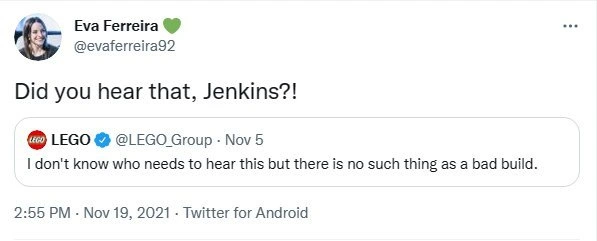
Now, the meme is a screenshot of a Twitter interaction. The bottom part is a tweet from the official LEGO account saying:

LEGO (@LEGO_Group): “I don’t know who needs to hear this but there is no such thing as a bad build.”

Above it, web developer Eva Ferreira (@evaferreira92) quote-tweets that with her own comment: “Did you hear that, Jenkins?!” This format – a quote tweet – means Eva is sharing LEGO’s tweet and adding her response on top. She’s addressing Jenkins as if it’s a person who can listen (developers often jokingly talk to tools like Jenkins or call it by name because it feels like a team member that’s always watching our code). The humor comes from the double meaning of “build.” LEGO is talking about building with LEGO bricks, encouraging creativity by saying no LEGO creation is bad. But developers can’t help reading it in the software sense: “no such thing as a bad build” sounds like “no code build ever fails.” That’s obviously not true in real life – ask anyone who’s dealt with a CI/CD pipeline. So Eva’s cheeky response is basically telling Jenkins, the strict build enforcer: “See, even LEGO says every build is good, so stop flagging mine as failed!”

For a junior developer or someone new to DevOps, here’s why it’s funny: Jenkins CI has a bit of a reputation. Picture Jenkins as a robot butler that automatically builds your project and runs tests. It’s super helpful because it catches mistakes continuously. But it’s also notoriously temperamental. If one tiny thing is off, Jenkins will declare the build “bad” (failed) with no hesitation. Sometimes the failures aren’t even your code’s fault – maybe the test environment had a hiccup, or a dependency didn’t download – but Jenkins doesn’t care, it just reports the failure. This can be frustrating, especially when you’re new: you push your code thinking everything is fine because “it works on my machine,” and then Jenkins runs it on a clean environment and says nope, something broke. It feels like Jenkins is being overly strict.

A common early-career experience is breaking the build and then hearing from a teammate or tech lead about it. Many teams configure Jenkins to send an email or Slack message when a build fails. Getting that “Build failed” notification can give you a mini heart attack the first few times! Over time, developers learn it’s normal – you check the Jenkins build log, find the error (maybe a failed test or a linting issue), fix it, and the next build hopefully passes (green). But that cycle of red-green-red-green can be exhausting, and it makes Jenkins feel like a grumpy teacher with a red pen. This meme taps into that feeling by humorously imagining Jenkins taking LEGO’s optimistic tweet personally.

To give a concrete idea, here’s a tiny example of what a Jenkins build pipeline might look like for a JavaScript project using Node.js:

pipeline {
    agent any 
    stages {
        stage('Build') {
            steps {
                sh 'npm install'    // Install dependencies
                sh 'npm run build'  // Compile the project (e.g., bundle JS files)
            }
        }
        stage('Test') {
            steps {
                sh 'npm test'      // Run automated tests
            }
        }
    }
}

In a Jenkins setup, a file like this (often named Jenkinsfile) defines what to do on each build. First, Jenkins would run the Build stage – perhaps installing packages and compiling code. Then it runs the Test stage – executing the test suite. If any command here returns an error (for instance, if npm test finds a failing test case), Jenkins will mark the whole build as FAILED. In Jenkins’ web interface, you’d see a big red ball or red bar indicating the failure. That’s what we call a “bad build” in software: something went wrong in the integration process. Jenkins can even halt the pipeline at that point, refusing to proceed to later stages (like packaging or deployment) because it doesn’t make sense to deploy broken code.

So, when LEGO says “no such thing as a bad build,” every developer smirks because we’ve seen plenty of bad builds. We’ve caused a few ourselves by accident! The tweet is basically one world (toys and creative building) accidentally cheering up another world (software builds) in a way that doesn’t quite fit reality. Jenkins, being one of the oldest and most ubiquitous CI tools, is used here as the symbol of all CI systems that grumble about bad builds. The meme tags like #BuildPipeline, #BuildFailures, and #ContinuousIntegration reflect that this is about the CI/CD process. And of course, #Jenkins is explicitly named because it’s the prime example of a CI server that would take issue with the “no bad build” philosophy. It’s a classic case of a pun in tech: a wholesome statement from a toy company becomes a tongue-in-cheek jab at the daily struggles of developers maintaining build automation. Even if you’re relatively new to coding, once you’ve had a taste of a CI pipeline, you get why this is amusing. It’s basically saying: If only Jenkins had the same chill vibe as LEGO!

Level 3: Boulevard of Broken Builds

The humor in this meme hits home for every experienced DevOps engineer who’s slogged through Continuous Integration woes. Here we have the official LEGO account proclaiming “there is no such thing as a bad build” – a wholesome message about creativity with toy bricks. But a developer quote-tweets it with “Did you hear that, Jenkins?!”, playfully calling out Jenkins CI. Why Jenkins? Because in the software world, “build” has a very different, more painful meaning. Jenkins is a popular (and sometimes notorious) automation server in Build Systems & CI/CD pipelines. When your code fails to compile or a test fails, Jenkins marks the build as FAILED – a bad build. Every seasoned developer knows the sinking feeling of a red build failure notification. The meme’s punchline lands because LEGO’s cheery mantra collides with the daily reality of broken software builds. It’s a perfect pun: LEGO’s world has no bad creations, while Jenkins lives in a world where bad builds are an everyday occurrence (often at 4 PM on a Friday, no less).

Diving deeper, this joke reflects the collective pain of maintaining CI pipelines. Jenkins, often personified as a butler, will tirelessly run your build jobs and tests on each code push. But he’s also quick to wave a red flag at the tiniest issue – a failed unit test, a misconfigured environment variable, an unmet dependency, you name it. For veteran developers, the phrase “no such thing as a bad build” is hilariously ironic: we’ve seen build pipelines crumble for countless trivial reasons. The meme also hints at Jenkins’s reputation. Jenkins is powerful and flexible (with innumerable plugins and configurations), yet it’s infamous for being finicky. It might be open-source and extensible, but it’s also the poster child for “works on my machine, breaks in CI”. Many teams have even institutionalized the pain: maybe you’ve heard of the “broken build tax” (bring donuts for the team if your commit breaks Jenkins). So when LEGO says every build is fine, developers immediately imagine Jenkins spitting out errors and think, “Oh really? Try telling Jenkins that!”. The shared industry experience being satirized here is continuous integration’s reality: no matter how carefully you code, build failures are inevitable. In fact, those failures are useful – they catch bugs early – but that doesn’t stop us from cursing Jenkins at 2 AM when a deployment pipeline fails. The meme is a lighthearted venting of this frustration. DevOps/SRE folks and senior engineers chuckle because they’ve been in the trenches with flaky Jenkins pipelines, race conditions in tests, and brittle build scripts. LEGO’s tweet was about embracing creativity without judgment, but in software, if something doesn’t compile or a test fails, somebody (Jenkins) will definitely judge it. This contradictory viewpoint creates the perfect storm of comedic relief. It’s a gentle poke at the optimistic world of toys using the cynical reality of software development: in theory, “no bad build” sounds great – in practice, ask any engineer watching Jenkins turn their commit into a big red X. We laugh, because otherwise we’d cry as we fix the pipeline again.

Description

The image is a screenshot of a tweet from user Eva Ferreira (@evaferreira92). Her tweet says, 'Did you hear that, Jenkins?!' and is a reply to a quoted tweet from the official LEGO Group account (@LEGO_Group). The LEGO tweet reads, 'I don't know who needs to hear this but there is no such thing as a bad build.' The humor is a classic pun based on the double meaning of the word 'build.' For LEGO, a 'build' is a physical creation with their toy bricks, where creativity is paramount and there are no mistakes. For a software developer, a 'build' is the automated process of compiling code into a usable artifact, a process managed by tools like Jenkins. These software builds can, and frequently do, fail or become 'bad' or 'broken,' halting development. The joke is a sarcastic, relatable jab at the notorious fragility of CI/CD pipelines, personifying Jenkins as a tool that needs to hear LEGO's forgiving philosophy
Comments

8
Anonymous ★ Top Pick The difference is that when a LEGO build is bad, you just have a weird-looking spaceship. When a Jenkins build is bad, you have a weird-looking spaceship on fire, in production, at 3 AM
  1. Anonymous ★ Top Pick

    The difference is that when a LEGO build is bad, you just have a weird-looking spaceship. When a Jenkins build is bad, you have a weird-looking spaceship on fire, in production, at 3 AM

  2. Anonymous

    LEGO says there’s no bad build - Jenkins heard that, updated 487 plugins at once, and turned the pipeline into an avant-garde red/green art installation

  3. Anonymous

    LEGO's marketing team accidentally wrote the most optimistic Jenkins pipeline documentation ever - clearly they've never experienced the joy of a build that passes locally but fails in CI because someone's test depends on the system clock being set to Pacific Time

  4. Anonymous

    LEGO's inspirational message about builds hits different when you've spent 3 hours debugging why Jenkins decided that today, specifically today, your previously green build should fail with 'Error: Success' - a contradiction that somehow feels perfectly on-brand for a tool that's been the backbone of CI/CD since before Docker made everything 'easier.' The real irony? LEGO instructions are deterministic and reproducible, while Jenkins builds are more like Schrödinger's pipeline: simultaneously passing and failing until you check the logs, at which point they're definitely failing, but for reasons that disappeared when you re-ran it

  5. Anonymous

    LEGO says there’s no such thing as a bad build; Jenkins replies with an “unstable” badge, exit code 137, and a mysteriously green check after the third retry

  6. Anonymous

    LEGO: “no bad builds”; Jenkins: tell that to my red ball from a flaky E2E, a 429 from the artifact repo, and an expired credentialsId in stage("Deploy")

  7. Anonymous

    Jenkins to LEGO: 'Challenge accepted - watch this monorepo merge turn prod red at 5 PM Friday.'

  8. @callofvoid0 4y

    bruh

Use J and K for navigation