The Tech Career Lifecycle, Illustrated by Cats
Why is this Career HR meme funny?
Level 1: From Kitten to Fat Cat
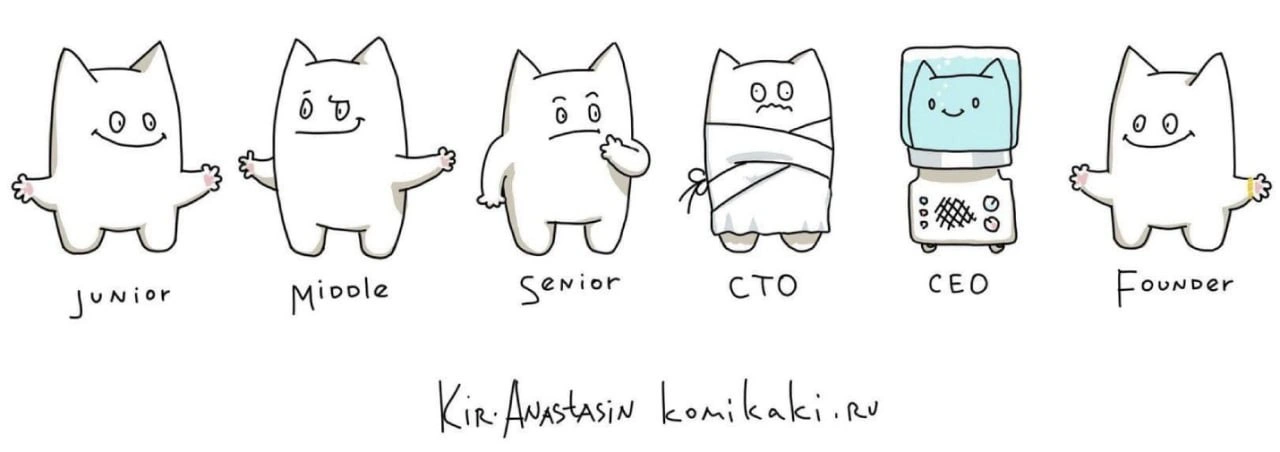
Imagine a little kitten that goes on a big journey growing up. At the very beginning, the kitten is happy and excited, bouncing around without a care – kind of like when you start a new fun project or your first day at school and everything is shiny and new. This is like the junior cat in the picture, who is smiling with open arms, just so excited to be there.
Now, as the kitten grows a bit older, it becomes a normal adult cat. It’s still doing its thing every day, but it’s not as bouncy as before – more calm and just going about its day. That’s like the middle cat in the meme: not super happy or sad, just steady. Think of it like when you get used to school – you’re not jumping with joy over the alphabet anymore, but you’re also not upset; you’re just doing your homework routinely.
As time passes, the cat grows more and starts facing some problems or worries. Maybe this cat has to take care of some kittens or it got into a tricky situation like getting stuck in a tree once. It starts to realize the world can be challenging. The senior cat in the picture looks a little worried, with a paw on its chin – that’s the “uh-oh, what could go wrong?” face. It’s like when you become an older kid who has seen some tough math problems or had some bad days – you’re a bit more careful and concerned than when you were a carefree kitten.
Then the journey gets really rough: imagine our cat had a really hard time, like it got into a big fight or a bad accident. It comes home with bandages all over, maybe one on the head, one on the tail – poor thing needs rest! That’s the CTO cat (the second from right) in the drawing, completely wrapped in bandages. This part of the story is showing that sometimes, as you take on really big responsibilities, you can get tired and hurt. It’s like a parent who works so hard they feel exhausted, or a superhero after a tough battle who is all wounded. The bandaged cat still standing there means even though it’s hurt or super tired, it’s continuing on. In simple terms, that stage is saying: big jobs can be tough on you – you might not get real bandages in life, but you’ll feel very tired like you need them!
Next comes a silly transformation: the cat actually turns into a water cooler. A water cooler is that big bottle in offices that gives people water to drink. In the picture, the second cat from the right (labeled CEO) has a water cooler jug as a head! This is a funny way to show that at some point, the cat has basically become part of the office furniture. What could that mean in a story? Think of someone who spends all their time making sure others are okay, like a friendly teacher or a team captain who’s always checking if everyone has what they need. They might feel like they’ve become just a “water provider” or a talking machine, rather than doing their own stuff. The CEO cat turning into a water cooler is a goofy cartoon way to say: “This cat is no longer running around catching mice; instead, it’s standing there letting others have a drink and talk.” It’s like the cat became the helper for everyone else, almost like it lost a bit of its own cat-ness because it’s busy taking care of others. Visually, it’s super silly (a cat with a water machine head!), which makes us laugh. It tells us that at very big responsibilities (like being the boss of a whole company), a person might feel less like they’re playing and more like they’re just there to support everyone (kind of like a watercooler supports the office with water).
Finally, at the end of the line, our cat becomes happy again and even has gold on its paws. This last cat is the Founder cat, and it’s smiling big, looking proud. The little golden dots on its paws can be seen like treasure or rewards. Imagine at the end of a long adventure, the cat found a chest of gold or got a big bowl of milk and fish as a prize. That’s what’s going on here. It’s like saying: after all those challenges (and even turning into a water cooler!), the cat achieved something great and is enjoying success. The founder cat has a grin kind of like the kitten at the start, but now it’s a grin that says “I made it!” Maybe the cat started its own little cat business or became the leader of its own kitten pack, and now it’s very proud and happy with some shiny rewards (the gold glints).
So, in very simple terms, this picture is a funny story of a cat growing up from a tiny newcomer to a big boss. At first, everything is easy and fun (the kitten jumping around). Then as it grows, life gets more routine (regular cat doing its job), then a bit worrying (cat thinking hard), then really hard (cat in bandages, ouch!), then kind of strange and selfless (cat turning into a water dispenser for others), and finally, in the end, the cat gets a big happy ending with riches (smiling with gold paws).
People find this cartoon funny because it exaggerates how life or a career can change someone. It’s like saying: “Growing up in a job, you might start simple and end up completely changed – maybe tired or feeling like just a tool – but hey, you could also end up with the reward you wanted!” Using cats makes it cute and silly, so even though it’s talking about serious things (like being super tired at work or having big responsibilities), it stays light-hearted. Plus, seeing a cat wrapped like a mummy or a cat with a water-cooler head is so absurd that you can’t help but giggle.
Imagine telling a child a tale: “Once there was a little kitten who started working at a store. First, he was so excited he smiled every day. Later he became a normal worker kitty, doing his job quietly. As he got promoted, he started worrying a lot, always thinking deeply, which made him frown. Then he became the chief cat in charge of all the work – he worked so hard he got all kinds of boo-boos and had bandages everywhere! After that, he became the big boss cat who spent all day making sure the other cats were happy – he did that so much he actually turned into the water machine that gives everyone drinks! And in the end, he started his own company and found great success – now he’s a very happy cat with golden paws from all the money he earned.” It sounds like a silly fairy tale, right? That’s basically what this meme is – a silly fairy tale for developers, told with drawn cats.
Anyone can laugh at the funny drawings, but those who work in offices or tech companies laugh extra because they know sometimes work really can feel like that. Even a kid might understand: it’s like when you play a game and level up, things get harder or you change a lot by the final level. But in the end, maybe you win a prize. Here our cat “leveled up” from a newbie to a founder, and indeed it shows all the changes along the way in a goofy, memorable way.
In short, the meme is joking that as you go from a junior (a beginner) to a founder (someone who starts and possibly leads a whole company), you go through many stages – happy, normal, worried, hurt, strange, and finally triumphant. It’s funny and a little bit true, and that’s why people in the tech world smile when they see it. Even if you’re not in tech, you can think of it as a cat’s wild adventure of growing up and chasing its dreams, with all the bumps and rewards that come with it.
Level 2: Clawing Up the Ladder
Let’s break down what each of these labeled cats means in the context of a startup career. This meme is using the cats as visual shorthand for common job titles and how people in those roles often feel or behave. It’s basically a comic take on the career_levels in a tech company. We’ll go through each role one by one – from junior developer all the way to founder – and explain both what that job entails and why the cat is drawn that way.
Junior Developer (Entry-Level Engineer): This is the first role on the ladder. A junior developer is usually someone new to the industry – perhaps their first or second year coding in a professional setting. They’re still learning the ropes, working on simpler tasks or smaller features under guidance. In the image, the junior cat is smiling widely with open arms. That pose radiates excitement and innocence. It suggests the junior is eager to take on work and probably unaware of the big scary problems that might lurk in the codebase. This matches reality: juniors often have a “can-do!” attitude. They’re happy to try new things, not afraid of breaking stuff (sometimes because they don’t fully realize what can break!). The meme captures that sunny enthusiasm – everything is new and fun, and the junior cat’s grin says “I’m ready to code, bring it on!”
Middle Developer (Mid-Level Engineer): The term “middle” here is essentially referring to a Mid-Level developer – an engineer with a few years of experience who’s moved past the junior stage. Mid-level devs can work independently on tasks, have a decent grasp of the tech stack, and are starting to design small systems or features on their own. They’re not newbies anymore, but they’re also not making the really big architectural decisions – they’re in the middle of the pack. The middle cat in the drawing looks pretty neutral: a straight-line mouth, arms just out normally. This neutrality implies steadiness. By this stage, a developer typically knows that sometimes things go wrong, sometimes they go right, and it’s all part of the job. The mid-level cat isn’t jumping for joy like the junior, but it’s also not freaking out. It’s just getting work done. This reflects how mid-level folks often become the dependable backbone of a team – they understand the workflow, they can handle bugs and features without too much drama, and they’ve lost a bit of that “new kitten” hyper-excitement as daily coding has become routine. In many workplaces, mid-level devs are the ones carrying out plans and writing a lot of the production code in a calm, day-to-day manner.
Senior Developer (Experienced Engineer): A senior developer is usually someone with significant experience (often 5+ years, though not just years – depth of knowledge and impact too). Seniors are trusted to make important technical decisions, mentor junior devs, and foresee problems in design and implementation. They often review others’ code, plan architecture, and ensure the software is robust. If something tricky comes up, people turn to the senior. Now, look at the senior cat in the meme: it has a slightly frowning (worried) face and is holding one paw to its chin as if thinking hard or stressing out. That image perfectly encapsulates the typical mindset of a senior engineer: always considering “What could go wrong here?” or “Have we thought of everything?” The worry comes from responsibility. Senior devs know that a small mistake now could cause a big outage later, and they’ve likely seen or fixed those mistakes before. They might also be aware of all the legacy code or half-implemented features that could bite the team, hence the concern. In short, the senior cat looks a bit anxious because experience has taught it to be cautious. This cat has probably debugged thorny issues or dealt with tight deadlines, so it’s always in a slight state of alert. The meme is playing on the stereotype that senior devs, while very knowledgeable, tend to lose a bit of the carefree attitude – they replace it with careful planning and sometimes overthinking. It’s a big jump from the junior’s “yay, let’s do it!” to the senior’s “hmm, let’s think this through (or else…).” That transition is a rite of passage in a developer’s career.
CTO (Chief Technology Officer): The CTO is a high-ranking position – in a startup, often one of the highest technical roles. The CTO is in charge of all technology and engineering in the company. This means not only guiding the technical strategy (choosing what platforms or languages to use, designing system architecture) but also managing engineering teams, setting processes, and often firefighting any major tech issues. In a small startup, the CTO might still code or fix bugs, but as the company grows, they become more of a leader and decision-maker than a day-to-day programmer. Now, the CTO cat in this cartoon is completely wrapped in bandages from head to toe, with only a pair of anxious eyes visible. The poor kitty looks like it came out of a war zone! This comedic exaggeration points to a concept known as CTO burnout. Burnout is extreme exhaustion (mental, physical, or both) caused by prolonged stress – and CTOs can get a lot of stress. Why? Because they’re accountable if the product crashes, if deadlines aren’t met, if the team is underperforming, or if a security breach happens – you name it. They juggle a ton of responsibilities. The bandages on the CTO cat indicate that this cat has been “injured” by the job. It’s a playful way to say the CTO has been through tough times (late-night emergency fixes, perhaps migrating servers over a weekend, dealing with endless feature requests and little resources). In techie joking terms, we often say a system is “held together by duct tape and prayers” – here the CTO itself is held together by bandages. Essentially, the meme is humorously showing that being a CTO at a startup can be painful! The bandaged CTO likely hasn’t slept properly in weeks, has constant headaches about system scalability, and maybe survives on coffee. This image resonates with developers who have seen their tech leads or CTOs under immense pressure (or have experienced it themselves). It’s common in startups that the technical co-founder or CTO is the one fixing critical bugs at ungodly hours and taking one for the team whenever a crisis hits. So, the CTO cat’s mummy-like appearance is a funny way to say: by the time you’re running all of engineering, you’ll have collected a bunch of battle scars (in a figurative sense) from all those intense tech battles.
CEO (Chief Executive Officer): The CEO is the person who runs the entire company. They’re responsible for the overall success of the business, setting the vision, making high-level decisions, and often being the face of the company to investors, press, and partners. In a startup, a CEO’s tasks range from fundraising (convincing investors to give money), deciding on product direction, managing the executive team, to even handling some HR and “people” issues, especially early on. They delegate the technical stuff to the CTO and other leaders while they focus on strategy and leadership. The meme’s depiction of the CEO cat is probably the most bizarre: the cat’s head is an office water cooler. You know those water dispensers with big jugs you see in offices? Exactly that – a big jug of water as the head, and the body is the dispenser unit (with even the little tap and drip tray drawn). It’s very silly, and that’s on purpose. Let’s unpack the meaning: In many offices, the water cooler is a place where employees gather and chat casually – hence the term “water-cooler talk”, meaning informal gossip or conversations about work or life. By turning the CEO into a literal water cooler, the cartoon suggests that a CEO’s role is highly about people and communication, rather than technical output. The CEO cat might be “all about company culture” – providing encouragement, listening to issues, and ensuring everyone’s “refilled” with motivation (just like a cooler provides water). Another angle: maybe the CEO has become an object of gossip or discussion (since employees often gossip about their boss around the water cooler). The image is saying the CEO is the water cooler, implying that everything the CEO does just becomes office talk, or that the CEO spends their time doing things that are as mundane as standing by the water cooler chatting. It’s a playful jab: as you get to the top executive level, you’re often removed from the technical trenches (you’re not coding or building directly). Instead, you are networking, talking, managing reputations – things that might feel like just standing around the water cooler rather than “real work” to an engineer. There’s also a phrase about leaders needing to “keep a cool head”, meaning stay calm under pressure. Well, a water cooler is literally a cool head (filled with cool water!), so this might be a little pun: the CEO has to have a “cool head”, and in the cartoon that became literal. Overall, the CEO cat in band form is showing a workplace stereotype: that the boss is often seen as a talking head who deals with fluffy stuff like meetings and pep talks, rather than the gritty work. It’s a bit tongue-in-cheek – real CEOs do work very hard, but it’s a different kind of work, and to a coder it might look like they just talk all day. So the cartoon makes fun of that by turning the CEO into essentially an office appliance devoted to talk and refreshments.
Founder: The founder is the person (or one of the people) who originally started the company. In startups, a founder often also holds a title like CEO or CTO, especially at the beginning. But not all CEOs are founders (some are hired later), and not all founders remain CEOs (some hire a CEO or step back). The founder role is unique because it often carries the original vision of the product or company. Founders are known for being very passionate and persistent – you have to be, to start something from scratch. They also typically own a significant chunk of the company’s shares. If the company succeeds, founders stand to gain a lot (fame, money, pride in creation). In this cartoon, the Founder cat stands last, with a big confident smile and little gold sparkles on its paws. Those gold bits suggest something valuable or golden. It could imply the founder has struck gold – perhaps they got a big investment, or the company went public or was sold for a hefty sum, making the founder wealthy. The founder cat looks happy, almost as cheerful as the junior cat at the very start. The difference is those gold glints, which signify success or wealth achieved. The founder’s pose (grinning, arms out a bit) also radiates confidence and pride. In contrast to the shy mid-level or worried senior, the founder seems to have regained that optimistic posture. This representation comes from a stereotype in the startup world: founders are the ones who dream big and if everything goes right, they’re celebrated and rewarded (like tech CEOs/founders who become billionaires or get featured in magazines). The meme is showing that after all the hard roles (senior, CTO, CEO) that maybe grind you down, the founder somehow ends up on top, happy and shiny. It’s a little ironic – one might expect the founder to be the most stressed of all (since they have the most at stake). But the cartoon chooses to highlight the positive outcome for the founder, which itself is a comedic twist. Perhaps it implies that being a founder requires optimism, or that the founder gets the “golden parachute” or big reward at the end. It’s also possible the founder’s golden paws nod to phrases like “golden touch” (everything they handle turns successful) or “golden handshake,” but in a cartoonishly literal way. In any case, this cat clearly represents success and a return of happiness at the end of the journey.
So, putting it all together: this meme uses a cat_character_meme style – simple cat drawings – to map out startup_role_progression from a newbie developer up to the person who started the whole company. Each cat’s expression or physical state is a stereotype of that role’s emotional state or responsibility level:
- The junior is excited and clueless (everything is awesome!).
- The mid-level is calm and steady (just doing my job).
- The senior is cautious and worried (I’ve seen some things...).
- The CTO is exhausted and beat up (so many fires to put out, I’m held together by bandages).
- The CEO has basically become part of the office (focusing on people over product, possibly feeling like an accessory rather than a builder).
- The founder is optimistic and potentially rich (dream paid off, confidence back with a sparkle ✨).
The humor lies in role_stereotypes that many in tech will recognize. If you’ve interned or started as a junior, you might recall being super happy-go-lucky about deploying code that, in hindsight, was full of bugs. Senior colleagues might have chuckled at your enthusiasm because they knew what was coming. As people move up, they often comment on how responsibilities increase. By the time someone becomes a CTO or CEO at a startup, it’s common to joke that they look “pretty beat” or they’ve aged faster (stress can do that!). This comic just literalizes that idea by showing the CTO all bandaged (like a hospitalized patient) and the CEO not even human-looking anymore.
Another thing: in startups, roles can blur. Sometimes founders wear multiple hats – one founder might be both CEO and CTO initially, for example. But for the sake of the joke, the meme separates them to show distinct differences. It also reflects an aspirational career path some developers consider: moving from engineering into management and maybe one day starting their own company. Each step has its pros and cons – more influence and maybe more money, but also more stress and less straightforward work. The drawing highlights the cons in a funny way (like, “look what happens, you turn into a water cooler!”). It’s a lighthearted cautionary tale as much as it’s a celebration of rising in career.
Finally, the artistic style is minimalist – just outline cats and handwritten labels – which gives it a casual, doodle feel. It’s like something a colleague might sketch on a whiteboard as a joke. The signature “Kir. Anastasin komikaki.ru” suggests it’s drawn by an artist (possibly Kirill Anastasin) known for such office humor comics, often featuring animals or simple characters to represent complex human situations. The simplicity makes the message clear: as title/role changes, so does the person (or cat, in this case), sometimes dramatically.
In summary, “From Junior to Founder: Cat Cartoon Explains Startup Career Ladder” is a humorous take on the developer_lifecycle in a company. Each cat from left to right represents a higher position (junior dev → mid dev → senior dev → CTO → CEO → founder) and shows a bit of what happens to people at each step:
- Bright-eyed beginner 🐱 →
- steady regular coder 😼 →
- concerned seasoned dev 🙀 →
- overworked tech leader 🤕 →
- ultra-social (or overly corporate) boss 🥤 →
- triumphant founder 😸✨.
It’s funny to people in tech because it exaggerates truths we often talk about: juniors are green and excited, seniors carry worries, technical leaders sometimes look burnt out, and top executives can seem out of touch (like office furniture). Yet, founders – if they succeed – might get the last laugh (and a golden payday). For a newcomer or junior developer, this meme also serves as a cheeky glimpse into possible futures – both the good and the comically bad. Don’t worry though, not every CTO actually ends up in bandages and not every CEO loses their head! It’s all a playful metaphor for the changes in work and mindset as one’s career progresses in the startup world.
Level 3: The Corporate Cat Tree
At first glance, this minimalist cat cartoon hilariously condenses an entire startup career ladder into six feline figures, each representing a rung on the corporate ladder from Junior Developer up to Founder. For those of us seasoned in tech, the humor cuts deep because it satirizes familiar role transformations: the wide-eyed coder slowly morphs into a battle-worn executive. The further up you climb, the less you resemble your old self – sometimes to absurd extremes (in this case, literally turning into office furniture). The meme uses these cat characters to poke fun at the escalating stress and abstraction of responsibility that comes with each promotion.
Consider the progression: The Junior cat is all smiles with open arms – a picture of naïve optimism and energy. That’s the fresh dev who just joined, eager to push code at 2 AM fueled by enthusiasm (and maybe too much caffeine). Move to the Mid-Level (labeled "middle"): this cat looks neutral, even a bit jaded. By this stage, a developer has shipped some features, fixed plenty of bugs, and learned that not every day in tech is fun and games. They’re competent and calm, no longer in constant cheerleader mode – perhaps the “honeymoon phase” with coding is over, but they’re steady and reliable.
Now the Senior Developer cat has a worried expression, hand on chin. Every senior engineer I've known carries a slight frown like that: it comes from seeing how the sausage is made in software projects. The senior isn’t panicking, but they’re deeply concerned – maybe over that looming production release or the mountain of technical debt the team’s been kicking down the road. They know enough to be perpetually “on alert.” This is the stage where one starts losing that blithe confidence and replaces it with cautious skepticism: “Did we handle all the edge cases? What if the server falls over on Black Friday? Are we sure it’s not DNS?” The senior cat’s worry is the look of someone who’s debugged a race condition at 3 AM – experience brings insight, but also a fair bit of anxiety.
Then we get to the CTO, swaddled head-to-toe in bandages, with only haunted eyes peeking out. This poor kitty looks like a mummy – a clear sign of CTO burnout. In a fast-paced startup, the Chief Technology Officer often has to be everywhere at once: architecting systems, reviewing code, firefighting outages, and strategizing tech direction. All those all-nighters and crisis calls inflict “wounds,” figuratively speaking. The bandages are a visual gag for the battle scars of leading tech in chaos – think of countless quick band-aid fixes and duct-tape solutions holding the product together. It’s the cartoon’s way of showing that the CTO is basically held together by tape and sheer willpower. Seasoned devs chuckle (perhaps a bit darkly) at this, recalling times they saw a tech lead or CTO practically live in the office, surviving on coffee and sheer determination. There’s a shared understanding: reaching the top of engineering often means accumulating scars from every emergency patch, server meltdown, and last-minute pivot along the way. It’s funny because it’s true – the CTO role can chew you up.
Next, the humor really shifts into absurdity with the CEO cat. Instead of bandages or expressions, this cat literally has a blue office watercooler for a head. It’s such a bizarre image that it immediately gets a laugh, but it’s also a sharp metaphor. By the time someone becomes a Chief Executive Officer, they’ve often shed their hands-on technical identity (no more coding claws for this cat). Here the CEO is depicted as an actual water cooler – possibly a sly pun on the phrase “keeping a cool head.” In corporate life, we say “cooler heads will prevail” during a crisis, expecting leaders to remain calm. Well, you can’t get a cooler head than a water cooler! 😼 More cynically, this transformation jabs at how CEOs can turn into walking office fixtures – spending the day in meetings, making small talk, and symbolizing the company culture. In tech companies, the CEO often deals with investors, strategy, and “watercooler talk” (the gossip and morale of the team). This cat’s head-in-a-jar look suggests that by the time you’re CEO, your whole head is occupied with keeping everyone else hydrated and happy – you become a provider of resources (water or morale) rather than doing the making yourself. Some developers jokingly view their CEOs as just dispensing pep talks and buzzwords; this cartoon takes that to the extreme by turning the boss into the actual office water dispenser. It’s a visual punchline about executive life: at the top, you might feel less human, more like a vessel serving others (or, humorously, a subject of office gossip around the watercooler). For those of us who’ve seen tech companies from the inside, the CEO’s metamorphosis rings true in an exaggerated way – a leader so absorbed in corporate culture and people management that they’re no longer “one of the cats coding,” but rather an abstract source of sustenance for the organization.
Finally, at the far right stands the Founder cat, grinning ear to ear with tiny golden sparkles on its paws. After the bandaged CTO and the watercooler CEO, seeing a founder smiling is both relieving and comical. The founder’s expression actually mirrors the junior’s bright smile – it’s like we’ve come full circle, but with a twist: those golden paws. The gold hints at success and wealth (think gold coins or the proverbial pot of gold). This could be nodding to a few interpretations. One is the stereotype of the “successful startup founder” who cashes out big (through an IPO or acquisition) and ends up living the dream – rich and happy, at least superficially. In startup lore, the founder is the visionary who had the courage (or crazy optimism) to start the whole venture, and if things go well, they reap the biggest rewards (hence the gold). Notice how confident and relaxed that founder cat looks compared to the frazzled CTO and dehumanized CEO; it’s a tongue-in-cheek reminder that ownership has its privileges. This contrasts with the typical expectation that a founder’s life is ultra-stressful – here the founder appears exuberant, maybe because they’ve “made it” and can finally enjoy the payoff. Another reading: founders often maintain a certain optimism throughout, even when others are stressed. That grin could represent the unyielding positivity many founders need to drive a startup forward. They might be firefighting like the CTO or juggling investors like the CEO, but a true founder keeps believing in the vision (smiling through the chaos) – otherwise they’d never get from an idea to a real company. The cartoon’s humor is that the founder cat has somehow come out the other side of the startup gauntlet gleaming, almost renewed. After all the transformation (and partial destruction) that happened in the intermediate roles, the founder ends up looking like a cat again – as if gaining success let them return to their original joyful form, now with some golden upgrades.
In essence, this meme distills a developer’s career trajectory in a startup into a series of increasingly absurd cat personas that any tech veteran can recognize. The journey from “junior” to “founder” is exaggerated but relatable: you start as an enthusiastic newbie, you mature and shoulder more responsibility (maybe losing some innocence), you get knocked around by tough projects and high-pressure leadership roles, possibly feeling like you’re held together by band-aids or turned into a piece of office hardware – yet, if you’re lucky or persistent enough to become a founder, you might just end up grinning with success (and maybe stocks or a “unicorn” valuation glittering at your fingertips). The workplace stereotypes are spot-on and deliberately extreme for comic effect. Each cat caricature highlights the folk wisdom passed around tech circles about those roles: juniors are cheerful and clueless, seniors are worried and wise, CTOs are battered heroes, CEOs are half-human corporate organisms, and founders are either delusional optimists or eventual victors (or both). We laugh because we see slivers of truth from our own experiences or stories we’ve heard in each stage. It’s a knowing, slightly dark humor that resonates with developers, especially those who’ve been through startup chaos or climbed the tech ranks. This one simple drawing manages to capture the entire lifecycle of a tech career – and it isn’t entirely a flattering portrait, which is exactly why it’s so funny and cathartic for those in the industry. The next time someone asks what climbing the startup ladder is like, just remember this cartoon: sometimes you start as a happy little cat with a keyboard, and if you’re not careful, you might end up as the water cooler (but hey, you could also end up with the gold 🏅).
Description
This is a six-panel comic strip illustrating the perceived emotional and physical state of various roles within a tech company, depicted by simple, white, cat-like cartoon figures. The progression is as follows: 'Junior' is a happy, smiling character. 'Middle' has a smug, confident grin. 'Senior' appears anxious, biting a claw. 'CTO' is wrapped head-to-toe in bandages, looking traumatized. 'CEO' is a smiling cat's head inside a water cooler dispenser, detached and cheerful. Finally, 'Founder' is happy and smiling again, wearing a gold bracelet. The comic humorously and cynically portrays the career ladder in tech. It suggests that happiness and confidence at the start of a career give way to anxiety and immense pressure as responsibility grows, culminating in the CTO role being a state of constant emergency and repair. The CEO is depicted as blissfully unaware, and the Founder as having escaped the turmoil with financial success
Comments
16Comment deleted
The CTO is just a senior dev who tried to resolve all the tech debt tickets in a single sprint
Startup ladder: Junior ships features, Middle ships hotfixes, Senior ships post-mortems, CTO is wrapped in PagerDuty bandages, CEO has literally become water-cooler talk, and the Founder’s busy telling investors the Band-Aid architecture “scales horizontally.”
The CTO wrapped in bandages is just the natural result of holding together a microservices architecture that started as "we'll just split the monolith into three clean services" four years ago
The career progression perfectly captures the paradox of success in tech: you start as a Junior with infinite optimism and zero responsibility, climb the ladder accumulating stress and constraints until you're literally mummified by obligations as CTO or imprisoned in corporate machinery as CEO, only to realize the ultimate escape is founding your own company where you get to be blissfully ignorant again - except this time with the added bonus of personal financial liability and no one to blame but yourself
Startup leveling guide: Junior ships features, Mid ships abstractions, Senior ships deletions, CTO ships 3am bandages, CEO ships water‑cooler OKRs, Founder ships a term sheet
The career ladder is just increasing distance from the compiler - by CTO you’re held together by incident runbooks, and by CEO you’re a water‑cooler interface to the investor API
Junior devs see the code; CTOs don't see it; CEOs view it through KPIs; Founders are just the legacy wrapper holding it together
Where should we laugh? Comment deleted
In Moscow Comment deleted
in the prison Comment deleted
CTO Comment deleted
LMAO Comment deleted
After the word "shovel" Comment deleted
Ok thanks, enough Comment deleted
notice how hands are growing out of ass Comment deleted
Based Comment deleted