Sabotaging Your Own Data Breach with CSVs
Why is this Security meme funny?
Level 1: Password Prank with Punctuation
Imagine you have a big list of information that’s all nicely organized, like a list of names and phone numbers separated by commas. Now, think of a comma as a sort of divider that tells where one thing ends and the next begins. If someone is reading that list, every time they see a comma, they know “Okay, next comes a new piece of info.”
Now here’s a playful trick: what if one of the pieces of information itself contains a comma? It’s like sneaking an extra divider where it doesn’t belong. This can really confuse whoever is reading the list.
Let’s use a simple analogy. Say you’re making a shopping list for the store, and you separate each item with a comma: “apples, bananas, milk, bread”. That’s four items. But you accidentally write “chocolate, milk” as one of the items (perhaps you meant a specific kind of milk like chocolate milk). Now your list looks like “apples, bananas, chocolate, milk, bread”. Someone who sees that might think you have five items: apples, bananas, chocolate, milk, and bread, when you really wanted only four. That stray comma in “chocolate, milk” tricked them into seeing an extra item! The list got messed up because of that unexpected comma in the middle of an item.
The meme is saying to do a similar kind of prank with your password. Normally, a password is just a secret word or phrase you use to log in somewhere. If a bad guy steals a bunch of passwords, they might list them all out in a table or spreadsheet. If your password has a comma in it, it’s like putting a little bomb in that table. When the bad guy tries to read or load that table, your password’s comma might split your entry into two parts by mistake, just like the shopping list item got split. It could make the table of stolen passwords all misaligned or confusing.
In very simple terms: adding a comma in your password is like a prank that won’t stop the thief from stealing your password, but it might make a mess in the thief’s notebook. It’s a funny idea because it’s kind of sneaky and clever in a childish way—like drawing a fake mustache on a portrait to confuse a robber. You’re basically using a tiny punctuation mark as a trick.
So why is this funny? It’s the image of a villain (Skeletor, from a cartoon) giving advice that sounds like a harmless prank: “Hey, do this little thing and it will annoy the bad guys!” He shouts the tip and then runs away saying “Until next time!” like he just taught us something secret. It’s amusing because we don’t usually think of commas or punctuation as weapons 😄. The emotional core here is a feeling of cheeky satisfaction — like sticking your tongue out at the bully. Even if you got caught (your password got stolen), you had the last laugh by causing the bully a bit of confusion. It’s a small win, but it feels good and silly.
Level 2: Delimiter Defense 101
Let’s break this down in simpler terms. First off, CSV stands for Comma-Separated Values. It’s a super common plain-text data format for storing tabular information (like a spreadsheet) where each piece of data is separated by a comma. For example, a line in a CSV file might look like:
Alice,[email protected],hunter2
This could represent a username, an email, and a password. Each comma tells the computer, “okay, the next field starts here.” The delimiter (separator) is a comma by default in CSV. Now, normally if any field itself contains a comma (say Alice’s password was hun,ter2 with a comma in it), the CSV is supposed to handle that by wrapping the field in quotes like "hun,ter2". That way, the comma inside the quotes is treated as part of the data, not as a separator. If whoever is creating or processing the CSV doesn’t do this properly, things go wrong. The line might “split” into more pieces than expected – essentially messing up the data’s structure. The computer reading it could think “hun” is one field (the password) and “ter2” is the next field (maybe thinking it’s supposed to be an email, which it isn’t). Everything shifts out of place, and the data becomes garbage unless someone fixes it. This is exactly the kind of format breakage the meme is joking about.
Now, what about the context of security and breaches? A data breach is when bad actors (hackers) manage to get unauthorized access to sensitive data – often things like user account information, which can include usernames, emails, and passwords. After a breach, these attackers often dump the stolen credentials into files to share or sell. A “breach dump” is basically a compiled list of all the stolen accounts. These dumps can be huge, with millions of entries, and a common way to organize them is by using a simple format like CSV or similar (sometimes they use other delimiters like a colon : or tab, but comma is common too). The meme assumes the breached data will end up in a CSV file or something similar.
Skeletor’s tip says: add commas to your passwords. Why? Because if your password contains a comma and the thieves aren’t careful when they create or use the CSV, that comma could act like a rogue separator. It’s like sneaking a delimiter into the data itself. If the attacker just naively writes username,password,email for each user on a new line, your password’s comma will throw a wrench in that process. For example, if your password was literally letmein,please, the line might become:
victimUser,letmein,please,[email protected]
Now, anyone (or any program) reading this line would initially expect something like [username],[password],[email]. But here it sees four chunks (victimUser / letmein / please / [email protected]) separated by commas. That doesn’t match the expected three. The result? Potential confusion or errors when parsing the file. The program might crash or misplace the data. The attacker might have to manually fix the file or at least scratch their head for a moment – which is oddly satisfying to imagine!
This concept is related to something newbies might not have heard formally named, but it’s akin to CSV injection or delimiter injection. Normally, injection attacks are a type of security vulnerability where someone puts malicious input into a system to make it do something bad (like SQL injection where text in a form field can trick a database). Here it’s almost reversed: the user’s input (their password) contains a special character that wasn’t expected by the attacker’s system, causing a sort of malfunction on the bad guy’s side. We could jokingly call it a "CSV escape attack" – an attack against the data format of the breach file. It’s like a booby trap in your password.
To clarify some terms for anyone new:
- Delimiter: A character used to separate data fields. In CSV it’s typically a comma
,(that’s why it’s comma-separated values). Other formats might use tabs, semicolons, etc. - Escape (or escaping a character): In data formats, escaping means handling a special character so it doesn’t do its special job. For CSV, that often means putting quotes around a field that has a comma so that comma doesn’t act like a delimiter. For example:
"letmein,please"would be a single field containing a comma, properly escaped with quotes. - Password dump files: These are files that contain a list of stolen usernames and passwords (and often other info like emails). After a breach, if passwords are cracked or stolen in plaintext, they might appear in such files. Typically, these should not exist in the first place if companies hash passwords, but unfortunately, due to either poor security or post-breach cracking, they do.
- Data leakage is similar to a breach – it means data got out when it shouldn’t have. Sometimes it implies maybe it wasn’t an active hack but an accidental leak, but in general use it overlaps with breach scenarios.
- Weak passwords: passwords that are easy to guess or crack (like “password123” or “qwerty”). Ironically, adding a comma to a password usually makes it stronger by increasing complexity and length (assuming the site allows it). So apart from messing with CSVs, using punctuation in passwords is generally good practice for security strength! It’s a two-for-one: more entropy for you, and possibly a parsing headache for the thief.
It’s important to note: this is not a standard or foolproof security measure. If your password gets stolen, having a comma in it won’t save you from the account being compromised. It’s more about causing inconvenience to the bad guys after the fact. Think of it as a harmless little prank. Many experienced devs laugh at it because it flips a common annoyance (unhandled commas in data) into a kind of joke weapon. We’ve all been annoyed when we accidentally had to deal with broken CSV data; the idea of turning that annoyance back on a hacker is humorous poetic justice.
Also, this relies on the idea that the attacker is sloppy. A well-structured breach dump would enclose passwords with special characters in quotes or use a format like JSON that handles commas in data properly. Many attackers or those who publish leaks do take care to format things cleanly (they don’t want to lose credibility by sharing a messed-up list). However, there have been cases where leaked data was a mess and analysts had to manually clean it. So it’s not entirely far-fetched. Even if the attacker formats it correctly, someone down the line might open the CSV in Excel without proper settings, and Excel might freak out (Excel might split a CSV on commas if not told about quoting conventions, resulting in similar chaos). There’s even a known issue where if a field in a CSV starts with certain characters (like =), Excel might try to evaluate it as a formula – an actual security risk known as CSV injection. So CSVs have a history of being finicky and even risky in surprising ways. This meme plays on that knowledge.
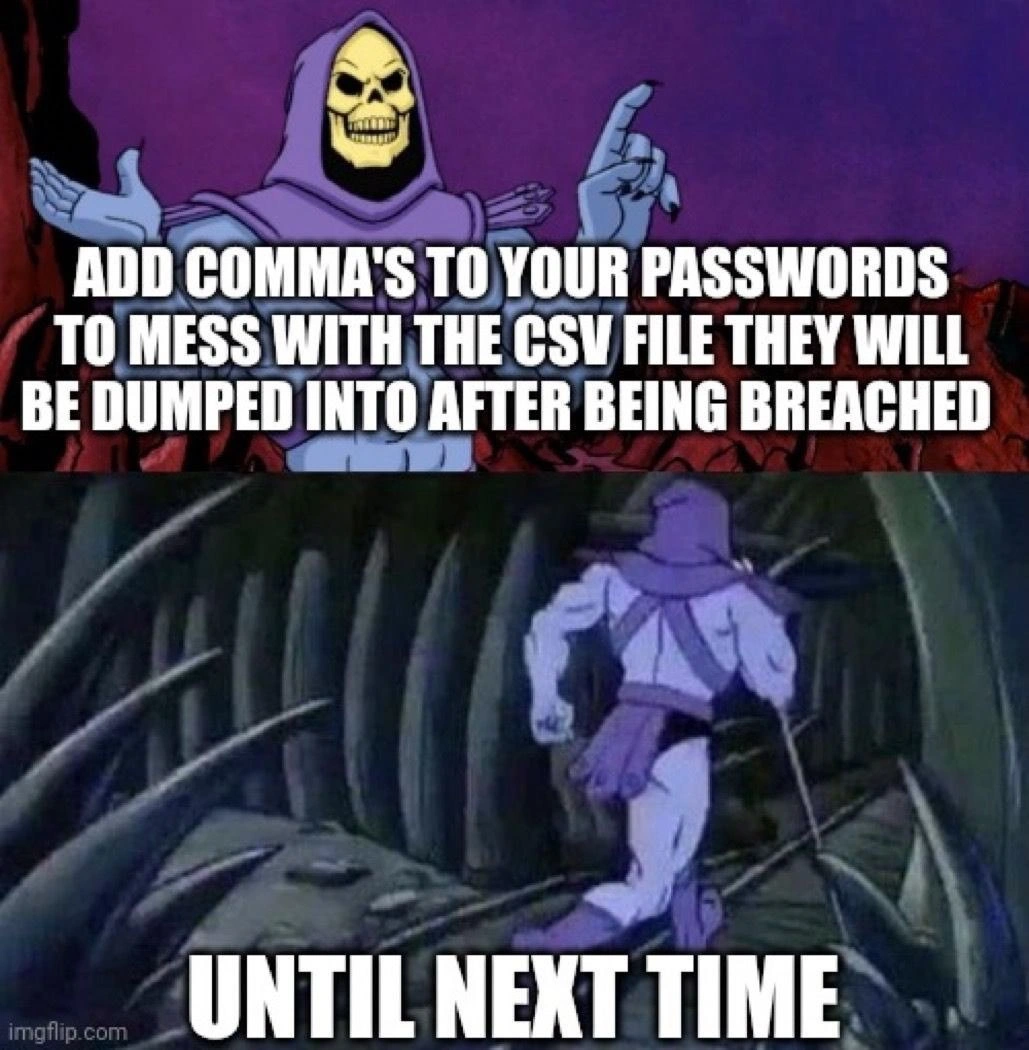
In the actual meme image, Skeletor (the cartoon villain from He-Man and the Masters of the Universe) is used as the spokesperson for this idea. This image format is popular: Skeletor states some knowledge bomb or edgy tip in the top panel, then in the bottom panel he runs away saying “Until next time!” as if he just dropped a smoke bomb of truth. It’s a comedic formula used in many variations. Here the top text is: “ADD COMMA’S TO YOUR PASSWORDS TO MESS WITH THE CSV FILE THEY WILL BE DUMPED INTO AFTER BEING BREACHED.” (Yes, the meme-maker added an apostrophe in “comma’s” by mistake – perhaps another layer of chaotic energy 😜.) Skeletor spreading password wisdom is funny because normally we expect security tips from infosec professionals, not cartoon villains. The bottom caption “UNTIL NEXT TIME” just completes the meme format, indicating Skeletor’s mischievous departure after giving you this cheeky advice.
For a junior developer or someone newer to these concepts, the takeaway humor is: a tiny character like a comma can have outsized effects in different contexts. We usually want to keep our data formats clean. Here, by intentionally making it a little dirty, the “good guy” (the user whose password was stolen) can annoy the “bad guy” (the hacker trying to use the stolen data). It’s a lighthearted twist on the usual serious topic of security vulnerabilities. In real life, the best defense is using strong, unique passwords (with or without commas) and not getting breached at all, but it’s fun to imagine that if a breach happens, at least you gave the attackers a small headache on your way down.
Level 3: Comma Chaos Tactics
At a senior engineering level, this meme hits on the intersection of data format quirks and security in a delightfully devious way. It’s playing off a real-world scenario: when user credentials are stolen in a data breach, the attackers often compile them into a big text file for later use or sale. Frequently these files are simple tables—like a CSV (Comma-Separated Values) spreadsheet with columns for username, email, password, etc. Now, Skeletor’s tongue-in-cheek “pro tip” suggests deliberately inserting commas in your password to wreak havoc with that CSV. Why is this funny? Because a stray comma in a field without proper handling will break the CSV parsing: it acts as a new column delimiter when it shouldn’t.
In an ideal world (for the attacker at least), every line in a stolen password dump looks like:
username,password,email
evilDoer,hunter2,[email protected]
innocentUser,sup3r$ecret,[email protected]
victimUser,my,secret,[email protected] <-- Oops, an extra comma in "my,secret"!
Here, victimUser’s password contains a comma ("my,secret"). If the breach compiler didn’t quote or escape that comma, the line now has four comma-separated pieces instead of three. Any script or analysis tool expecting exactly three columns per line will choke or produce gibberish for that entry. The attacker’s neat spreadsheet suddenly goes haywire for that row. It’s as if our crafty user lobbed a tiny grenade into the enemy’s dataset.
This joke resonates with experienced devs because we've all seen what happens when data formats aren’t handled carefully. CSV files are infamous for causing off-by-one column errors when fields contain the delimiter character unescaped. Seasoned engineers remember the Little Bobby Tables XKCD comic, where a parent names their child Robert'); DROP TABLE Students;-- to exploit sloppy database code. This meme is a similar flavor of mischievous injection — but instead of attacking a database, the user is defensively attacking the attacker’s password dump files. It’s a nerdy form of retaliation: If you leak my password, I’ll at least make your parsing job annoying.
From a security standpoint, this is more of a prank than a robust defense. It’s not going to stop a serious data breach or protect your account (if your password is leaked, you’re already in trouble). But it satirizes the idea of “fighting back” in a minor, clever way. The humor also highlights a subtle truth: many breaches involve human error and unsophisticated handling of data. Not all cybercriminals are ultra-prepared data scientists; some might just be script-kiddies who naively throw stolen creds into Excel or a poorly written Python parser. If they do, your comma-laden password could indeed cause parse pandemonium.
There’s an undercurrent of shared developer pain here: virtually every engineer has been bitten by a delimiter issue or a poorly formatted CSV. We spend time writing scripts to sanitize inputs, escape commas and newlines, and handle quotes to prevent exactly this kind of breakage. So the absurdity is funny: we usually add these characters by accident and suffer for it — but here Skeletor suggests adding them on purpose as an “evil” tactic. It flips the script. Instead of developers scrambling to handle special characters to avoid breakage (think of all those times you had to handle commas, tabs, or UTF-8 BOMs in data), now the user is intentionally leveraging that fragility against someone else.
The meme’s format (Skeletor making a grand statement and then running off yelling “Until next time!”) enhances the humor. Skeletor is a cartoon villain known for dramatic exits. Here he drops a nugget of chaotic-neutral advice and flees, leaving us cackling at the mental image of a hacker’s CSV data leak turning into a jumbled mess. It’s the Skeletor meme format often used to share surprising tips or truths and then vanish. The fact that it’s Skeletor, the archetypal schemer, giving a security tip makes it extra tongue-in-cheek — like the villain teaching us how to be a little villainous to potential villains!
Importantly, experienced folks will also note the practical caveats: a well-prepared attacker could use a different delimiter or properly quote fields, neutralizing the comma trick. And many breaches involve hashed passwords, not plain text, meaning your literal comma might not even appear in the dump unless they crack it. So this isn’t serious security advice; it’s a humorous take on how data formats can be a double-edged sword. It’s poking fun at the idea of “trolling” the bad guys with something as mundane as punctuation. In a way, it’s also commentary on how even weak passwords or strong passwords alike share one potential function: if structured incorrectly in a dataset, they can cause format breakage.
Seniors get a kick because it’s plausible enough to imagine an attacker cursing at a CSV import error caused by an unexpected comma. It’s a tiny victory for the little guy – a form of creative compliance with password complexity rules that yields an side-effect the rule-makers never imagined. After all, many corporate password policies annoy users with requirements like including symbols; this meme implies one fun benefit: that symbol might become a wrench in a hacker’s gears. It’s a classic case of exploiting assumptions – the attacker assumed no commas would be in the password field (bad assumption!), and the user’s quirky password shatters that.
So at Level 3, we’re laughing at our deep knowledge of CSV pitfalls, injection antics, and the idea of turning tables on data thieves. It blends Security know-how with DataFormats trivia, and that combination tickles the techie funny bone. Skeletor’s security pro tip is both absurd and technically grounded, making it prime meme material for those who have been around enough CSV and breach horror stories to appreciate it.
Description
This is a two-panel meme featuring the character Skeletor from 'He-Man and the Masters of the Universe,' in a format where he gives terrible advice and then leaves. In the top panel, Skeletor is facing the viewer with his hands open, and the caption reads: 'ADD COMMA'S TO YOUR PASSWORDS TO MESS WITH THE CSV FILE THEY WILL BE DUMPED INTO AFTER BEING BREACHED.' The bottom panel shows Skeletor walking away with the text 'UNTIL NEXT TIME.' The joke is a cynical take on cybersecurity, suggesting that since data breaches are inevitable, one might as well inconvenience the attackers. The humor lies in the technical detail: a comma in a password could break a poorly configured CSV parser, as commas are the default delimiter. For a senior developer, this is funny because it's technically plausible yet utterly useless as a security measure, highlighting the absurdity of trying to get petty revenge in the face of systemic security failures

Comments
27Comment deleted
Using a comma in your password won't stop a breach, but it might cause an intern to spend a week debugging a broken import script, and that's a small victory
Security through RFC 4180 non-compliance: slip a couple commas into your password so when the breach hits, the attacker’s import script and a 3 AM intern both get to discover why pandas suddenly thinks there are 17 columns
The real CSV injection vulnerability was the plaintext passwords we stored along the way. Though honestly, if your breach response plan involves hoping attackers can't handle RFC 4180 compliant parsing, you've got bigger problems than delimiter escaping
The real genius here is weaponizing CSV's Achilles' heel: assuming commas are just delimiters. When your password is 'P@ssw0rd,123,"DROP TABLE users;--', you're not just defending against brute force - you're launching a post-breach DoS attack on the attacker's pandas.read_csv() pipeline. It's the security equivalent of salting the earth after the barbarians have already sacked Rome. Sure, your account is compromised, but at least their ETL job will fail spectacularly at 3 AM, and some junior analyst will spend hours debugging why their credential stuffing automation keeps throwing ParserErrors. Defense in depth? More like spite in depth
If your breach mitigation strategy is weaponizing commas, you don’t need a red team - you need RFC 4180, salted hashes, and a ban on “Export to CSV.”
Because post-breach, why hand attackers clean CSVs when you can force them into a delimiter-fueled ETL debugging marathon?
Password policy: 16+ chars, a symbol, a digit, and one unescaped quote - can’t stop breaches, but we can make their RFC4180 parser rage‑quit on line 1
Big brain time Comment deleted
small brain actually: regular_value,",,,"","" Comment deleted
csv exporter that makes escaping by default: hmm, interesting Comment deleted
Newcomer meme Comment deleted
Or just do what google and youtube does add this to every response's beginning: }]), ); And add ) at the end of the request Comment deleted
And add "; delete table users; Comment deleted
What Comment deleted
Yes I am reversing youtube and google search so i can use it without api key as native apps Comment deleted
But no seriously why do they return that? Comment deleted
Idk but if I remember correctly then youtube has also a response that forces the client to reload the page... you know the page normally doesnt reload completely just updates the non-static content with JavaScript with get requests... so this means the youtube site is already in the browser and doesnt need to be reloaded so when the yt servers get updated and the "old" site in the browser makes a request with the old header the server sends this back to force reload the site: }]), );("reload":"now")) This is totally funny to me Comment deleted
That's normal Comment deleted
for youtube you're probably better off with youtube-dl (well, that's dead, go with the yt-dlp fork) Comment deleted
wait, ydl is dead? Comment deleted
waow, yt-dlp is already available in the main arch repos Comment deleted
I already figured out a lot of stuff at my own. I can rip videos in best quality just like those fake looking video converter sites. Comment deleted
https://xkcd.com/538/ Comment deleted
password he tells: "семидесятипятимиллиметровый" (read as syemIdyesyatIpyatImillimetrOvyiiy (capital letters are stressed), means has length of 75 mm) you have only one attempt for writing password Comment deleted
— Is "seventy-five-millimeters-long" actually long or short? — That depends on the subject: if it is a password, then, probably, yes, otherwise it may be considered tiny. Comment deleted
http://termorect.narod.ru/ Comment deleted
Why the heck someone will use CSV for dumping if it can be SQLite or MySQL? https://datasette.io/ take a look at this. Comment deleted