Skip to content
DevMeme
5221 of 7435
The Unmaintainable Legacy System as a Farm Animal
LegacySystems Post #5725, on Dec 3, 2023 in TG

The Unmaintainable Legacy System as a Farm Animal

Why is this LegacySystems meme funny?

Level 1: No Instructions, Big Problem

Think about building a giant LEGO castle with a friend. Your friend was the one who knew how all the pieces fit together, and they started building it while you watched. But then suddenly your friend moved away and didn’t leave you the instruction book. Now the half-finished LEGO castle is sitting in every room of your house (it’s everywhere!), and some parts of it are starting to fall apart. Your parents have given you a list of 20 things that are wrong with the castle – “this tower is crooked, that door won’t open, the bridge collapsed,” and so on – and they want you to fix them. But you have no instructions on how the castle was built, and the only person who knew all about it (your friend) is gone. You’re totally lost, right? You’d probably look at this sprawling, broken castle and say, “Oh great, this is impossible... what am I supposed to do now?!” Maybe you even feel like yelling “Why me?!” or saying a not-so-nice phrase like “FML” under your breath because it’s just so frustrating. That’s exactly the feeling this meme is joking about: being stuck with a big problem that someone else created, with no help or guide on how to fix it. It’s funny in a my luck couldn’t be worse kind of way, and anyone who’s felt overwhelmed by a mess left by someone else can relate – even if it’s not LEGO castles but computer code.

Level 2: The Missing Manual

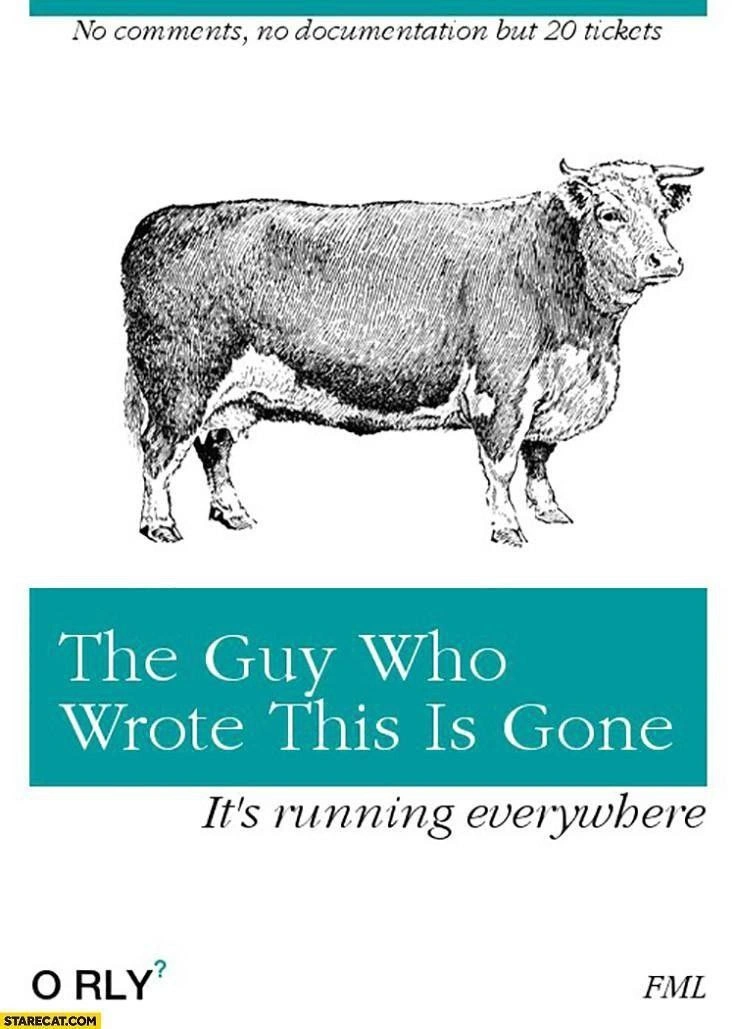
For a newer developer (or someone outside the software world), let’s break down why this situation is such a big deal. The image is styled like an O’Reilly programming book cover – those are famous tech books (with an animal on each cover) that usually teach you something. Here, it’s a parody book teaching us what happens when documentation is missing. The top phrase says “No comments, no documentation but 20 tickets.” Each part of that is important:

  • No comments – In source code, developers often write comments (notes) alongside the code to explain tricky logic or intent. If there are no comments, it means when you read the code, you get zero hints why things were done a certain way. It’s like reading a novel with no footnotes or explanations for the weird parts. A newcomer opening such code is greeted with walls of functions and weird variables with no clarification.

  • No documentation – Beyond code comments, teams usually have documentation files or wiki pages (like a README, design docs, or user guide) that explain how a service works, how to set it up, what each part is supposed to do, etc. “No documentation” means there’s absolutely no manual or guide for this service. It’s as if someone delivered a complex machine with no instruction booklet at all. New developers can’t look up any architecture diagrams or design rationale – they’re basically flying blind.

  • ...but 20 tickets – “Tickets” refer to problem reports or work items in a tracking system (like JIRA, GitHub Issues, etc.). Having 20 open tickets implies there are at least 20 known problems or requests related to this system. So, not only does nobody know how it works internally, but there’s a queue of issues to fix or features to add. It’s the perfect storm: lots of things to do, but no guidance on how to do them. If you’re a junior dev assigned to work on this, it’s like being asked to fix a machine while blindfolded.

The big green title “The Guy Who Wrote This Is Gone” is basically telling us: the original programmer (the one who wrote this code/service) isn’t around anymore. Maybe they quit the company or transferred teams. This is critical because you can’t even go ask them “Hey, what does this part of the code do?” or “Why did you design it this way?” The phrase is almost a meme on its own in tech circles – a lot of us have heard “well, the guy who wrote it left” followed by an awkward shrug. It highlights what we call the Bus Factor or Bus Risk: if only one person knows the system and they disappear (whether hit by a bus or just leave the job), the knowledge disappears too. Here the bus factor was 1, and now that person’s gone, so the bus factor is effectively 0 – nobody else has the full picture of the system.

The italic subtitle “It’s running everywhere” means this service is not just on one machine or used in one place – it’s likely deployed across many servers or used by many applications. In a modern context, imagine a microservice or a library that every other team’s project depends on. If it’s “running everywhere,” it also means if there’s a bug in it, everyone feels the pain. For example, if this is an authentication service with no documentation, every app that logs in users might be affected by its quirks. As a junior dev, you might wonder, “How did something with no documentation get to run everywhere?” It happens over time: maybe it started as a quick solution that proved useful, and other teams copied it, and before anyone realized, it became part of the critical infrastructure – just without the paper trail to support it. This is a form of TechnicalDebt: early shortcuts (like not writing docs or tests) were taken to move fast, but now the “interest” is due, in the form of extra difficulty maintaining it.

Now, the bottom of the meme has two little corner texts mimicking a book cover’s publisher info: on the left, “O RLY?” and on the right, “FML.” “O RLY?” is internet slang for “Oh, really?” often paired with a picture of an owl (fun fact: the O’Reilly Media logo is actually a little owl, so this is a double pun). It’s poking fun at O’Reilly (which sounds like “Oh really”) and expressing a bit of sarcastic disbelief – like the system is everywhere “oh really?!”. On the right, “FML” stands for “F*** My Life,” which is a crude way of saying “I’m utterly frustrated with my situation.” If you’ve never seen that: it’s what someone says when lots of bad things happen at once and they just feel exasperated. In our context, it’s exactly what a developer might utter when they realize they have to deal with this undocumented, authorless, broken system. Imagine being handed 20 trouble tickets for a program but zero help on how the program works. “FML” indeed.

The cow illustration is there to complete the O’Reilly book joke – O’Reilly books always have a woodcut-style animal drawing on the cover (like a camel for Perl, a python for Python language, etc.). Here a cow is used, likely just a random choice to nail the style (and maybe imply the situation is udderly ridiculous, if we want to pun!). The absurdity of a cow on a tech book cover adds to the humor because it’s such a stoic, unconcerned animal juxtaposed with the chaos the text describes.

So why do developers find this meme funny? It’s almost an exaggeration, yet close to reality. Many of us, even early in our careers, encounter code that’s poorly documented. Maybe you’ve opened a code file and found nothing but dense logic and thought, “Huh, some comments would be nice...” Or you joined a project and asked for documentation and people just shrugged. It’s frustrating and a bit scary. This meme takes that and multiplies it: imagine the worst case scenario of that – the one guy who knew everything is gone and now you have to fix things without any map. It’s comedic in the same way as dark humor: you laugh a bit because it’s true and you might one day be the person dealing with it (or maybe you already have).

The lesson hidden in the humor is clear, especially for someone early in their career: write comments and documentation! When you code, don’t assume you or others will “just remember” why something was done. Otherwise, you might accidentally author the next “The Guy Who Wrote This Is Gone” saga for your team. And trust me, no one wants to be the subject of that book!

Level 3: Bus Factor Blues

This meme brilliantly parodies a classic O’Reilly programming book cover to spotlight a nightmare scenario that seasoned developers know all too well. The faux title "The Guy Who Wrote This Is Gone" hits like a horror story for anyone maintaining LegacySystems. It screams BusFactor failure: a critical service written by one person who’s now vanished, taking all their knowledge with them. The top tagline “No comments, no documentation but 20 tickets” sums up the triple-whammy of TechnicalDebt in production: the code has zero comments explaining its logic, there’s no external documentation or README to be found, yet there’s a couple dozen bug reports and support tickets piling up. In other words, the system is a maintenance nightmare – it’s broken in many places (20 open issues) but nobody left behind a map to navigate or fix it.

The italic subtitle “It’s running everywhere” twists the knife: this undocumented legacy service isn’t tucked away in some corner – it’s deployed everywhere. Perhaps it started as a small internal tool, but over time it spread to multiple applications, servers, and environments until it became an invisible backbone. Now it’s a critical dependency across the entire stack. When such a ghost service hiccups, it causes chaos in multiple systems at once. Every senior dev knows the dread of discovering that some mysterious component is ubiquitously running in production without clear ownership. It’s the kind of thing that triggers 3 AM on-call alerts and sends you diving into ancient code repositories trying to make sense of it all.

Why is this so funny (and painful) to experienced engineers? Because it satirizes a real industry anti-pattern: single point of failure in human knowledge. We’ve all encountered that one script or microservice nobody fully understands because its sole author left the company (commonly joking: “got hit by a bus”). The bus factor of such a system was effectively 1, and once that person is gone it drops to 0. You’re left with a production system running on autopilot, and any change or incident feels like defusing a bomb without the instructions. It’s an amalgam of LegacyCode, DocumentationWoes, and pure DeveloperFrustration. The meme’s fake publisher “O RLY?” at the bottom left is a cheeky twist on O’Reilly’s name (and the Internet slang “Oh, really?”), as if the book itself is incredulously asking “Oh, really? It’s everywhere?” Meanwhile, the “FML” in the opposite corner bluntly captures the mood of the poor soul inheriting this mess (for the uninitiated, FML stands for “F** My Life”*, a sardonic expression of despair).

The choice of a cow as the cover art completes the homage to O’Reilly Media’s animal-themed books – here it might also symbolize a proverbial “cash cow” system that the business milks even though no one tends to its codebase. Seasoned devs might chuckle at the cow and “O RLY?” owl pun, but they’re probably also cringing. It reminds us of those times we had to become code archaeologists, digging through a haystack of spaghetti logic while production incidents scream for a fix. With no documentation, you end up piecing together clues: commit history (if you’re lucky), log output, maybe an old design doc if one exists. Sometimes you find a cryptic comment or a bizarre workaround left in code and catch yourself muttering, “Why on Earth is it doing that?!” Only the original author knew, and they’re long gone:

// A mysterious legacy condition with no explanation:
if (configValue === 7) {
    launchSequence();  // Magic number 7 unlocks something? Only the author knew.
} else {
    failSafe();        // Fallback for unknown cases… FML indeed.
}

In such legacy systems, you’ll often see “magic numbers” like 7 or weird business rules with zero comments. Why 7? Why not 6 or 8? With the author gone, you have to reverse-engineer intent from the code itself – a slow, error-prone process. It’s a perfect recipe for ProductionIssues because any small misunderstanding can trigger new bugs. Veteran engineers have a grim joke: “It’s always in the last place you look – usually at 3 AM in a log file.” The truth is that writing good documentation or even a few comments could have saved countless hours. But many teams (or managers) don’t prioritize it. Deadlines, overconfidence (“the code is self-documenting!”), or plain laziness lead to critical systems shipped with zero knowledge transfer. Years later, that negligence surfaces as a crisis: you have 20 trouble tickets open and only a ritualistic understanding of the service (“restart it and hope” becomes the ops guide).

From a senior perspective, this meme isn’t just poking fun – it’s a cautionary tale. TechDebt like this accrues interest. Every quick fix without documentation, every “temporary” workaround that becomes permanent, adds to the debt. Eventually, you’re paying for it with massive debugging sessions and overtime. The “author vanished” scenario is the worst-case outcome of ignoring that debt. Companies end up handcuffed to legacy systems they’re scared to touch. Rewriting or replacing it is risky and costly, but continuing with it is equally dangerous. It’s the kind of scenario behind real-world stories of systems running on code nobody has touched in decades (banks still running COBOL from the 70s, anyone?). When the rare brave soul tries to fix or update it, they often break something else because no one fully understands the interdependencies. And so the tickets keep coming.

In summary, the humor here is dark and spot-on: it highlights the absurd (yet common) reality of inheriting a widely deployed, undocumented service after the only person who knew it has left. It’s a shared scar in the developer community – we laugh because otherwise we’d cry. This imaginary “O’Reilly book” is one every developer hopes never to write or star in, but many of us already have a copy on our shelf in the form of lived experience. FML, indeed.

Description

A meme formatted like a book cover. The top text reads, 'No comments, no documentation but 20 tickets'. Below this is a black and white, detailed sketch of a large bull, signifying a powerful, unpredictable, and dangerous entity. Underneath the bull, a teal-colored block contains the main title in a serif font: 'The Guy Who Wrote This Is Gone', followed by a subtitle, 'It's running everywhere'. At the bottom of the image, 'O RLY?' is printed on the left and 'FML' on the right, with a 'STARECAT.COM' watermark. This meme perfectly captures the nightmare scenario for a developer inheriting a critical, yet entirely undocumented, legacy system. The original creator has left, leaving behind a black box that's essential to operations but plagued with issues, making any attempt to maintain or debug it a daunting and frustrating task
Comments

19
Anonymous ★ Top Pick That system has a bus factor of one, and the bus was a one-way ticket to a competitor. Now it's a sacred cow that we can't touch, but it's also a bull in the china shop that is our production environment
  1. Anonymous ★ Top Pick

    That system has a bus factor of one, and the bus was a one-way ticket to a competitor. Now it's a sacred cow that we can't touch, but it's also a bull in the china shop that is our production environment

  2. Anonymous

    We call it the sacred cow microservice: no tests, no docs, 9-year uptime, and the only place the author still commits is in git blame

  3. Anonymous

    The only thing more distributed than this undocumented system is the blame when it finally crashes - but at least the original developer achieved perfect job security by making themselves irreplaceable... right up until they weren't

  4. Anonymous

    Ah yes, the mythical 'self-documenting code' that's actually running in production across seventeen microservices, three data centers, and somehow also powers the CEO's personal dashboard. The original author achieved what we all dream of: writing code so critical that it became unfireable even after they left. Now it's your job to reverse-engineer a system where the only documentation is a git blame pointing to '[email protected]' (mailbox disabled), and the architecture decision records are apparently stored in someone's head who now works at a competitor. The tickets keep piling up, but nobody dares refactor it because last time someone tried, it took down the payment system for three hours. It's not technical debt anymore - it's a technical mortgage with compound interest, and you just inherited the house

  5. Anonymous

    Bus factor was 1 and the bus already left; blast radius global - the architecture diagram is “kubectl get all” and the design doc is “git blame.”

  6. Anonymous

    Black-box legacy: feed it Jira tickets, pray the bull doesn't charge during refactoring

  7. Anonymous

    It’s the perfect blend of pets vs cattle: one undocumented pet script cloned across every cattle node, and the only person who knew why got promoted to ex‑employee

  8. @sylfn 2y

    the win-sudo moment

    1. @ZgGPuo8dZef58K6hxxGVj3Z2 2y

      Whats that

      1. @sylfn 2y

        https://github.com/purplesyringa/win-sudo

        1. @ZgGPuo8dZef58K6hxxGVj3Z2 2y

          Is this for script compatibility on windows?

          1. @sylfn 2y

            yes

            1. @ZgGPuo8dZef58K6hxxGVj3Z2 2y

              Interesting thanks for showing it

        2. @callofvoid0 2y

          > no installation needed install.sh

          1. @purplesyringa 2y

            yea that's a later addition by someone else

  9. @s2504s 2y

    It is literally me 0_o

  10. @sylfn 2y

    win-sudo is recommended in msys2 afaik

  11. @purplesyringa 2y

    gsudo requires compilation, this one's a script

  12. @Agent1378 2y

    There is tortoise git on windows, why would you need all that....

Use J and K for navigation