The Grand Vision of AI vs. The Reality of an API Outage
Why is this AI ML meme funny?
Level 1: Huge Promise, Tiny Problem
Imagine your friend boasts that they’ve built the most amazing robot in the world. They say, “This robot is so powerful and smart, it could run the whole world, it’s like a super genius that can do anything!” – that’s a huge promise, almost like saying they made a machine as mighty as a god. But the next day, when you ask the robot a simple question, it doesn’t respond at all because the internet is down. Your friend just sighs and says, “Uh, can I get the internet back, please?” All that big talk about a world-running robot, and now it can’t even answer a question due to a tiny everyday problem (no Wi-Fi!). 😅 It’s funny because of the huge difference between what was promised and what actually happened. One moment your friend was talking about doing something gigantic and magical, and the next moment they’re stuck on a very normal, ordinary issue. This meme is just like that: people are talking about AI in an extremely grand way (like it will change everything in the universe), but then the AI doesn’t work because of a simple technical glitch, so someone just says, “I just want the basic thing to work, please.” The joke is that even the most extraordinary plans can be stopped by an ordinary hiccup, and seeing those two extremes side by side is what makes us laugh.
Level 2: AI Dreams, API Realities
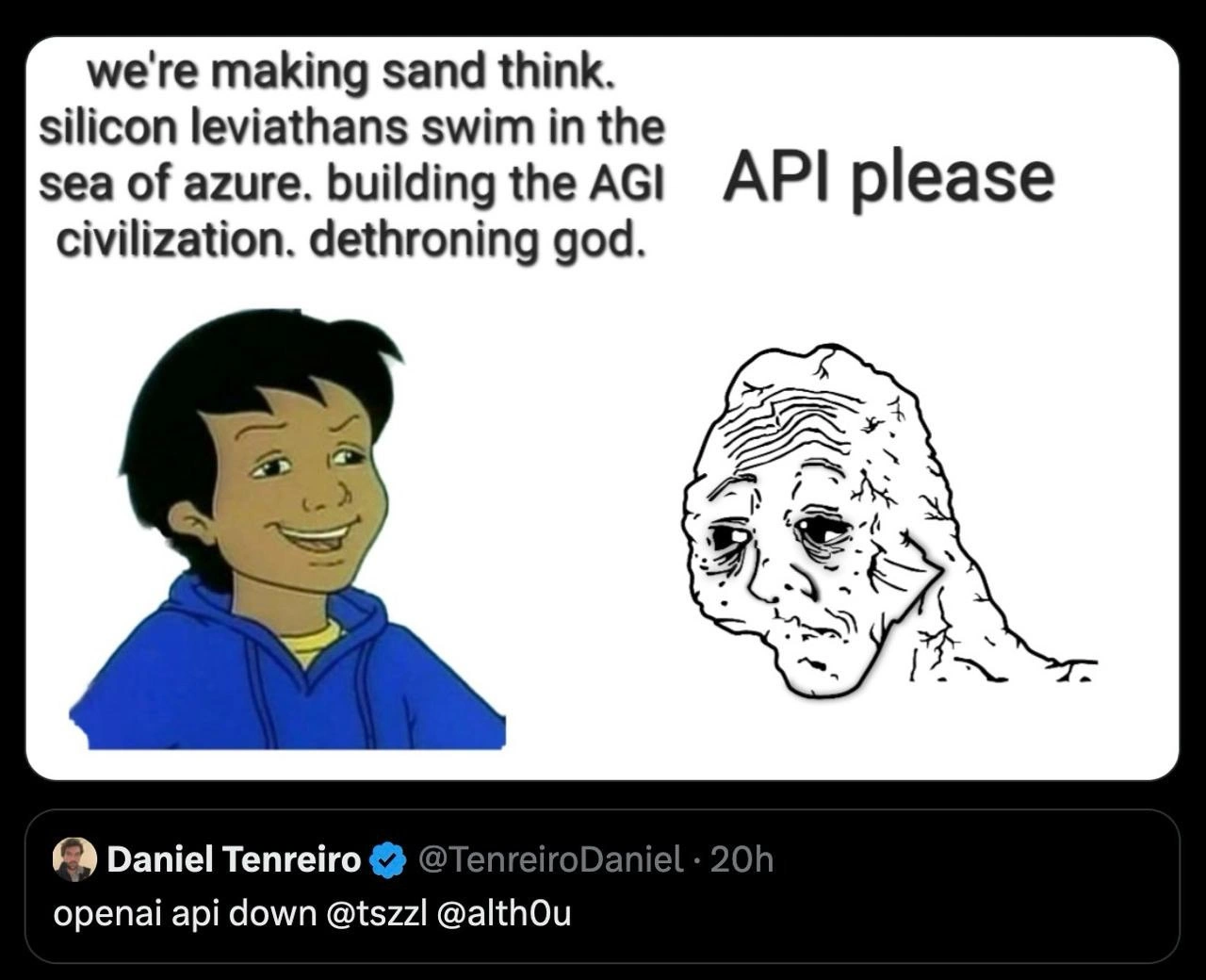
On the left side of this meme, a cartoon boy in a blue hoodie is spouting very grand, almost fantastical phrases about artificial intelligence. He says things like “making sand think” and “building the AGI civilization, dethroning god.” Let’s break that down in plain terms. Sand here refers to silicon, the material in microchips — essentially, computer processors are made from refined sand. So “making sand think” means creating computers or AI so advanced it’s as if the silicon chips themselves are thinking. Silicon leviathans swimming in the sea of Azure is a flowery way to describe huge computer systems (leviathan = giant creature) running in Microsoft’s Azure cloud (Azure is a cloud computing platform, and azure also means a blue sea-colored sky). In simpler words, it means there are enormous AI machines running in Microsoft’s data centers. “Building the AGI civilization” refers to developing Artificial General Intelligence – a very advanced AI that could do all sorts of tasks as well as or better than humans – and hinting that these AIs could form a whole new “civilization.” And “dethroning god” – that’s extreme hyperbole suggesting this AI revolution will be so huge it’s like becoming as powerful as a god or replacing God. These phrases represent the AI hype in its most excited form. It’s the kind of talk you hear in tech articles and conferences when people get extremely optimistic (or dramatic) about what AI/ML will achieve.
Now, the right side of the meme shows a very different scene: a simply drawn, weary-looking Wojak face saying, “API please.” Wojak is an internet meme character often used to depict relatable feelings – in this case, the face looks tired or unamused, like a fed-up engineer. “API please” translates to a very basic, pragmatic request: “Can I just get access to the API?” An API (Application Programming Interface) is how one program requests service from another. Here it specifically refers to the OpenAI API, which developers use to get AI models (like GPT) to generate text or answer questions. If someone says “API please,” they’re likely frustrated that the service isn’t responding. In fact, below that, the meme shows a tweet from Daniel Tenreiro saying “openai api down” and tagging some usernames. This indicates that at the time, the OpenAI service had an outage — it wasn’t working — and users/developers noticed and were complaining or asking about it on Twitter. So the right side is basically a real-life example of a developer just needing the AI service to work, without any grandiose flair. It’s OnCall_ProductionIssues in action: something broke in production, and now people just want it fixed.
The meme’s humor comes from this huge contrast. On one hand, we have big dreamy talk about near-magical AI advancements (the kind that gets headlines and makes non-engineers go “Wow!”). On the other hand, the actual day-to-day reality for developers is dealing with things like an API outage – a very normal, even boring problem. It’s like saying, “Sure, your AI might dethrone god, but right now it can’t even handle regular user requests without crashing.” In developer terms, it’s an AIHypeVsReality joke: the hype is the promise of AGI changing the world, the reality is that even advanced AI is delivered over the internet as a service, and that service can go down like any website or app.
For a junior developer or someone new to this area, let’s connect the dots further. OpenAI is a company that provides advanced AI models (like ChatGPT) to developers, primarily through an API. You send their API a prompt or question, and it sends you back a response generated by the AI – for example, completing a sentence or answering a question. This happens over the internet (specifically over HTTP requests). Now, OpenAI’s tech runs on a lot of hardware behind the scenes. Microsoft’s Azure is essentially a huge network of data centers full of servers and special hardware like GPUs (Graphics Processing Units) which are very good at AI computations. OpenAI uses Azure’s infrastructure to host their models. When the meme mentions “silicon leviathans,” think of hundreds or thousands of GPUs working in parallel – a giant compute resource – to power these AI models. However, like any large-scale system, things can go wrong: servers can crash, networks can fail, or the system can get overloaded if too many people use it at once. That’s likely what happened when the tweet says “openai api down”. It means developers trying to use the AI service at that time were getting errors because the service was unavailable.
Being on-call means a developer or engineer is designated to respond if such a problem occurs, even if it’s late at night or a weekend. They will get an alert (PagerDuty, phone call, etc.) if the system goes down, and it’s their job to jump in and fix it. So imagine someone at OpenAI or Microsoft getting that page and scrambling to identify the issue – perhaps a spike in usage that exhausted all available GPU servers, or a bad deployment that caused an error. It’s a stressful, very down-to-earth task. There’s nothing glamorous about rolling back a buggy update or reallocating servers at 2 AM. Yet, that work is crucial to actually deliver the AI magic everyone talks about.
The meme is highlighting that gap. The left side’s agi_grandiosity (grandiose talk about AGI and “dethroning god”) meets the right side’s openai_api_outage (the API being down). Engineers who have been through a few hype cycles find this funny because it’s true so often: IndustryTrends_Hype promises the moon, but you still have to deal with mundane realities like server maintenance, error logs, and support tickets. Think of previous tech hypes: “cloud will solve all scaling issues” – yet you still get downtime if you misconfigure something; or “blockchain will revolutionize everything” – yet you might spend days just debugging a smart contract that keeps failing. Here it’s “AI will become godlike,” yet you might be debugging an HTTP 503 error for the AI service.
In summary, the left side is the dream (AI as an almighty force), and the right side is the reality (it’s delivered via a plain old API that can go down). The meme uses a popular format (cartoon character vs. Wojak) to represent these two viewpoints. If you’re new to developer humor, just know: whenever you hear extremely grand tech predictions, there’s usually an engineer somewhere dealing with very basic problems to make it happen. It’s this irony that makes the meme funny. The grand talk sounds like science fiction, while the response “API please” sounds like someone just wanting their tool to work. As a developer, it reminds you that no matter how advanced the technology, you eventually face the same old tasks: making sure your requests return something and not an error. DeveloperHumor often comes from these exact incongruities – big AI_ML ideas vs. the down-to-earth work of keeping systems running.
Level 3: Hype vs Uptime
The meme perfectly skewers the clash between lofty AI evangelism and gritty production reality. On the left, we have what sounds like a startup CEO’s poetic pitch: “we're making sand think. silicon leviathans swim in the sea of azure. building the AGI civilization. dethroning god.” This grandiloquent prose evokes Artificial General Intelligence (AGI) as a near-mythical achievement. It’s talking about turning raw silicon (basically purified sand in microchip form) into sentient machines, deploying massive GPU clusters (hence “silicon leviathans”) across Microsoft’s Azure cloud (the “sea of azure”), and ushering in a new AI-powered epoch that rivals divine power. In other words, it’s AI hype dialed to 11 – the kind of language you hear in visionary keynotes or investor decks where “disrupting reality” is just Tuesday’s agenda.
On the right, reality crashes the party with two deadpan words: “API please”. Accompanying this plea is a crumpled Wojak face – the meme visage of a tired, unamused engineer. It’s the quintessential developer response to all that cosmic grandstanding: Cool story, bro, but can I just get a working JSON response? This side of the meme channels the voice of an on-call SRE (Site Reliability Engineer) or developer who’s been paged at 3 AM because the OpenAI API is returning 500 errors. No talk of dethroning deities here – just a humble request for the endpoint to stay up. The humor bites hard because anyone who’s maintained real systems knows this exact feeling. You sit through a meeting where AI is touted as world-changing magic, and later that night you’re frantically debugging why the production service is down. The enormity of “building the AGI civilization” meets the mundanity of “the API is timing out again.” It’s AI hype vs reality distilled in one image.
This contrast is painfully familiar to industry veterans. We’ve endured hype cycles where grand promises collide with Murphy’s Law of software: anything that can go wrong, will. Sure, GPT-4 might write sonnets and debug code, but none of that matters when an outage strikes – when the Azure GPU fleet powering it runs out of quota or a new deployment breaks something critical. The lofty phrase “dethroning god” ironically meets its match in something as banal as a misconfigured load balancer or expired token. It’s a cheeky nod to how even cutting-edge AI/ML projects live and die by uptime and SLAs. As engineers like to joke, “God may be in the clouds, but your service better not be.” Here, OpenAI’s service going down is the cloud equivalent of a reality check. In fact, the meme even includes a screenshot of a tweet complaining “openai api down,” tagging presumably OpenAI team members. That tweet is the real-world “SOS!” behind the meme: even as AI is hailed as a technological messiah, developers are on Twitter going “hey @Team, the API is down, everything’s on fire.” It’s both hilarious and cathartic because we’ve all been that person begging a remote service to come back to life.
To really drive home the absurdity, consider a literal translation of the flowery claims versus what’s actually happening behind the scenes:
| Visionary Claim | Reality Check (What’s Actually Happening) |
|---|---|
| “we're making sand think.” | Running billions of transistors (tiny switches made from sand/silicon) to perform calculations. |
| “silicon leviathans swim in the sea of azure.” | A massive GPU cluster on Azure cloud, gulping electricity – and occasionally drowning (crashing) under load. |
| “building the AGI civilization.” | Trying to coax a large LLM (language model) to produce useful answers without throwing errors or nonsense. |
| “dethroning god.” | A bold claim on slides; meanwhile a service outage dethrones the on-call engineer’s sleep schedule at 3AM. |
The table says it all: the left column is AGI grandiosity, the right is the pragmatic translation that seasoned devs deal with. The joke is that “dethroning god” sounds epic, but you might end up simply restarting pods and checking dashboards at ungodly hours because the API is down. It’s a classic case of AI hype vs uptime concerns. The phrase “silicon leviathans” evokes awe at giant AI supercomputers, yet to the poor dev on duty, those “leviathans” are just flaky Kubernetes nodes that might be OOM-killed. And “making sand think” is a poetic way to describe computers, but it conveniently glosses over the reality that thinking sand still throws the same old exceptions when something goes wrong.
For those of us with some battle scars, this meme hits a nerve. It’s essentially an OnCall_Humor piece. We chuckle (or groan) because we’ve lived this: the CTO proclaims “Our AI will change everything!” at an all-hands meeting, but at 2:00 AM you’re in the logs, muttering “Why the heck is the v1/complete API returning 502 Bad Gateway?”. The IndustryTrends_Hype around AGI paints a future of sentient silicon deities, but the DeveloperHumor reality is a lot of pager alerts and a Slack full of “API down, investigating...” messages. As a dev, you learn fast that no matter how advanced or intelligent the system, it still behaves like any other software: it breaks, it needs patching, and it definitely needs a human babysitter when it all goes sideways. The meme’s punchline “API please” is basically a one-line prayer every programmer utters at some point – a plea for simple functionality in the face of marketing hyperbole. In short, the gods of AI may promise miracles, but the code still crashes like it’s only mortal.
Description
A two-part meme contrasting the hype of AI development with the reality of infrastructure dependency. The left side features a smug cartoon character next to grandiose text: 'we're making sand think. silicon leviathans swim in the sea of azure. building the AGI civilization. dethroning god.' This represents the lofty marketing and ambition of the AI industry. The right side shows a haggard, desperate-looking Wojak character with the simple plea, 'API please'. Below these panels is a screenshot of a tweet by Daniel Tenreiro that says 'openai api down', providing the context for the meme. The joke highlights the comical disparity between the world-changing goals of AI and the fragile reality that all this progress can be halted by a simple API outage, leaving developers helpless

Comments
9Comment deleted
We're busy dethroning god, but we've submitted a sev-2 ticket to the deity's SRE team because their `/create_universe` endpoint is returning a 503
Nothing like a 500 from the path to god-mode intelligence to remind us that AGI still depends on someone remembering to renew the SSL cert
After 20 years in tech, you realize the real AGI isn't Artificial General Intelligence - it's Actually Getting Infrastructure that stays up long enough to ship your quarterly OKRs before the next reorg hits
When your startup's entire value proposition depends on a third-party API with a 99.9% SLA, but you're in that 0.1% during your Series A demo. Sure, they're building AGI and contemplating the nature of consciousness, but right now you just need a 200 OK so your production pipeline stops throwing exceptions and your on-call engineer can finally sleep
Nothing humbles an AGI roadmap like a 503 from a third-party API - apparently dethroning God is easier than staying within the error budget
We promised AGI; prod delivered “API please” and a 503. Civilization is just a thin client over someone else’s SLA
Silicon leviathans dethroning gods? More like dethroned by a 502 during your most critical inference run
That's not how it works Comment deleted
Text block is cute but still incoherent meme Comment deleted