LOIC DDoS Tool: We Still Talk About You at the Grave
Why is this Security meme funny?
Level 1: The Old Water Fight
Imagine a bunch of kids ten years ago who found a really powerful water hose in their backyard. One hot summer day, they all pointed that hose at their neighbor’s small sandcastle and turned the water on full blast. The poor sandcastle got totally washed away because so much water hit it at once. Now, that water hose was old and got put away (and maybe the adults locked it up after seeing the mess it made). Years later, those kids have grown up a bit. The sandcastle is long gone, and that hose isn’t used anymore – it might even be thrown out – but whenever those friends get together, they still laugh and talk about “that one time we blasted a sandcastle with a hose.” It’s a wild childhood memory, a mix of “Wow, I can’t believe we did that” and a little bit of pride.
This meme is like that story. The “water hose” is LOIC, a tool that used to let lots of people blast a website with traffic (instead of water) to knock it down, kind of like destroying the sandcastle. It was a big mischief tool back in its day. Now it’s old and nobody really uses it (it’s “buried in the ground” like in the picture). But the grown-up tech folks – the ones who were there when it happened – still remember it and talk about it with a chuckle. The top part of the picture with the person saying “We still talk about you” is just like those friends saying, “We haven’t forgotten that crazy thing we did.” It’s funny because even though that tool is gone and years have passed, the memory is so strong that people still bring it up. In simple terms, the meme is joking that even when something is long gone, if it was legendary (or notorious) enough, people will keep telling its story. Here, LOIC’s story lives on as a kind of nerdy legend that still makes the old-timers smile and shake their heads.
Level 2: Script Kiddie Starter Pack
LOIC stands for Low Orbit Ion Cannon, and no, it’s not a space weapon – it’s a famous (or infamous) old hacking tool used for DDoS attacks. A DDoS, or Distributed Denial of Service, is a type of cyber attack where many computers bombard a target (like a website or server) with so much traffic (requests, data packets, etc.) that the target gets overwhelmed and stops working for real users. Think of a tiny store suddenly flooded by a thousand people who aren’t buying anything, just taking up space; real customers can’t get in, and the store is effectively shut down. LOIC was a program that made it easy for anyone to join such an attack with just a click. It became the quintessential script kiddie tool – “script kiddie” is a derogatory but common term in tech for a newbie hacker who uses pre-made scripts or programs to do attacks without fully understanding them. Basically, if hacking were cooking, script kiddies aren’t chefs; they’re people who just microwave a ready meal. LOIC was that ready meal for launching a cyberattack.
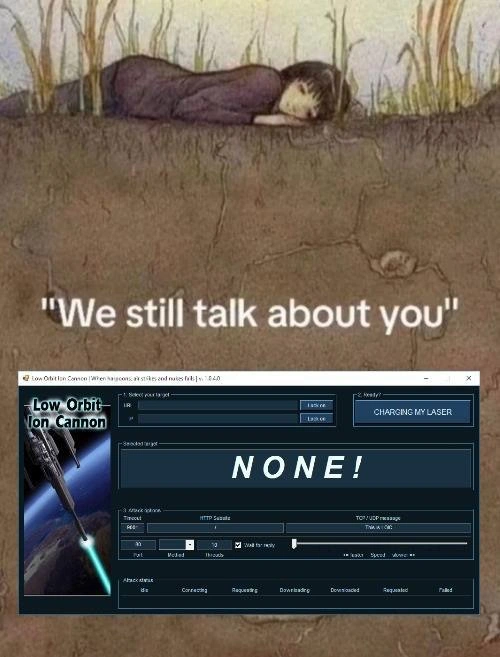
The bottom half of the meme shows a screenshot of the actual LOIC program. It’s a Windows application with a dark blue interface that looks both tacky and intimidating in a retro way. In the screenshot, you see the text “Low Orbit Ion Cannon” with a graphic of a spaceship firing a laser (because why not, it fits the sci-fi vibe). There’s a big text field in the middle where you’re supposed to enter the target’s address (the website or IP you want to attack). In the image, it amusingly says NONE! in big letters – meaning no target is currently set. Typically, you’d put something like “www.targetsite.com” there. Below that, there are sliders and input boxes for things like “Threads” and “Speed”. These let the user adjust how many parallel attack threads to run and how fast to send the packets or requests. In simple terms, threads mean how many virtual “cannons” you’re firing at once, and speed is how quickly each cannon shoots. Cranking those up means you’re trying to send as many requests as possible to the target every second. It’s basically an intensity dial for the attack.
And then there’s the big friendly fire button – labeled “CHARGING MY LAZER”. This is actually a catchphrase from an old internet meme (the “Shoop Da Whoop” meme, which had a character shouting “IMMA CHARGIN MAH LAZER!” and then firing a laser blast). The developers of LOIC gave a nod to internet culture by using that phrase. When you click the “Fire” button (which literally says “Fire Teh Lazer” or something similar once charged), LOIC starts blasting the target with traffic. The use of that meme phrase made the whole thing feel like a goofy in-joke among internet folks – it lowered the barrier to entry, making it feel fun and rebellious to use, almost like a game. You can imagine a teenager in 2010 giggling that they’re “firing their laser” at some corporation’s website.
Now, the top half of the meme shows someone lying face-down on the ground above a grave, with a small skeleton buried below. The caption over that image reads “We still talk about you”. This is symbolic. The skeleton represents LOIC – implying that LOIC is basically dead and buried as a tool (it’s old, outdated, and “in the grave”). The person on the ground saying “We still talk about you” represents today’s tech community, especially the older security engineers, essentially paying respects or reminiscing. It’s saying: Even though LOIC is gone, we haven’t forgotten it. We still mention it in stories and jokes.
Why is LOIC considered “dead”? Well, by 2025 (and even much earlier), almost nobody would use LOIC in a serious attack anymore. It’s widely known and very easy to defend against compared to more modern methods. LOIC doesn’t hide the attacker’s identity at all – every user’s IP (internet address) is visible to the target. So anyone using it could be traced and potentially prosecuted. And many were; after those high-profile LOIC attacks coordinated by the group Anonymous around 2010-2011, law enforcement tracked down and arrested quite a few participants because their digital fingerprints (IP addresses) were all over the attack logs. Also, websites and internet service providers got better at handling DDoS attacks. They installed hardware and services to detect “Hey, we’re getting flooded by junk traffic” and then block or absorb it. LOIC’s style of attack, which is basically a firehose of uniform requests from a limited set of computers, became relatively easy to filter out. It’s a bit like if a stadium knows a water balloon fight is incoming, they can put up tarps and drains. Modern DDoS attacks use more sophisticated “balloons” (different kinds of traffic, often from huge numbers of hijacked devices all over the world) to get around these defenses.
Because of all this, LOIC fell out of use. However, it left a strong impression. It was one of the first widely-used tools that let basically anyone with an internet connection join a coordinated cyber attack. It’s part of tech history now. Older developers and security professionals will reference it the way people reference, say, old software like Napster or MySpace – not because it’s relevant now, but because it was a big deal at a certain time. If you hear someone jokingly say, “Time to fire up the old Ion Cannon,” they’re not being serious – it’s a tongue-in-cheek reference to this once notorious tool. They “still talk about it” like a legend or a meme. It’s similar to how people in a town might still talk about the big prank that happened ten years ago. LOIC is that legendary prank-tool in the cyber world.
In summary, this meme is highlighting the dichotomy between past and present in cybersecurity. LOIC is shown as a relic (the skeleton in the grave) that nonetheless is not forgotten (the person saying we remember you). The humor comes from the fact that LOIC is treated almost like a fallen hero or old friend in stories, even though it was actually a malicious tool. It’s a mix of nostalgia, irony, and a bit of techie inside joke. If you’re new to security, just know: LOIC was an early 2010s one-click DDoS tool that people talk about in the same way gamers talk about an old console or soldiers talk about an old piece of gear – with a smirk and a nod to “the good (or bad) old days.”
Level 3: Elegy for an Ion Cannon
Picture a weary veteran sysadmin gazing at a tiny skeleton in a shallow grave, whispering "We still talk about you." That’s the exact vibe of this meme. The Low Orbit Ion Cannon (LOIC) is portrayed as that skeleton – long dead in tech years – and the mournful visitor above is every seasoned security engineer who lived through the era of its infamy. This bottom panel of the meme, the screenshot of LOIC’s old-school Windows GUI, hits veterans of the Anonymous ops era right in the nostalgia. It’s a dark-blue interface with retro sci-fi flair, complete with a spaceship graphic and the cheeky CHARGING MY LAZER button. For anyone who was around the hacker scene in the early 2010s, seeing that UI is like hearing the first notes of a song that was on repeat during a wild summer: instantly recognizable and tied to a dozen war stories.
Why is this funny? Because LOIC is essentially the tech history equivalent of a notorious urban legend. It’s a deprecated weapon from a bygone time in cybersecurity, yet its name still gets tossed around in conversations with a mix of irony, fear, and fond amusement. In security meetings, a grey-bearded network engineer might joke, “At least it’s not someone firing up LOIC on us,” and the whole room will chuckle. It’s the gallows humor of those who remember that, once upon a time, a simple free tool with a meme-ish name could send companies scrambling. We laugh because we survived it (or heard tales from those who did), and because it seems so quaint now.
The meme’s top half — the person lying on the grass above a grave saying “We still talk about you” — captures the almost affectionate nostalgia veteran tech folks have for this old cannon. It’s like we’re paying respects to an old threat that shaped our defenses. After all, LOIC was part of the infamous arsenal used in coordinated attacks by hacktivist groups (most famously Anonymous). Back then, headlines blared about teenage “hackers” taking down big corporate sites and even government pages using LOIC in mass volunteer campaigns. It was both alarming and, in hindsight, a bit comical: alarming because websites actually fell over, comical because of how facepalm-simple and overt the attacks were. Script kiddies – a term for young or inexperienced hackers using premade tools – flocked to LOIC because it was literally point-and-shoot. Type in a target, crank the thread and speed sliders to max, and smash that big fire button emblazoned with an internet meme catchphrase. Cue the flood. The interface screamed “I’m a leet haxor” in the most cartoonish way, which today is prime meme material. Senior engineers recall running network logs during those attacks and seeing a bazillion requests all proudly screaming “HI I’M LOIC USER #12345” (figuratively speaking) – it was that blatant. There was no subtlety, no stealth. Using LOIC was akin to walking into a bank with an airhorn: noisy, attention-grabbing, and not very sophisticated, but if enough people do it at once, it creates chaos.
So we still joke about LOIC because it represents a simpler (if crazier) time in cybersecurity. It’s the quintessential hacker culture relic: something that HackerCulture enthusiasts and security pros reference to both bond over shared history and to poke fun at how far things have come. Defending against LOIC taught hard lessons. Companies learned what happens when you ignore DDoS threats – even a swarm of amateurs can knock you offline if you’re unprepared. Many an on-call engineer had a baptism by fire (or rather, by laser) circa 2010, jolted awake at 3 AM because some forum got angry and decided to aim a “ion cannon” at their login server. Those nights turned into the war stories seniors pass down to the juniors: “I remember filtering thousands of IPs during the great LOIC barrage of ’10,” one might say with a wry grin.
This meme taps into that shared lore. It humanizes an old piece of software as if it were a fallen comrade. The truth is, even though LOIC is obsolete (modern attackers have far mightier and more covert tools, and defenders have better shields), it left a mark on our collective memory. In the grave, that little skeleton might also symbolize the innocence (or ignorance) of an earlier time: when people honestly thought naming an attack tool after a spaceship laser and using it openly was a good idea. It was the era of learning the hard way – dozens of LOIC users eventually got visits from law enforcement because, surprise, broadcasting your IP address while doing illegal DDoS isn’t wise. The “We still talk about you” caption acknowledges all of this with a sentimental chuckle. We speak of LOIC in past tense, as a legend or a cautionary tale. It’s the nostalgiaware of cybersecurity – something we’d never use now, but we keep around in stories to remember how it all went down.
In essence, the humor here is both cathartic and educational. It’s cathartic for those who endured the LOIC days – we can laugh now at what was once a serious nuisance. It’s educational (in a tongue-in-cheek way) for those who weren’t there – if you’re new and hear old-timers jest “Careful, or they’ll point the Low Orbit Ion Cannon at us,” now you know they’re referencing this skeleton in the ground, a bygone DDoS cannon that’s more meme than threat today. The meme deftly combines reverence and ridicule: reverence for an artifact of hacker history that united thousands in cooperative mayhem, and ridicule for how primitively hilarious that artifact looks through modern eyes. We’re essentially saying to LOIC’s memory: Thank you for the lessons and the laughs; you may be long dead, but oh boy, we still talk about you.
Level 4: Ionized Packet Storms
At the packet level, LOIC turned your computer into a rapid-fire cannon of network traffic. Technically, it’s a classic example of a volumetric DDoS attack generator. LOIC could launch floods at multiple network layers: it had an HTTP mode (application-layer requests), as well as TCP and UDP modes (transport-layer floods). Under the hood, it spawns numerous threads, each thread opening sockets and hurling packets or HTTP GET requests at the target as fast as your CPU and network card allow. The goal is simple: saturate the target’s bandwidth or overwhelm its request handling capacity. Think of it like trying to win a traffic war by sheer volume of cars on the road.
From a networking theory perspective, LOIC’s approach exploits the fundamental asymmetry in resource allocation: sending a packet is cheap for the attacker, but processing thousands of packets is expensive for the defender. Each TCP connection or HTTP request forces the target server to allocate memory and CPU to respond (or at least to drop the request), so a swarm of them can exhaust server resources. In pseudo-code, LOIC’s logic is straightforward:
# Simplified pseudocode illustrating LOIC-like attack logic
target_host = "victim.com"
target_port = 80 # common HTTP port
for thread in range(num_threads): # LOIC uses multithreading
while attack_in_progress: # each thread sends packets in a tight loop
try:
sock = socket.socket(socket.AF_INET, socket.SOCK_STREAM)
sock.settimeout(0.5)
sock.connect((target_host, target_port))
# Send a basic HTTP GET request
sock.send(b"GET / HTTP/1.1\r\nHost: victim.com\r\n\r\n")
except Exception as e:
# If the connection fails or target resets, just continue sending
continue
This code sketch shows the brute-force nature: open connection, send data, repeat endlessly. Multiply that by dozens of threads and thousands of participants, and you get a torrent of traffic – a packet storm. In network terms, if AttackTraffic > TargetCapacity for a sustained period, the target service becomes unreachable. It’s a crude force-of-numbers tactic. Mathematically, one could say:
$$ \text{DowntimeProbability} \approx \min\Big(1,\ \frac{N_{\text{attackers}} \times R_{\text{perAttacker}}}{C_{\text{targetBandwidth}}}\Big) $$
In plain terms: if enough people fire their “laser”, the target’s pipe overflows. LOIC doesn’t use fancy amplification or reflection – no DNS amplification, no IP spoofing. Every packet comes straight from the attackers’ own machines. This direct approach means defenders can identify and block attacking IP addresses relatively easily at the firewall or upstream router. Modern DDoS tactics evolved beyond LOIC’s simplicity: they often spoof source addresses or leverage vulnerable servers to reflect and amplify traffic (for example, tricking open DNS resolvers into replying with large responses to a victim). By contrast, LOIC was essentially a crowd-sourced cannon, highly visible and inefficient by today’s standards. It relied purely on many willing users coordinating their firepower. The only “coordination algorithm” was human: attackers would synchronize via chat (famously IRC, Internet Relay Chat) or online forums to all click that big fire button in unison. In fact, LOIC even had a Hivemind mode where you could put it on autopilot: it would connect to an IRC channel and wait for a command like “TARGET example.com” broadcasted by a leader. Once that command appeared, every connected LOIC would automatically start flooding the specified target. This essentially formed a voluntary botnet—no malware needed, just a lot of eager participants. It was a brute-force implementation of distributed consensus: if enough people agree to flood the same target at the same time, the attack can succeed.
From an operating systems and networking standpoint, LOIC’s traffic is not subtle. There’s no exponential backoff, no concern for congestion control – it’s the antithesis of polite network behavior. TCP mode might try to handshake normally (which itself can exhaust a server if repeated massively), while UDP mode just sprays stateless packets without any handshake at all. The OSI model layers get pummeled: layer 3 (network) sees a flood of IP packets, layer 4 (transport) sees endless TCP SYNs or UDP datagrams, and layer 7 (application) can see a blitz of HTTP requests that mimic a browser (but a very, very angry one). Defenders have to mitigate at multiple layers too – e.g., network ACLs or scrubbing centers to drop the excess traffic, and application gateways to spot fake HTTP floods. LOIC vividly demonstrated the challenge of networking under stress: routers experience queue buildup, packet loss skyrockets, and legitimate users’ packets fail to get through. It’s almost like a denial-of-service stress test for the internet plumbing, albeit an unwelcome one.
The legacy of LOIC in technical terms is a proof by example: if enough bandwidth is thrown at a target, pure quantity can trump quality. It taught network engineers the hard way that capacity planning must account not just for organic traffic growth but for sudden malicious spikes. It also underscored the importance of upstream DDoS protection services (like traffic scrubbing, anycast networks, and rate-limiting). By today’s standards, LOIC is a relic, but it’s a relic that crystallized many fundamental principles of cybersecurity and network defense: the need for resilience against brute-force floods, the value of identifying traffic patterns, and the reality that even “primitive” attacks can cause real damage when scaled up. In summary, LOIC’s low orbit barrage might have been technologically simple, but it made a high-impact point about the physics of the internet: overwhelm anything enough, and it falls over.
Description
A two-part meme. The top panel shows an illustration of a person lying at a grave saying '"We still talk about you"'. The bottom panel shows the UI of LOIC (Low Orbit Ion Cannon), a notorious DDoS attack tool from the early 2010s, with its interface showing fields for URL/IP, attack method settings (HTTP Subtitle, TCP/UDP message), port, threads, and an attack status bar. The 'CHARGING MY LASER' button and 'NONE!' target field are visible. The meme is a nostalgic tribute to the early internet hacktivist era when LOIC was widely used by Anonymous for coordinated DDoS attacks
Comments
18Comment deleted
LOIC: the tool that taught an entire generation that 'distributed' in DDoS means 'distributing criminal charges among all participants who forgot to use a VPN.'
Modern DDoS mitigation involves complex traffic scrubbing and global anycast networks. Back then, the height of defense was just unplugging your dial-up modem
Every red-team toolkit upgrade meeting eventually ends with someone saying, “Sure, but will it ever replace LOIC?” - and we all laugh, then double the budget for Cloudflare
The only thing harder than killing a legacy system is explaining to the new CTO why the 15-year-old LOIC-era codebase is still load-bearing infrastructure that processes 40% of production traffic
When the only person who understood the monolithic payment processing system left three years ago, but the codebase still runs in production with zero documentation, commented only with 'TODO: refactor this mess' from 2009. We light a candle at standup and whisper their name when deployments fail, hoping their spirit will guide us through the nested callbacks and global state mutations they left behind
Ion cannon locked on release date since 2012... still charging at 0%. The ultimate async await
In every postmortem, someone asks if it was LOIC - as if 2025 DDoS isn’t 10 Tbps of L7 cache‑busting from a for‑hire botnet that vaporizes both your WAF and your cloud credits
LOIC was the OG crowd‑sourced load test - consensus via IRC and a big “CHARGING MY LASER” button; now our anycast + WAF budget outscales the attackers, but we still tell the origin story
Do we? Comment deleted
I don't even know what this is Comment deleted
LOIC, old-ass packet flood ddos tool Comment deleted
huh. never heard of it Comment deleted
Welcome to Earth, our dear space traveler! There is a lot we should tell you about what was happening here during your distant voyage. 😁 Comment deleted
Not sure whether I'm also a space traveler, or just not old enough… Comment deleted
The thing is that time goes differently in space: seconds above turn into centuries below. Everything is relative. It would take a long time to explain, though. Comment deleted
mean. I guess I'm just too young to know Comment deleted
Isn't HOIC is around as well? Comment deleted
true Comment deleted