Skip to content
DevMeme
6492 of 7435
No Netflix, Just a Local Jellyfin Server With 20TB of Pirated Media
Infrastructure Post #7117, on Sep 11, 2025 in TG

No Netflix, Just a Local Jellyfin Server With 20TB of Pirated Media

Why is this Infrastructure meme funny?

Level 1: Homegrown Movie Night

Imagine you go to a friend’s house to watch a show on Netflix, but your friend says, “Actually, I don’t have Netflix – I have all the movies and shows right here on my own computer!” They point to a big computer in the room that’s storing a huge collection of videos (more than anyone could watch in a lifetime). Your friend basically built their own mini-Netflix at home. It’s like, instead of borrowing books from the library or buying them from a store, they made a giant personal book library in their house. It’s both impressive and a bit funny: your friend went through a lot of effort to collect everything themselves when most people would just log into Netflix or another service. They’re excited and proud to show it off. The joke is that they took something simple – “let’s watch a movie” – and turned it into a whole do-it-yourself project so they can be independent and in control. It’s their way of saying, “Who needs the official service? I made my own!”

Level 2: Localhost & Chill

At a high level, this meme is about a techie who built their own mini-Netflix at home. Instead of streaming from Netflix’s online service, they set up a local Jellyfin server on their personal computer (that beige tower in the room). Jellyfin is an open-source program that lets you organize and stream your videos on your own network – kind of like running a private Netflix for your household. In other words, it’s a self-hosted solution: the person is hosting (running) the media service themselves on their own machine, rather than using a company’s servers. In tech terms, we’d say it’s running on localhost (which means “this computer here” in networking). So all the movies are coming from a server in the same room, not from the internet cloud.

The fox character brags about having “twenty terabytes” of movies and shows. A terabyte (TB) is 1,000 gigabytes – a huge amount of data. Twenty terabytes is almost comically large for a personal media collection; it could hold roughly 4,000+ high-quality movies (or tens of thousands of episodes of TV). To store this much, our enthusiast likely has multiple hard drives working together. Many hobbyists build RAID arrays or use network-attached storage to combine several physical disks into one big drive. So a 20 TB library suggests some serious hardware behind the scenes – possibly a box with a bunch of disks inside. This isn’t a typical plug-and-play external drive; it’s a mini server setup. The cluttered bedroom lab (wires everywhere, an old PC tower, a game controller on the floor) hints that this person has a whole homelab for tinkering with such projects. It’s the kind of setup where someone has their own server rack or DIY media center humming away next to their gaming gear.

Now, “pirated media” means the movies and shows were downloaded for free from unofficial sources (basically, not paid for – think torrent downloads or copies passed around). It’s the kind of collection people amass when they don’t want to rely on streaming subscriptions or when certain content isn’t available legally. The meme plays this for humor: the fox is proudly announcing it. It’s a bit audacious because piracy is illegal, but in geek culture there’s a long-running trope of hoarding a huge personal media library. (People jokingly call their stash “Linux ISO collection” as a nerdy euphemism, since Linux installation files are big downloads – but everyone knows it’s actually movies, games, etc.) The joke highlights how far this person is willing to go: instead of paying for Netflix or dealing with its limited catalog, they’ve taken matters into their own hands, building anentire archive of content. It’s both admirable (you’ll never run out of things to watch!) and absurd (maintaining all that is a lot of effort).

The fox’s t-shirt text, $ sudo "make me a sandwich", is a joke every Linux fan chuckles at. In Linux and other Unix-like systems, sudo is a command that grants you administrator powers for one action. There’s a famous webcomic (XKCD) where a person orders someone to make a sandwich, gets refused, then tries “sudo make me a sandwich” and suddenly it works. The idea is, if you’re the superuser (the all-powerful admin), even silly commands get obeyed. The shirt prints it like a console command (including the $ prompt) to really lean into the nerdiness. It basically tells us the person wearing it is comfortable with the command line interface and has a cheeky sense of humor about having “root” (highest level) access.

As the XKCD joke shows, using sudo can turn a refusal into compliance. For example, in a terminal you might see:

$ make_me_a_sandwich          # normal user tries a command
bash: make_me_a_sandwich: command not found
$ sudo make_me_a_sandwich     # user tries again with superuser power
Okay.                         # with sudo, the "impossible" becomes possible

Finally, notice the poster of a penguin on the wall. That penguin is Tux, the mascot of Linux. This, along with the sudo shirt, signals that the Jellyfin server is probably running on a Linux operating system. Many people who build home servers prefer Linux because it’s free and reliable for running services. The whole scene screams “open-source nerd”: they’re using Open Source Software (Jellyfin) instead of a commercial product, making jokes about admin commands, and decorating their space with Linux mascots. This kind of setup – running your own server, managing huge storage, customizing everything – is often called a homelab (a home laboratory for IT projects). The phrase “localhost & chill” is a play on the phrase “Netflix & chill.” Here it means kicking back and relaxing with movies from your own local server. The humor is that our fox friend has gone to extreme lengths to be independent: they built and administer their own little streaming service. It’s both a brag and a geeky way of life – why use Netflix when you can tinker and create your own?

Level 3: RAIDers of the Lost Archive

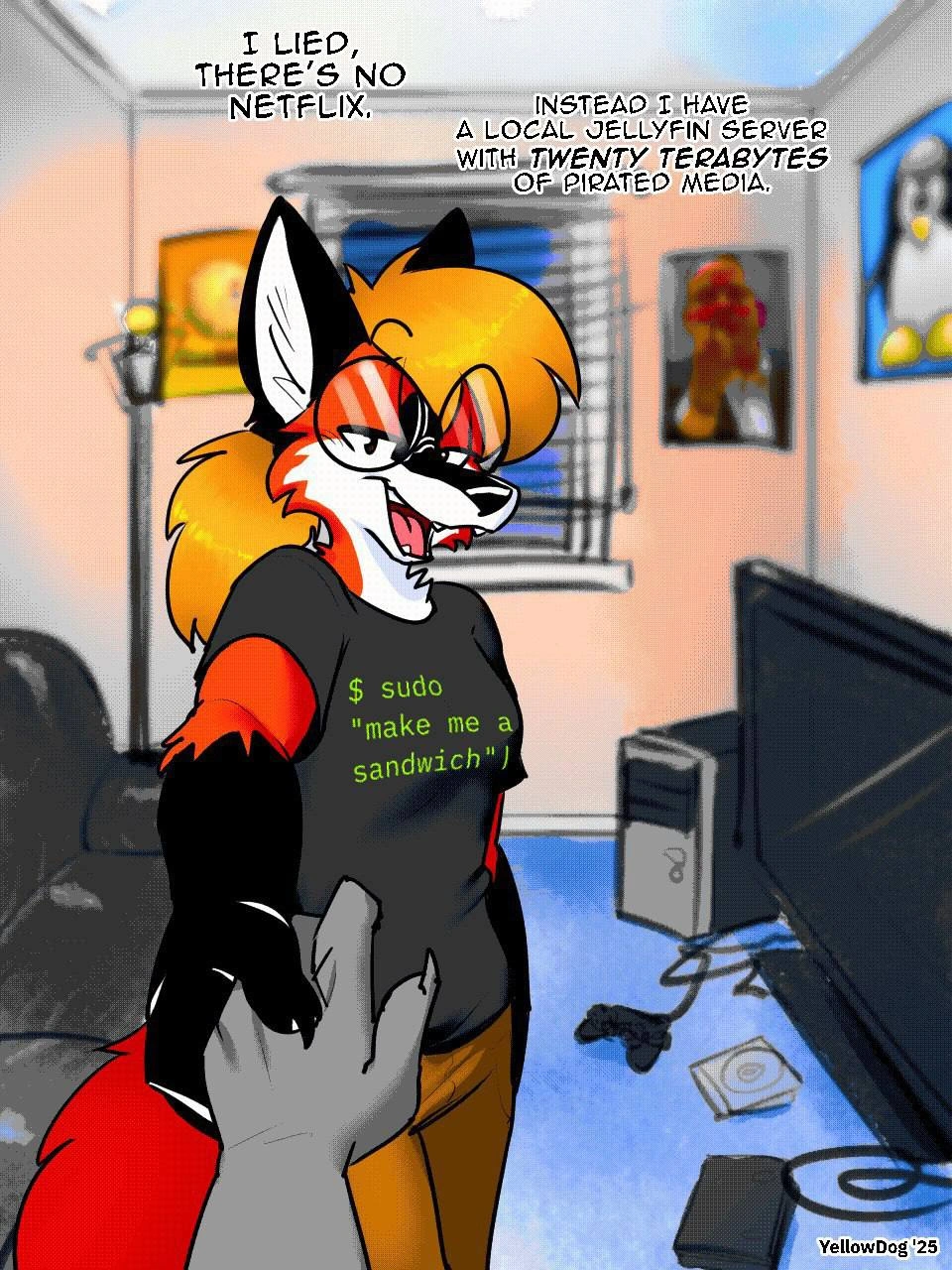
This cartoon captures a full-stack geek power move: ditching corporate streaming infrastructure in favor of a self-hosted media empire. The anthropomorphic fox character extends a paw and proudly admits, “I lied, there’s no Netflix. Instead, I have a local Jellyfin server with twenty terabytes of pirated media.” For seasoned developers and sysadmins, this single panel is packed with in-jokes and tech pride:

  • Jellyfin vs Netflix: Jellyfin is an open-source media server that you run on your own hardware – essentially a DIY Netflix. Instead of relying on a cloud service or data center, this fox has built a personal streaming platform on their localhost. Netflix runs on huge clusters and worldwide CDNs, but here all the content delivery happens from that beige tower PC in the bedroom-lab. It’s a classic self-hosting flex: controlling your data and streams with no monthly fee (just the upfront cost of drives and elbow grease). The meme contrasts big corporate convenience with geeky independence.

  • Twenty Terabytes of Storage: 20 TB is an absurdly large personal library. That’s on the order of thousands of movies or TV episodes stored locally. Achieving such capacity likely means this enthusiast set up serious data storage solutions – possibly a multi-disk RAID array or a NAS tucked in that beige case. The context tag raid_array_pride is spot on: home-labbers often boast about combining drives for huge storage (and sometimes redundancy). Managing 20 TB turns you into a part-time Systems Administrator at home – monitoring disk health, swapping out drives, and praying you don’t see a drive failure at 3 AM. It’s overkill in the best way, a point of pride for anyone who’s spent weekends assembling a home server while friends were bingeing Netflix.

  • Open Source & Linux Culture: The room is decorated with hints of the owner’s tech loyalties – notably the Tux poster on the wall. Tux, the penguin, is the mascot of Linux, signaling that this whole setup likely runs on a Linux distro. Home server enthusiasts often choose Linux for its stability and flexibility (and because it’s free). The fox’s black t-shirt is emblazoned with green console text: $ sudo "make me a sandwich". This references a classic XKCD comic and a beloved Command Line Interface joke. In Unix-like systems, sudo lets you execute commands as the superuser (admin). The famous exchange goes: “Make me a sandwich.” “What? No.” “Sudo make me a sandwich.” “Okay.” By wearing that, our fox is cheekily flaunting root-level cred. It’s a double flex: not only does this person run their own media server, they do it with terminal commands and superuser privileges. In short, the décor and wardrobe scream “Linux geek here!”

  • Pirated Media & DIY Ethos: The fox casually mentions a pirated media library, which is the tongue-in-cheek crown jewel of this setup. That means all those movies weren’t exactly acquired through official channels. It’s a wink at a rebellious streak common in tech circles: back in the day, many of us ripped DVDs or torrented shows to build massive collections of “backup files” (often jokingly referred to as Linux ISOs as a cover). Here, twenty terabytes of Linux ISOs movies is an outrageous brag – essentially saying, “I have everything and I own it outright.” This resonates with veteran engineers who remember hoarding MP3s and AVIs before streaming was ubiquitous. The humor comes from how over-the-top it is: instead of simply subscribing to Netflix, our crafty sysadmin built a mini Netflix from scratch. It’s both an impressive engineering project and a nerdy form of rebellion. The meme gets a laugh (and some admiration) because it captures that why do it simple when you can over-engineer it? mentality. It’s the ultimate nerd flex: a homebrew Netflix alternative that only a truly passionate (and slightly crazy) techie would prefer using twenty terabytes of personal infrastructure.

Description

A furry-style cartoon (by YellowDog '25) showing an anthropomorphic fox character in a room with a computer setup, gaming controller on the floor, and a Tux (Linux penguin) poster on the wall. The text reads: 'I LIED, THERE'S NO NETFLIX. INSTEAD I HAVE A LOCAL JELLYFIN SERVER WITH TWENTY TERABYTES OF PIRATED MEDIA.' The fox wears a black shirt with '$ sudo "make me a sandwich"' (a classic Unix joke). The meme combines self-hosted media server culture, Linux enthusiasm, and the piracy-adjacent homelab community

Comments

18
Anonymous ★ Top Pick The Jellyfin-to-divorce pipeline: Step 1: Set up media server. Step 2: Spend more time curating metadata than watching content. Step 3: Your partner leaves. Step 4: More storage space!
  1. Anonymous ★ Top Pick

    The Jellyfin-to-divorce pipeline: Step 1: Set up media server. Step 2: Spend more time curating metadata than watching content. Step 3: Your partner leaves. Step 4: More storage space!

  2. Anonymous

    A 20TB Jellyfin server isn't just a media library; it's a high-availability, self-hosted relationship status that says 'I have my data, and my standards, locally replicated.'

  3. Anonymous

    A 20 TB Jellyfin box is impressive - right up until ZFS starts resilvering and movie night turns into a three-day scrub marathon

  4. Anonymous

    The real flex isn't the 20TB of 'Linux ISOs' - it's having a Jellyfin server that actually transcodes without buffering, unlike that production Kubernetes cluster you swear is 'almost ready' after three years of overengineering

  5. Anonymous

    Ah yes, the classic engineer's progression: start with a simple Raspberry Pi running Plex, end up with a 20TB Jellyfin cluster in your basement that consumes more power than your HVAC system. You tell yourself it's about 'learning infrastructure' and 'data sovereignty,' but really you just can't stand Netflix removing your favorite show mid-season. At least when your wife asks why the electricity bill tripled, you can confidently explain that your homelab's RAID array and transcoding workload are 'basically production-grade infrastructure' - conveniently omitting that the 'production' is just streaming The Office for the 47th time

  6. Anonymous

    Escaped vendor lock‑in, entered ops lock‑in: a 20TB single‑node “cluster” under the TV where the SLO is “99.9% unless someone trips the HDMI cable.”

  7. Anonymous

    Serverless cold starts? Pfft - my 20TiB pirate Netflix localhost spins up instantly, no Lambda bills required

  8. Anonymous

    A 20TB Jellyfin in the living room is basically a self-hosted CDN - congrats, you’re the platform team and the compliance department; shame the shirt quotes sudo, so even your RBAC is a syntax error

  9. @RiedleroD 10mo

    my communal server only has ~3.5T 😔 we gotta step our game up

    1. @RiedleroD 10mo

      wait I forgot the anime folder. around 7T actually

    2. @nicovillanueva 10mo

      Communal? That's really cool

      1. @RiedleroD 10mo

        yeah ^^

    3. @f0cu53d 10mo

      Like a big LAN?

      1. @RiedleroD 10mo

        it's connected to the internet. up/down speeds are decent enough to stream from/to the server

        1. @RiedleroD 10mo

          password protected and invite-only of course

  10. @Capstra 10mo

    partner material

  11. アレックス 10mo

    >implying that’s not way cooler

  12. @gongchanM1 10mo

    Is that Xenia?

Use J and K for navigation