Skip to content
DevMeme
Onboarding Juniors to the Legacy Monolith
LegacySystems Post #31, on Jan 29, 2019 in TG

Onboarding Juniors to the Legacy Monolith

Why is this LegacySystems meme funny?

Level 1: The Treasure Map of Tape and String

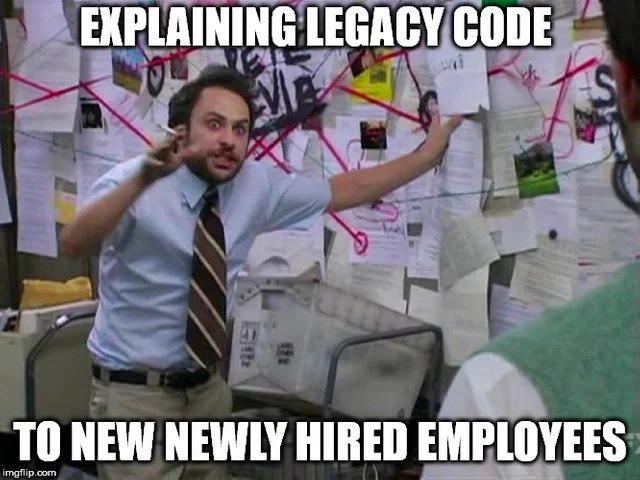
Imagine your first day at a new school, and instead of a tour, a wild-eyed kid drags you to a wall covered in hundreds of taped-up notes connected by red yarn, and explains — talking very fast — that you must never use the third water fountain, the gym door only opens if you jiggle it twice, and the cafeteria schedule is a lie on Thursdays. He's not making any of it up. Every insane rule is true, and he learned each one the hard way. That's what it's like when programmers explain an old computer system to someone new: the explanation looks crazy, but the crazy thing is the system — the person with the string is just its most honest map.

Level 2: Legacy, Tribal Knowledge, and Your First Week

Decoding the jargon pinned to that wall:

  • Legacy code is old code still running in production — usually mission-critical, usually written under constraints nobody remembers, in styles or frameworks no longer taught. The practical definition many engineers use: code without tests and without its original authors. It's not "bad code"; it's code whose context has evaporated.
  • Technical debt is the accumulation of shortcuts ("we'll fix it after launch") that makes such systems progressively harder to change — the interest payments are the hours of explanation happening in this image.
  • Tribal knowledge is critical information that lives only in people's heads: which config flag is a lie, which service must restart in a specific order, why the table is named tbl_final_v3_new. The conspiracy board is tribal knowledge made visible.
  • Onboarding is your structured introduction to a codebase as a new hire. Expectation: clean docs and a tidy diagram. Reality, frequently: a senior engineer saying "okay, so, technically the orders service doesn't create orders" while drawing arrows that loop back on themselves.

If you're the new hire in this picture, two survival tips. First, the explainer is not unhinged — they are compressed. Every weird arrow encodes a real outage; take notes, because you're watching the only copy of the documentation perform itself. Second, write down what you're told while it still sounds insane. The most valuable docs in any company are written by newcomers in their first month, before the madness becomes invisible to them too.

Level 3: The Architecture Diagram Is Load-Bearing String

The still is Charlie Day as Charlie Kelly in It's Always Sunny in Philadelphia — the "Pepe Silvia" scene: disheveled blue shirt, loosened striped tie, cigarette in one gesturing hand, eyes at full mania, papers and photos pinned floor-to-ceiling and lashed together with chaotic red string. Caption: "EXPLAINING LEGACY CODE" / "TO NEW NEWLY HIRED EMPLOYEES" — and yes, the "new newly" stutter is right there in the image, an accidental garnish that works suspiciously well, because that's exactly how you talk by hour three of an onboarding walkthrough.

What the template captures, with documentary accuracy, is that onboarding into a legacy system is epistemically indistinguishable from being pitched a conspiracy theory. Consider the structural parallels. The explainer possesses vast, internally consistent knowledge that exists nowhere in writing — pure tribal knowledge, accumulated through incidents. Every claim sounds insane but is verifiable ("the invoice service reads this column, but only on Tuesdays, because of a cron job nobody owns"). The connections are real but undocumented, so the red string is doing the work an architecture diagram should — and as any veteran will tell you, the string is more accurate, because the official diagram on the wiki was last updated three re-orgs ago. And crucially: the explainer wasn't crazy when they started. The system made them this way, one production incident at a time. In the original scene, Charlie has discovered that "Pepe Silvia" doesn't exist — and the legacy-code translation is exquisite: every old codebase contains its own Pepe Silvia, a module everything references and fears (UserManagerHelperImpl2) which, upon investigation, turns out to have no maintainer, no tests, no author still at the company, and possibly no reason to exist. It cannot be deleted. Deleting it breaks billing. Nobody knows why.

The deeper satire is aimed at why organizations end up here. Documentation loses to deadline pressure every sprint, so knowledge concentrates in long-tenured humans — a bus factor of one, wearing a tie. The new hire in the foreground (that blurred shoulder belongs to the eternally patient onboarding victim) is receiving the only transfer mechanism the org ever funded: an oral tradition, delivered at conspiracy-wall intensity. Companies will buy any tool — wikis, Confluence, diagram-as-code, AI summarizers — before they'll buy the thing that actually fixes this, which is time allocated to writing things down while they're still true. And so the ritual repeats: today's wide-eyed listener is, give it four years and a few pager rotations, the next person at the wall, cigarette optional.

Description

This meme uses the popular 'Charlie Kelly Conspiracy' or 'Pepe Silvia' format from the TV show 'It's Always Sunny in Philadelphia'. The image features a wild-eyed, disheveled man standing in front of a wall covered in papers, photos, and diagrams connected by red strings, as if explaining a complex conspiracy. The top text reads 'EXPLAINING LEGACY CODE', and the bottom text says 'TO NEW NEWLY HIRED EMPLOYEES'. The visual chaos perfectly mirrors the feeling of trying to articulate the convoluted, often illogical, and poorly documented architecture of a legacy software system. For experienced developers, this isn't just hyperbole; it's a painfully accurate depiction of knowledge transfer, where years of accumulated technical debt, historical workarounds, and tribal knowledge have to be explained to someone with fresh eyes, making the senior engineer feel like a mad conspiracy theorist
Comments

8
Anonymous ★ Top Pick And this red string connects the payment gateway to a global variable set by a dev who left 8 years ago. We don't touch it, we don't know why it works, and yes, your first task is to refactor it. Welcome aboard
  1. Anonymous ★ Top Pick

    And this red string connects the payment gateway to a global variable set by a dev who left 8 years ago. We don't touch it, we don't know why it works, and yes, your first task is to refactor it. Welcome aboard

  2. Anonymous

    Press “Submit” in the shiny React frontend and follow the red yarn: seven implicit RPC hops later a COBOL job on the AS/400 prints a dot-matrix report… straight to the shredder queue - welcome to our event-driven architecture

  3. Anonymous

    "And this singleton manages state for three different systems because Dave from 2008 thought dependency injection was 'too much overhead,' but don't worry, the race condition only happens on Tuesdays."

  4. Anonymous

    The red string IS the architecture diagram - it's the only artifact that's been kept in sync with production since 2009

  5. Anonymous

    This is the exact moment when the new hire realizes that 'well-documented codebase' in the job description was technically true - the documentation exists, it's just scattered across 47 Confluence pages, 23 Slack threads, 8 deprecated wikis, and the institutional memory of one engineer who's been here since the monolith was a microservice. The red string represents the actual dependency graph that would crash your IDE if you tried to visualize it, and those sticky notes? Each one is a TODO comment from 2014 that became a permanent architectural decision

  6. Anonymous

    Welcome aboard: the red yarn marks our implicit coupling via shared DB tables, the pins are cron jobs pretending to be event handlers, and that giant knot is the 2012 “temporary” hotfix that still owns checkout

  7. Anonymous

    New hires see a conspiracy board; grizzled vets recognize the actual module dependency graph

  8. Anonymous

    Welcome aboard - our C4 diagram is red yarn; every knot marks temporal coupling we couldn’t unit test, and that drooping strand is the cron that keeps the monolith alive

Use J and K for navigation