Skip to content
DevMeme
A Developer's Most Loyal Companion
Bugs Post #30, on Jan 27, 2019 in TG

A Developer's Most Loyal Companion

Why is this Bugs meme funny?

Level 1: The Friend Who Never Leaves

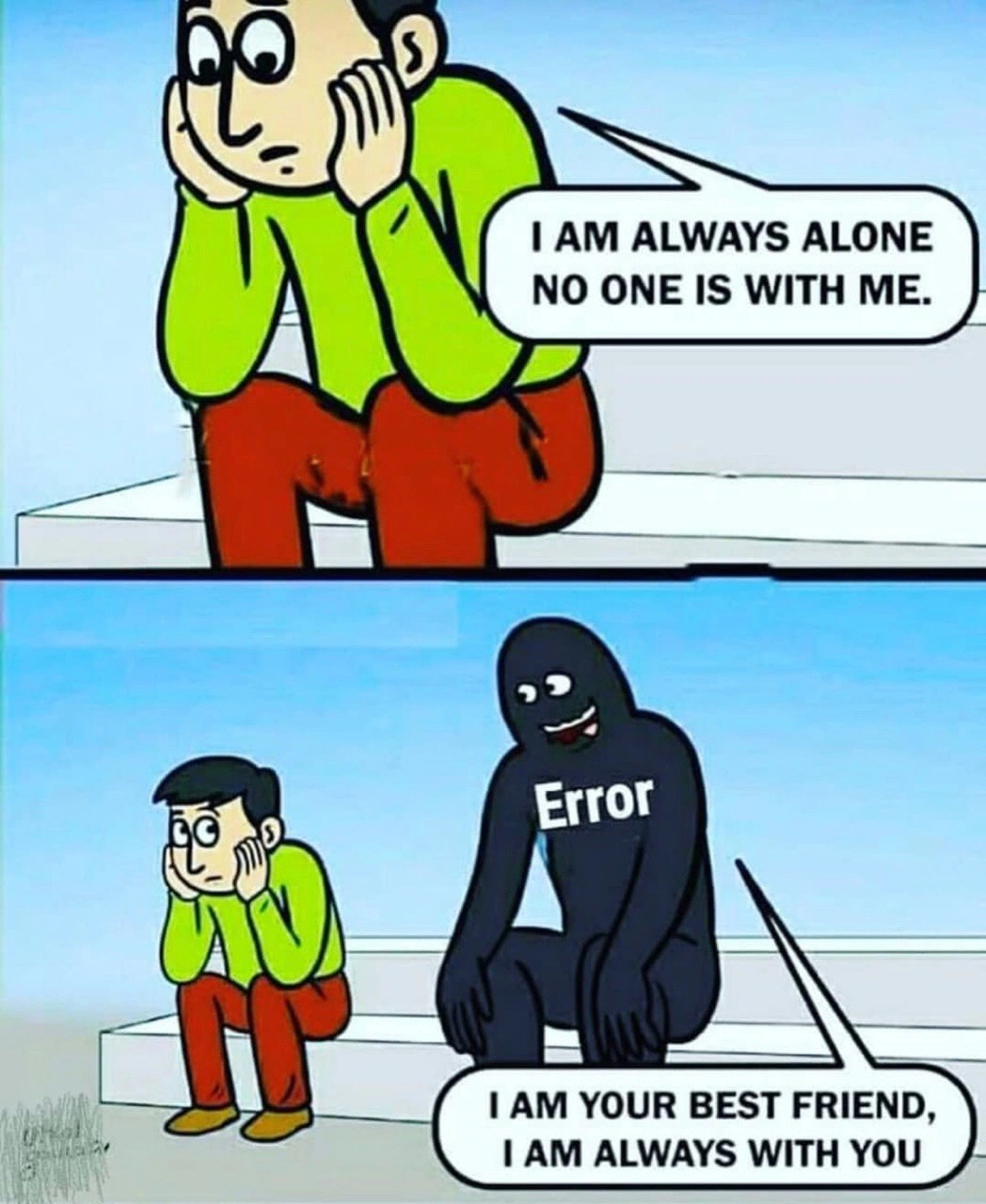
A sad person sits on the steps saying nobody ever stays with them — and a big smiling shadow plops down beside them, copies their pose exactly, and says "I'm your best friend, I'm always with you." Except the shadow is named Error, the thing that pops up when a computer program breaks. It's funny the way a rain cloud following a cartoon character is funny: programmers spend so much of their day with things going wrong that the going-wrong has effectively become their most devoted companion. You'd cry, but honestly — at least someone showed up.

Level 2: Meeting Your New Best Friend

Terms worth unpacking for those early in the friendship:

  • An error is the program's formal announcement that something went wrong — a missing file, a typo in the code, dividing by zero. It usually arrives as red text plus a stack trace: a breadcrumb trail of which function called which function, ending at the exact line that failed. New developers tend to see a wall of scary text; the trick is that the most useful part is usually the first or last line, which names the problem and its address.
  • Debugging is the practice of figuring out why the error happened — the actual day-to-day substance of programming. The realistic ratio surprises everyone at first: writing new code is the minority of the job; conversing with errors is the majority.
  • The rite of passage this comic compresses: your first project, where the same error message greets you on every single run for an afternoon. It feels personal. It is not. Every person who has ever programmed — including the people who built the language you're using — spent today with the same companion. The pros didn't escape Error; they just got faster at the conversation and stopped taking its visits as a verdict on their worth.
  • One genuinely practical reframe hiding in the punchline: read what your friend says. The error message is trying to help. undefined is not a function is awkward phrasing for "you called something that doesn't exist — go look at that name." Developers who befriend the message debug in minutes; developers who treat it as an enemy alt-tab to despair.

Level 3: The Only Dependency That Never Breaks Up With You

The comic is a repurposing of the well-worn "shadow friend" template. Panel one: a young man in a green sweater slumps on white steps, head in hands —

I AM ALWAYS ALONE. NO ONE IS WITH ME.

Panel two: a large, grinning black silhouette with Error printed on its chest sits down beside him, mirroring his exact pose, and answers —

I AM YOUR BEST FRIEND, I AM ALWAYS WITH YOU

The original template personifies depression as the companion; swapping in Error works because the substitution is nearly lossless, and that near-losslessness is the joke's dark engine. Errors really do satisfy every formal property of a loyal friend: perfect attendance (first Hello World to last pre-retirement deploy), unconditional availability (nights, weekends, vacations via PagerDuty), and total indifference to your status (staff engineers get them in distributed consensus code, juniors get them in semicolons — the friendship scales). The meme is structurally sound in a way most format-swaps aren't: notice the shadow doesn't loom or attack. It sits down companionably, copies his posture, smiles. That's exactly the relationship experienced developers eventually negotiate with failure — not adversarial, but cohabitational.

There's an actual professional insight buried under the gallows humor, which is why seniors share this rather than just wincing at it. The error is the only honest interlocutor in the whole toolchain. Documentation lies through staleness, comments lie through drift, the product owner's spec lies through optimism — but a stack trace tells you precisely what happened, where, with line numbers. The maturation arc of a developer can be measured as the journey from panel one (errors as persecution: "why is this happening to me") to panel two (errors as information: the system attempting communication). The red text never abandoned you; you just had to stop reading it as rejection. Silence is the actually terrifying state — the program that fails with no message, the corrupted data discovered three months later. When Error sits next to you, at least someone showed up to the incident.

And yet the template's origin keeps the second reading alive, and the meme is sharper for not resolving it. The figure is still drawn as the depression-shadow; the loneliness in panel one is still real. Debugging is genuinely isolating work — hours alone with a failure no one else can see, the quiet 2 AM conviction that everyone else's code just works. The comic lets both readings coexist: a joke about SyntaxError being clingy, and a quieter observation about a profession where, some weeks, the most consistent presence in your life really is the thing that's broken. Alert fatigue and burnout live exactly in the gap between those two readings.

Description

A two-panel comic strip depicting the relationship between a developer and their code. In the top panel, a cartoon man in a green shirt sits alone on some steps, looking dejected, with a speech bubble that says, 'I AM ALWAYS ALONE NO ONE IS WITH ME.' In the bottom panel, the man's expression is unchanged, but he is now accompanied by a large, black, vaguely humanoid creature with a wide, slightly unnerving smile. The creature has the word 'Error' written in white on its chest and says, 'I AM YOUR BEST FRIEND, I AM ALWAYS WITH YOU.' This meme personifies software errors as a constant, inescapable companion in a programmer's life. The joke is a darkly humorous take on the reality of software development: no matter how skilled you are, bugs and errors are an ever-present part of the job, turning a feeling of isolation into a state of perpetual, frustrating companionship

Comments

8
Anonymous ★ Top Pick The junior dev meets syntax errors. The senior dev has a long, complicated, and deeply co-dependent relationship with intermittent race conditions that only show up in production
  1. Anonymous ★ Top Pick

    The junior dev meets syntax errors. The senior dev has a long, complicated, and deeply co-dependent relationship with intermittent race conditions that only show up in production

  2. Anonymous

    We migrated the J2EE monolith into 300 Lambdas, and the same NullPointerException still shows up to every release - our most loyal microservice

  3. Anonymous

    After 20 years in tech, I've realized errors aren't bugs - they're the only stakeholders who actually read my code and provide immediate, honest feedback without scheduling a meeting first

  4. Anonymous

    Twenty years in, and Error is still the only dependency with 100% uptime and no breaking changes to its commitment

  5. Anonymous

    Every senior engineer knows that 'Error' isn't just a companion - it's a stage-5 clinger with perfect attendance. You can refactor, you can add tests, you can even rewrite in Rust, but Error will find you. It's the one relationship in tech with 100% uptime and zero documentation on how to break up

  6. Anonymous

    The only thing with true 99.999% uptime in our stack is the error log - strongly consistent across dev, staging, and prod, and it somehow always passes the health checks

  7. Anonymous

    Errors: the one microservice that scales perfectly, refuses isolation, and never needs a health check

  8. Anonymous

    The most highly available service in our architecture is Error - multi‑region, zero‑downtime, bypasses every feature flag, and still pages me at 3am with five nines

Use J and K for navigation