The Original Cloud Computing Pioneer
Why is this TechHistory meme funny?
Level 1: The Oldest Tech Support Story
It's a joke that works like this: a man in an ancient painting walks up a mountain into a cloud, and comes back down carrying a tablet with important writing on it. Squint, and that's exactly what we say about phones today — "I downloaded it from the cloud onto my tablet." The funny part is the word "technically," which is how people talk when they know they're being ridiculous but dare you to prove them wrong. You can't. The cloud was there, the tablet was there, the files arrived. Case closed, several thousand years before Wi-Fi.
Level 2: What "the Cloud" Actually Is
Unpacking the modern half of the pun:
- The cloud is just other people's computers — vast warehouses of servers run by companies like Amazon, Google, and Microsoft, which you rent over the internet. When you "save to the cloud," your file travels to one of those data centers. The name comes from old network diagrams, where the internet was drawn as a fluffy cloud shape meaning "stuff out there we don't control."
- Downloading means copying data from a remote machine to your local device. (Uploading is the reverse. Moses, notably, only downloads — the sync is one-directional, which is also how the relationship was specified.)
- A tablet today is a flat touchscreen computer; for roughly five thousand years before that, it was a flat slab you wrote on — clay in Mesopotamia, stone at Sinai, wax in Rome. The device category literally borrowed the ancient word, which is the hinge the whole meme swings on.
- Read-only describes data you can view but not change — and a chisel inscription is about as read-only as storage gets. Engineers prize immutability because data nobody can quietly edit is data everyone can trust; the meme accidentally showcases the original trusted artifact.
The relatable beat for newer developers: this meme is the kind of joke that gets made in every office when someone says "it's in the cloud" and a colleague mutters "you mean a building in Virginia." Learning that the cloud is physical — racks, fans, electricity bills — is a real little rite of passage, and the meme's anachronism works because the fluffy-sky misunderstanding is one everybody briefly, genuinely had.
Level 3: Immutable Infrastructure, Circa Mount Sinai
The text banner declares:
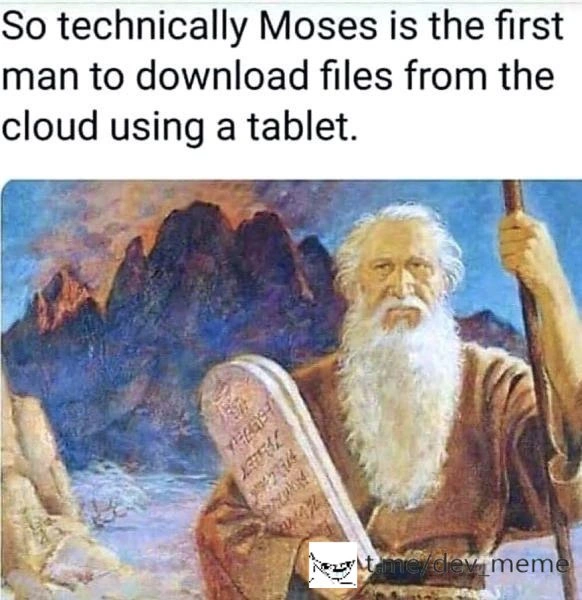
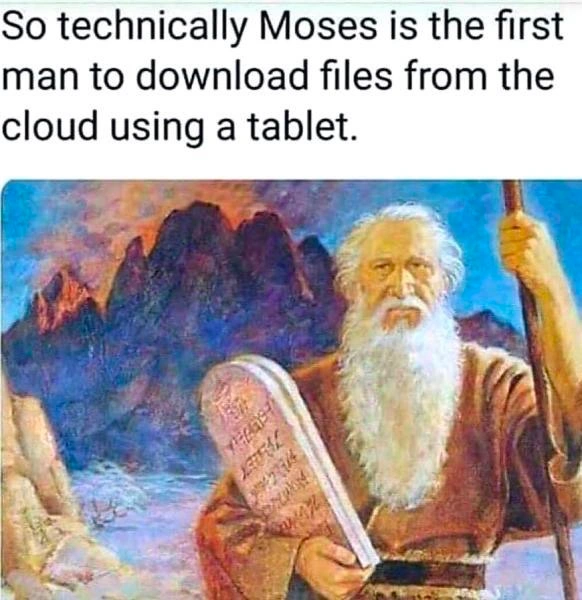
So technically Moses is the first man to download files from the cloud using a tablet.
Below it, a classical-style painting does the visual proof-of-claim: Moses — white beard, brown robe, wooden staff — descending before the dark crags of Sinai with a glowing, smoke-filled sky behind him, cradling a stone tablet inscribed with the Commandments. The word "technically" is the load-bearing joke token. This is the technically correct genre — the pedant's favorite — where humor comes from applying modern terminology to an old referent with such literal precision that the absurd mapping refuses to be falsified. Cloud (divine, cumulonimbus, on the mountain) → cloud (storage). Stone tablets → tablet (device). Receiving the law → download. Each mapping is wrong in spirit and irritatingly airtight in letter.
What elevates this for an engineering audience is how far the metaphor extends before it breaks — much further than the meme itself bothers to push. The Commandments are arguably the founding artifact of several modern infrastructure ideals. They're read-only storage in the most literal sense available to the Bronze Age: chiseled stone, no write API for the recipient. They're immutable configuration distributed from a single authoritative source — exactly ten declarative rules, pushed top-down, no pull requests entertained. The transmission even includes the canonical disaster-recovery story: Moses, encountering an unauthorized golden-calf deployment in production, smashes the first set of tablets — and the system recovers via a full re-download from origin, because the source of truth was never the local copy. That's the cloud-storage value proposition in one parable: your device is replaceable; the canonical data survives device loss. Sinai had better durability guarantees than most startups' backup strategies.
The meme also belongs to a sturdy lineage of tech-vocabulary archaeology jokes — observing that the industry, starved for names, strip-mines older civilization for metaphors: clouds, tablets, scrolls (we still scroll), logs, daemons, avatars, icons (a literal term from religious art). The comedy boomerangs: we laugh at Moses "downloading," but the actual historical event is that engineers named their products after his props. Marketing did the anachronism first; the meme just runs the mapping backward. And the "first man" framing slyly mimics the tech industry's own habit of retroactively crowning firsts — every keynote claims its product invented something a prior generation did in stone.
Description
The meme displays text at the top: "So technically Moses is the first man to download files from the cloud using a tablet." Below the text is a classical painting depicting the prophet Moses, with a long white beard and holding a staff, standing before a mountainous landscape. He is holding two stone tablets inscribed with ancient text. This meme is a classic example of using historical or religious narratives to create a tech-related pun. It humorously anachronizes the story of Moses receiving the Ten Commandments from God on Mount Sinai, equating it with modern terminology. "The cloud" is a double entendre for both God in the heavens and cloud computing, while the stone "tablet" is the precursor to today's digital tablets. This joke resonates with senior developers who appreciate the long view of technology and how fundamental concepts of information transfer have existed for millennia, albeit in different forms

Comments
8Comment deleted
This was the original immutable infrastructure. The API was literally set in stone, and the EULA was non-negotiable
Moses basically invented immutable infrastructure: cloud-provisioned, read-only tablets with a strict 10-line config - zero downtime until the golden-calf team pushed an unauthorized hotfix to prod
And just like modern cloud migrations, it took 40 years of wandering in production before anyone could successfully implement the solution
Two tablets, ten commandments, zero revisions accepted - the original immutable infrastructure with a single source of truth
Moses clearly had the advantage of a direct API connection to the divine cloud provider - no OAuth, no rate limiting, and zero latency. Though the storage medium was admittedly write-once-read-many (WORM), and the backup strategy involved literally breaking the first set of tablets and requesting a complete re-download. At least he didn't have to deal with S3 egress fees or worry about GDPR compliance for those commandments
Moses shipped the first cloud-to-tablet release: WORM storage, no feature flags, infra literally immutable, and rollback meant shattering prod
The original cloud-to-edge rollout: WORM storage on dual tablets, signed by the root authority via lightning, 40‑day cold start, and absolutely no rollback policy
Stone tablets: immutable infrastructure perfected before Kubernetes - zero drift, eternal compatibility