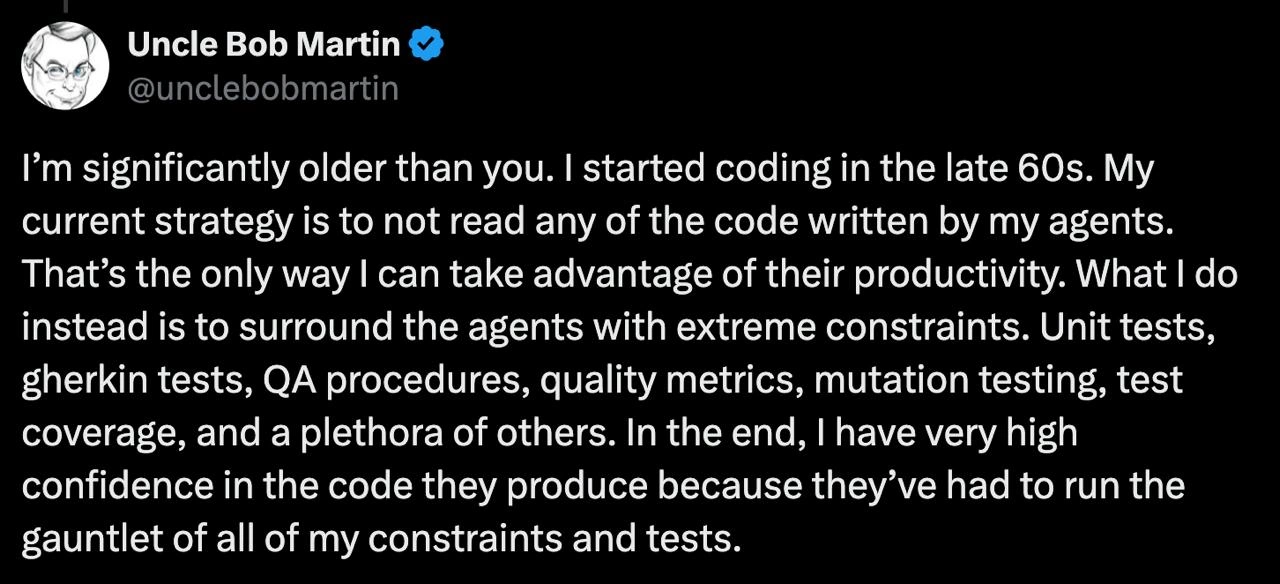
When lawmakers ship code straight to prod without tests or reviews
Why is this CodeQuality meme funny?
Level 1: House of Cards
Imagine you and your friends are building a giant tower out of blocks. Normally, you’d try to keep it simple and stable – a strong base and not too complicated, right? Now picture one friend who insists on making the tower super fancy and tall, adding weird little block structures all over (even when they aren’t needed). They never test the tower’s stability as they build; they just keep stacking blocks higher without ever gently shaking it to see if it might fall. They also never ask for help or a second opinion – usually, you’d have someone walk around the tower to spot if it’s leaning, but nope, this friend won’t let anyone review what they’re doing. There are also some old wobbly sections at the bottom from way earlier, but they refuse to take those unused pieces out (they just leave every block they ever placed, even if it’s not helping). So the tower gets more and more complicated, with blocks perched in odd ways. You can see it towering like a shaky house of cards. Finally, it gets so tall and so unstable that – crash! – the whole thing collapses under its own weight. Everyone saw it coming because the basics were ignored: it wasn’t simple, it wasn’t tested, nobody double-checked it, and the shaky bits were never fixed. It’s funny in a “I told you so” way: you can’t help but grin a little because the disaster was so obvious. This is just like the joke in the meme – it’s comparing making laws to building that doomed block tower. If you don’t keep things simple and you don’t check your work, the end result can be a big, toppled mess that surprises no one.
Level 2: Keep It Simple, Stupid (KISS)
Let’s unpack the tweet’s joke in simpler terms. It’s saying that lawmakers, if they were software developers, would be doing everything wrong according to basic clean coding principles and good software process. Each line in the tweet references a specific concept in programming and project management. If you’re a junior developer or just learning, here’s what those mean and why ignoring them is bad:
KISS (Keep It Simple, Stupid): This is a classic principle in software engineering (and design in general) that means you should keep solutions as simple as possible. The idea is that complexity is the enemy – the more complicated your code or design, the more likely it is to have bugs or be impossible to maintain. The tweet says “They don’t KISS,” implying lawmakers make things overly complicated. For a developer, not following KISS might be like writing a 300-line function for something that could be done in 30 lines, or creating an overly elaborate architecture for a simple app. Simple code is easier to debug and extend; simple laws would likely be easier to understand and enforce. By saying lawmakers don’t KISS, the meme suggests they create overly complex laws full of exceptions and special cases, rather than straightforward, clear rules. This sets the stage for a complex codebase (or legal code) that’s hard to work with.
They don’t write tests: In software, writing tests (like unit tests and integration tests) is how we check that our code actually works as intended and continues to work when we change things. Think of tests as safety nets or rehearsals: before we release new code to users, we run these automated checks to catch errors. If developers “don’t write tests,” they won’t know if their code breaks something until a user finds the bug (yikes!). The tweet is saying lawmakers pass laws without “tests” – obviously we don’t have automated tests for laws, but the equivalent might be pilot programs, impact studies, or simulations to see if a law will work as expected. Skipping that is like a coder not running their program to see if it even runs correctly. For a junior dev, imagine writing a new feature, not testing it at all, and directly giving it to users – chances are something will go wrong that you didn’t anticipate. It’s a basic step in development to write and run tests, just as in a good policy process you’d want to test ideas on a small scale or at least thoroughly think through consequences. When the tweet says lawmakers don’t do this, it humorously points out a real frustration: sometimes laws are passed and only afterward do we discover big problems, just like releasing untested software that crashes or misbehaves.
They deploy directly to prod: Prod means the production environment, which is the live system used by end-users or, in this analogy, the public. In a normal software release cycle, after writing code, you’d deploy it to a staging or testing environment first, then to production once you’re confident it works. Deploying directly to prod means you skip any safe testing stage and release it straight to everyone. It’s often jokingly referred to as “YOLO deploy” or “testing in production” – essentially treating your actual users as guinea pigs. This is considered very risky because any bug or problem goes straight out to real users, possibly causing downtime or errors in a live app. In the context of lawmakers, “deploying directly to prod” means when they pass a law, it immediately affects the real world without trials or phased rollouts. There’s no provisional phase to see if it works; it just becomes the law of the land. For a new developer, deploying code without trying it out in a controlled setting is something mentors warn you never to do, because it can lead to outages or emergency fixes. For example, if you built a new login feature, you’d first test it locally, then maybe on a staging server with sample data. Imagine skipping all that and one morning just replacing the login code for millions of users in one go. If there’s a bug, nobody can log in, and you’ll be scrambling to fix it live. That stress is exactly what we try to avoid with proper deployment practices. The meme is funny because lawmakers often do make sudden changes (new laws or regulations) that everyone has to deal with immediately, and if there’s a flaw, well, too late – it’s already “in production” and causing issues.
They rarely peer review code: In software teams, peer review (or code review) is when someone other than the author of the code checks it before it’s merged or shipped. This is a critical part of ensuring code quality. Another set of eyes can catch mistakes, point out confusing parts, and uphold standards. When the tweet says lawmakers rarely peer review code, it’s pointing out that laws (or bills) might not be thoroughly reviewed by lots of peers before going live. The analogy in coding would be if only one developer wrote a huge piece of code and nobody else looked at it for bugs or design issues, but it still got released. For a junior developer, think of the times a teammate or senior developer reviewed your code and found a mistake you missed. It’s easy to become “blind” to your own errors. In government, peer review might correspond to committees or public comment periods – processes that ideally would catch issues or refine the proposal. Suggesting that lawmakers “rarely peer review” implies laws might be drafted and passed by a small group, or even lobbyists and a few officials, without broad scrutiny. In coding terms, that’s scary – it’s like pushing code to production that only one person vaguely checked (or no one at all). It usually leads to bugs in software, and in legislation it can lead to loopholes or unintended consequences. This line in the meme highlights the pain point of skipping reviews: whether it’s unreviewed code or an unread 1000-page bill, there’s a good chance something’s wrong with it.
They don’t garbage collect unused routines: In programming, “garbage collection” is a mechanism (often built into languages like Java, Python, etc.) that automatically frees up memory by deleting objects or data that are no longer used. More broadly, it’s a metaphor for cleaning up unused code – functions, variables, or entire modules that aren’t needed should be removed to keep the codebase clean. Unused routines means bits of code (routines = functions or procedures) that no longer have a purpose in the current system. If you never remove or clean up, your project can become bloated with dead code, which makes it harder to maintain. For example, imagine you wrote a feature and later replaced it with a better one, but left all the old functions and files from the first attempt still in the application. Six months later, another developer might trip over that old code, not realizing it’s obsolete, or even accidentally call it causing weird behavior. It’s like having junk in your house – eventually it gets in the way. The meme says lawmakers don’t do this cleanup. In real terms, that points to governments often leaving old laws on the books that aren’t enforced or relevant, or old programs running that no one has use for anymore. A classic example: some jurisdictions still have antiquated laws (like century-old regulations that are technically still valid but nobody follows). In a code analogy, that’s like having a bunch of commented-out code or unused functions cluttering your system. A junior dev learns that refactoring and deleting dead code is part of the job: you routinely “garbage collect” your codebase by removing what’s no longer needed (sometimes manually, if your language doesn’t do it for you automatically). If you don’t, you risk confusion and possibly even memory leaks or performance issues. The tweet humorously criticizes lawmakers for not doing the equivalent in lawmaking – never repealing outdated laws or consolidating overlaps – so the legal code just grows endlessly. That’s funny to developers because we know how bad an idea it is to never take out the trash in a project. It leads to technical debt, where you carry all that unnecessary weight and it makes every change harder.
Heaping complexity upon complexity until the system collapses: This is basically the end result of all the above bad practices. Code complexity refers to how complicated and intertwined a software system is. There are even metrics for it (like cyclomatic complexity, which counts the number of different paths through the code). If you keep increasing complexity – for instance, by adding new features on top of a shaky, untested foundation, with no cleanup – you get a system that is fragile and difficult to understand. A junior developer might experience this when a simple project turns into a big ball of spaghetti code after adding too many features quickly without structure. Eventually, you can reach a point where nobody fully understands how the system works; fixing one thing breaks two other things. We call that a system collapsing under its own weight. In real life, developers may declare code “unmaintainable” when it gets this bad, and often the solution is a complete rewrite or major refactoring because incremental fixes just don’t cut it anymore. In the analogy, the system is basically the government or society running under a super complex set of laws and regulations. If lawmakers keep layering new rules without simplifying or removing old ones, the legal system can become nearly impossible to navigate or enforce properly. You might hear terms like “bureaucratic red tape” – that’s the real-world equivalent of a tangled codebase where even simple tasks require wading through endless complexity. When the tweet says “until the system collapses under its own weight,” it implies a failure point. For software, collapse might mean the application crashes constantly, or any new update is virtually impossible (development grinding to a halt). For a legal system, collapse could mean the rules become so contradictory or cumbersome that they fail to function effectively (or public trust collapses because nobody understands the law anymore). This is the tweet’s punchline: all these practices are exactly how you not to run a project. It’s amusing because it suggests one day the “government project” might crash spectacularly, much like a program with too many bugs and no maintenance will eventually just stop working. And just as a junior dev learns, cleaning up complexity early is much easier than trying to fix a collapse later, the underlying satirical message is that lawmakers might want to adopt some “code maintenance” habits in their process.
All together, each of these points in the tweet maps a software development concept to a flaw in the lawmaking process. For someone new to coding, it’s a cheeky way to reinforce why we have best practices: keep code simple, test your work, do code reviews, clean up after yourself, and manage complexity. When we ignore those, we incur technical debt – basically, you save time now by cutting corners, but you pay for it later with huge problems. The meme jokes that lawmakers operate like developers who incur massive technical debt in the “code” of society. It resonates as humor because those in the know see the parallel: a badly run software project and a badly run legislative process have a lot in common! If you’ve just started programming, take this meme as a lighthearted warning – these practices exist for good reason. Even if we’re laughing at the comparison, the underlying truth is clear: skipping the fundamentals (whether in code or law) leads to a messy, fragile system. And if you ever needed an extreme example of why good process matters, well, think about laws as code and you’ll get the idea. It’s funny, but it’s also a bit of a lesson in disguise about why we emphasize code quality in the first place.
Level 3: Complexity by Committee
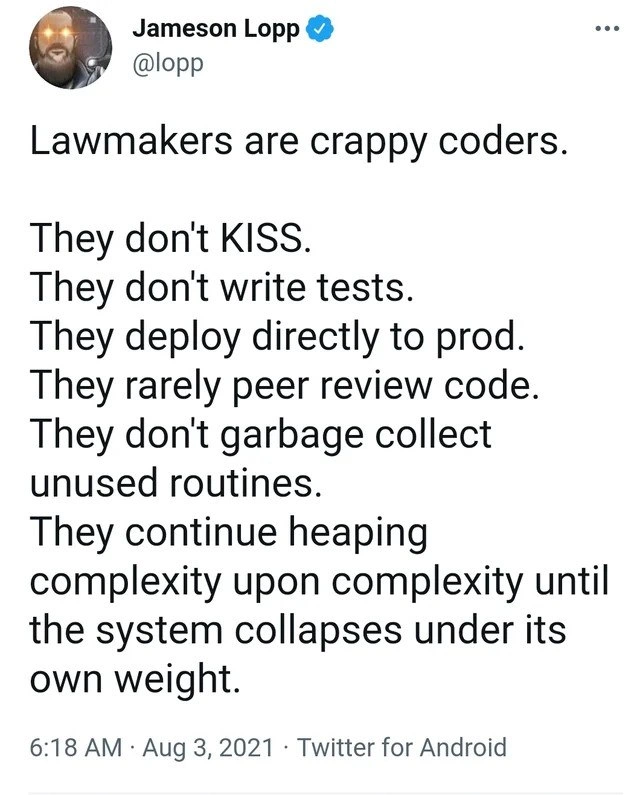
This meme is a screenshot of a tweet by Jameson Lopp that hilariously compares how lawmakers create legislation to how bad developers write software. At a senior engineering level, the humor lands because it lists every cardinal sin of code quality and software development process: ignoring the KISS principle, not writing tests, deploying straight to production, skipping code reviews, not cleaning up unused code, and piling on technical debt until everything crashes. Experienced developers immediately recognize these as the classic ingredients of a doomed project. The tweet basically says, “If governments wrote code, their SDLC (Software Development Life Cycle) would be a nightmare.” And honestly, it’s painfully true – we’ve all seen systems (and organizations) that heap complexity upon complexity until they collapse under their own weight.
Let’s break down why this is funny from a seasoned dev’s perspective. They don’t KISS – KISS stands for “Keep It Simple, Stupid,” a guiding clean code principle reminding us that simpler is usually better. In engineering, when designs get overly complex, bugs breed like rabbits and maintenance becomes impossible. In legislation, we see the same: laws get stuffed with exceptions, riders, and fine print (often thanks to design by committee), becoming the legal equivalent of spaghetti code. Senior devs chuckle (and cringe) because we know an over-engineered solution when we see one. If you’ve ever inherited a codebase that’s accreted hacks for years, you know the feeling – it’s like reading a tax law that’s been amended a hundred times. Simplicity isn’t just elegance; it’s survivability. When lawmakers ignore the “Keep it simple” mantra, they produce convoluted regulations no one fully understands, just as newbie coders produce 300-line functions no one can debug. The meme calls this out with a knowing wink to clean code principles.
Next, they don’t write tests – every senior dev’s eye twitches at this. Not writing unit tests or integration tests is a surefire recipe for disaster in code, because you only find bugs in production when users are already suffering. The tweet jabs that lawmakers similarly pass laws without “tests” – meaning they don’t try small-scale experiments or carefully simulate outcomes before rolling rules out nationwide. It’s “testing in production” on a society-wide scale. Deploying a new policy straight to the public is like pushing untested code to millions of users: best case, minor annoyances; worst case, catastrophic failure at 3 AM and an emergency scramble to patch things. Seasoned engineers have war stories of production crashes because someone merged code on Friday without proper tests. By comparing this to lawmakers, the meme suggests that society often becomes the unwitting QA team for rushed legislation. The humor has a dark edge: we know exactly how bad an untested release can be. It’s a shared pain point — every developer has muttered “Who in their right mind deployed this without testing?” and here we are implying the government does it all the time. Deployment pain points? Check. It’s both a laugh and a facepalm.
They deploy directly to prod – no staging server, no sandbox, just ship it live! This is essentially cowboy coding in the wild west of politics. In professional engineering, deploying straight to production without a dry run or a gradual rollout is almost heresy. We use canary releases, feature flags, beta tests, etc., to avoid blowing up the whole system. Lawmakers, by contrast, often flip the switch on a law for everyone at once, discovering only afterward what breaks. Senior devs find this hilarious in a grim way: it’s the classic anti-pattern we warn juniors about. If a developer handled mission-critical code the way some laws get passed (last-minute changes, no testing, immediate effect), they’d be prepping their résumé the next day. The meme deftly uses deployment pain points we all dread – imagine a massive production outage – and implies lawmakers invite those same crises by skipping proper rollout. It’s a sarcastic nod to the fact that real-world governance can be as chaotic as a 2 AM production hotfix.
They rarely peer review code – in software teams, skipping code review means fewer eyes to catch bugs or bad design. It’s a cornerstone of maintaining code quality: even the best devs benefit from a colleague saying “hey, you might have a bug here” or “this naming is confusing.” The tweet implies that legislation often isn’t peer-reviewed in any meaningful sense. Sure, there are committees and votes, but how many senators actually read the entire 1000-page bill (the diff, if you will)? It’d be like merging a giant PR without anyone looking at it because the deadline is tomorrow. Seasoned devs grin at this because we’ve been there: somewhere, sometime, a critical piece of code got merged without proper review (maybe the sole reviewer just rubber-stamped it), and naturally, it blew up later. The analogy suggests lawmakers push through “code” (laws) with hardly anyone doing a thorough line-by-line review. It tickles that part of a developer’s brain that remembers production bugs caused by a single un-reviewed typo. It’s funny and frightening – a code review pain point writ large. We rely on peer review to maintain standards; imagining a world where that rarely happens (or happens perfunctorily) is both absurd and uncomfortably familiar.
They don’t garbage collect unused routines – now this one is a clever deep cut. In programming, garbage collection is about cleaning up unused memory or disposing of code that isn’t needed, preventing bloat and memory leaks. Any senior engineer has seen projects where old unused functions, configs, or hacks stick around far past their usefulness, like ghosts in the machine. Over years, that cruft makes the system slower, harder to navigate, and prone to weird side effects (someone accidentally calls a deprecated function that hadn’t been removed – oops!). The meme equates that to lawmakers never repealing outdated laws or retiring programs that no longer serve a purpose. It’s the reason why some legal code still has bizarre, archaic rules (you’ve probably heard those funny lists: like “In X state, it’s illegal to ride a donkey in a bathtub” – laws that linger like dead code nobody cleaned up). To experienced devs, the analogy is golden: a codebase that never deletes old code is eventually an incoherent mess, just like a legal system with centuries of accumulated laws, many obsolete. There’s a hint of technical debt here, too: not cleaning up means you carry the cost of complexity forever. We laugh because it’s true – whether in code or law, failing to refactor or purge the junk means trouble down the line. It’s a sardonic reminder that deletion is also part of creation in healthy systems. Veteran coders often say, “code isn’t truly done until the cleanup is done.” The tweet observes that lawmakers skip the cleanup entirely. Cue the collective groan from devs who’ve dealt with a legacy codebase where nothing was ever thrown away. We know exactly how that story ends.
Finally, they continue heaping complexity upon complexity until the system collapses. This line is where the analogy really hits home for senior folks. We’ve seen big systems – whether code projects or entire companies – implode under the weight of unmanaged complexity and technical debt. Maybe it’s that monolithic enterprise software with layer upon layer of hacks and quick-fixes that one day simply stopped working because no one could understand its tangled logic. Or a project where so many features were piled on without refactoring that adding one more breaks everything. In an extreme case, the only fix is a complete rewrite (or the project gets canceled outright). Now think of government: laws piled on top of laws, sprawling regulations with internal contradictions, an ever-expanding code complexity in the legal “codebase.” It’s not a far-fetched scenario – history has seen empires and economies buckle under bureaucratic complexity. For instance, seasoned devs might even liken this to the famous “Y2K” sort of situation, where old decisions (two-digit years) piled up until a crisis loomed. In government, you get byzantine tax codes or healthcare systems so convoluted that they eventually require radical reform (the equivalent of a full system refactor because incremental patches no longer work). The tweet nails this parallel, and it’s funny in the bitter way any technical debt joke is funny: we laugh so we don’t cry. Every experienced engineer has at some point thrown up their hands and said, “This whole thing is collapsing under its own weight; we should have kept it simple from the start!” Seeing that same frustration applied to lawmakers is both validating and comedic. It’s a bit of “see, even outside of software, if you ignore these fundamental principles, chaos ensues.” The DeveloperHumor here comes from familiarity – we’ve seen that collapse coming a mile away, and we can’t help but smirk when the analogy spells it out.
In short, this meme works so well with senior devs because it’s satire grounded in truth. It roasts lawmakers by portraying them as the crappiest coders imaginable, and every example maps to a well-known cause of software failure. It’s basically a checklist of how to create a tech debt nightmare, and coincidentally (or not-so-coincidentally) a checklist of how many of us perceive legislation being made. The shared understanding of these software principles is what makes the joke land. We’ve all battled messy legacy systems that “Congress” (so to speak) left behind. So when we read this tweet, we nod, we laugh, and maybe we shudder a little. It’s a perfect storm of DeveloperHumor and cynical insight: code or law, if you don’t do the basics – keep it simple, test it, review it, clean it – you’ll end up with disaster. And everyone from a battle-scarred architect to a tech historian can appreciate that punchline.
Description
Screenshot of a tweet from the verified account "Jameson Lopp (@lopp)" on a white Twitter interface. The tweet reads: "Lawmakers are crappy coders. They don't KISS. They don't write tests. They deploy directly to prod. They rarely peer review code. They don't garbage collect unused routines. They continue heaping complexity upon complexity until the system collapses under its own weight." A timestamp below shows “6:18 AM · Aug 3, 2021 · Twitter for Android.” Visually, the profile picture, blue check, handle, and multiline text follow the typical Twitter layout on a white background. Technically, the tweet satirically maps governmental legislative processes to poor software-engineering practices: ignoring the KISS principle, lacking automated tests, bypassing staging environments, skipping peer reviews, forgoing dead-code elimination, and allowing unbounded complexity - classic ingredients of technical debt and eventual system failure
Comments
10Comment deleted
Legislation is the only repo where a one-line bug fix arrives as a 2,000-page “omnibus” PR, code review is every two years by QA named “voters,” and rollback requires a constitutional migration script
The only difference between lawmakers and that one cowboy developer we all know is that when the cowboy's untested code brings down production, at least we can roll back the deployment - with laws, we're stuck debugging in production for decades while the original authors have already left the company
This is essentially describing a codebase with a 20-year technical debt backlog, zero test coverage, and a deployment strategy of 'YOLO to prod.' The real kicker? Unlike software systems that can be refactored or rewritten, this particular 'legacy system' requires a constitutional amendment just to change a variable name, and the original architects left no documentation except some parchment from 1787
Policy-as-code would be nice, but right now governance runs trunk-based development with no staging, zero feature flags, and a rollback policy called “judicial review” whose P99 latency is measured in decades
Policy is the worst legacy monolith: shipped straight to prod, tests are lawsuits, riders are memory leaks, "sunset clauses" are feature flags nobody flips, and rollback requires an election
We refactor legacy spaghetti; lawmakers just pile on a 2,000-page omnibus bill until the whole repo crashes
I would laugh on that, really, if that wasn't terrible truth of our lives :(( We all affected by this shit Comment deleted
Lawmakers just goes brrrr Comment deleted
Sad but true Comment deleted
I think they do peer review. Like 2+ readings Comment deleted