YouTube coding tutors flex harder than the infamous phone scammers
Why is this Learning meme funny?
Level 1: Teacher vs Trickster
Imagine two people from the same place, but one is a bad guy and the other is a good guy. The bad guy is like someone who calls your house pretending to be helpful but is actually trying to trick you into giving him your piggy bank money – pretty mean, right? Now the good guy is like a friendly teacher who helps you and all your friends learn cool new things for free, just because he loves to teach.
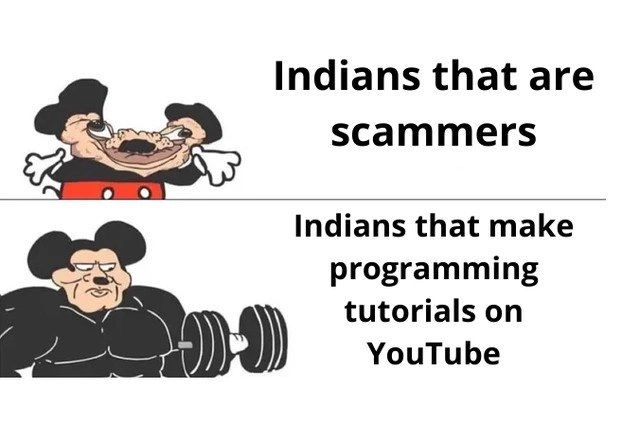
In the picture, the bad guy is drawn as a tiny, weak-looking Mickey Mouse to show he’s not someone to admire. The good guy is drawn as a huge, super-strong Mickey Mouse (like a superhero lifting heavy weights) to show he’s awesome and powerful in a nice way. The joke is saying: the trickster (the scammer) is weak and scrawny, but the teacher (the YouTube coding tutor) is the real hero, strong and mighty. It’s funny and happy because it reminds us that the ones who help others (even if they’re far away in another country) are much cooler and stronger than the ones who try to cheat people. It’s like showing a villain versus a hero, and of course the hero wins in the end!
Level 2: YouTube University
Let’s break this meme down in simpler terms. We have a two-panel image of Mickey Mouse in two very different forms, each with a caption:
- In the top panel, Mickey looks small, scruffy, and kind of weak (he has a distorted face and tiny arms). The caption next to him says “Indians that are scammers.” This is pointing to the stereotype of phone scammers from India. Think of those annoying calls where someone with a heavy accent might say, “Hello, sir. I am calling from your bank/tech support…” and try to trick you into giving away money or personal information. In real life, there have been many scam call operations based in India, so that’s why Mickey is labeled that way. He’s drawn weak because, well, we’re not exactly impressed by these scammers — they’re doing something bad and shady.
- In the bottom panel, Mickey Mouse has turned into an absolute muscled powerhouse. He’s huge and wearing a black tank top, and he’s even lifting a heavy dumbbell as if he’s at the gym. His face is pixelated (blurred out) as if he’s an anonymous hero. The caption here reads “Indians that make programming tutorials on YouTube.” This refers to the many Indian folks who create programming tutorial videos on YouTube that thousands of people watch to learn coding. This Mickey is super strong to show that these tutorial creators are awesome and “strong” in terms of knowledge and helpfulness. It’s like saying: the people teaching coding online (for free) are the real champions, doing the heavy lifting for the programming community.
So, why is this funny or interesting to developers? It’s all about the contrast:
- Scammers vs. Teachers: On one side, you have scammers – people who use technology as a tool for fraud. They often pretend to be tech support or pretend to fix your computer, but they really just want to trick you. On the other side, you have teachers – specifically, those who offer free programming tutorials on YouTube. They genuinely help others, expecting little in return except maybe a like or subscribe. The meme is comparing these two very different roles that happen to involve people from India. One is doing harm (and is shown as weak Mickey), the other is doing immense good (and is shown as ultra-strong Mickey).
- Reputation and Impact: In the developer world, Indian programming tutors on YouTube have a huge positive reputation. If you’re on your own learning-to-code journey, you’ve probably typed a question into Google or YouTube like “How to learn Python loops” or “JavaScript tutorial for beginners.” Often, the top results might be a video where an Indian instructor patiently explains the topic with examples. These videos cover everything from basic coding 101 (printing “Hello World” as your first program) to very advanced topics like building a complete web application using a full-stack framework. (A full-stack framework is a set of tools that help you build both the front-end and back-end of an app — basically the whole thing. Think of something like Node.js with Express on the backend and Angular or React on the frontend: together they’re “full-stack.”) Many developers, including beginners worldwide, rely on such tutorials because they break down complex concepts into simple, follow-along lessons. It’s like having a personal tutor, except it’s a YouTube video and it didn’t cost you a dime.
Let’s clarify some of the terms and why they’re significant:
- Programming tutorials on YouTube: These are step-by-step video lessons uploaded to YouTube that teach you programming. For example, someone might create a series on “Java for Beginners” or “Learn Data Structures in C++.” These videos are usually free to watch. A lot of them are made by individuals from India, and over time they’ve gained a reputation for being extremely helpful. It’s not that only Indians make coding videos, but there’s a noticeable trend where many popular and thorough tutorials feature Indian educators. This has become a friendly joke in the developer community — like “I didn’t understand this in class, but then YouTube University (wink) taught me better,” referring often to a video by an Indian instructor.
- Indians that are scammers: This refers to a unfortunately common type of scam. Some scam operations (for things like fake tech support, IRS scams, or fake bank calls) have been based in India. Callers from these scams often follow a script and hope you’ll fall for it. For example, they might pretend to be calling from a big company (like Microsoft or Amazon) and say there’s something wrong with your account or computer, then ask for money or remote access. It’s a known problem and has been featured in many news stories and even prank-busting videos. So in the meme, that group is represented by a weak, unimpressive Mickey — implying we look down on them.
- Mickey Mouse “weak vs. jacked” format: This is the cartoon format the meme uses. Mickey Mouse is a famous Disney character. In internet memes, people sometimes use two versions of Mickey: a rough, crudely drawn thin Mickey to represent something unimpressive or weak, and a super muscular Mickey (often with a veiny forehead, big arms lifting weights) to represent something awesome or powerful. Here, the meme creator chose that format to visually compare the two types of “Indians” in the joke. It’s a direct visual way to say “this first type is lame, but the second type is amazing!” without even needing to read the text, the pictures give you the vibe.
Now, the fun part is how this resonates with developer communities (DevCommunities). If you’ve been hanging around programmers, especially newbies or self-taught coders, you’ll notice that sharing YouTube resources is a huge part of developer culture now. Online, people often swap recommendations like “Check out this tutorial by so-and-so, he explains pointers so well,” and a lot of those shout-outs happen to be about Indian instructors. It’s become almost a wholesome running joke: “I learned more from an Uncle in India on YouTube than from my professors.” Many developers say this with genuine appreciation. So this meme taps into that cultural phenomenon. It basically says: We acknowledge the stereotype of Indian call scammers, but even more prevalent and important to us are the Indian coding teachers who have basically trained an entire generation of developers for free. The exaggeration of Mickey’s muscles is just the comic cherry on top — it’s kind of like saying “these YouTube teachers are the real giants or superheroes to us.”
In simpler terms, the meme is celebrating the good by comparing it to the bad. It’s pointing out: Hey, not all “calls from India” are bad — in fact, the ones coming through YouTube tutorials are incredibly good! That contrast makes it funny and uplifting. Developers find it hilarious because it’s true: we’ve all groaned when a scam call happens, and we’ve all smiled in relief when a YouTube tutorial finally made us understand something after hours of confusion. Seeing Mickey Mouse cartoonified as weak vs. strong just makes the message loud, clear, and comical. It’s an OnlineCommunities in-joke saying thank you to those unsung teacher heroes, while playfully dissing the scammers.
Level 3: Hello Sir vs Hello World
At the highest level, this meme highlights a dramatic contrast in the tech community using the classic Mickey Mouse weak vs jacked format. In the top panel, a scrawny, deformed Mickey with a sly grin represents “Indians that are scammers.” This refers to the notorious phone scammers often (stereotypically) associated with call centers in India – you know, the ones who cold-call people claiming “Hello sir, I’m from Microsoft support…” and try to con unsuspecting users. In the bottom panel, we see an incredibly muscular Mickey (face pixelated like an anonymous legend) labeled “Indians that make programming tutorials on YouTube.” This symbolizes the Indian YouTube coding channels and educators who have become heroes to many developers worldwide. The humor comes from juxtaposing a negative tech stereotype with a jacked positive one, effectively saying the coding mentors are far more powerful (and beneficial) than the scammers could ever be.
From a seasoned developer’s perspective, the meme lands because it’s rooted in shared experience. It’s a piece of DeveloperHumor that plays on two extreme ends of tech interactions:
- The Infamous Scam Call: Most of us have encountered or heard about those scam calls – a person with a certain accent insisting “your computer has a virus” or demanding gift cards. These scammers misuse tech jargon but typically couldn’t fix a real computer problem if their life depended on it. They give tech support a bad name.
- The YouTube Coding Guru: On the flip side, almost every developer has learned something from a free programming tutorial on YouTube, often taught by an Indian instructor. Stuck on implementing a data structure or debugging an error at 2 AM? Chances are, a quick search lands you on a video by “some Indian guy on YouTube” who patiently walks through the solution. These creators do serious heavy lifting – explaining everything from basic data structures (like linked lists and binary trees) to entire full-stack frameworks – all for free, with clarity and dedication. They’re essentially doing the work of professors, and their knowledge muscles are huge. No wonder the meme depicts them as a Mickey who can literally bench-press a dumbbell!
The caption “YouTube coding tutors flex harder” isn’t about physical strength – it’s about flexing knowledge and community impact. In developer culture, “flex” means showing off skill or prowess. Here it implies that these tutors demonstrate far more prowess (and earn far more respect) than any scammer. The muscular Mickey is flexing both a dumbbell and his coding know-how. The face blur on buff Mickey comically suggests these programming senseis are like superheroes whose true identities we protect – or simply that they’re so legendary that they’re almost anonymized icons.
This meme also speaks to the heart of DevCommunities and our global DeveloperCulture. It’s exaggeration with a core of truth: the international dev community adores those YouTube teachers. Many a junior dev will tell you they effectively got their CS education from “YouTube University” courtesy of generous coders from India. Meanwhile, scam call centers are universally despised in tech circles. The meme cleverly acknowledges a cultural stereotype (India being famous in tech both for scammer call centers and for prolific coding educators) and then subverts it by elevating the educators to hero status. It’s an inside joke with an appreciative tone – turning a potentially negative generalization upside-down to celebrate the positive. In other words, the OnlineCommunities of developers collectively nod and laugh because, yeah, that buff Mickey is basically that one YouTube tutor who taught us all about OAuth or dynamic programming for free.
To really break down the contrast, consider this side-by-side comparison of what each Mickey represents in real-world tech terms:
| Scammer Stereotype (Weak Mickey) | YouTube Tutor Hero (Jacked Mickey) |
|---|---|
| “Hello sir, I’m from Windows support…” — deceptive script to trick people | “Hello friends, welcome to this tutorial…” — warm greeting to actually help people |
| Goal: exploit naive users for money 💰 | Goal: teach naive users for free 📚 |
| Pretends to know tech, but can’t actually fix anything | Deeply knows tech, can actually solve problems live on screen |
| Uses fear and lies (fake viruses, IRS threats) | Uses patience and clarity (real code, step-by-step explanations) |
| Dreaded nuisance in the community (infamous for eroding trust) | Celebrated mentor in the community (famous for empowering newcomers) |
| Short-term gain by hurting others | Long-term gain by uplifting others (gains followers, respect, maybe the occasional Patreon support) |
| Gives the tech world a bad rep internationally 😖 | Gives the tech world a good rep globally 😃 |
Every seasoned programmer sees the irony here: one group erodes trust in technology, the other builds it up. The meme’s TechHumor works because it taps into that collective experience of frustration vs. gratitude. It’s funny and a bit sarcastic, but also kind of heartwarming – we’re essentially cheering on the real MVPs (Most Valuable Programmers) who freely share knowledge. In the grand scheme, the “Indians who make programming tutorials” have done more for the global coding community (hence the giant muscles 💪) than any scammer could undo. The meme exaggerates to make it crystal clear: the Indian YouTube coding tutor is depicted as a powerhouse, a titan carrying our learning on his shoulders, whereas the scammer is a shriveled nobody behind a fake call center desk. And as any battle-scarred dev will tell you with a grin, when you’re debugging a tricky issue, you’d much rather hear “Hello World” from a friendly tutorial than “Hello sir…” from a fraud. The former means you’re about to learn something awesome, the latter – well, time to hang up the phone.
Description
Two - panel meme on a white background using the Mickey-Mouse “weak vs. jacked” format. Top panel: a scrawny, distorted Mickey with a sly grin and tiny arms, standing behind a counter; black bold caption to the right reads “Indians that are scammers.” Bottom panel: a hugely muscular Mickey wearing a black tank top and lifting a heavy dumb-bell; the face is pixel-blurred for anonymity. The bold caption to the right says “Indians that make programming tutorials on YouTube.” The joke contrasts the stereotype of phone-scam calls with the widely appreciated Indian creators whose free YouTube tutorials teach developers everything from data structures to full-stack frameworks, highlighting community impact on the global learning ecosystem
Comments
20Comment deleted
The official docs crashed on page two; the Indian guy on YouTube had a 15-part playlist, five-nines uptime, and a side-quest on eventual consistency - all before his intro music finished
The real MVP is that one Indian YouTuber who saved your production deployment at 3 AM with a 240p tutorial recorded on an unregistered Bandicam from 2011, complete with Notepad++ and cursor highlighting every single keystroke
The meme perfectly captures a universal truth in software engineering: when you're stuck at 2 AM debugging a segmentation fault or wrestling with async/await patterns, it's almost guaranteed that an Indian developer's YouTube tutorial will be the one that finally makes it click. They've essentially become the unofficial Stack Overflow video edition, except with better explanations and a 'like and subscribe' reminder. The real strength isn't just in the tutorials themselves, but in the sheer volume and quality - covering everything from 'Hello World' to distributed systems architecture, often with production-grade insights that paid courses struggle to match
Internet taxonomy: people who phish your OTP and people who teach why “exactly once” in Kafka is really “idempotent at-least-once” - only one of them ever saved my on-call
Senior incident response: tail -f prod logs while watching a 28-minute YouTube tutorial at 2x, jump to 14:37, and ship the “temporary” fix that outlives three CTOs
Scammers exploit zero-days; these legends deploy full-stack empires in a single 10-hour vid
Хули тут все всегда в комментариях пишут на английском? Comment deleted
Украина нелегитимное государство Comment deleted
Eng: Ukraine is an illegitimate state Comment deleted
ban Comment deleted
Please speak English Comment deleted
Это тип многонациональный канал, поэтому надо на инглише p.s. либо пиши на нашем, но добавляй перевод снизу Comment deleted
Eng: its international channel, so speak in English p.s. or write in Russian, but add an English translation Comment deleted
That would be highly appreciated Comment deleted
Thanks I got it. Comment deleted
Хули Comment deleted
Eng: Hooli Comment deleted
Gun Comment deleted
No one is talking about BroCode who have high quality guide for newbies Comment deleted
Especially how to make TWRP and/or Custom ROM on various Android phones Comment deleted