Skip to content
DevMeme
3412 of 7435
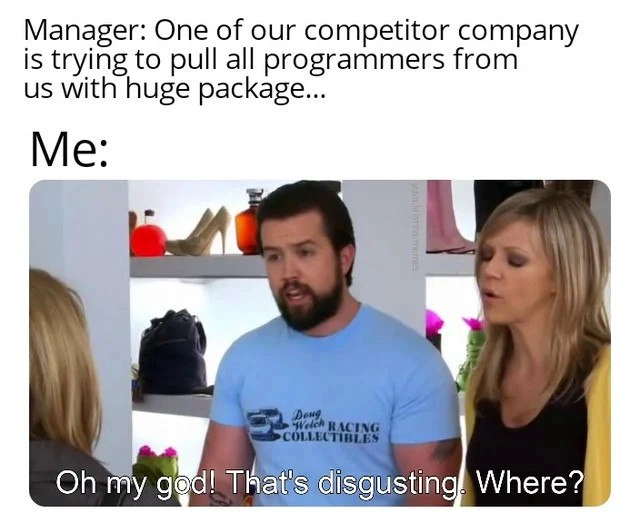
When competitors offer huge packages and devs feign disgust while asking directions
Career HR Post #3745, on Sep 25, 2021 in TG

When competitors offer huge packages and devs feign disgust while asking directions

Why is this Career HR meme funny?

Level 1: Where’s the Candy?

Imagine you and your friends are playing together, and one friend’s mom says, “I heard another kid down the street is giving away giant candy bars to get all of you to come play at his house instead.” You put on a shocked face and say, “Oh wow, that’s really awful to bribe kids with candy... So, um, where exactly is this house?” 😇 You’re basically pretending to be upset, but secretly you just really want that candy. In simple terms, it’s funny because you act like it’s “so bad” that someone is offering a big treat to lure you away, but two seconds later you’re asking for the address so you don’t miss out on the treat. It’s like saying, “I’m totally loyal to my friend… unless someone has a huge bag of candy, then I’m interested!” The meme is the grown-up, tech job version of that: the developer pretends to be disgusted that a competitor company is trying to win them over with a lot of money, but immediately shows he actually wants to know where to sign up. The joke works because we all understand that feeling – sometimes something is so good (whether it’s candy or a big reward) that even if we know we should act loyal or disapproving, we can’t help but ask, “Where can I get it?”

Level 2: Talent Tug-of-War

In this meme, the situation is basically a talent tug-of-war between companies. The top text sets up a conversation:

Manager: “One of our competitor companies is trying to pull all programmers from us with a huge package...”
Me: “Oh my god! That’s disgusting. Where?”

Let’s break down what that means. The manager is warning the team that a rival company (a competitor) is attempting to pull all our programmers away. “Pull away” in this context means hire them out from under us. In tech, that’s called poaching – when one company actively tries to recruit employees from another company. The manager mentions the competitor is doing this with a huge package. Here, package means a salary package, i.e. a very generous compensation offer. A salary_package usually includes the base salary, bonuses, stock options, and benefits like healthcare or paid vacation. So a huge package implies the rival is offering a lot more money (and perks) to lure the developers. 💰

Now, look at the developer’s response: “Oh my god! That’s disgusting. Where?” This is the punchline of the meme. The dev says “That’s disgusting” – pretending to be shocked and appalled by the competitor’s aggressive hiring practices. On the surface, he’s acting like it’s disgusting (really inappropriate or unethical) for a company to try to buy out programmers with money. This is the feigned disgust. But in the very next breath he asks, “Where?” He wants to know where this is happening, essentially asking “Which company and where can I find them?”. That tells us he’s actually interested in the offer! He’s not truly upset; he’s curious and maybe excited. The humor comes from this quick about-face: he’s acting loyal and offended, but obviously the idea of a huge raise is so attractive that he can’t help but ask for details. It’s like saying, “I’m horrified... and I’d like to know how I can get in on it, please.” 😅

This speaks to real-life CareerHumor in the tech world. Companies often worry about employee_turnover, which means employees leaving the company. Losing a bunch of programmers to a competitor is a manager’s nightmare because hiring new people is hard and projects can fall behind. So managers focus a lot on developer_retention – keeping their team happy enough to stay. They might try to create a good CorporateCulture (fun offices, team events, interesting projects) or offer some raises and promotions to make people stay. Despite that, when there’s a talent_war going on, another company might swoop in with a much higher offer. In tech, there’s high demand for skilled developers, so competitors often offer big salaries, sign-on bonuses, or other goodies to attract talent. That’s what’s happening in this meme: a rival company is basically saying “We’ll pay you a lot more, come join us.”

For a newer developer (or anyone new to this work world), here are some key terms in simpler words:

  • Poaching: This is like when a basketball team tries to recruit star players from another team. In the workplace, poaching means hiring someone away from their current employer. It’s not literally stealing a person, because everyone is free to change jobs, but the original company sure feels like something was stolen when their employee leaves for a competitor.
  • Huge package: A casual way to say “a really high compensation offer.” Think of not just a bigger salary, but maybe a sign-on bonus, stock in the company, free meals, and whatever else. A package is the whole deal you get for a job. A huge package = an offer so good you’d seriously consider switching jobs for it.
  • Developer retention: “Retention” means keeping people on your team. Developer_retention is all about how to make sure developers don’t quit. Companies might use tactics like giving raises, better work-life balance, or cool projects to keep their programmers from leaving.
  • Counter offer: If your company finds out you got an offer elsewhere, they might respond with a counter_offer, which means they’ll offer you something (like more money or a promotion) to convince you to stay instead of taking the new job. It’s literally an offer that counters the other one.
  • Talent war: This is a dramatic way of saying lots of companies are competing to hire the same skilled people. In a talent_war, companies might keep increasing salaries and benefits to outbid each other for top talent. It’s like an arms race, but with job offers. The result can be huge salary packages for developers who are in demand.
  • Job hopping: This is when someone changes jobs frequently (every year or two) instead of staying at one company for a long time. In tech, job_hopping is pretty common because moving to a new job can lead to a big jump in salary or a better role more quickly than waiting for a promotion. Some managers don’t like it, but many developers do it to advance their careers faster or escape a dull job.
  • Misaligned expectations: This phrase means two sides expect totally different things. In the meme, the manager expects loyalty and maybe a bit of outrage at the competitor’s behavior. The developer, on the other hand, expects to look out for his own best interest (higher pay). Their expectations are misaligned – not matching up. That’s why the conversation turns funny, because the manager’s subtext and the dev’s subtext are worlds apart.

This meme is making light of a CorporateCulture truth: employees often won’t say openly “I want more money,” so they play along like they care about the company’s feelings — even though, quietly, they might leave if a better deal comes along. In tech especially, people joke about getting LinkedIn messages from recruiters or hearing about friends getting giant offers. It’s common DeveloperHumor to swap stories like, “My friend got offered 2x his salary to join a competitor, and I was like ‘Wow, shocking... which company was it?’” The reason we laugh is because it’s relatable. We all understand that little glint in the eye when someone mentions a big job offer.

So, for junior devs or anyone new: the meme is funny because the developer in the joke is pretending to be a loyal, dutiful employee (saying the competitor’s act is “disgusting”) while immediately betraying his true interest (eagerly asking “Where?” to find out more about this high-paying opportunity). It’s poking fun at the polite facade versus the honest reality. In real workplaces, you might not directly ask “where?” out loud to your boss, but you can bet people start Googling that competitor as soon as the meeting ends! This is a lighthearted take on how HiringPractices and personal ambition clash in a comedic way.

Level 3: Everybody Has a Price

At a senior level, this meme hits on the talent war reality of tech. The boss announces a competitor is offering developers a huge package – an over-the-top salary and benefits deal – to poach the whole programming team. Officially, everyone is supposed to react with loyalty and moral outrage: “How dare they try to steal our people?!” The humor is that the developer’s response is a two-faced quip: “Oh my god! That’s disgusting. Where?”. In one breath, he condemns the competitor’s tactics as “disgusting,” and in the next, he’s practically asking for the competitor’s address. This punchline perfectly captures the cynical truth that even the most loyal team member can be swayed when the price is right. It’s an exaggerated, tongue-in-cheek admission that everyone has a price in the software industry’s salary saga.

Why is this funny to an experienced dev? Because we’ve all seen this scenario play out in real life. Companies talk a big game about loyalty and CorporateCulture, but when a rival comes in waving a fat check (or a stock option windfall), suddenly those speeches about “we’re a family” start to ring hollow. The manager here frames the competitor’s recruiting as an almost villainous act (“pulling all programmers from us”), expecting the team to share his indignation. But the developers in the trenches know the score: if a competitor is offering a salary_package too good to refuse, you’d be crazy not to at least hear them out. The meme’s sitcom screenshot nails that moment when your MisalignedExpectations collide – the company expects you to be disgusted, but you’re mostly disgusted that you haven’t gotten that offer yet.

This scenario is a core piece of CareerHumor and CorporateHumor in tech. It satirizes the unspoken understanding that companies will do what’s best for them (hire top talent from wherever) and engineers will do what’s best for them (go where they’re valued, job_hopping if necessary). The line “That’s disgusting. Where?” is said with the same energy as a developer feigning shock in a meeting while secretly opening LinkedIn in another browser tab. It’s a coping mechanism and a joke – you act like “Oh how awful!” even as you angle to get in on the action. Seasoned developers find it hilarious because it’s too real: we’ve watched colleagues who one day insist “I’d never leave this team” and the next week are gone, seduced by a competitor’s lucrative competitor_offer. In a hot market, a talent_war means the counter_offer dance becomes common: one company’s “disgusting” move is another engineer’s big break. The meme pokes fun at this delicate dance of developer_retention – where managers cling to hope that team spirit will prevail over cash, and developers politely pretend that’s true until a better deal comes along.

Let’s be honest, veterans know that tech industry “loyalty” often lasts only until the next quarter’s big hiring wave. There’s even history here: back in the late 2000s, some Silicon Valley giants secretly agreed not to poach each other’s engineers, precisely because throwing huge packages around was causing a salary arms race. That turned into a scandal (and a lawsuit) because, well, free market aside, companies really hate it when their top talent walks for more money. But can you blame the programmers? As the saying goes, loyalty isn’t a valid currency at the grocery store. The employee_turnover in tech can be notoriously high, and this meme wryly captures why: if a competitor offers to double your pay or give you a life-changing role, suddenly those midnight deployments and pizza-fueled crunch sessions at your current job feel a lot less compelling. The comedic genius is that the developer outwardly calls the offer “vile” while practically asking for directions to the new gig. It’s gallows humor for coders: we’d like to stay loyal, but did you see the size of that paycheck? 🤷

In summary, the meme zeroes in on an inside joke about HiringPractices and human nature in tech. The manager’s warning is meant to instill fear or loyalty, but instead it lights up the dev’s eyes like a kid hearing the ice cream truck. It’s a classic example of MisalignedExpectations between management and engineers. Senior folks laugh at this because they’ve lived through the awkward team meeting where a boss insists “we can’t be bought,” while half the room is already calculating their stock vest or updating their résumé. The humor isn’t just in the contradiction; it’s in the shared knowledge that, however “disgusting” it may be to chase the money, the question on everyone’s mind is still: Where?.

Manager: “One of our competitors is trying to pull all programmers from us with a huge package...”
Me (instantly): “Oh my god! That’s disgusting. Where?”

The manager’s words and the developer’s thought process might as well be in different languages. Here’s a cheeky side-by-side for clarity:

Manager Says What the Dev Hears
“They’re trying to steal our programmers.” “They want to hire me (for a lot more $$).”
“It’s a disgusting tactic by them.” “It’s a tempting offer for me.”
“We need you to stay loyal to us.” “Will loyalty pay my rent or should I hear them out?”

The table above shows the comical translation: the boss emphasizes stealing and loyalty in moral terms, while the developer mentally reframes it as opportunity and self-interest. That contrast is exactly why the meme gets knowing chuckles from experienced developers. We all recognize that faux-innocent “Where?” as the not-so-subtle hint that we’re definitely writing down directions to that competitor’s office – you know, just to “stay informed.” 😉

Description

White-background meme with two parts. Top text in black reads: "Manager: One of our competitor company is trying to pull all programmers from us with huge package..." followed by a line break and bold "Me:". Below, a cropped sitcom screenshot shows three people in a boutique; their faces are blurred for anonymity. The man in the center, wearing a light-blue T-shirt that says "Long Beach RACING COLLECTIBLES," looks intrigued while a blonde woman stands beside him. Large white subtitle at the bottom states, "Oh my god! That's disgusting. Where?" The humor plays on developers pretending to be appalled yet eagerly wanting the location of the generous salary package, a familiar scenario of talent poaching and retention battles in tech companies
Comments

6
Anonymous ★ Top Pick Manager: The competitor’s dangling 2× salary to poach our devs. Me: “Morally outrageous… also, do they support blue-green resignations or is it a big-bang two-weeks cutover?”
  1. Anonymous ★ Top Pick

    Manager: The competitor’s dangling 2× salary to poach our devs. Me: “Morally outrageous… also, do they support blue-green resignations or is it a big-bang two-weeks cutover?”

  2. Anonymous

    The best retention strategy isn't a ping pong table or free snacks - it's realizing your senior engineers have already automated their LinkedIn response to recruiters with 'Current TC + 40% and we can talk.'

  3. Anonymous

    The classic developer response to hearing about competitor offers: expressing moral outrage while simultaneously opening LinkedIn in an incognito tab. It's the tech industry's version of 'I would never leave... but hypothetically, what's the TC breakdown, equity vesting schedule, and do they have unlimited PTO?' Every senior engineer knows the dance - you're not actively looking, but you're definitely passively listening, especially when 'huge package' could mean finally affording that San Francisco studio apartment or paying off those student loans from your CS degree that the bootcamp grads somehow avoided

  4. Anonymous

    Competitor wants to “git pull” us with a huge package; I’ll switch remotes for equity, not for an 800MB npm tarball with 1k transitive deps and a surprise crypto miner

  5. Anonymous

    If comp is a package, ours is a transitive dependency pinned to 2019 with known CVEs; theirs is a signed zero‑cliff LTS build - of course the branch will fast‑forward

  6. Anonymous

    PMs hype the rival's 'huge package' as innovation; we know it's just another gigabyte node_modules disaster waiting to vendor-lock your build

Use J and K for navigation