LaTeX: the ‘compile target’ every dev secretly customizes to prank newcomers
Why is this Languages meme funny?
Level 1: Hidden Shortcut Surprise
Imagine you’re trying to build a super complicated LEGO castle without any instructions. You dump all the pieces out and start guessing how to put them together. It takes forever and it’s really confusing! Now, suppose all the other kids around you do have an instruction booklet for their castles, but they didn’t tell you. They watch you struggle a bit, not to be mean exactly, but they kinda find it funny because they’ve all been through that struggle too. After a while, one friend finally shows you the hidden booklet and goes, “Oh! You mean you didn’t use this? We thought you knew!” You’d probably feel a mix of relief that there’s an easier way and a bit of “Hey, why didn’t you share that?!”
In this story, building the castle is like learning LaTeX the hard way. The secret instruction booklet represents all those shortcuts and tools that experienced folks have. At first, you do things the long, hard way because you didn’t know there was any other option. When you finally find out everyone else had a simpler method all along, it’s a surprise! You might feel a little tricked (like they played a prank by keeping it secret), but you also can’t help but laugh at how overly hard you were working. The humor comes from that feeling of “Whoa, I was doing this the toughest way possible and nobody told me!” It’s a friendly kind of joke that anyone who’s learned something the hard way can understand.
Level 2: Typesetting Trickery
LaTeX (pronounced “lah-tek”) is a special computer language used for creating nicely formatted documents. It’s different from a typical programming language (like Python or JavaScript) – instead of writing instructions for a program, you write text mixed with formatting commands. For example, if you want a section heading, you write \section{Results} and if you want bold text, you write \textbf{important}. You then run a LaTeX compiler program, which reads your .tex file and compiles it into a finished document (often a PDF). In simple terms, LaTeX is a tool where you describe what you want on the page (text, headings, figures, citations) with code-like markup, and the computer handles how to lay it out nicely. It was a game-changer for things like math and science papers because it can render equations and handle references way better than a normal word processor.
Now, when the tweet says LaTeX is actually a “compile target”, think of it like this: Usually, we write something in a source language and compile it down to a target. For instance, a developer might write code in TypeScript, but that code isn’t run directly; it gets compiled into JavaScript (the target) which then actually runs. Here, the joke is that programmers aren’t writing LaTeX as their source language – they’re using something else and producing LaTeX as the output. In other words, LaTeX is treated like a low-level format that all their tools eventually produce, rather than something they craft by hand. So a veteran might actually write their content in Markdown or a word processor or some custom script, and with a bit of toolchain magic, that ends up generating a .tex file (which then gets compiled to PDF). The newbie, not knowing this, goes directly into writing LaTeX from scratch. That’s like a beginner seeing the JavaScript and thinking they need to write that, not realizing others were coding in a friendlier language and auto-converting it. No one told them about the converter, so they assumed JavaScript (or LaTeX in our analogy) was what everybody writes by hand.
The “personal system” part means each experienced person has their own way of doing this. There isn’t one universal easy tool – over time, every developer or researcher kind of cobbles together what works for them. One person might swear by writing in Org-mode in Emacs and exporting to LaTeX, another might use an R Markdown notebook that generates LaTeX for reports, and someone else might have a folder full of custom .sty files (LaTeX packages) that they include to handle formatting. These are like personal shortcuts or secret recipes that outsiders wouldn’t know immediately.
So, calling LaTeX a prank on newcomers is a humorous exaggeration. It’s saying “hey, maybe we’ve all been a bit bad about sharing our shortcuts, so from a newbie’s point of view it’s like we played a joke on them – we let them struggle with raw LaTeX while we quietly used easier methods.” In reality, it’s not usually on purpose or mean-spirited. It’s just that the knowledge of better ways is passed informally, often only after someone has felt the pain for a while. A newcomer often goes through a period of DeveloperFrustration, thinking “wow, this is so hard, how do people live like this?” and then they discover the tips & tricks and go “ohhh, I get it now!” The meme finds humor in that aha moment – turning the pain into something we can laugh about.
This humor falls into the category of Documentation and Tooling jokes. LaTeX is squarely a documentation tool (used for writing reports, theses, manuals), and the frustration is a tooling issue – figuring out how to use this complex tool efficiently. In developer communities, especially online ones like Twitter or forums, it’s common to vent and joke about these kinds of struggles. You’ll see tags like DeveloperHumor or posts on Reddit’s programming humor threads about the agony and irony of dealing with such tools. The “language wars” angle is also present: developers love to playfully argue about which programming languages are good or bad. By throwing LaTeX (a typesetting language) into that arena and ranking it among the “worst,” the meme exaggerates just how unfriendly LaTeX can feel. It’s not literally a war, just a shared tongue-in-cheek gripe.
In summary, the misconception being joked about is: Beginners think LaTeX is something everyone writes directly, but in truth, experienced users treat it as an output format. When you’re new, nobody hands you the memo that “Hey, you could use X tool or Y template to save yourself a ton of trouble.” Eventually you figure it out, but during those initial struggles, it really can feel like everyone else knew a shortcut except you. The tweet resonates because it captures that collective experience in one punchy, sarcastic line. It’s the dev community’s way of saying “we’ve all been there” – and now we can all laugh about it.
Level 3: Custom Compile Conspiracy
In the wild world of developer inside jokes, this meme captures a scenario many of us know too well. It suggests that LaTeX isn’t really something you write directly – instead, all the experienced folks have secretly built their own toolchains that spit out LaTeX for them. And then they collectively decided not to tell the newbies, just to watch them squirm. 😈 Of course, that’s an exaggeration (no real secret society is plotting to prank you), but it feels spot-on when you’re the newcomer sinking hours into debugging a document that an older hand could’ve fixed in minutes with a hidden script or template.
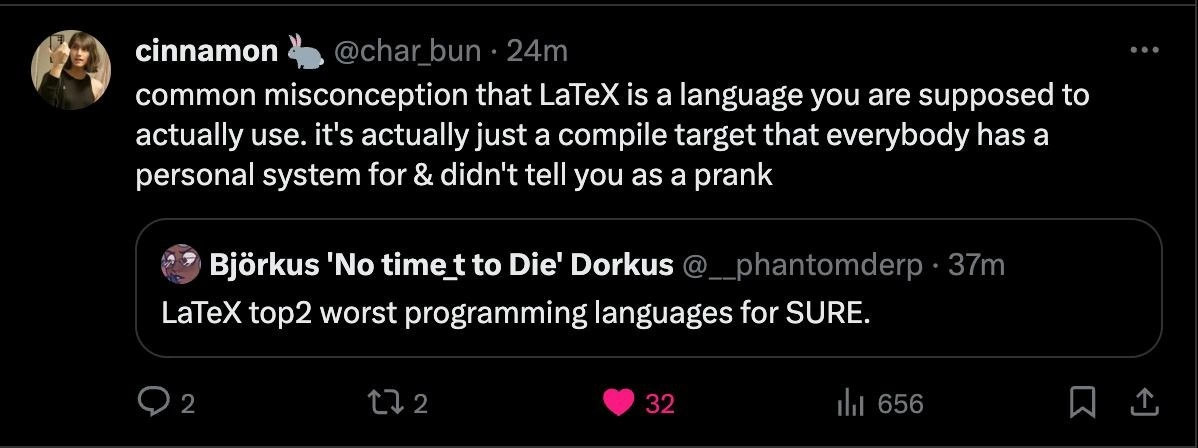
For context, the meme comes from a Twitter thread where one user quips:
“common misconception that LaTeX is a language you are supposed to actually use. it’s actually just a compile target that everybody has a personal system for & didn’t tell you as a prank.”
Reading that, veteran developers and academics everywhere smirked in agreement. The tweet nails the absurd truthiness of how LaTeX is treated in practice. The reply in the screenshot adds, “LaTeX top2 worst programming languages for SURE,” poking fun at just how painful writing in LaTeX can be, to the point of ranking it among the worst experiences a coder can have. This taps into DeveloperHumor and those perennial LanguageWars where people rant about their most hated languages or tools. By elevating LaTeX (a document preparation system) to the status of a “programming language,” the meme emphasizes that using LaTeX can feel like programming – complete with cryptic errors and headache-inducing syntax – and not the fun kind of programming either.
So why do we find this funny (and painfully relatable)? Because it’s lampooning a real dynamic: experienced LaTeX users rarely do things 100% manually, whereas beginners think they’re supposed to. A newcomer might spend a whole day wrestling with why their figure won’t center on the page, painstakingly tweaking LaTeX commands. Meanwhile, their mentor or senior colleague long ago wrote a macro or found a package to handle figure placement automatically. But unless someone shares that knowledge, the newbie toils away, reinventing the wheel. When they eventually discover that a personal script or a ready-made template could have saved them, it genuinely feels like everyone else knew a secret cheat code and intentionally kept them in the dark. That “Did you all just prank me?!” feeling is equal parts frustrating and comical in hindsight.
This dynamic often isn’t due to malice; it’s usually inertia and the siloed nature of tooling. In many DevCommunities (open-source projects, research labs, etc.), people set up their own LaTeX workflows. They might use a combination of Makefiles, continuous integration, and custom class files to generate beautiful docs. It works so well for them that they forget it’s not obvious to newcomers. The next person joins the team, and unless there’s great onboarding, they start from scratch with raw pdflatex commands and vanilla LaTeX. It’s almost a rite of passage. Only after struggling do they stumble on that hidden company_report_template.tex or someone casually mentions, “Oh, you could have just used pandoc to convert your Markdown to LaTeX.” Facepalm. In retrospect, it feels like all the seniors were sitting around watching the newbie fight with an overfull hbox (a classic LaTeX overrun error) and silently chuckling.
To highlight the contrast, consider the different approaches:
| Newcomer (hand-coding LaTeX) | Veteran (automating LaTeX) |
|---|---|
Starts a document by typing every LaTeX command from scratch (e.g. writing \begin{document} and formatting commands manually). |
Uses a pre-existing template or tool so they begin with a framework (one click and the whole document structure is there). |
| Manually adds every section, citation, and format tweak by trial and error. | Relies on personal macros or a style file: e.g. one custom command \NewSection{...} might handle a bunch of formatting under the hood. |
Struggles with cryptic compiler errors like ! Misplaced \cr or ! Undefined control sequence and Googles furiously. |
Probably encountered those errors years ago and has since armored their workflow to avoid them (or knows exactly which package update caused it when it happens). |
| Thinks LaTeX is what “real pros” directly write, so feels compelled to tough it out in pure LaTeX source. | Thinks LaTeX is the output. They write in something easier (like Markdown) or higher-level, hit a script, and get LaTeX generated as an intermediate step to PDF. |
| Feels baffled and a tad betrayed on discovering colleagues had automation (like an internal tool or a set of commands) all along. 🤦♂️ | Remembers feeling the same way years ago. Might give a wry smile and say, “Yeah, we probably should have told you about that earlier... my bad.” |
The table above isn’t an exaggeration – many of us have been that newbie on the left, then eventually migrated to the right side as we got wiser (or lazier?). The “prank” isn’t an actual prank, but the emotional effect is similar: you feel like the last to know a big secret. It’s a form of communal hazing that just happens in tech. Senior devs often assume “oh, everyone knows about using X tool to make this easier,” while the junior is silently slogging through the mud. Then comes the light-bulb moment when the junior discovers the shortcut, and after the initial are-you-kidding-me reaction, they often laugh and think, “I wish someone told me sooner, but ha, I guess I leveled up the hard way!”
Importantly, LaTeX is a special case because it’s ubiquitous in certain circles (academia, scientific publishing, and developer documentation) yet notoriously old-school. Entire forums (like TeX StackExchange) are dedicated to helping people out of the weeds. Over the years, a kind of folklore developed: “nobody writes raw LaTeX if they value their sanity.” Instead, you copy a predecessor’s project, use a GUI front-end like Overleaf, or script the boring parts away. The meme humorously frames that accumulated wisdom as one big inside joke—“Oh, you actually wrote LaTeX? We were all just generating it! Gotcha!” It’s cathartic humor for those of us who wished we knew on day one what we know now. And for the record, calling LaTeX a “top 2 worst” language is hyperbole born from love-hate. We gripe about it (boy, do we ever) because we also rely on it—kind of like complaining about an old, clunky car that nonetheless is the only vehicle that gets us to a particular destination. We’ve all got some LaTeX battle scars, and laughing about them together makes the pain a little more bearable.
Level 4: Turing-Complete Typesetting
LaTeX runs on top of TeX, a typesetting engine Donald Knuth created back in the late 1970s. Under the hood, TeX isn’t just some simple text formatter – it’s essentially a quirky macro processor powerful enough to be Turing-complete. In plain terms, that means you could, in theory, write any computation or algorithm using TeX commands and macros (people have even done mind-bending demos like implementing games or a Turing machine in pure TeX). This makes LaTeX a bit of a Turing tar pit: a place where everything is possible, but doing even simple things can feel ridiculously complex. It’s as if a document formatting tool accidentally got the brain of a programming language genius, and now we’re all stuck dealing with that complexity for even basic tasks like making a table of contents.
From a language design perspective, LaTeX is more like a domain-specific language or even an assembly language for documents rather than a conventional high-level programming language. When the meme jokes that LaTeX is a “compile target,” it’s hinting at a compiler analogy: in software, a high-level language (like C or Rust) gets compiled down to a low-level target (like machine code or WebAssembly). Here, LaTeX is being compared to that low-level target. Seasoned users often generate LaTeX from something more user-friendly, just like a compiler generates assembly. For example, someone might write in Markdown or Org-mode or use a documentation tool, and that tool spits out .tex files. Those .tex files are then fed into the TeX engine to produce the final PDF output. In this workflow, LaTeX itself is never lovingly hand-crafted; it’s the intermediate grunt work – akin to how no one hand-writes raw bytecode when they can write in a higher-level syntax.
Historically, this came about because TeX (the engine behind LaTeX) was intentionally frozen in development by Knuth (he famously declared it essentially “done” except for bug fixes, so it sits at version 3.14159... and changes only in extremely tiny ways). With the core unchanging, innovation shifted to macros and packages built on top of TeX. Leslie Lamport’s LaTeX (from the 1980s) is itself a large collection of TeX macros meant to simplify document creation. But even LaTeX’s macros weren’t one-size-fits-all. Over decades, communities and individuals wrote countless .sty packages and custom macro sets for their needs. As a result, every veteran ended up with their own mini language on top of the base LaTeX. In compiler terms, each person designed a different front-end that ultimately targets the same back-end (TeX). The meme exaggerates this as “everyone has a personal system and they didn’t tell you,” which is funny because it’s almost true – everyone’s LaTeX setup is unique and often opaque to others. It’s like each developer built a secret layer over an old machine that only they fully understand. No wonder a newcomer walking up to LaTeX feels like they’re being hazed by the entire programming world! The fundamental complexity and flexibility of TeX’s design practically invites users to hide their clever tricks under the hood, inadvertently leaving newbies to grapple with raw LaTeX as if it were some arcane machine code.
Description
Dark-mode screenshot of a Twitter/X thread. The main tweet from “cinnamon 🐇 @char_bun • 24m” says: “common misconception that LaTeX is a language you are supposed to actually use. it's actually just a compile target that everybody has a personal system for & didn't tell you as a prank”. Quoted beneath it is “Björkus 'No time_t to Die' Dorkus @__phantomderp • 37m” stating: “LaTeX top2 worst programming languages for SURE.” Reaction bar shows 2 replies, 2 retweets, 32 likes, 656 views, plus share icon, all on a black background UI. Visually minimal, the humor hinges on the irony that every engineer treats LaTeX as a private, bespoke build chain rather than a real language, echoing long-standing tooling pain familiar to veteran devs maintaining documentation pipelines

Comments
12Comment deleted
LaTeX isn’t a language - it’s Schrödinger’s build system: both legacy markup and the sprint-long onboarding trap your junior still can’t compile
The real LaTeX conspiracy is that we all maintain elaborate build pipelines with makefiles, custom scripts, and Docker containers just to avoid admitting we'd rather write Markdown but our advisors insist on 'proper' formatting - meanwhile, the LaTeX maintainers are laughing at us from their perfectly configured Emacs setup that hasn't changed since 1994
LaTeX is the perfect example of Conway's Law in reverse: instead of the system reflecting the organization's structure, every organization independently evolved the exact same Rube Goldberg machine of Makefiles, custom scripts, and CI/CD pipelines to avoid actually writing LaTeX directly - and we all collectively agreed never to document it, ensuring each new PhD student experiences the same archaeological expedition through Stack Overflow answers from 2009
LaTeX: top 2 programming languages because it's #1 for power and #2 for 'why does this even compile?' - every preamble a legacy monolith
LaTeX is the only “language” where onboarding is a Makefile that runs pdflatex → bibtex → pdflatex → pdflatex, and the senior engineer’s crown jewel is a 20‑year macro named \FIXTHIS no one dares expand
LaTeX is basically an ABI for everyone’s private thesis.cls; the only CI check is ‘compiles on my TeX Live 2019’
How else would we comply with all the academia requirements for papers? 🌚 Comment deleted
My diploma would never survive the refinements without LaTeX. But with it it was even re-used by 3 more people easily - just changing some constants at the document settings and that's it All hail the king LaTeX! Comment deleted
Those "constants" are called "document properties" in WYSIWYG word processors, and can also be changed on-the-fly without editing the entire document text. Comment deleted
Now change the positioning, sizes, caption font, caption positioning, and clipping of every single image in a 120+ page doc with WYSIWYG editor :) While those are literally 3 constants in LaTeX (if you set it up correctly and have not overrided those settings manually throughout the doc) Nevertheless, each way has it's own benefits and disadvantages, but IMO LaTeX is a great thing for science documents with a lot of standards* *depends on if your university/laboratory/company has standards or not and how hard they are being checked Comment deleted
Have you ever heard of styles in WYSIWYG word processors? Comment deleted
Your effort should be boilerplated and published on schools git repo :) Comment deleted