Slaps roof of Redis: unlimited capacity for questionable architecture choices
Why is this DesignPatterns Architecture meme funny?
Level 1: All Eggs in One Basket
Imagine you have one big box where you put everything: your toys, clothes, books, phone, snacks – all in the same box because it's easy to toss stuff in there. At first, it seems great: one place holds all your stuff. But pretty soon the box is a huge mess, and if that box breaks or gets lost, you lose everything at once. It's the old "don't put all your eggs in one basket" idea.
This meme is joking about a similar situation with technology. Redis is like that big convenient box. Some people try to use it to hold all the different parts of their app (settings, messages, user data, you name it). In the picture, a salesman is patting the Redis "car" and bragging that you can fit so many bad ideas in it. It's funny because he's treating a flaw (stuffing everything in one place) as a selling point. We laugh because we know if you rely on one thing for too much, it’s just asking for trouble – just like cramming your whole life into one box and expecting nothing to go wrong.
Level 2: Just Use Redis
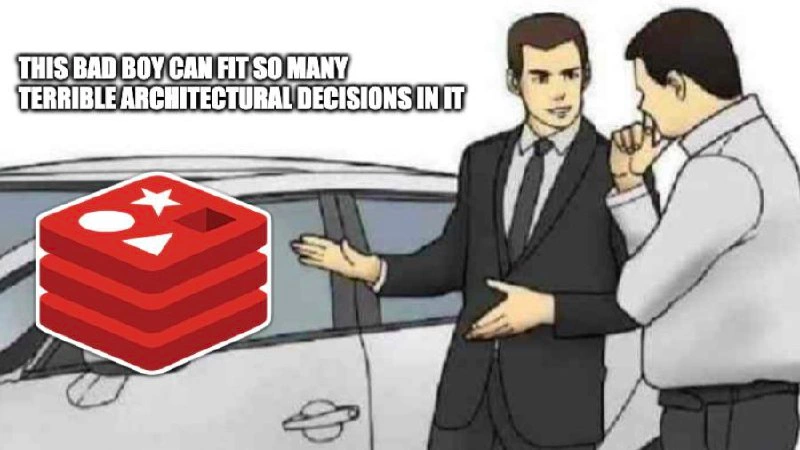
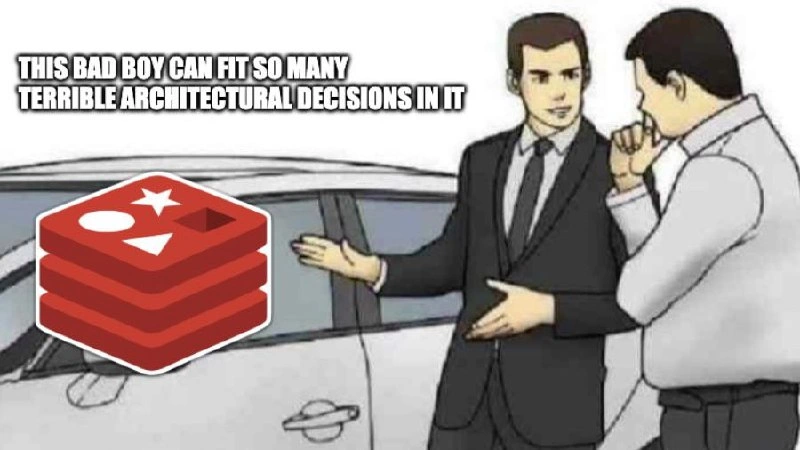
This image uses the popular "car salesman slaps roof" meme. Here, the product being sold is not a car, but Redis (that red stack logo). The caption jokes that Redis can fit "so many terrible architectural decisions." In simpler terms, it means developers sometimes use Redis for everything, even when they probably shouldn't.
First, what's Redis? Redis is an open-source, in-memory database known for being extremely fast. It's often used as a cache – which is like a short-term memory for your app. Instead of repeatedly asking a slower database for the same info, the app can stash it in Redis and grab it quickly. Think of Redis as a big key-value map that lives entirely in RAM. It's super speedy but, unless configured to save to disk, it forgets everything if it restarts (kind of like a chalkboard that wipes clean).
Now, what are those "terrible architectural decisions" the meme mentions? Basically, it's when teams start relying on Redis for tasks it wasn't originally designed to do. For example:
- Storing sessions: Web applications often keep track of who's logged in using sessions. Some teams store session data in Redis so all servers can quickly check it. It's actually a common use of Redis. But if that Redis is ever cleared or goes down, every user might get logged out at once – not fun.
- Job queue: Imagine you have tasks or messages that need to be processed (email sending, task scheduling). There are specialized tools for this (like RabbitMQ or Kafka), but some projects just use Redis lists or its pub/sub feature as a makeshift message queue. It works... until Redis crashes or can’t handle the load, and then those queued jobs vanish because Redis doesn't permanently log them like a real queue would.
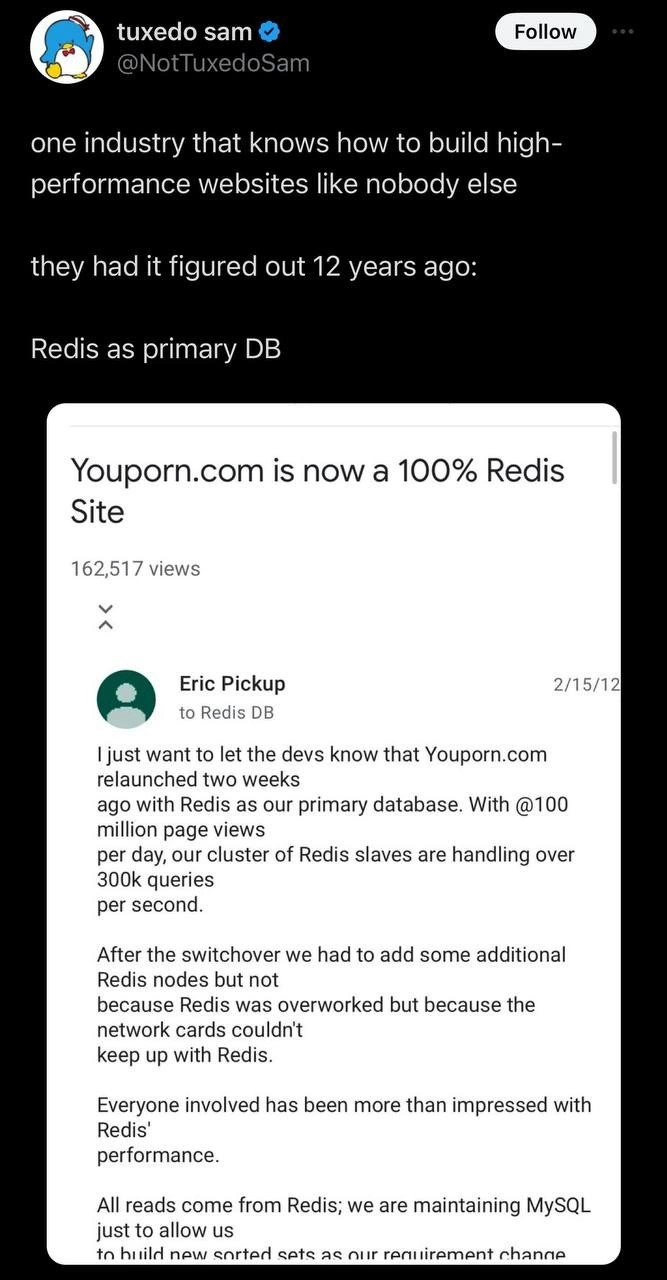
- Main database: In some wild cases, teams use Redis as the primary datastore for all their data. They treat the in-memory store as if it were a normal persistent database. This is risky because by default Redis keeps data in RAM and periodically writes snapshots to disk. If it's not carefully set up (with AOF persistence, for instance), a crash could lose recent writes. Also, Redis isn't built for complex querying or large relational data sets, so using it this way can turn into a maintenance nightmare as your data grows.
- Configuration storage: Some applications need to share configuration values or feature flags across different services. Instead of building a proper config service or using files, teams might stick those settings in Redis. It's quick to implement and everyone can read the config from the same place. But if those keys expire or someone accidentally deletes them, parts of the app suddenly don't know their settings and weird errors start popping up.
At first glance, each of these ideas might seem clever or convenient – after all, Redis is already there and is very easy to work with. This is why you'll hear the phrase "Just use Redis" in some teams when any new problem comes up. It's like the Swiss Army knife that they pull out for every job. Technical debt is the catch: by using one quick solution for everything, you're piling up potential problems for later. Technical debt means you saved time or effort now, but you'll pay for it in future headaches. All these different responsibilities (sessions, messaging, main data, config) end up resting on one single tool. That creates a fragile system. If Redis has an issue, it's not a small inconvenience – it's a big outage, because so many parts of the application depend on it.
Developers find this meme funny because it's a tongue-in-cheek warning. The salesman in the picture is boasting about something that is actually a bad practice. It's like he's saying, "Look how much stuff we can cram into this one tool!" Experienced folks are laughing because they know that feeling: it works great until the day it spectacularly doesn’t. In short, the meme humorously highlights over-engineering (or really mis-engineering) by using Redis as an "everything store". Just because you can put all those things in Redis doesn’t mean it’s a good idea in the long run.
Level 3: One Size Fits None
"THIS BAD BOY CAN FIT SO MANY TERRIBLE ARCHITECTURAL DECISIONS IN IT"
This meme repurposes the classic "car salesman slaps roof" format, with a twist: the "car" is the Redis logo. The joke is that Redis – an in-memory data store – is being sold as a miracle car that can carry an absurd load of bad architecture choices. Seasoned engineers recognize this immediately: it's poking fun at how teams often shoehorn every function into Redis just because it's fast and convenient.
In real projects, Redis tends to become the tech equivalent of a spare closet where people stuff everything:
- Session storage – Need to share user sessions across servers? Just toss it in Redis. Never mind that if you wipe the cache, all users get logged out.
- Message queue – Don’t have a proper message broker? Use Redis lists or pub/sub to shuttle events around. What could go wrong (besides lost messages when a node restarts)?
- Primary database – Why bother with PostgreSQL or MongoDB when you can keep all app data in memory? Sure, it's blazing fast until an outage wipes out your single source of truth.
- Configuration store – Share feature flags or app settings by storing them in Redis keys. Convenient, until some script calls
FLUSHALLand nukes your config in one shot.
Each bullet is a real-world "terrible decision" people have crammed into Redis. The humor lands because we've seen it: one tiny cache grows into an in-memory monolith holding sessions, queues, configs, and more. This violates basic separation of concerns. Instead of independent components, everything becomes tightly coupled through one Redis instance. It's the ultimate single point of failure. One crash or misguided flush command and poof – your entire system’s state, across multiple domains, vanishes or corrupts simultaneously.
Why does this happen? Often due to architectural trade-offs made under pressure. Redis is ridiculously easy to use – a few lines of code and you've got shared state between services. It's the path of least resistance. Need a quick fix for inter-service communication? "Just use Redis, it’s already in our stack." Over time, these ad-hoc add-ons pile up inside Redis. The result is an in-memory footgun: a tool so handy and powerful that it's easy to shoot yourself in the foot with it. Everything works great during development and even initial production... until that fateful 3 AM incident. (The veteran engineers reading this have that thousand-yard stare – they remember being paged because the cache that held everything fell over.)
The meme nails the absurdity: a salesman bragging about a car's capacity is normal – but bragging that your data cache can hold unlimited bad decisions is darkly comedic. It’s a head-shake and a chuckle from anyone who’s debugged a tangled Redis-centric outage. Yes, this "bad boy" can fit all your design anti-patterns in it, and that's exactly the problem.
Description
The image uses the classic 'car-salesman slaps roof' meme template. Two faceless characters stand beside a white sedan; the suited salesperson is gesturing expansively toward the door while a large Redis logo (red stack with a star and disk icon) is super-imposed over the car. Bold white uppercase caption text at the top reads: "THIS BAD BOY CAN FIT SO MANY TERRIBLE ARCHITECTURAL DECISIONS IN IT". Visually, the logo replaces the car itself, implying Redis is being 'sold' as an all-purpose solution. For seasoned engineers, the gag pokes fun at teams that cram session storage, message queues, primary data, and configuration into Redis simply because it's fast and easy, accumulating hidden coupling and technical debt
Comments
18Comment deleted
Sure, you can persist user sessions, feature flags, cron schedules, and the CFO’s horoscope in Redis - just remember to budget extra for the inevitable post-mortem when FLUSHALL wasn’t the feature you thought it was
After 15 years in the industry, I've seen Redis evolve from 'that fast cache' to 'our entire microservices communication layer, job queue, session store, and oh yeah, it's also our primary database because who needs ACID when you have speed?' - and the best part is watching junior devs discover Redis persistence is optional after their first production data loss
Redis: because why architect a proper solution when you can just throw everything into an in-memory key-value store and call it 'distributed caching'? It's the Swiss Army chainsaw of backend engineering - technically capable of solving your session management, message queuing, rate limiting, distributed locking, and cache invalidation problems, but that doesn't mean it should. Senior architects know the real skill isn't recognizing Redis can do something, it's knowing when it absolutely shouldn't
Enterprise architecture: optimized for diagram density, not operational sanity
Pro tip: if Redis appears as database, queue, cache, and lock service on the same diagram, you’ve accidentally drawn your incident’s root cause
Redis is where “temporary” features get tenure - six services deep on a BRPOPLPUSH queue, a Redlock that mostly works, and TTLs moonlighting as data-retention policy
Do you just steal memes from profunktor? Comment deleted
We change from time to time This week I steal from them, another week they still all of the memes from there We been doing it for years already Comment deleted
I see, typical meme channel moment. Thank you, keep going! Nice memes 😍 You make my day a bit brighter Comment deleted
huh? Comment deleted
Translate Desighners: - look, we've got the same ideas - nooooo, you stole it Channel admins - i stole yo meme - it ain't mine Comment deleted
so "rabotu" is "idea" ,right? Comment deleted
Artwork Comment deleted
in that context of speak of two artists only, generally for the translation is just "work" Comment deleted
I can barely understand below convo +I stole your meme -it wasn't mine Comment deleted
i find it gud cz dont have to look into two channels 👁️ Comment deleted
Redis? I don't get about architecture decisions here... Comment deleted
Finished. Comment deleted