The 4 AM Compile-Time Stare Down
Why is this BuildSystems CICD meme funny?
Level 1: Tired Friends Waiting
Imagine you and your three best friends decide to play a new video game together, but first, the game has to download a really big update. It’s super late at night – so late that it’s actually 4 in the morning. All of you are very tired. You make some hot cocoa or maybe grab some soda to stay awake. Now, all four of you are sitting on the couch, staring at the screen, which shows a little progress bar slowly filling up... 10%... 20%... and it’s just crawling. One friend’s head is nodding, another is rubbing his eyes, you’re slumped over a pillow. It’s taking so long that it’s almost funny – you’re all together for a “fun night,” but instead of actually playing, you’re just waiting and fighting off sleep. You start joking, “Wow, at this rate, we’ll be able to play when the sun comes up!” Everyone chuckles weakly because you’re all exhausted.
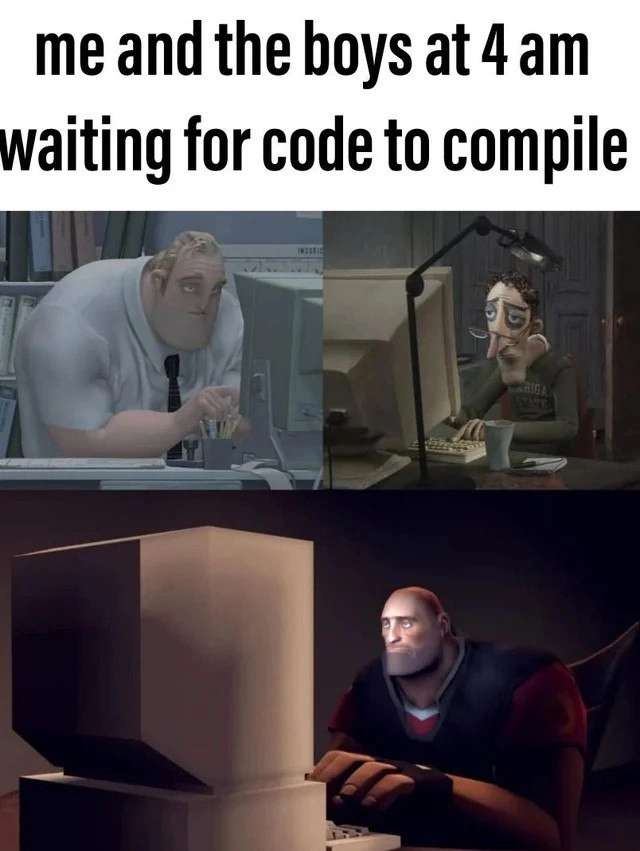
That’s exactly what this meme is showing, but with computer programmers. They wrote some code and need the computer to finish processing it so they can see if it works (that’s what “compiling code” means – the computer is getting the code ready to run). It’s taking so long that it’s 4 AM and they’re all just sitting there, like you and your friends waiting for the game update. They’ve got their coffee (like your hot cocoa) and they’re slouched in their chairs, super sleepy. The picture uses funny cartoon characters to stand in for the real people, which makes it extra silly. The joke is that these big strong characters (who usually might be fighting robots or saving the world in their stories) are now just bored and tired, doing something as mundane as waiting for a computer progress bar. It’s a little sad and a lot funny, because you can imagine how bored they must feel. Just like you guys waiting for that game update, they can’t do anything but wait and maybe crack jokes to keep themselves awake. And when you’re that tired, everything feels a bit ridiculous, which is why this scene of “me and the boys at 4 AM waiting for code to compile” makes people laugh. It’s about friends sticking together through a dull, sleepy situation – and knowing eventually, when that bar finally fills up, it’ll feel like a victory (or at least, time to finally get some sleep!).
Level 2: Build Process Basics
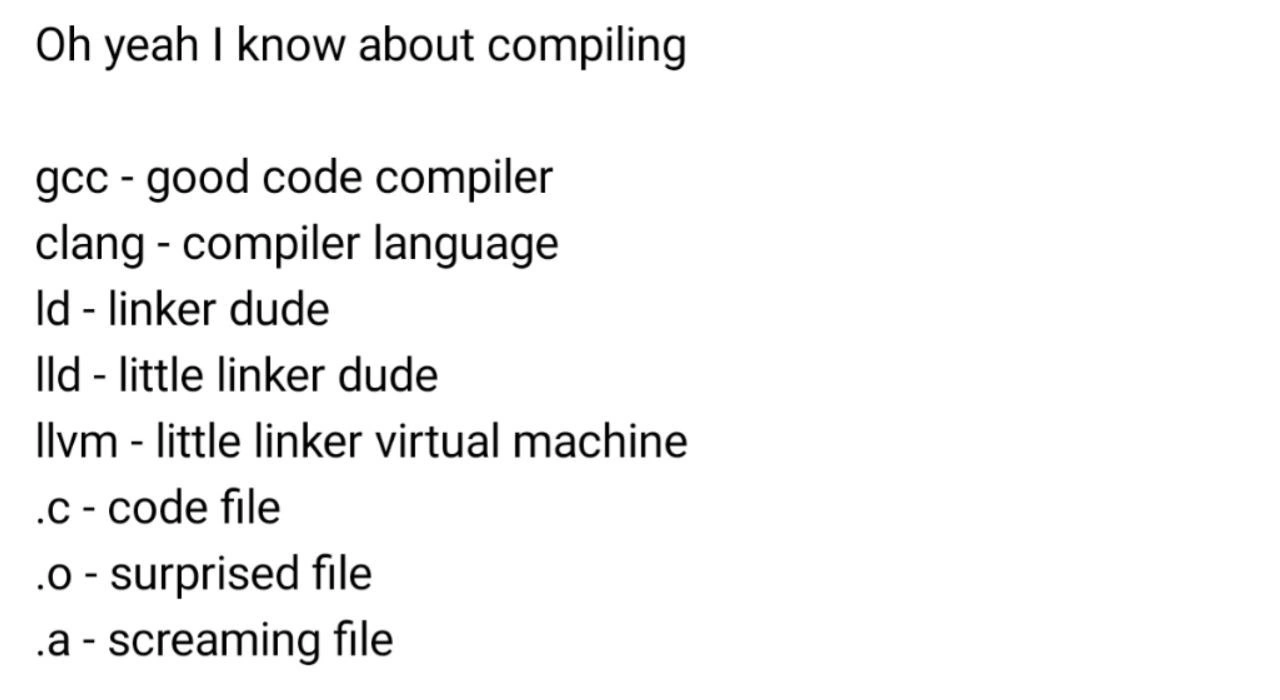
So, what’s actually happening when we “wait for code to compile,” and why does it sometimes take so long that it’s meme-worthy? Let’s break down the BuildProcess in simpler terms. When you write code in a compiled language (like C, C++, Java, or Go), you can’t just run that human-readable source code directly. You first need a program called a compiler to translate your code into a lower-level form (machine code or bytecode) that computers can execute. CompilingCode means running this translation step. It’s kind of like translating a book from English to another language – it takes some time, especially if the book (codebase) is really long or complex.
A typical software build pipeline has multiple stages:
- Compiling: The compiler goes through each source file (the code you wrote) and converts it to machine instructions. For big projects, there might be hundreds or thousands of source files, so the compiler has to do this many times. Modern build tools will try to compile a bunch of files in parallel (at the same time) if possible, to speed things up.
- Linking: After everything is compiled, you usually have a bunch of intermediate pieces (like puzzle pieces). The linker is a program that fits these pieces together into the final executable program or library. If compiling is translating each chapter of a book, linking is like binding all the translated chapters into one book and making sure the chapters reference each other correctly (“Chapter 3, meet Chapter 5, you mentioned a function defined in Chapter 5, let’s hook that up”). Linking can be a slow step if there are a lot of pieces, because it’s doing one big job at the end.
- Testing and packaging (often part of a build pipeline in professional projects): After the code is built, typically you run an automated test suite to verify nothing is broken. Then you might package the program (e.g., into an installer, a Docker image, etc.). These steps can add more time, especially tests – if you have thousands of tests, running them all can take minutes or hours.
Now, imagine a BuildAutomation setup, commonly part of what’s called a CI/CD pipeline (Continuous Integration/Continuous Delivery). When developers commit code, a CI system (like Jenkins, Travis CI, or GitHub Actions) automatically runs the build and tests. The idea is to catch issues early. However, if that pipeline is not optimized, it might be very slow. Many teams have something called nightly builds or overnight_builds – these are builds that run during the night, perhaps doing a full rebuild and running all tests while developers sleep, so they have results by morning. If a team is waiting at 4 AM for a build, it’s a sign that something went wrong with that plan – either the build started late (maybe due to a last-minute change) or it’s so slow it’s encroaching into the early morning hours. Sometimes developers stay late (or all night) to babysit these builds, because if a build fails halfway through and needs a fix, they want to catch it immediately rather than discover in the morning that nothing produced a usable result. That’s why you see those characters with coffee cups and tired eyes – they’re essentially acting as build babysitters.
Why do long compile_wait_times happen? A few common reasons:
- Huge codebase: If you have millions of lines of code, even doing the minimal amount of work to compile it all is time-consuming. It’s like trying to read an entire library of books; you can’t do it in a minute.
- Lots of dependencies: Modern software often isn’t just one self-contained thing. It relies on libraries and modules. If a low-level piece changes (like a core library), it might force everything that depends on it to recompile. Think of a big tower of blocks: if you change a block at the bottom, you may have to rebuild the whole tower.
- Inefficient build process: Sometimes the scripts or tools that handle the build aren’t configured well. For example, maybe they always do a clean build (throwing away all previous results and starting from scratch) even if you only changed one file. Or they might run steps that aren’t actually needed. This is like if you were baking 5 cakes and the recipe said you must preheat the oven 5 separate times – obviously inefficient, but it happens in poorly optimized processes.
- Hardware limits: The computers doing the build might not be very fast or might not have enough memory, especially if the scene has old CRT monitors (hinting the hardware or environment is outdated). If the build machine is from the Flintstones era, it’s going to take its sweet time to crunch through modern software.
- High optimization settings: In some cases, the code is compiled with optimization settings that make the program run faster, but the trade-off is the compiler has to do a lot more work (like trying lots of ways to optimize, which is extra computation). This makes compile times slower. It’s like a chef trying 10 different ways to decorate a cake to find the most perfect one – great result, but it took much longer than just slapping on some icing.
For a junior developer or a student who’s only worked on small projects, it can be surprising to learn that waiting_for_compile is a real chunk of developer life in many places. On small projects, compiles might be seconds or a few minutes, hardly enough time to finish a coffee. But scale that up to a huge professional project, and compiles can be tens of minutes or hours. That’s why there’s a whole category of developer jokes and memes about “time to get coffee while it compiles” or “I started compiling, so I went to stackoverflow, and by the time I came back, it was still compiling.” It’s a classic DeveloperPainPoints scenario: the frustration of being stuck in limbo while the computer does its thing.
This meme also touches on DeveloperCulture – the fact that a bunch of devs are LateNightCoding together. It’s not actually something to celebrate (sleep is important!), but it’s often worn as a badge of honor that you pulled an all-nighter to get the job done. “Me and the boys” style caption turns it into a bit of a joke, like these guys are on a ridiculous adventure together – except the “adventure” is just staring at progress bars. The characters in the images come from various animated worlds (you might recognize some if you’re into games or Pixar/DreamWorks movies), so using them as a stand-in for "the dev squad" is just inherently funny. It visually says, this is us, a ragtag crew, united in boredom and sleepiness. Even if you don’t know exactly who the characters are, you get the idea: they’re cartoonishly beefy or unique-looking dudes who are usually doing something exciting. But instead, they’re hunched over ancient monitors, waiting for something to happen. That contrast makes the absurdity clear: team_morale has hit rock bottom when even these epic characters are deflated by a slow build.
In simpler terms, the meme is poking fun at the very real scenario of slow_builds in programming. It highlights how a slow BuildProcess can turn confident, energetic developers into tired, apathetic “boys” at 4 AM just waiting... and waiting. Anyone who’s hit “compile” and then had to wait more than a few minutes can empathize. Multiply that feeling by 100 for serious projects, and you have the recipe for an all-night wait fest. It’s both a caution (“maybe we should improve our build times”) and a camaraderie thing (“at least we’re all in this together”). And importantly – it’s funny because it’s true!
Level 3: Midnight Build Marathon
It’s 4 AM, and the dev squad looks like a band of exhausted warriors waiting for the next battle. The battle, in this case, is a slow build finally completing without errors. The meme nails a very real software engineering nightmare: those interminable late-night build sessions. The caption “me and the boys at 4 am waiting for code to compile” hits home because many of us have literally been there, slumped in our chairs, watching a progress bar inch forward. In the images, these big, burly animated characters (pulled from CGI movies and games) usually look invincible or full of life, but here they’re defeated by a mere compile job. That contrast is hilarious and painfully relatable. It’s a tongue-in-cheek portrayal of developer life: even tough guys (or the toughest developers) are reduced to zombies by a build that just. won’t. end. The use of the "me and the boys" format is itself a nod to meme culture – originally a meme about goofy villains bonding, it’s repurposed here to show devs bonding over a shared suffering. DeveloperCulture in many teams includes these war stories of all-nighters and ridiculous waits, and humor is a coping mechanism.
Why are they all waiting at 4 AM, anyway? It suggests a scenario every seasoned developer dreads: maybe a critical fix was made at 3:30 AM and now they need to rebuild the entire product to deploy a hotfix or to make sure nothing else broke. Or perhaps this is a nightly build that’s required to run overnight because it takes so long, and the team is staying late (or coming in absurdly early) to check on it. This is classic DeveloperFrustration material. One unspoken rule of veteran dev life is “never push a large change at 5 PM on Friday” – because you might end up exactly like this, staring at logs under flickering fluorescent lights hours after you intended to head home. Here it might not even be Friday; it could be any day when the crunch is on, and the BuildPipeline is moving at glacial speed.
From a senior dev perspective, a lot of factors can create this 4 AM compile purgatory. Technical debt in the build system is a big one: maybe the project uses a decades-old build script that wasn’t designed for a codebase this large. Over time, features got bolted on, dependencies tangled up like spaghetti, and now any small change triggers a full rebuild of the world. You get poor incremental-build setups – meaning even if you only changed one file, the system doesn’t realize it can skip rebuilding unrelated parts. It’s like if your car manual said you have to rebuild the entire engine every time you replace one spark plug. Another cause is just sheer project size; if you’re building something like an AAA game or a big enterprise application, the final artifact might involve hundreds of modules and libraries. Even with perfect parallelization, it’s going to take time to compile and then run thousands of automated tests. And often things aren’t perfectly parallel. We’ve all seen that moment where 16 cores are blasting away compiling stuff, and then they all finish and… now one lonely linker process kicks in, pegging a single CPU at 100% while the other 15 cores twiddle their silicon thumbs. That’s the bottleneck we lament in our CompilingCode laments.
The humor also points to the human side: the team_morale aspect. There are coffee cups scattered around those characters – practically a staple of LateNightCoding sessions. The developers are physically together (or at least in spirit, if those characters are stand-ins for real teammates), sharing the agony. Ever notice how misery loves company? In dev culture, if you’re going to be stuck waiting for an hours-long compile, it feels slightly less terrible if your buddies are there too, cracking jokes like “Maybe the code’s still compiling because it decided to also calculate the meaning of life.” This kind of late-night gallows humor keeps the team sane. At 4 AM, everything is funnier and more absurd, so that caption could have even been typed by one of the devs in the moment as a way to stay awake. It’s a meme born directly from DeveloperPainPoints: use humor to vent about the otherwise demoralizing truth.
On the productivity side, a senior engineer knows exactly how costly these slow builds are. In terms of DeveloperProductivity, long compile times break your flow and drain your energy. You write some code, kick off a build, and then… wait. If the wait is 5 minutes, maybe you check email. If the wait is an hour, maybe you start scrolling memes (hence this meme existing!). If it’s multiple hours, you either multitask on something else (risky, might lose context) or you and the team end up just killing time together. One could calculate the lost engineering hours: five devs sitting idle for 2 hours is 10 developer-hours gone. If that happens regularly, it’s a huge hidden cost. There’s a well-known frustration in big projects where a full build before you can run tests or deploy takes so long that it encourages bad habits – like not testing locally or batching tons of changes together (since “I don’t want to do this again today”), which then leads to big bang integrations that break the build even more. It’s a vicious cycle.
Why not fix it then? That’s the million-dollar question. Often, speeding up the build means investing in better tooling or architecture. For instance, splitting a monolithic codebase into more modular components can help (so you don’t always compile everything). Or adopting a more advanced build system (Facebook created Buck, Google uses Bazel) that can do sophisticated incremental builds and caching. But migrating to those is a project in itself, sometimes met with internal resistance (“if it ain’t broke… well, it is broke, but not completely broken?”). And ironically, you need time to invest in build improvements, which managers may not allocate because they’re pushing features – so teams end up in a perpetual state of “too busy firefighting to fix the smoke alarm.” The people in the meme, by 4 AM, are certainly aware of how they got here. Perhaps earlier someone said, “We really should improve the build process,” and someone else replied, “Yeah, but not this sprint.” Now here they are, paying the price with interest.
There’s also a comedic hint in the imagery: those are old-school CRT monitors on the desks, casting a dim bluish glow. It gives the scene a retro, almost archaic feel. It’s as if the environment itself is outdated. It subtly suggests that maybe the tools or infrastructure are antiquated too – like they’re stuck with a legacy build server as old as those monitors, grinding away slowly. Or it’s just an aesthetic choice to emphasize the gloom of late-night office vibes, reminiscent of the early 2000s era of coding all-nighters. Either way, it reinforces the vibe: this is a classic scenario in programming, not something new. Developers have been pulling overnight compile marathons for decades. (Some veterans might even reminisce: “Back in my day, we started the build on Friday, went camping for the weekend, and it’d be done by Monday!”)
Ultimately, the meme is funny to us because it’s true and absurd at the same time. DeveloperHumor often comes from exaggerating real pain points. Here the exaggeration is mild – waiting for code to compile at 4 AM is only a slight exaggeration for some teams! The shared experience is what causes that knowing laugh (and maybe a wince). It’s almost a rite of passage in software development: the first time you stay up practically all night due to a build or deployment, you earn a badge of honor (the “I survived the overnight build” badge, perhaps). And what do devs do with painful experiences? We make memes about them to share the pain and the laughter. So this meme resonates strongly because behind the cartoon faces and the humor, every seasoned dev sees themselves and their teammates in that scenario, remembering the exact taste of 4 AM coffee and the sound of a whirring PC that refuses to hurry up.
# 11:58 PM – The team triggers a full rebuild
$ ./build_all.sh
Compiling module 1 of 150...
Compiling module 2 of 150...
...
Compiling module 150 of 150...
Linking everything into final executable...
Running test suite...
# 2:30 AM – Still going, coffee #3 in hand
Running test 257 of 980...
...
# 4:00 AM – Nearing completion (hopefully no errors now!)
Packaging release build...
(Above: a dramatization of an overnight_builds log. The suspense is real.)
In that code snippet of a timeline, you can practically feel the tedium. By 4:00 AM, when it says “Packaging release build...”, all the developers can do is stare at the console and pray nothing fails. If an error pops up now, you’ll see grown developers cry (or curse) in unison. It’s a mix of camaraderie and despair – exactly what the meme humorously captures.
Level 4: Build Bottleneck Blues
At 4 AM, a compilation bottleneck can feel like a computer science curse. Under the hood, a compiler is crunching through thousands (or millions) of lines of code, performing parsing, optimization, and code generation. In big projects, the build system must analyze a huge dependency graph of modules before it even starts the heavy lifting. This dependency resolution is like solving a gigantic puzzle: figuring out which pieces (source files) depend on which others. In theory, scheduling all these compile tasks in the optimal order across multiple cores is akin to a parallel scheduling problem – something so complex it's NP-hard in the general case. In practice, build tools use heuristics to run as many compilation tasks in parallel as possible, but some steps inevitably become a sequential bottleneck. For instance, the final linking phase (when all the compiled pieces are combined into an executable) often runs on a single thread, serially. No matter how many CPU cores you throw at it, that part won't speed up beyond a limit – a sobering lesson straight out of Amdahl’s Law.
Modern compilers and build systems try to outsmart these limits. Techniques like incremental compilation only rebuild the parts of the code that changed. Tools like ccache and Bazel use content-addressable caches to skip compiling identical code twice. But setting these up correctly in a massive project can be tricky, and if something invalidates the cache (say a broad change in a core header file), you're back to square one: a full rebuild grind. Certain languages (looking at you, C++ with heavy templates) can inflate compile times exponentially; a template-metaprogramming trick might make the compiler itself execute a kind of mini-program at compile time, eating CPU and memory. It’s almost darkly comedic – we’ve made our compilers so powerful that they can solve complex computations while compiling, but we pay for it with extra hours of wait. The theoretical maximum compile speed is hemmed in by these realities. There’s a fundamental amount of work needed to transform source into optimized machine code, and if your codebase is huge, that work scales at least linearly – often worse if the code triggers heavy optimization paths or worst-case parsing scenarios.
At this level of complexity, waiting for a compile becomes a lesson in computer science fundamentals. You start contemplating things like the halting problem at 4 AM: “Will this build ever finish, or am I stuck in an infinite loop?” – a tongue-in-cheek reference to the fact we can’t always predict if a process will halt. Of course, the build will eventually finish (we hope), but when the progress bar has been stuck at 99% for what feels like an eternity, even a battle-hardened dev’s mind drifts to impossibly theoretical explanations. We joke that maybe the compiler has hit some cosmic complexity barrier or entered an undecidable state. In reality, it's just slogging through the last, hardest part of the job – perhaps a huge link of many modules or final test packaging. BuildSystems like Make, Ninja, or Gradle orchestrate these steps, and they’re doing the best they can, but they can’t defy math: if step 9 depends on the output of steps 1-8, you simply can’t parallelize that. The result? The team sits there, eyes glazed over, as the computers churn. It’s the Build Bottleneck Blues – an unwanted late-night jam session with the compiler as the lead singer, wailing a slow, sorrowful tune while the developers keep time with sips of cold coffee.
Description
A three-panel meme captioned, 'me and the boys at 4 am waiting for code to compile'. The image combines three separate scenes of animated characters looking utterly exhausted while staring at their computer screens in dimly lit rooms. The top-left panel features a weary Mr. Incredible from 'The Incredibles' at his desk. The top-right panel shows Charlie Jones, Coraline's father, looking drained. The bottom, larger panel depicts the Heavy from the video game 'Team Fortress 2' with a similar vacant, tired expression. This meme humorously and relatably illustrates the agony of long compilation times, a common pain point for developers working with large codebases (like in C++, Java, or Rust). The 4 AM timestamp emphasizes the long hours and lost productivity spent just waiting, a shared experience of developer burnout and deadline pressure

Comments
7Comment deleted
Some say if you listen closely during a full rebuild, you can hear the ghost of Dennis Ritchie weeping over what we've done
4 AM stand-up: four seniors, one monolith, and a linker so slow we had time to architect the rewrite twice - turns out the only thing distributed is our misery
The same team that optimized our build from 45 minutes to 12 minutes somehow made the incremental builds take 11 minutes
At 4 AM, waiting for C++ template metaprogramming to compile, you realize the real incremental build was the friends you made along the way - all equally questioning their life choices while watching progress bars that haven't moved in 20 minutes. Meanwhile, the Rust developers are still arguing about whether their 45-minute clean build is 'worth it for the safety guarantees.'
4am: change one header, 10k translation units rebuild, Bazel spins up half of AWS, and the linker still insists on being single-threaded
Monorepo cold builds at 4am: the only force that can humble Mr. Incredible's superspeed
At 4am we learned that `ninja -j200` doesn’t parallelize the linker - just our regrets