Biased Facial Recognition Logic
Why is this AI ML meme funny?
Level 1: One Kind of Face
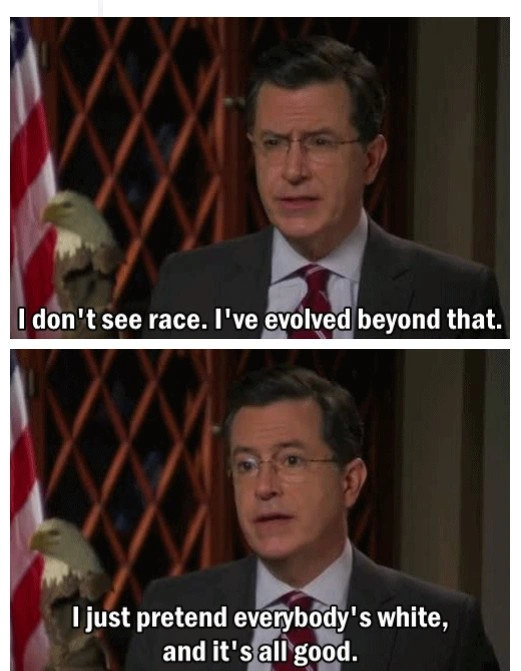
This is like making a face-matching game by practicing mostly with one kind of face, then claiming the game is fair for everyone. The funny part is that the person says they are being fair, but then admits they are pretending everyone is the same as the group they know best. The joke points out that ignoring differences does not fix unfairness if the system was built from unfair examples.
Level 2: Biased Training Data
Facial recognition uses machine learning to compare or identify faces in images. A model learns patterns from training data, which is a large collection of example images and labels. If that data is not representative, the model may work better for some groups than for others.
The meme is saying that a system can claim, "I don't see race," while still acting as if one group is the default. That can happen when most of the training examples look similar, when test results are reported only as one overall score, or when developers do not check how errors differ across groups.
AI fairness means measuring and reducing these uneven outcomes. It is not enough for a model to be accurate on average. Developers need to ask who the model fails on, what harm those failures cause, and whether the product should be used in that context. For a junior data scientist, this is one of the big lessons: data is not automatically neutral just because it is stored in a table.
Level 3: Neutrality Is Not Fairness
The first subtitle says:
I don't see race. I've evolved beyond that.
The second undercuts it:
I just pretend everybody's white, and it's all good.
With the post caption about facial recognition algorithms trained on biased datasets, the meme becomes a sharp satire of algorithmic bias. The system claims to be neutral because it does not explicitly reason about race, but its behavior still reflects a hidden default. In machine learning, "we did not include race as a feature" is not the same as "the model treats everyone equally." If the training data, labels, camera conditions, evaluation process, or deployment context are skewed, the model can reproduce that skew with a very clean conscience and a very ugly confusion matrix.
Facial recognition is especially vulnerable to this because the pipeline has many places for bias to enter. The dataset may overrepresent some demographics and underrepresent others. Images may differ in lighting, camera quality, pose, age, skin tone, or geographic source. Labels may be noisier for certain groups. The model may be tuned to optimize aggregate accuracy, which can hide poor performance for a subgroup. Then a vendor presents a single benchmark number, and everyone pretends the spreadsheet has solved society. Excellent, the false positive rate has been averaged into moral comfort.
The joke's cruelty comes from the phrase "pretend everybody's white." That is exactly the kind of default assumption biased systems can encode without ever writing it as a rule. A model does not need prejudice in the human sense to produce discriminatory outcomes. It only needs historical data, proxy variables, objective functions, and deployment incentives that reward convenience over fairness testing. The machine is not hateful; it is obedient. Unfortunately, it is obedient to the wrong distribution.
For experienced AI and data teams, this points to the gap between model performance and model governance. Responsible facial-recognition work requires subgroup evaluation, representative datasets, error analysis, threshold calibration, privacy review, consent boundaries, auditability, and serious consideration of whether the system should be deployed at all. The meme is funny because the excuse is so bad. It is unsettling because real systems have shipped with more polished versions of the same excuse.
Description
The image is a two-panel TV screenshot of a suited man speaking in an office-like setting with an American flag and decorative background behind him. The first subtitle reads, "I don't see race. I've evolved beyond that." The second subtitle reads, "I just pretend everybody's white, and it's all good." With the sibling post caption, "Facial recognition algorithms trained on biased datasets be like," the meme uses the quote as satire for machine learning systems that claim neutrality while encoding skewed training data and demographic blind spots.
Comments
1Comment deleted
A model can be proudly colorblind and still deploy a confusion matrix with a very specific favorite class.