Skip to content
DevMeme
2384 of 7435
Pair Programming with a Senior Dev When You Have Impostor Syndrome
MentalHealth Post #2650, on Jan 21, 2021 in TG

Pair Programming with a Senior Dev When You Have Impostor Syndrome

Why is this MentalHealth meme funny?

Level 1: Dress-Up vs the Real Thing

Imagine you have a friend who is really good at something – say, baking cookies. Your friend, the expert baker, can crack eggs, mix batter, and bake perfect cookies every time. Now imagine you’re standing next to them in the kitchen, but you don’t really know how to bake yet. You decide to put on a chef’s hat and apron, just so you look like a baker, hoping nobody notices you’re unsure what to do. You hold a spatula and smile, but inside you’re thinking, “I hope they don’t ask me to actually bake anything!”

In this scenario, your skilled friend is like the senior developer (the real chicken in the meme that can lay eggs), and you are like the junior developer (the dog wearing the chicken costume). Your friend effortlessly bakes batch after batch of cookies (that’s like the senior effortlessly completing tasks or “laying eggs”). Meanwhile, you’re just dressed up like a baker, nervously stirring an empty bowl, feeling like you’re only pretending and that any moment someone will figure out you’re not a real baker yet. That worried feeling of being a pretender next to someone who’s the real deal – that’s what we call impostor syndrome. It’s when you feel like you’re just faking it and everyone else is truly skilled.

The meme shows this feeling in a silly way: a dog puts on a chicken outfit next to a real chicken that laid real eggs. It’s funny to look at, but it’s also a bit like how a new developer might feel working with a very experienced developer. The new person might dress the same and be on the same team, but they worry they’re not actually capable of laying any “eggs” (doing good work) like the experienced person can. It’s like playing dress-up next to a professional – you have the costume, but you’re still learning the real skill.

The important thing to remember is that the dog in the costume isn’t expected to lay eggs. In real life, if you’re new at something, nobody reasonable expects you to be as fast or skilled as someone who’s been doing it for years. The experienced friend (or senior dev) knows you’re learning and is usually happy to help you out. And one day, with practice, you’ll be baking your own cookies or writing your own code without feeling like you’re pretending. In the meantime, it’s okay to feel a bit nervous – almost everyone feels like that when they’re new. The funny chicken-and-dog picture just helps us laugh at that feeling and remember that we’re not alone in feeling like a faker sometimes. Eventually, with a little time, you won’t need any costume at all – you’ll be the real thing.

Level 2: Fake It vs Make It

Let’s break down what’s happening in this meme in simpler terms and define some key ideas for those new to the developer culture:

  • Senior Developer (Senior Dev): This is an experienced programmer on the team who has been coding for years. They know the codebase and the tools really well. They’re like the real chicken in the picture that can actually lay eggs. In a project, the senior dev easily delivers features or fixes bugs (each egg on the floor is like a finished task they've completed). They often guide others and are seen as very productive and knowledgeable.
  • Junior Developer (Junior Dev): This is someone newer to programming or with less experience on the team. Think of a newcomer or a fresh graduate. In the meme, the junior dev is represented by the Shiba Inu dog wearing a chicken costume. The junior is trying to do the same work the senior is doing, but they are still learning. They might not produce as many “eggs” yet. The dog wearing a chicken hat is a funny way to show the junior attempting to fit into the team and appear capable, even if they feel out of place.
  • Impostor Syndrome: This is a common feeling in the tech world (and many other fields) where a person, often a high-achiever, feels like a fraud or “impostor” despite being competent. They constantly think they don’t deserve their success or role. A junior developer with impostor syndrome feels like they aren’t a “real” developer, even if they have the job title. In the meme context, the junior dev literally feels like a dog pretending to be a chicken – as if they’re just faking being a developer and everyone will soon find out. It’s an anxiety that they are not as good as people think they are.
  • Project Collaboration Dynamics: This refers to how people of different skill levels work together on the same project. When a junior_dev works side by side with a senior_dev on a shared codebase, the differences in experience become very visible. Ideally, the senior guides the junior (mentoring, pair programming, code reviews) so the junior learns and the project benefits from both. However, for the junior, this collaboration can cause junior_dev_anxiety: they might worry they’re slowing the team down or not contributing enough. The meme exaggerates this dynamic with humor – the senior is the one actually laying eggs (contributing directly), while the junior sits there, a bit nervous, dressed for the part but not yet fully able to perform at that level.

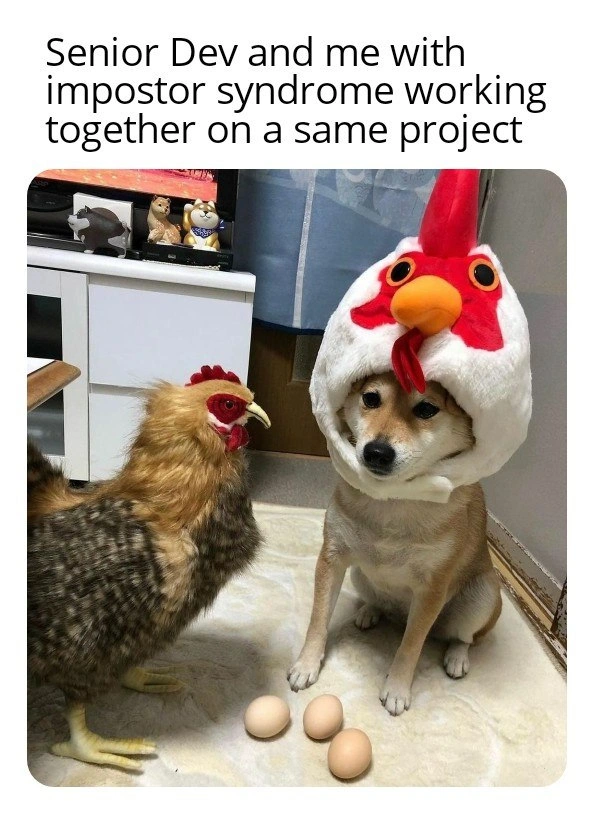
Now, think about the literal scene: a Shiba Inu dog is wearing a fluffy chicken hat and looking slightly uneasy, and a real chicken is staring at it while actual eggs lie between them. Here’s how that translates to a real workplace scenario in software development:

  • The real chicken is like the senior developer who produces real outcomes. For example, a senior might crank out three crucial bug fixes or implement major features (represented by those three eggs on the floor) in a short time. This comes from years of experience—just like a hen that lays eggs routinely because it’s done it many times.
  • The dog in the chicken costume is like a junior developer who is “faking it ’til they make it.” The junior has the title of developer (wearing the "uniform," which in this silly case is a chicken suit), but inside they might feel like they’re not truly qualified. The Shiba Inu’s nervous expression is exactly how a junior might feel sitting next to a senior in a meeting or coding session: “Do I look like I know what I’m doing? Am I fooling anyone?” They may try to use the same technical jargon or tools as the senior (wearing the same "hat"), but inside they’re worried they’re doing it wrong.
  • The eggs symbolize delivered work or productivity. The fact that the eggs are clearly coming from the real chicken and none are coming from the dog highlights the junior’s fear: “The senior is producing all this work, and I haven’t produced anything real yet – will they realize I’m not as good?” In a real dev team, this could be like the senior pushing lots of code to the repository, while the junior is still struggling with their part of the assignment, feeling slow.

The meme uses an animal_costume_meme format (animals dressed as other animals) to make a serious point in a lighthearted way. It’s visually absurd, which makes it funny, but it’s also relatable humor for many in the software industry. New developers often feel like that dog: they pretend to be confident and capable (just as the dog wears a confident chicken disguise) because they want to impress or at least not disappoint their teammate. Meanwhile, the senior developer is calmly doing what they do best, possibly even slightly amused or puzzled (the way the real chicken is literally looking at the dog like “...really?”).

It’s worth noting that impostor syndrome isn’t just shyness or modesty; it’s a real form of self-doubt where even evidence of your abilities (like getting a job, or actually writing good code) doesn’t erase the fear that you’re not good enough. A junior dev might finish a task successfully yet still believe it was just luck or that any “real” developer could have done it better. This mindset makes them think they have to constantly wear a “mask” of confidence or competence. That’s exactly what the Shiba Inu with the chicken hat represents: wearing a mask (or costume) to fit in with the real developer(s) on the team.

In a typical corporate culture setting, especially in tech companies, teamwork between seniors and juniors is common. Some companies pair new hires with experienced mentors – which is great, but it can also inadvertently trigger impostor feelings. Imagine it’s your first month at a job as a junior programmer and you’re assigned to help a senior engineer on a critical project. The senior engineer writes code that runs on the first try, knows shortcuts in the IDE, references past projects or uses design patterns you’ve never heard of. You’re sitting there trying to keep up. You might start thinking “I’m clearly the weakest link here. I hope they don’t regret hiring me.” That’s impostor syndrome talking. The truth is, no one expects a junior to know as much as a senior. The senior likely understands you’re new. But because you’re ambitious and care about doing well, you put a lot of pressure on yourself.

The meme’s popularity in developer humor circles comes from this very truth: ImpostorSyndrome among SeniorVsJuniorDevelopers is extremely common and relatable. It’s almost a rite of passage in developer culture to realize one day that those brilliant seniors you idolize are just humans who learned over time (and they might have even felt exactly like you do now when they were juniors). Many developers bond over the fact that they once felt (or still sometimes feel) like phonies in a room full of “real” programmers. Seeing it depicted as a dog in a chicken suit offers some comic relief – it’s a goofy reminder that hey, we’ve all been the dog.

The good news is that with experience, the junior (dog) will start laying eggs of their own. In real terms, that means completing projects, committing code that makes it to production, and gaining confidence. Over time, the impostor syndrome fades as you prove to yourself you can do it. And often, senior devs will tell juniors that they too had impostor syndrome. It helps to know even the real chicken once wore the costume. In a supportive team (senior_dev_guidance done right), the senior will encourage the junior, share knowledge, and maybe even reveal their own past mistakes to make the junior feel better.

So if you’re a junior dev feeling like this dog, remember a few things:

  • You were hired for a reason: the team sees potential in you, even if you don’t fully see it yet.
  • Seniors are there to help: ask questions! A good senior remembers what it was like not to know something.
  • Every expert started off inexperienced: The real chicken didn’t hatch overnight as an expert egg-layer; it grew and learned. Likewise, every senior developer was once a beginner who wrote buggy, simple code. They improved with practice.
  • Don’t be too hard on yourself: It’s okay to make mistakes or not know everything. You’re there to learn. Producing fewer “eggs” at the start is normal. Quality and understanding matter more than just quantity of output when you’re learning.

Finally, understand that impostor syndrome is actually a sign that you care about your craft and that you have a realistic grasp of how much there is to learn. It tends to affect people who strive to do well. The key is not letting it paralyze you. With time, as you gain experience (maybe crack a few eggs or even lay some golden ones!), you’ll realize you do belong. That dog won’t need a costume forever — one day, they’ll be comfortable in their own developer skin (or fur, in this case) and maybe even mentor the next newbie who feels the same way. This meme is telling new developers: “We see you, we’ve been you, and hang in there — it gets better!”

Level 3: The Chicken-and-Egg Paradox

At first glance, this meme hilariously captures a senior vs junior developer dynamic using barnyard imagery, but beneath the humor lies a too-real commentary on impostor syndrome in tech teams. The real chicken on the left represents the senior developer – a seasoned pro who can reliably "lay eggs" (i.e., deliver results or ship features) with calm confidence. The Shiba Inu on the right, nervously sporting a goofy oversized chicken hat, is the junior developer consumed by impostor syndrome – desperately trying to look the part but fearing they don’t truly belong. The three eggs on the floor are tangible proof of productivity (completed tasks, bug fixes, deploys) that the junior fears they can’t match.

In developer culture, this scenario is painfully relatable: working alongside a rockstar senior engineer can make a junior feel like a fraud in costume. The caption "Senior Dev and me with impostor syndrome working together on a same project" nails that sense of performance gap. The senior dev (real chicken) effortlessly hatches solutions, while the junior (costumed dog) is winging it next to someone who literally has wings. This is the chicken-and-egg paradox of career growth: you need experience to feel confident, but you gain experience by surviving moments of doubt. It’s a catch-22 many juniors face – you feel you can’t “lay an egg” because you lack confidence, and you can’t gain confidence until you’ve laid a few eggs!

From a seasoned engineer’s perspective, this meme also highlights project collaboration dynamics and the importance of mentorship. The senior dev isn’t actually a barnyard demigod (even if it seems like they poop out golden eggs of code daily); they’ve just accumulated years of knowledge of the codebase and domain. They remember being the anxious newbie once. In healthy corporate culture, a good team or senior_dev_guidance will let the junior safely learn, rather than expect them to magically produce eggs from day one. Sadly, in some environments the junior’s anxiety is compounded by unrealistic expectations or comparison, making them feel like they must “fake it ’til you make it.” The Shiba Inu’s wide-eyed, slightly worried expression basically is junior_dev_anxiety incarnate: “I’m trying to look like a productive team member, but any minute now they’ll realize I’m just a dog in a chicken suit!”

The humor lands so well among developers because it satirizes a universal experience in tech: that first time you pair program with a senior dev and they blaze through a tough bug fix or refactor in minutes, while you (the junior) sit there feeling like an imposter for not knowing those tricks. We laugh, a bit nervously, because we’ve all been that dog at some point — nodding along in a meeting, hoping our disguise (perhaps confident jargon or a GitHub streak) hides our inexperience. It’s a form of mental health humor in the workplace: calling out the silent fear many have. And importantly, even many seniors still feel impostor syndrome; the difference is, with experience, you learn to trust that you can figure things out eventually. The meme’s optical absurdity (a shiba inu in a chicken hat staring down a real chicken) exaggerates the junior’s internal narrative. Yet, it also hints that the whole charade is in the junior’s head — the senior likely doesn’t view them as a fake at all. If anything, the senior might chuckle at that costume and kindly show the dog how to lay the first egg (mentor them through their first big task).

In sum, this meme resonates on multiple layers: as lighthearted developer humor, as a comment on developer culture that values output, and as an empathy-building reminder that feeling out of place (like a dog in a hen house) is a normal part of growth. It’s funny because it’s true: in software teams just like in this bizarre farm tableau, the impostor syndrome makes the junior dev feel like they’re merely pretending to be a “real developer.” Meanwhile the senior, with their wealth of experience (and maybe a bit of plumage), just gets to work producing result after result. The real punchline is that nearly every senior was once that junior in the costume. Each “real chicken” in tech often started as a nervous pup trying to blend in, until one day they hatched some eggs of their own. The juxtaposition of fake vs real productivity in the image is absurd, but every dev who’s ever been the least experienced person in the room immediately gets it. You can almost hear the internal dialogue:

Junior Dev’s mind: “Any minute now they'll figure out I'm not a ‘real’ developer...”
Senior Dev’s mind: “They’re doing fine for a junior; I remember feeling the same way starting out.”

This gap between perception vs reality is the crux of impostor syndrome on engineering teams. The meme encapsulates it in one snapshot: the impostor feeling is usually self-imposed, and often the senior is more supportive (or at least benign) than we fear. In other words, the dog already had the job on the team — nobody actually expected it to lay eggs on day one! But try telling that to the junior’s brain. Instead, the poor Shiba Inu sits there in a feathery facade, walking on eggshells (literally and figuratively), until experience catches up with expectation. It’s a memorable reminder in tech: don’t chicken out just because you feel like an impostor; even the greatest “egg-laying” coders started somewhere, and with time, you’ll deliver your eggs (features) too. 🥚🥚🥚

Description

A meme with a top caption that reads, 'Senior Dev and me with impostor syndrome working together on a same project'. The image below the text features a real-life brown and black rooster on the left, looking intently at a Shiba Inu dog on the right. The dog is sitting upright and staring forward with a slightly anxious expression, wearing a large, fluffy white chicken hat that covers its head. On the floor between them are three brown eggs. The scene humorously visualizes the concept of impostor syndrome in a technical team. The rooster represents the authentic, experienced senior developer who naturally produces results (the eggs). The dog in the chicken costume represents the less experienced developer who feels like a fraud, merely imitating the appearance of a productive team member while feeling completely out of place and unqualified

Comments

18
Anonymous ★ Top Pick My main contribution to the project is polymorphism: I present the same 'Chicken' interface as the senior dev, but my underlying implementation is a Shiba Inu having a panic attack
  1. Anonymous ★ Top Pick

    My main contribution to the project is polymorphism: I present the same 'Chicken' interface as the senior dev, but my underlying implementation is a Shiba Inu having a panic attack

  2. Anonymous

    The senior dev just birthed three microservices and a Terraform module before stand-up; I’m next to them in a full chicken costume, pushing README commas so the DORA metrics think I’m laying eggs too

  3. Anonymous

    The real irony is that after 15 years, the senior dev still googles 'how to center a div' just as often - they've just gotten better at pretending the eggs were intentional features, not bugs that happened to compile

  4. Anonymous

    The senior dev is the actual chicken laying eggs (shipping features), while you're just a dog in a chicken suit trying to figure out how they make it look so effortless. The real kicker? That senior dev also wore the costume for their first five years, they just don't talk about it anymore. The eggs on the floor represent the production bugs you're both pretending aren't there during standup

  5. Anonymous

    Senior dev drops architecture eggs that hatch into scalable systems; you're the Shiba in feathers, praying your PR doesn't crack under review

  6. Anonymous

    Pairing with the staff engineer, they hatch a zero-downtime migration while I, in the chicken hat, contribute three eggs: a feature flag, a bash one-liner named fix.sh, and a very apologetic PR description

  7. Anonymous

    Pair programming is realizing your confidence is DI’d via a chicken costume while the senior casually lays three production-safe eggs - complete with ADR, rollback plan, and zero-downtime migration

  8. @RiedleroD 5y

    notice that neither is a real chicken

  9. @freeseacher 5y

    double impostor syndrom. cause eggs are clean and from fringe

  10. @freeseacher 5y

    seems they are from stackoverflow ;)

  11. @GLXBX 5y

    Wow, nice cocks 👍

    1. @RiedleroD 5y

      neither are cocks. these are merely female specimens of their species.

      1. @GLXBX 5y

        I'm not an expert in cocks and chickens so thanks for clarifying this

        1. @RiedleroD 5y

          I am glad that you are thankful for I am the supreme lord of chicken knowledge. Please contact me next time as well.

          1. @Lucyf_r 5y

            String bootstrap(String str){ if(str.equals("chicken")) { bootstrap("egg") } else{ bootstrap("chicken") } return "stackoverflow" } String supremeLord = bootstrap("sepreme lord's big brain");

            1. @RiedleroD 5y

              in this caase, the chicken comes first, which, of course, is ridiculous

  12. @ryankrage77 5y

    the egg came first. The mutation that led from dino to bird happened in the egg

  13. @Magilarp 5y

    Amog us

Use J and K for navigation