The 3 AM Code Refactoring Epiphany
Why is this Refactoring meme funny?
Level 1: Midnight “Oops” Moment
Imagine you spent all day building a big LEGO castle. You worked really hard on it and finally got it to stand up. But later that night, when you’re lying in bed, you suddenly realize a much easier way to have built that castle – a way that would have used fewer LEGO pieces and made it stronger. You might sit up and think, “Oh no! I could have done it differently and better!” Now you can’t sleep because you keep picturing how you should have built it.
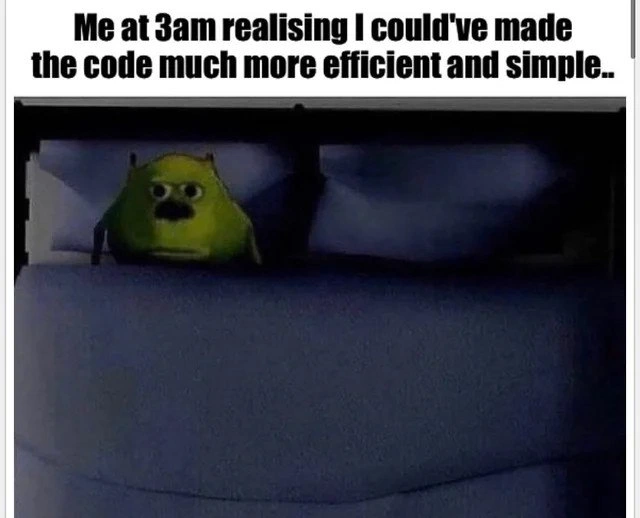
That’s exactly what’s happening in this meme, but with writing computer code instead of LEGO. The green monster in bed (Mike Wazowski from Monsters, Inc.) is like the programmer. He’s wide awake at 3 AM, with a shocked look, because he just thought of a simpler, smarter way to solve a problem in his code. It’s a funny way to show that uh-oh feeling we all get when we remember something important at the wrong time. Just like realizing a better way to build your LEGO castle after you’ve finished, this programmer is realizing a better way to write his code after it’s already done.
The reason it’s funny is because it’s so relatable – even if you’re not a coder, you know that feeling of late-night worries or sudden ideas that pop up when you’re trying to sleep. Maybe you remember you had homework that you could have done a simpler way, or you think of a clever comeback to an argument way after the fact. Here, it’s about code, but the idea is the same. The poor monster can’t sleep because he’s thinking, “I made a mistake or missed an opportunity,” and that’s keeping him up.
In simple terms, the meme is telling a little story:
- During the day: the person wrote some code and thought it was fine.
- Late at night: they realize, “Oops! I know how I could have done it better and easier!”
- Emotion: a mix of surprise and regret — surprised by the new idea and regretting not having it sooner.
It makes us laugh because we’ve all had that “midnight oops moment” about something. And seeing a cartoon character in that situation makes it light-hearted and easy to nod along with, instead of feeling bad. The picture is exaggerated (big eyes in the dark) to show how startling that midnight thought can be. It’s like when you suddenly remember you left the stove on – your eyes might pop open in bed! For the coder, remembering a better way to code is their “stove moment.”
So the core of this meme is: sometimes our best ideas come at funny times, and it can make us a bit crazy. The good side is, now the programmer knows a better way and can fix it later. The silly side is, of course it came at 3 AM! It’s a gentle joke about how our brains work on problems in the background and often choose inconvenient times to give us those “Aha!” insights.
If you’re not into programming, just think of it like this: you did something the hard way, and later you suddenly figure out the easy way – and you facepalm, maybe can’t sleep because you’re thinking about it. That’s the whole joke. And seeing a friendly monster character experiencing it makes it humorous and not just stressful.
In the end, the meme is both a comfort (“This happens to lots of people, even funny monsters!”) and a little reminder (“Maybe next time, I’ll try to think of the simpler way first... or at least not worry about it at bedtime!”). It’s funny because it’s true to life, and it uses a cute image to poke fun at that serious feeling. So we can all chuckle and say, “Haha, I’ve been Mike Wazowski in that bed before!”
Level 2: Refactoring Regrets Explained
Let’s break down the meme’s meaning in simpler terms and define some key ideas for newer developers. The scenario here is a programmer lying in bed at 3 AM thinking, "Wow, I just realized a much better way to write that code!" This is something many coders experience. It touches on topics like code efficiency, simplicity, and refactoring, so let’s explain those:
Code Efficiency: This refers to how well your code uses resources (like time and memory). Efficient code runs faster and/or uses less memory. In the meme, the person suddenly realizes their code could have been more efficient – maybe it’s running slower than necessary because of the approach they took. Perhaps they wrote a solution that checks too many things or repeats work it didn’t need to. For example, imagine you wrote a program to search for a number in a list of 1000 items. A simple but inefficient way is to check each item one by one until you find it; that could take up to 1000 checks in the worst case (this is an example of O(n) time, where n is the number of items, here 1000). But if the list was sorted, you could use a faster method (like binary search, which is O(log n)) that finds the number in at most 10 checks or so. Realizing a more efficient method after writing a clunkier one is exactly what’s happening in this meme. That "aha!" moment might be "Oh, I could have used a different data structure or algorithm to do this in a fraction of the time."
Code Simplicity: Simple code means it’s easier to read, understand, and maintain. It usually also means there are fewer things that can go wrong. In the meme, the programmer at 3 AM regrets not writing simpler code. This could mean they wrote something overly complicated — maybe a very long function or a bunch of confusing logic — when a cleaner solution existed. Simpler doesn’t always mean shorter, but in many cases, a well-thought-out solution does end up with fewer lines of code or clearer structure. Sometimes, after you struggle with a problem and step away, you realize an easier approach was possible. For instance, perhaps you manually sorted a list by writing many lines of code, then you remember the language has a built-in
sort()function. Or you had a complex series ofif/elsestatements and later realize you could use a dictionary (hash map) lookup to simplify all that branching logic.Refactoring: This is a big one in the tags (#RefactoringNeeded, #RefactoringPain). Refactoring means changing the code to improve its internal structure and quality without altering its external behavior (what it actually does). In other words, you make the code cleaner, simpler, or more efficient, but it still produces the same outputs as before. The meme’s developer at 3 AM is basically thinking about a refactor they wish they had done. They’ve recognized that their code could be improved (more efficient and simple), and their mind is essentially planning that rewrite while lying in bed. Refactoring is a normal part of programming – after you get something working, you might revisit it to make it better. The “pain” part (#RefactoringPain) comes from the fact that refactoring can be time-consuming and sometimes risky (you might introduce new bugs while changing the code). If you realize a better design at 3 AM, you might be annoyed because you know you’ll have to spend time later to implement it, or else live with a less-than-great solution.
Technical Debt: This is a term we mentioned. It’s like taking shortcuts in code that you’ll have to fix later, just as taking on financial debt means you have to pay it back in the future. Writing code "quick and dirty" to meet a deadline can create technical debt – the code works, but it might be messy or inefficient (debt you “owe” to the codebase). The meme’s caption suggests the person is now aware of this debt: the code works but isn’t efficient or clean, so they’ve essentially "borrowed time" during the day and now must "pay interest" in the form of worry and later refactoring. The awareness at 3 AM is the interest coming due on that debt.
Late Night Coding & Sleep Deprivation: The tags #LateNightCoding and #SleepDeprivation reflect a common developer habit: working or thinking about code late into the night and consequently not getting enough sleep. Many developers have a hard time shutting off their brain. If you’ve ever tried to sleep but your mind keeps thinking about a bug or a feature, that’s exactly what’s shown in the image. Mike Wazowski’s wide eyes = coder who can’t sleep. This can lead to #DeveloperFatigue – being really tired the next day, which ironically might make you less productive or cause more mistakes in your code. It’s a bit of a vicious cycle: you think about code at 3 AM, then you’re tired when actually coding the next day, which could lead to more oversights or inefficient code, and so on.
Developer Anxiety: This refers to the stress or worry a developer might feel about their work. Here, the anxiety is about code quality: "Did I write that the best way? Could it be better?" It can also be about fear of bugs or how others will view your code. At 3 AM, alone with your thoughts, it’s easy for a small concern to grow. The meme highlights a form of this anxiety — second-guessing your decisions when nobody is around, and feeling a bit of panic that you made a mistake or missed an opportunity to write better code.
Coding Mistakes & Learning: The truth is, everyone writes code they aren’t proud of sometimes, especially when learning. This meme is a testament to that. Realizing your code could be better is actually a sign of learning and growth. It means you’ve thought of an improvement! For newer devs, it might be surprising how often even experienced programmers look back and say "what was I thinking?". It’s normal. Part of becoming a better coder is recognizing flaws in your old code and fixing them – ideally, during the day at work, not exclusively in nightmares!
Now, let’s connect these ideas to the visual of the meme. Mike Wazowski is a character from a kids’ movie, but here he represents the developer themself. The look on his face is shock and regret. We can almost hear him thinking: "Oh no... what have I done?!" The caption makes it clear what he’s so stunned about: realizing a much better solution exists after the fact. It’s a comedic way to show something that isn’t inherently funny when it happens to you (it’s usually frustrating or anxiety-inducing), but sharing it as a meme makes us feel less alone and we laugh at the exaggeration.
To give a concrete example of what such a code improvement might be, consider a small coding task: checking if all elements in a list are unique. A newer coder might do it in a straightforward but not super efficient way, like this:
# An initial approach (less efficient, more complex)
def all_unique(items):
for i in range(len(items)):
for j in range(i + 1, len(items)):
if items[i] == items[j]:
return False # found a duplicate
return True
# Usage
numbers = [1, 2, 3, 4, 5]
print(all_unique(numbers)) # True (since all numbers are unique)
This function works by comparing each item to every other item (for loops inside for loops). It does the job, but it’s not very efficient. If there are n items, this approach could take up to n×n checks (which is O(n²) time complexity). Now imagine our developer wrote something like that during the day and it works fine. But later that night, perhaps they recall a simpler method. For example, using a set in Python, which automatically only keeps unique elements:
# A refactored approach (more efficient and simpler)
def all_unique_using_set(items):
return len(items) == len(set(items))
# Usage
print(all_unique_using_set(numbers)) # True
This one-liner creates a set of the items. Since sets can’t have duplicates, if you convert the list to a set and the size doesn’t change, it means all items were unique. This approach is typically more efficient (around O(n) on average) and the code is much shorter and easier to read. If the developer had this realization at 3 AM — "Whoa, I could just use a set!" — Mike Wazowski’s face would make sense. He’s essentially going "I wrote all that code with two loops, but I could have done it in one simple line!" That mix of excitement at discovering a better way and despair at having done it the hard way is exactly what the meme conveys.
Now, in real life, how do we handle such revelations? Generally, the next day you’d go and refactor the code if possible. You’d replace the complicated approach with the simpler one, test to make sure it still works, and then feel a lot better about it. The meme’s humor is that the realization hit at a ridiculous time. It hints at the fact that a programmer’s brain doesn’t always adhere to the work schedule – it might solve a problem whenever, even at 3 AM when you’d rather be sleeping.
We can also talk about why we often realize these things only after stepping away. When you’re actively coding and maybe stressed to get it done, you might not see the problem as clearly. Once you relax (like when you’re almost asleep), your brain can process it differently, sometimes more creatively or efficiently. It’s similar to how you might get a new idea in the shower or while taking a walk. This is a known phenomenon in problem-solving: taking a break can lead to breakthroughs. But in the moment captured by this meme, that breakthrough is a bit unwelcome only because it’s disrupting the poor guy’s sleep!
Let’s not forget the tags about mental health (#MentalHealth, #DeveloperAnxiety). This meme also gently points out that programmers can have a tough time mentally disconnecting from work. It’s using humor to acknowledge something real: burning the midnight oil or losing sleep over code can be a sign that you’re either very passionate or maybe a bit too worried (or both). If you’re a new developer seeing this, the takeaway is that you should care about code quality, but also take care of yourself. It’s common to have imposter syndrome (feeling like you’re not good enough) or worry that your code isn’t perfect. The image of Mike Wazowski awake at 3 AM is like the physical embodiment of those worries. We laugh at it because we’ve all been there, but it also reminds us it’s okay to step away and rest. No one writes perfect code in one go. There will always be something you think of later. That’s why we have iterative development – we improve in passes.
Another key term in the tags is PrematureOptimization (from the common phrase "premature optimization is the root of all evil in programming"). This phrase warns developers not to try to make code super efficient too early, before you actually know what needs optimizing, because you might waste time or make the code more complex unnecessarily. It’s interesting because in this meme, the developer didn’t optimize at first (maybe following that wisdom), but now they’ve realized an optimization that actually matters. The trick is knowing when an optimization or simplification is important. In our example, using a set wasn’t premature optimization – it was just a smarter approach. The person probably isn’t regretting that they avoided micro-optimizations, but rather that they missed a fundamental improvement that was relatively obvious in hindsight. It shows the balance developers have to strike: don’t overthink everything upfront, but also review your solution to catch any big inefficiencies or needless complexity.
In summary, Level 2 boils down the meme to the key ideas for a junior developer or someone new to these concepts:
- The meme is about realizing a better way to code something after you’ve already done it the harder way.
- Refactoring is the act of cleaning up the code after the fact, which is what the person wants to do once they realize their mistake.
- Code efficiency and simplicity are good goals; they make software faster and easier to maintain. But in practice, we don’t always achieve them on the first try.
- Feeling a bit of worry or regret when you find a better solution later is normal, but it’s also how you learn. Next time, you’ll remember that insight (like using a set or a built-in function).
- Almost every programmer has had a “could have written this better” thought — it’s practically a milestone on the journey of learning to code.
And one more reassuring note: the fact that this happens at 3 AM is exaggerated for effect – it emphasizes the idea of a sudden, untimely realization. It doesn’t literally mean you will routinely wake up in the middle of the night in a panic (though late-night thoughts do happen!). More often, you might realize the better solution the next morning, or during a code review, etc. The meme just pushes it to the extreme (3 AM in bed) to make it funny and instantly understandable. So don’t worry that programming will ruin your sleep every night – but if you do catch yourself thinking about that code you wrote as you fall asleep, well, just know you’re not the only one. We’ve all had those sleepless refactoring thoughts at some point!
Level 3: O(n²) Nightmares at 3AM
At 3:00 AM, the developer’s brain performs an unscheduled code review. In the meme, wide-eyed Mike Wazowski lies awake in bed, representing every programmer who suddenly recalls a much better way to write the code they finished earlier. The humor comes from painful familiarity: it's the midnight epiphany where you realize your code is more convoluted or less efficient than it needed to be. This combination of elements is funny because it's tragically relatable. The caption’s bold text ("I could've made the code much more efficient and simple") paired with Mike’s haunted stare nails that feeling of code-quality regret. By referencing Monsters, Inc., the meme cleverly makes "the monster under the bed" a messy codebase or poor algorithm lurking in the developer’s mind. Mike Wazowski, a literal monster, is ironically the one scared – not of a child’s scream, but of his own code’s complexity. It’s a tongue-in-cheek portrayal of developer insomnia: the mind won’t let go of a problem even during supposed rest.
For seasoned developers, this meme hits on the shared trauma of realizing too late that a simpler solution existed. It satirizes the industry pattern of shipping code that "works" by day, only to have the optimal solution reveal itself in the dead of night. Why does this happen? Often because under tight deadlines or crunch, we implement a solution that is good enough to pass tests and meet requirements. We might even over-engineer things, adding needless layers or not fully considering algorithmic efficiency. Then, when our brain finally quiets down (or when we’re trying to sleep), we subconsciously refactor the code in our head. Suddenly it hits us: we reinvented the wheel or chose a suboptimal approach. Maybe we used a clunky double loop where a hash map would do, or wrote 100 lines of custom logic only to recall a built-in function could handle it in one line. The meme’s humor is in that dramatic "Eureka... oh no" moment we’ve all experienced.
Consider a real scenario: you write a function with nested loops that runs in O(n²) time to filter duplicates or compute something. It’s late, you’re tired, and you push the code to meet the sprint deadline. But in the stillness of 3 AM, your mind resurfaces a forgotten CS lesson – perhaps an algorithm that could do the same task in O(n log n) or O(n). You suddenly remember that Python’s set or a sorted binary search could have saved you from quadratic time. Or maybe earlier that day you hacked together a bunch of if-else conditions and messy state variables. At 3 AM, you recall the elegant design pattern or algorithmic trick that would simplify it all. It’s an agonizing enlightenment: you see how inefficient your current solution is compared to what could have been. For a senior developer, this pang is especially acute because you know better – you’ve seen these refactoring opportunities before. The meme encapsulates that senior perspective of "I should have known to keep it simple". There’s a well-known principle in software design called KISS (Keep It Simple, Stupid). At 3 AM, KISS is basically screaming in Mike Wazowski’s ear. The code as written violated simplicity, and the coder’s brain is now paying the price by replaying how they ignored the rule.
This late-night realization often connects to technical debt. Perhaps to ship a feature, you took on some shortcuts or left the code in a less-than-ideal state. The term technical debt means you’ll have to "pay" for those shortcuts later with extra work (like refactoring). In the meme, that debt is literally keeping the developer awake. It highlights a common systemic issue: companies push for quick delivery, so developers often merge code that gets the job done but plan to clean it up "later". Later might never come due to new priorities, so the code stays messy and inefficient, and the guilt festers until it sneaks into your thoughts at night. This is the refactoring pain the tags mention—it’s harder to fix after the fact. A senior dev reading this meme nods knowingly, recalling times when the simple, elegant solution occurred to them only after the code was deployed. It’s practically an industry rite of passage to lie in bed thinking, "I really should refactor that in the morning."
The visual of Mike Wazowski, eyes wide open on the pillow, emphasizes the developer anxiety at play. There’s a mental health angle: continuous stress about code quality can lead to sleep deprivation and burnout. The meme subtly points out the human cost of striving for CodeQuality. It’s funny because Mike’s expression is cartoonishly intense, but it also reflects reality—many of us have stared at the ceiling, mentally debugging or rewriting our code at absurd hours. We chuckle at the meme, but we also feel it. It’s a reminder that even experienced devs aren’t immune to late-night doubt. In fact, the more you care about your craft, the more these 3am epiphanies happen. The humor is a bit self-deprecating: of course we think of the better solution once it’s too late!
Importantly, fixing the issue at 3 AM isn’t usually practical. You’re not going to roll out of bed, remote into work, and push a refactor (at least, you shouldn’t). So you’re stuck in a state of helpless awareness until morning. That absurd predicament is what the meme nails: the developer’s paradox of knowing exactly how to improve the code, but being physically and mentally unable to act on it right then. It’s like your brain’s CI/CD pipeline has run a build at the worst possible time. You can’t deploy the fix now, so the thought just loops in your mind. Senior devs know that feeling of code running in your head on an infinite loop. Some may even keep a notepad on the nightstand for such ideas (or risk forgetting the genius insight by morning).
Another layer of truth: this scenario is universal across languages and stacks. Whether you’re writing a Python script, a front-end feature in JavaScript, or a backend microservice in Java, the refactoring revelation strikes all. Maybe you recall a library function in JavaScript like Array.prototype.filter or a LINQ one-liner in C# that would replace 20 lines of your manual code. The regret is the same: "I made it harder than it needed to be." The meme’s broad tags like #CodingMistakes and #RefactoringNeeded capture that it’s not about one specific technology – it’s about the developer experience in general. Everyone has an example of a time they overcomplicated something or missed an obvious optimization.
Sometimes, the cause is overengineering – you thought you needed a super generic solution or you designed an architecture astronaut solution for a simple task. Other times, it’s the opposite: underthinking due to fatigue or rush – you slapped together a brute-force approach just to get it done, ignoring efficiency. Either way, hindsight kicks in as you replay the problem calmly. Software engineering is full of trade-offs, and this meme hints at the classic tension: make it work now vs. make it right later. By 3 AM, "later" has become "right now in my head," and there’s no escape.
The humor also nods to the idea that our brains keep coding even after we stop typing. There’s a famous anecdote that bugs or design issues become clearer when you step away – like when you take a shower or try to sleep. The meme takes that common wisdom and gives it a sardonic twist: sure, the solution emerges, but at a time that robs you of rest. It’s a comical exaggeration of the dedication and obsession many programmers have. We joke about the job being 9-to-5, but our minds often work overtime, voluntarily or not.
In summary, this meme resonates because it’s an honest, if exaggerated, snapshot of developer life: the 3am epiphany where you suddenly achieve clarity about your code’s inefficiencies. It blends technical reality (refactoring and algorithmic efficiency) with a poignant human moment (insomnia and self-doubt). Senior engineers see in Mike Wazowski’s face the reflection of countless nights they’ve grappled with technical debt demons. It’s funny because it’s true – and a little too real. We laugh, perhaps nervously, because we know that exact late-night stare. The meme’s brilliance is capturing that Refactoring Revelation in one image and one sentence, tickling our shared experiences in the dark hours of a coder’s life.
To illustrate the dual perspective of coding at 5 PM versus reflecting at 3 AM, here’s a comparison:
| During the day (coding) | Late at night (reflecting) |
|---|---|
| "It works, ship it. Good enough!" | "Why did I do it that way?" |
| Focused on finishing the feature. | Focused on code elegance & efficiency. |
| Uses a quick fix or brute-force loop. | Imagines a cleaner algorithm or built-in function. |
| Ignores minor inefficiencies for speed. | Obsessively rethinking every unnecessary step. |
| Celebrates that tests passed. | Dreads a future code review on this. |
By day, you’re in “just make it work” mode; by night, you’re the unforgiving code critic of your own work. The table above encapsulates how our mindset flips. In the sunlight, getting results feels paramount – we’re often trading simplicity for speed. But in the stillness of night, the brain replays those decisions and often judges them harshly. The humor is that hindsight is 20/20, and at 3 AM our hindsight vision is perfect (maybe too perfect). It’s almost like having two different developers in one body: the pragmatic daytime coder and the idealistic midnight architect. Mike Wazowski’s blank stare is the face of that idealist suddenly appalled by the pragmatist’s code.
To seasoned devs, this scenario also underscores the value of processes like code review and pair programming – practices that can force these realizations at more convenient times. Ideally, you catch the inefficiency while you’re still at your desk, not after you’ve gone to bed. But real life is messy. Even with reviews, sometimes the insight comes only after you’ve detached from the code. The meme wryly acknowledges that even the best of us write code we wish we could rewrite. And it hints at a sort of dark advice: if you want a good night’s sleep, maybe don’t code right up until bedtime! The tag #LateNightCoding suggests many devs push themselves late, and #DeveloperFatigue is the inevitable result. This picture nails the irony: the more fatigued you are, the easier it is to miss the simple solution... but then that same fatigue won’t let you rest once the solution pops into your head.
In the context of MentalHealth, this meme gently reminds us that obsessing over code isn’t entirely healthy. It’s normal for a developer to care about CodeQuality – in fact, passion for improvement is a great trait. But losing sleep frequently over code might signal burnout or anxiety. The communal laughter at this meme is partly a coping mechanism: “Haha, I do that too!” It’s a shared acknowledgment that many of us struggle to unplug our engineering brain. The tags #DeveloperAnxiety and #SleepDeprivation aren’t just jokes; they’re real issues. The comedic relief of the meme also carries a nugget of wisdom: maybe we should jot down the idea and get some rest, rather than stare like Mike until dawn. After all, you’ll write better code when you’re not exhausted.
So at Level 3, we see the deep, nitty-gritty side of this joke: the algorithmic regret, the systemic industry habits, and the psychological toll behind that single frame from Monsters Inc. It’s funny, it’s sad, and it’s technically insightful all at once. The meme packs in themes of RefactoringNeeded, TechnicalDebt, and the perpetual tug-of-war between DeveloperProductivity and code perfectionism. A senior engineer can appreciate how this single image conjures up everything from Big-O complexity nightmares to the importance of the KISS principle. It’s a perfect storm of dev humor: a popular movie visual, a universally understood caption, and layers of truth about the coding life. At 3 AM, indeed, one’s code can feel like a monster – and acknowledging that with a meme helps exorcise a bit of that demon for all of us who have been there.
Description
A popular meme format featuring a screenshot of the character Mike Wazowski from the movie 'Monsters, Inc.' (specifically, a version with Sulley's face edited onto it) sitting upright in bed with a look of intense realization. The room is dark, indicating it's the middle of the night. Above the image, white text on a black background reads, 'Me at 3am realising I could've made the code much more efficient and simple..'. The meme captures the universally relatable experience for software developers of being unable to mentally switch off from a problem. The joke lies in the timing of these epiphanies, which often occur at inconvenient hours when one is supposed to be resting. For senior engineers, this isn't just about a bug fix, but a deeper, more architectural realization about code elegance, performance, and maintainability - the kind of insight that can lead to significant refactoring
Comments
7Comment deleted
The best optimization algorithms are discovered at 3 AM, benchmarked on a pillow, and then completely forgotten by the time you get to your standing desk
3 AM: when you discover the Kafka-gRPC saga you shipped could’ve been a single indexed SELECT - and your conscience suddenly pegs every core in the cluster
The real horror isn't the monster in your closet - it's realizing your O(n³) solution could've been O(n log n) after you've already deployed to prod and written the post-mortem defending your 'pragmatic approach to time constraints.'
Ah yes, the classic 3AM architectural review - where your brain suddenly becomes a principal engineer with perfect clarity about how that nested callback hell could've been a simple async/await chain, or how that 500-line God class was screaming for the Strategy pattern all along. It's the universe's way of reminding you that the best code reviews happen when you're horizontal, in the dark, and completely unable to do anything about it. Pro tip: Keep a notepad by the bed, because by morning you'll either have forgotten this brilliant insight entirely, or you'll realize it would've actually made things worse and your 3AM self doesn't understand the business constraints that led to that 'inefficient' implementation in the first place
The true cost of technical debt: interest compounded nightly by your subconscious auditor
That 3am moment you realize the Strategy‑Factory‑Visitor opus is just a missing hash map keyed by type - and you’ve mentally approved a 500‑line delete PR
3am epiphany: pure function + hash map solves it; 9am reality: GDPR deletes, multi-tenant isolation, legacy protocol quirks, and an audit trail - so yeah, we built a saga