A Pragmatic Guide to Choosing Your Language (and Workplace)
Why is this Languages meme funny?
Level 1: Right Tool for the Job
Imagine you have a toolbox with different tools, and you ask, “Which tool is the best: a hammer, a power drill, a quick glue gun, or a big all-purpose wrench?” Someone wise might answer: “Well, it depends on what you’re trying to do.” This meme is just like that, but for programming languages. It’s saying:
- If you need to do a very hard, heavy-duty job (like building the foundation of a house), you use the strong, specialized tool – that’s like using C for making an operating system.
- If you need to build a complicated machine really efficiently (like a race car), you use a complex high-powered toolset – that’s like using C++ for a big fast application.
- If you want to put something together quickly (like assembling a simple piece of furniture in a hurry), you might grab the easy glue or a quick tool – that’s like using Python when you need to get a program done fast and it doesn’t have to be the fastest thing in the world.
- But if a boss comes and says, “You must only use this one wrench for everything or you’re fired,” that’s like the Java situation. You’d probably use the wrench (because you need to keep your job), but you’d be pretty unhappy about it – maybe you’d even start thinking, “Hmm, maybe I should find a new workshop where they trust me to choose the right tool.”
The joke in the meme is basically showing that each tool (or language) is best for a certain kind of task, and it’s silly when someone forces you to use a tool in the wrong way. It makes people laugh because they know it’s true: just like you wouldn’t use a tiny paintbrush to paint a whole wall, a good programmer wouldn’t pick a slow language to do a super fast job or vice versa. And if your teacher or boss made you do something with the wrong tool and threatened you, you’d feel it’s unfair or funny in a ridiculous way. So the meme’s answer is funny-common-sense: choose the right tool for what you’re building, and don’t let a bad boss’s demands be the only reason you use something – if that happens, maybe it’s time to find a better place to work or play.
Level 2: Performance vs Deadlines
For a newer developer or someone early in their career, this meme is a funny reality check about choosing the right programming language for the task. The question asks, “Which language is best, C, C++, Python or Java?” – a very common thing beginners wonder about. The answer, however, doesn’t pick one winner. Instead, it gives different suggestions for different situations, highlighting that each language has its strengths and weaknesses. Let’s break down the advice in simpler terms, and explain some of the technical concepts:
C – Good for Operating Systems and Low-Level Stuff: The first part says, “If you are writing an operating system, use C.” An operating system (OS) is the core software that runs on a computer and manages everything (for example, Windows, Linux, or macOS). Writing an OS is a very advanced, low-level project – it means directly managing hardware, memory, and processes. C is a programming language from the 1970s that’s very close to the machine. It doesn’t have a lot of automatic safety features, but that’s actually why it’s used for OS development: you have direct control over things like memory and CPU instructions. C code is compiled (turned into machine code that the computer’s hardware can run directly) and it’s super fast and efficient. For example, the Unix/Linux kernel is mostly written in C. If you tried to write an OS in a language like Python, it wouldn’t work well because Python is interpreted (run by another program) and much slower, and it can’t easily interact with hardware at the low level without an OS already in place. So the meme suggests C for operating systems because it’s the right tool for that job. As a junior dev, you might not be writing an OS anytime soon, but it’s helpful to know that C is commonly used for things like device drivers, embedded systems (the small computers in your microwave or car), or any program where you need to be very close to the hardware for speed or control. Key point: C gives great performance and control, but it’s harder to use safely – you have to manage memory yourself with functions like
malloc()andfree(), and bugs in C can cause crashes easily. It’s powerful, like a sharp tool that you have to handle carefully.C++ – Good for Large, Fast Applications: The second line says, “If you are writing a very complex application where execution speed is extremely important, use C++.” C++ is essentially an extension of C that adds a lot of features to help handle large and complex software projects. “Execution speed is extremely important” means you need the program to run as fast as possible – maybe you’re doing millions of calculations per second, or rendering high-end 3D graphics, or running a big server that handles tons of requests. C++ is known for producing programs that run really fast (almost as fast as C, sometimes just as fast, because it’s also a compiled language that can be optimized heavily by the compiler). But importantly, C++ also supports higher-level concepts like object-oriented programming (with classes and inheritance), and templates/generics (writing code that works with any data type), which help manage complexity. Think of software like major video game engines (Unreal Engine, for example) or high-frequency trading systems – these often use C++ because they have to be optimized to the max, and they’re huge codebases where C++’s extra structure helps. As a newcomer, you might have heard that C++ is complicated, and that’s true: it gives you a lot of ways to do things, which is powerful but can be confusing. It also inherits C’s manual memory management (though modern C++ has smart pointers and such to help). The meme is basically saying: if you need high performance and you’re building something big, C++ is a strong choice. But note the wording: “very complex application” and “extremely important” speed – that implies that if your app isn’t super performance-critical, maybe C++ is overkill because it can make development slower and harder. This is a common trade-off in programming: using a lower-level language like C or C++ can make a program run faster, but it usually takes more time (and more expert knowledge) to write and maintain that program.
Python – Good for Fast Development (Rapid Prototyping): The third part says, “If time to market is key, but execution speed is not important, use Python.” “Time to market” means how quickly you can develop a product and release it to users or customers. If something needs to be built quickly (for example, a startup needs to demo a new feature next week, or you’re writing a quick automation script), Python is often a great choice. Python is a high-level, interpreted language known for its straightforward and readable syntax (it looks kind of like pseudocode). It lets you write something in a few lines that might take five times as many lines in C or Java. For a junior developer, Python is usually one of the first languages because it’s friendly: you don’t have to worry about types as much (it’s dynamically typed), and you don’t have to manage memory. But the downside is performance: Python programs generally run slower than equivalent programs in C/C++ or even Java, sometimes by a large margin, because Python has to do a lot of work at runtime (it’s often executed by an interpreter called CPython). In real-world use, Python is everywhere in scripting, web development (with frameworks like Django/Flask), data science and machine learning (where libraries like NumPy and pandas actually use C/C++ under the hood for speed, but you get the ease of Python on the surface), and automating tasks. The meme’s advice basically says use Python when you care more about developer speed than program speed. As an early-career dev, you might have experienced this: maybe you had to quickly write a script to parse some data or automate a routine task – doing it in Python would likely be much faster to write than doing it in a lower-level language. And often, that’s fine because today’s computers are fast, and for many tasks Python’s speed is “good enough.” The funny part of the meme here is how blunt it states “execution speed is not important” – of course, sometimes speed does turn out to matter, and then developers might have to optimize or switch languages. But in contexts like a prototype or a tool with a deadline, getting the thing working soon is more valuable than making it run super fast. We’ve all heard the phrase “Works on my machine” or “good enough for now” – that’s the spirit: Python lets you hit those deadlines.
Java – Used When It’s Mandated (Corporate Standard): The last line says, “If your boss told you: ‘do it in Java or you are fired’… use Java and look for a better workplace.” This one needs a bit of unpacking about workplace culture. Java is a very popular programming language, especially in large companies, banks, and enterprise environments. It was designed to be write-once, run-anywhere (thanks to the JVM – Java Virtual Machine that runs the Java bytecode on any platform), and it emphasizes stability, cross-platform compatibility, and large-scale application structure. Java is statically typed (you have to declare types, which can prevent certain bugs), and it has automatic memory management via a garbage collector (so you don’t manually free memory as in C/C++). These are all good things, but Java also has a reputation: in many enterprises, it became the default choice for any project – sometimes to a fault. The meme’s scenario of “boss told you to do it in Java or you’re fired” is an exaggerated joke to illustrate when you might use Java: essentially when you have no choice due to company policy. As a junior dev, you might encounter this in real life: you join a company and discover that, for example, “all our software here is done in Java,” so even if Python or C++ might be technically better for a specific small task, you’re instructed to stick with Java because that’s the company’s ecosystem. This can happen for various reasons: the IT department might only support deploying Java apps, or the team’s expertise is all Java, or your boss just trusts Java more because it’s been around and is considered “enterprise-grade.” The meme’s punchline, “look for a better workplace,” is a humorous way of saying that such a strict, threat-driven mandate isn’t a healthy environment. It implies that a good workplace should allow engineers to discuss and choose appropriate technologies, not just impose one “or else.” Now, not every use of Java is because of a threat, of course! Many projects choose Java for solid technical reasons (it’s robust, has a huge ecosystem of libraries and tools, and decent performance due to the JVM’s Just-In-Time compilation). But the joke resonates with developers because most of us have seen cases where a boss or managing person just forces a tech choice out of stubbornness or ignorance. For a junior developer, the takeaway is: Java is commonly used in big companies, it’s practically a requirement to learn if you want to work in certain industries (finance, enterprise software, large-scale backend systems etc.), and it’s often part of the standard stack. But also remember that good companies will usually have a reason for using Java (like maintaining consistency or leveraging existing code), and they won’t threaten to fire you over the choice! The meme exaggerates that part to make us laugh and also subtly say “hey, if you ever do find yourself under such a rigid management, think about whether that job is right for you.”
Why this is funny to developers: It’s because the answer is brutally honest in a way that you don’t usually see in formal discussions. It basically says “there’s no single best language – each has its place – and sometimes the ‘best’ choice is dictated by non-technical reasons.” For someone early in their career, this is a valuable lesson: context matters. The question “Which language is best?” is kind of like asking “Which tool is best: a hammer, wrench, screwdriver, or drill?” Well, it depends on the task – you can’t rank them without knowing what you need to do. The meme answer uses humor to get that point across. Each recommendation addresses a different use case:
- C for when you need to get super close to the machine (fast and lean).
- C++ for when you need both speed and the ability to handle a big complex project.
- Python for when you need to build something quickly and can afford not to squeeze out every drop of speed.
- Java for when, frankly, it’s out of your hands and the “powers that be” have decided it – highlighting a bit of developer cynicism about corporate decisions.
As a newer dev, you might relate to hearing conflicting advice about languages. One mentor says “C++ is the best for serious programming,” another says “Why bother, just use Python for everything,” and someone else says “Java is what will get you a job.” It can be confusing! This meme’s answer is funny because it acknowledges those different perspectives in a tongue-in-cheek way. It basically lists the stereotypical strengths of each language and then throws shade at the idea of being forced to use one. It’s both informative and a little sassy. The last line especially is a bit of classic DeveloperHumor – poking fun at bad bosses or rigid companies is a common theme, because many in tech value creativity and flexibility, and chafe against non-sensical orders.
To sum up the straightforward meaning for each language:
- C – Use it when you need ultimate performance and control, like in system programming or embedded devices. It’s old but gold for those scenarios.
- C++ – Use it for high-performance applications that are too large or complex for plain C. It’s powerful for things like games, real-time simulations, or heavy-duty server software, but it comes with complexity.
- Python – Use it when you want to write code quickly and get results fast, and you can tolerate it running a bit slower. Great for scripting, automation, prototype, web development, etc., especially when developer time is more critical than CPU time.
- Java – Use it often in enterprise and large-scale environments, especially if that’s the team’s standard. It’s a balanced language (fast enough due to the JVM, easier than C++ in some ways, but more structured than Python). However, if someone is forcing you to use Java in an unreasonable way (“or you’re fired!”), that’s a sign of a bad workplace culture in the joke’s view.
The meme is a lighthearted way to remind us that choosing a language is about knowing the requirements and context. And importantly, it hints: “Don’t let anyone tell you a single language is objectively the best – it always depends on what you’re trying to do (and sometimes who’s calling the shots).” For a junior dev or anyone learning, that’s a great lesson wrapped in humor.
Level 3: Compile, Interpret, Resign
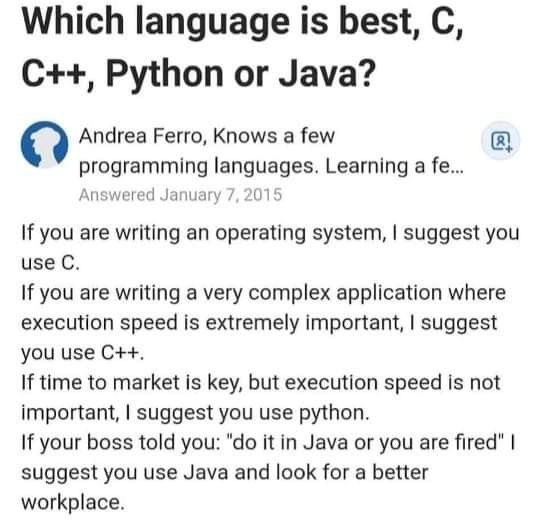
At a senior level, the humor in this meme strikes a chord because it distills decades of language wars and hard-won wisdom into four blunt recommendations. The Quora answer isn’t just ranking languages arbitrarily – it’s mapping each of C, C++, Python, and Java to the scenarios where they traditionally shine (or suffer). The kicker is the last line about Java, injecting a dose of CorporateCulture cynicism that makes experienced developers smirk knowingly. Let’s break down why this combination of advice is funny and true:
C for Operating Systems: The answer starts in the trenches of low-level programming. "If you are writing an operating system, I suggest you use C." Seasoned engineers know this is spot-on. C gives you direct access to memory and hardware with minimal runtime overhead – crucial for an operating system kernel that manages CPU, memory, and devices. Writing an OS means dealing with things like interrupts, registers, and memory addresses, where high-level safety nets would just get in the way. In practice, major OSes like Unix, Linux, and Windows have large portions written in C (with some assembly), because performance and fine-grained control are paramount. Using a garbage-collected language or an interpreter here would be like trying to build a microprocessor using LEGO bricks – absurd and impractical. The humor lies partly in how obvious this is to veterans: of course you’d use C for an OS! The thought of writing an OS in Python is laughably horrid (someone probably tried in a research project, and it ran about as fast as a snail on sedatives). So the answer opens with a straightforward truth that sets the stage: languages have domains where they are the natural choice, no single one is “the best” universally.
C++ for High-Performance Complex Applications: Next, the answer ups the ante: "If you are writing a very complex application where execution speed is extremely important, I suggest you use C++." This is a nod to situations demanding both high performance and large-scale software structure. C++ is basically C with extra power tools and abstractions (like classes, templates, and the STL), suitable for building huge applications (think game engines, real-time trading systems, 3D graphics renderers, or even parts of a web browser). These are projects where you need to squeeze every ounce of speed from the machine, but also manage complexity beyond what plain C comfortably handles. Experienced devs chuckle here because C++ is famously a double-edged sword: it can be blazingly fast and spectacularly complex. It’s like a racecar with a hundred buttons on the steering wheel – capable of amazing performance, but only if you really know what you’re doing (and you might crash if you mismanage it). We recall the classic saying: “C makes it easy to shoot yourself in the foot; C++ makes it harder, but when you do it blows your whole leg off.” The humor is that the answer matter-of-factly steers you towards C++ for speed-critical apps, which is true, but any senior dev reading that also winces remembering the trade-offs: the long compile times, the template meta-programming sorcery, the mysterious segmentation faults. It’s a qualified recommendation that implicitly pokes fun at how painful “extremely important speed” can become when you’re debugging a memory corruption at 3 AM.
Python for Fast Development (When Speed Isn’t Critical): Then comes the shift to productivity: "If time to market is key, but execution speed is not important, I suggest you use Python." Every experienced engineer has faced the performance vs deadlines dilemma. Python represents the camp of “get results quickly, even if it runs a bit slower.” The meme’s author is essentially saying: if you need to whip up a solution ASAP (maybe a proof-of-concept, a script, a web app for an upcoming demo), and you don’t have strict performance requirements, then Python is your friend. It’s interpreted (or bytecode-compiled at runtime) and has a reputation for being slow compared to C/C++, but it’s also famously fast to write. You don’t fuss with manual memory management or complex type systems – you just express your idea in code, and Python’s simplicity lets you do in an hour what might take days in C++. Seasoned devs smile here because this is a well-known trade-off: Python’s development speed often outweighs its runtime speed penalty for many projects. Plus, Python comes with “batteries included” – a rich standard library and countless frameworks that let you hit the ground running. Need a web server or a data analysis script? Python likely has you covered with a few import statements. Of course, the punch line is “execution speed is not important” – if you’ve ever written a Python program that accidentally processed a huge dataset or ran into a performance bottleneck, you know the pain of hitting Python’s speed limits. (We’ve all watched a naive Python script chug along slowly while thinking, “In C++ this would be done by now... but in C++ I’d still be writing the code.”) The humor here is gentle: it acknowledges Python’s strength (rapid development) and weakness (slower execution) in one breath. It’s a wink to the PerformanceTradeoffs every developer grapples with.
Java “Because the Boss Said So”: Finally, the answer delivers the zinger: "If your boss told you: 'do it in Java or you are fired' I suggest you use Java and look for a better workplace." This is where the meme unleashes its snark, and why most developers cackle at this part. It captures an unfortunately common scenario in CorporateCulture: technology decisions dictated from the top down by non-technical (or stubborn) leadership. Java here isn’t being recommended for any technical merit; it’s being chosen purely due to an ultimatum. The answer essentially translates to: “Use Java when your hands are tied by management, and start updating your résumé.” The humor has multiple layers for the experienced crowd. First, it plays on Java’s image in our industry. Java is a solid, general-purpose language used in countless enterprise applications – but it’s also the poster child for corporate standardization. Many large organizations default to Java for everything: internal tools, web services, backends, you name it. Sometimes that mandate makes sense (the company has a big Java ecosystem and JVM infrastructure). But other times, it’s just “because the boss/architect said so,” even if Java might not be the ideal tool for that specific job. Seasoned programmers have been in those meetings where a higher-up insists on using some enterprise-approved stack over a more fitting solution. It’s frustrating! This Quora answer taps directly into that frustration and exaggerates it to comic effect: do it in Java or you're fired. That phrasing is so blunt and extreme, it makes us laugh – it’s taking the unspoken subtext in some workplaces (“we only code in X here, no discussion”) and making it explicit and ridiculous. And yet, it’s not entirely fiction; many devs have felt the implicit job pressure to conform to a tech stack. The kicker advice “...and look for a better workplace.” is the kind of candid, no-nonsense guidance a grizzled mentor might give you over beers. In other words, if you’re stuck in a place where technical choices are governed by fear and authority rather than reason, that’s a big red flag. The answer’s author plucks a truth every senior dev knows – that working under leadership pressure to use the “One True Language” is demoralizing – and spins it into a punchline. The laugh comes with a nod of agreement: Yep, been there, got the t-shirt, left the company. It’s a moment of comedic camaraderie among developers: we all know that one shop that was “100% Java” (or .NET or whatever) just because the CTO decreed it, and how soul-crushing that can be when it’s the wrong choice. By advising “use Java and then bail out,” the meme highlights the absurdity of those situations. After all, in a healthy environment, the choice of language should be based on trade-offs and project needs, not workplace ultimatums under threat of firing.
In summary, the meme humorously captures the essence of LanguageComparison in real-world contexts. Each paragraph in the answer is funny to us because it’s true in that slightly exaggerated, tongue-in-cheek way. There’s a satisfying clarity in how it allocates each language to its ideal use case – it’s like a mini-guide born from collective industry experience. Seasoned developers appreciate this because we’ve lived these scenarios: we’ve written low-level C code for embedded systems or OS modules, we’ve wrestled with C++ to optimize critical loops, we’ve cranked out Python scripts to meet a deadline, and we’ve complied with questionable Java mandates from on high. The meme condenses those experiences into a few crisp lines, then ties it together with a jab at toxic corporate policy. The DeveloperHumor here comes from recognizing our own professional lives in these extreme-yet-familiar statements. We laugh, perhaps a bit ruefully, because we’ve asked “Which language is best?” at some point – and life taught us the nuanced answer that this Quora response delivers with a comedic punch: “It depends on what you’re doing… and sometimes, it depends on what your boss forces on you (in which case, good luck!).” The final flourish about finding a better workplace is more than a joke; it’s a gentle reminder of a truth learned in the school of hard knocks: the best language in the world won’t save you from a toxic workplace, so choose your tools wisely and your workplace even wiser.
Description
This is a screenshot of an online Q&A post, likely from a site like Quora. The question at the top is, "Which language is best, C, C++, Python or Java?". The answer, provided by Andrea Ferro on January 7, 2015, gives a breakdown of use cases for each language. It recommends C for operating systems, C++ for high-performance applications, and Python for rapid development where speed is less critical. The punchline comes with the final point: "If your boss told you: 'do it in Java or you are fired' I suggest you use Java and look for a better workplace." The humor resonates with senior developers by playing on a common stereotype of Java (especially around 2015) as a verbose, often mandated language in large, bureaucratic enterprise environments that developers might not choose freely. The advice is presented as pragmatic and reasonable until the final jab, which turns it into a commentary on workplace culture and developer autonomy

Comments
7Comment deleted
The post is from 2015. An update for today: the advice for C and C++ is the same, Python is what you use when time to market is key until you hit the GIL, and Java is now surprisingly good but you're probably still stuck on version 8 from the last decade
C when the silicon is the API, C++ when nanoseconds affect revenue, Python when marketing already put the demo in the slide deck, and Java when you’re really just integrating with the org chart
The four stages of language enlightenment: C for when you need to talk directly to the metal, C++ for when you need objects but still care about nanoseconds, Python for when you realize developer time costs more than CPU time, and Java for when you realize your mortgage costs more than your principles
The real architectural decision framework: C for when you need to count every cycle, C++ for when you need to count every cycle but with classes, Python for when you need to ship before the heat death of the universe, and Java for when you need to update your résumé. The most honest language selection criteria is often 'what keeps the lights on while you interview elsewhere' - a reminder that sometimes the most critical technical debt isn't in the codebase, it's in the org chart
Java: where the JVM's warmup time matches your sprint to update the resume
The only decision tree that optimizes for Amdahl's Law right up until Conway's Law throws a checked exception
C for things that boot, C++ for things with microsecond SLAs, Python for things that must demo Friday, Java for things that must survive procurement