Skip to content
DevMeme
1298 of 7435
The Burden of Programmer Stereotypes
DevCommunities Post #1452, on Apr 30, 2020 in TG

The Burden of Programmer Stereotypes

Why is this DevCommunities meme funny?

Level 1: Builders vs Thieves

Imagine someone who builds houses for a living. Now say a friend excitedly asks them, “Oh, you’re a house builder? Great, can you break into every house on the block for me tonight?” Sounds crazy, right? Just because a person knows how to make something (like a house) doesn’t mean they know how to break into anything and everything. It’s the same with this meme: a programmer is like a builder (they make programs and apps), but hacking into social media accounts is like being a thief breaking into houses – a completely different job (and definitely not a nice or legal thing to do!). The joke is funny because the request is so absurd. It’s showing how some people just don’t understand the difference between creating with technology and breaking technology, and that mix-up is what makes everyone who does programming laugh and shake their heads.

Level 2: Building vs Breaking In

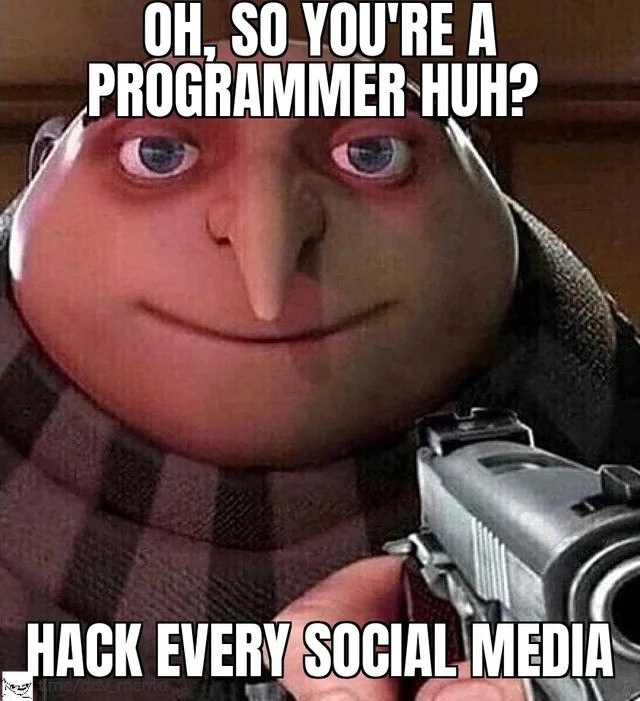
This meme shows Gru (a cartoon villain from Despicable Me) pointing a gun and asking a programmer to “hack every social media.” It’s making fun of how some people think being a programmer automatically means you can break into any computer system. Let’s break down why that’s funny and what’s actually happening:

  • Programmer (Developer): Someone who writes code to create software, websites, or applications. For example, a programmer might build a social media app or a website by writing code in languages like Python or JavaScript. Their job is to build and solve problems by making new things that work on computers. They usually specialize in specific areas (web development, mobile apps, databases, etc.). They spend time on tasks like writing features, fixing bugs, and making sure software runs correctly.

  • Hacker (in the context of security): In everyday use, when people say “hacker,” they often mean someone who breaks into computer systems or accounts without permission. (In tech, the word hacker can also mean a clever programmer, but here it’s about the security meaning.) A security hacker’s focus is finding weaknesses or vulnerabilities in systems and exploiting them – basically, figuring out how to get in when they’re not supposed to. For instance, a hacker might look for a bug in a website that lets them see other users’ private data, or they might use phishing (tricking someone into giving their password) to access an account. Importantly, not all hackers are “bad guys” – ethical hackers or penetration testers work with companies (with permission) to test security and report problems so they can be fixed. They use similar skills, but for good. Someone like that might participate in a bug bounty program, where companies reward them for finding security holes.

Now, why is it silly to tell a random programmer to “hack every social media”? Because programming and security hacking are very different specializations. It’s like the difference between a car mechanic and a professional race car driver – both involve cars, but the skills and day-to-day work are extremely different. Most programmers do not spend their time learning how to break into systems; they’re busy building them. Cybersecurity is its own field. Just because you know how to make a website doesn’t mean you know how to bypass all the security of another website.

Also, consider how social media platforms (like Facebook, Twitter, Instagram) protect themselves. They use strong encryption (basically turning your password and messages into secret code that’s very hard to read without the key) and often have two-factor authentication (you need your password and a code from your phone, for example). These defenses are there specifically to stop hackers. So even a skilled security expert would have a tough time breaking into even one account without permission – let alone “every social media” account! It’s an almost impossible task, definitely not something you can do just because you know programming. For a programmer who isn’t trained in hacking, trying to do this would be like an amateur swimmer trying to win an Olympic race against Michael Phelps.

There’s also a legal aspect. Hacking into accounts you don’t own is illegal. Professional developers aren’t criminals; they can actually get in serious trouble if they even tried. In the real world, if a company wants to test their security, they hire ethical hackers or firms to do controlled attacks (penetration testing). But no normal client or boss should ever ask a developer to illegally break into another company’s system – that’s a huge red flag (and a quick way to get fired or sued). When relatives ask casually, they might not realize it, but they’re literally asking someone to commit a crime.

For a junior developer or someone new to tech, this meme is a funny heads-up. When people hear you “work with computers,” some will assume you can do anything with technology. You might be writing Java code or designing a database, but friends or family might still ask you to fix their laptop, remove a virus, or yes, even “hack” into an account. They don’t see the difference between IT support, programming, and cybersecurity – it’s all one big magic to them. So the meme captures that moment where a developer has to respond, “Uh… that’s not what I do.” It’s poking fun at how non-tech folks lump all tech skills together.

In short, the meme is highlighting a misunderstanding: knowing how to create software isn’t the same as knowing how to break into any software. It uses an extreme example (hacking every social media platform) to make it obvious how crazy that assumption is. For anyone not familiar with tech, remember: a programmer is more like an architect or builder, whereas a hacker (security expert) is like a locksmith or sometimes a burglar (depending on intent). Both deal with buildings (or computer systems, in this analogy), but one is about construction and the other is about infiltration. Mixing them up can lead to some pretty funny — and awkward — requests, just like the one in the meme.

Level 3: Hack the Planet!

OH, SO YOU'RE A PROGRAMMER HUH?
HACK EVERY SOCIAL MEDIA.

The meme lampoons a classic misconception in tech: that every programmer is secretly a world-class hacker on demand. In the image, Gru (the villain from Despicable Me) aims a gun with a smug grin, as if a non-technical person were holding the developer at gunpoint to make an outlandish demand: “You code? Great, now break into every social media platform.” The humor lies in this absurd stakeholder expectation. It’s a situation many developers know too well – a client or relative dramatically overestimates your abilities (and moral flexibility), confusing software development with Hollywood-style cyber intrusion.

This meme brilliantly exaggerates the gap between programming and hacking. In reality, writing clean Python code for a web app is a very different skill from, say, exploiting a buffer overflow in C to gain unauthorized access to a server. But to the uninformed, it’s all “computer magic.” The phrase “Hack every social media” is deliberately over-the-top. Modern social networks (Facebook, Twitter, Instagram, etc.) are heavily fortified with encryption, bug bounties, and dedicated security teams. The idea that a lone coder—especially one who perhaps builds e-commerce sites or mobile apps for a living—could casually breach all of them is both technically laughable and illegal. The meme mocks that ignorance. Gru’s menacing pose and the imperative tone (“HACK EVERY SOCIAL MEDIA”) mimic the pressure a developer feels when someone makes a clueless request with total confidence. It’s like the person asking has watched one too many episodes of Mr. Robot and now assumes you can summon a hack_everything() function from your toolkit.

Veteran developers chuckle (or groan) at this because it resonates with real-life interactions. We’ve all had that phone call or family dinner scenario:

  • “I forgot my Gmail password. You work with computers – can you hack into Google and get it for me?”
  • “Hey, you’re a programmer! Could you write a quick script to break into my friend’s Instagram? I just need to see their messages.”
  • “We need our competitor’s client list. You can just hack their database, right? You’re the IT wizard!”

These requests range from the innocent-but-naive to the ethically dubious. They reveal a MisconceptionsInTech that programming skills = omnipotent control over technology. The developer’s internal reaction is usually a mix of amusement, facepalming, and mild horror. As the meme’s villainous framing suggests, being asked to do this stuff can feel like being a henchman for an evil scheme (“hack them all, or else!”). The stakeholder/client making the request often has no clue that they’re essentially asking for a series of felonies. From a senior engineer’s perspective, it highlights how misunderstood our work is: people think we spend our day guessing passwords and crunching binary code to infiltrate systems, when in fact we might be fixing CSS alignment bugs or writing unit tests for an API endpoint.

Another layer of humor is the security aspect. Within the industry, we distinguish between developers (who create software) and security researchers or penetration testers (who specialize in breaking software safely to improve it). The meme conflates these roles in the most extreme way. It’s poking fun at the trope that all techies are hoodie-clad hackers hammering away at firewalls. In truth, hacking even a single well-protected platform is non-trivial. It requires deep knowledge of vulnerabilities, networking, cryptography, and often social engineering (tricking people, not coding). No one “just hacks” into Facebook on a whim. Companies run penetration tests and bug bounty programs precisely because breaking in is so challenging that they’ll pay experts to try. The average software engineer isn’t combing through exploit databases or crafting zero-day attacks during their 9-to-5. They have their own stack of tasks, none of which involve typing sudo hack --all-social-media into a console.

The Gru meme format amplifies the absurdity. Gru is a cartoon villain known for outrageous plots, so him representing the person asking for a hack is spot-on. His smirk almost says, “I have no idea how coding works, but I’m convinced you can do this dark deed for me.” It’s a perfect visual metaphor for those bold, clueless requests. And the gun pointed at the viewer – that’s how a developer might feel under sudden pressure from a boss or family member who thinks hacking is just another computer chore. It’s an ironic threat model where the true danger is ignorance.

Ultimately, this meme hits home for anyone in software development who has had to explain, “No, I can’t just hack into [insert mega-corporation]’s database for you.” It underscores the divide between public perception and technical reality. Seasoned devs see the phrase “Hack every social media” and laugh because it’s a caricature of the wild requests we field outside of work. The humor is equal parts catharsis (we’ve been there) and eye-rolling ridicule of the “all computers are the same” mindset. In a way, it’s also a gentle reminder of how specialized our industry is – a front-end developer, a database admin, and a security analyst are very different beasts. Mix them up, and you get requests as ridiculous as this one.

Description

This meme features a close-up of Gru from the animated film 'Despicable Me,' who is pointing a pistol directly at the viewer with a slightly menacing and expectant smirk. The image is overlaid with large, white, impactful text. The top line reads, "OH, SO YOU'RE A PROGRAMMER HUH?" and the bottom line demands, "HACK EVERY SOCIAL MEDIA". The meme humorously captures a common and frustrating stereotype faced by software developers: the assumption by non-technical friends, family, or acquaintances that programming ability is synonymous with being a master hacker capable of illegally accessing any system on demand. It highlights the vast difference between building software and cracking complex security systems, a nuance often lost on the general public
Comments

7
Anonymous ★ Top Pick My family thinks my job is like Mr. Robot. In reality, I spend most of my day trying to center a div and figuring out why a YAML file is mad at me
  1. Anonymous ★ Top Pick

    My family thinks my job is like Mr. Robot. In reality, I spend most of my day trying to center a div and figuring out why a YAML file is mad at me

  2. Anonymous

    My family thinks “software engineer” means I can breach Instagram on a weekend - meanwhile I need two change-requests and a CAB meeting just to add one redirect URI to our own OAuth flow

  3. Anonymous

    After 20 years in the industry, I've learned the fastest way to 'hack' someone's Facebook is to wait for them to leave their laptop unlocked at a coffee shop - which, ironically, is exactly the kind of social engineering our security training warns about, yet somehow less impressive than the GUI interface in Visual Basic they're expecting

  4. Anonymous

    Ah yes, the classic Thanksgiving dinner conversation: 'You write JavaScript for a living? Perfect! Can you hack into my ex's Instagram and also fix my printer while you're at it?' Nothing says 'I understand your profession' quite like conflating frontend development with felony computer fraud - bonus points when they're genuinely disappointed you can't breach OAuth2 implementations on demand

  5. Anonymous

    My favorite growth hack? Misconfigured OAuth with redirect_uri=* and scope=write - you don’t hack one platform, you widen the blast radius

  6. Anonymous

    Asking a SWE to “hack every social media” is like filing a P0 Jira for nation‑state red‑teaming - my only reliable exploit is enabling your 2FA and patching Layer 8

  7. Anonymous

    Real devs wrestle CAP theorem trade-offs; these 'coders' just brute-force 'password123' at scale

Use J and K for navigation