A Function Has No Name: The Lambda Warrior
Why is this FunctionalProgramming meme funny?
Level 1: Secret Helper
Think of it like this: you have a quick job to do, and a helper appears, does the job, and leaves without even introducing themselves. Imagine you’re cleaning up toys and a friend wordlessly joins in, helps you pick everything up, then slips away without you even catching their name. In programming, that quick, no-name helper is what we call an anonymous function. It’s a tiny bit of code that we use on the spot without giving it a permanent name, because we only needed it for a moment.
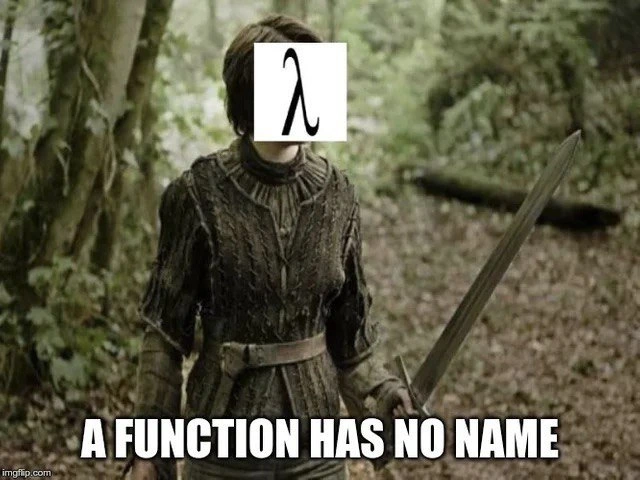
Now, why is the meme funny? It takes a serious scene from a TV show (Game of Thrones) where a character boldly says “a girl has no name” – she’s declaring she has given up her identity. The meme replaces “girl” with “function” to make it about coding. So it’s joking that an unnamed piece of code is as dramatic as a mysterious character with no name. It’s an exaggerated comparison: a small coding idea presented as a grand proclamation. That contrast is what makes people who know both chuckle. Essentially, it’s saying: sometimes in code we have functions with no names... and that’s totally okay (and kind of badass, like Arya Stark).
Level 2: Anonymous Functions 101
Let’s break down the basics behind this meme. In programming, an anonymous function (a.k.a. a lambda expression) is just a function that isn’t given a name. Usually when you write a function, you name it something like calculateTotal or printMessage. For example, in Python you might do:
def greet(name):
return f"Hello, {name}!"
Here greet is the name of the function. But you can also create a function on the fly without a name. In Python, the keyword lambda lets you do this. The same greeting function as an anonymous one-liner would be:
lambda name: f"Hello, {name}!"
This expression defines a function that takes name and returns a greeting, but notice we didn’t write something like def greet. We just wrote lambda name: ... without ever assigning it a name. It’s a function literal, created right where it’s needed. We could use it immediately or pass it to another function. For instance, if we had a list of names and wanted to greet them all, we might map this lambda over the list, all without naming a new function.
Many languages have their own syntax for anonymous functions. JavaScript uses arrows:
(name) => `Hello, ${name}!`
This is effectively the same as the Python lambda above – an unnamed function that greets someone. You could do ["Arya", "Jon"].map(name => \Hello, ${name}!`)to greet each person in an array, and the partname => "Hello..."is the anonymous function doing the work for each element. In Java (since version 8), you might write something like(x, y) -> x + yto add two numbers without naming the function. And in a functional language like **Haskell**, you’d write\x -> x + 1` for a function that increments its input. Different syntax, same idea: unnamed little helper functions.
Now, the meme itself: it shows Arya Stark from Game of Thrones. In the show, Arya trains with a cult of assassins who follow the Many-Faced God, and she must give up her identity – hence her saying, “a girl has no name.” The meme swaps “girl” with “function” to say “A function has no name.” It’s describing an anonymous function in a fun, dramatic way. The white square covering Arya’s face has a λ on it, which is the Greek letter lambda. In programming and math, we often use “lambda” to denote an anonymous function (this convention comes from LambdaCalculus, a mathematical formalism of functions). So by putting λ on Arya’s face, the meme is literally turning her into a symbol for an anonymous lambda function, a faceless entity.
This is SyntaxHumor combined with a PopCultureReference. If you’ve just started coding, you might have seen the term lambda or arrow functions and thought, “What’s with the Greek letter?” It’s just a fancy (historical) way of saying “function here, no name needed.” Anonymous functions are a handy concept: for example, if you need to sort a list of users by their last name, you might pass a quick lambda to the sort routine instead of writing a full function and naming it getLastName. It keeps the code short and localized. The meme humorously personifies this concept. It’s as if the code community is saying, “This function doesn’t need a name, it does what it needs to do and moves on – just like Arya becoming no one to fulfill her mission.” In short, a function has no name = a little snippet of code written inline without a formal name. Pretty cool, right?
Level 3: Anonymous in Action
For seasoned developers, this meme hits on multiple levels. First, there’s the obvious PopCultureReference: taking Arya Stark’s solemn line “a girl has no name” from Game of Thrones and giving it a programming twist. It’s the kind of mashup of fantasy drama and code-speak that DeveloperHumor lives for. If you’re a dev who binge-watched GoT and also wrangles code, seeing the fearless Arya labeled with a λ is an instant grin moment. It’s as if our coding tools have joined the cast of the show. Arya’s rigorous training to become “no one” parallels what a piece of code might undergo to become an anonymous function – shedding any identifier and just performing its task. The caption in bold Impact font, “A FUNCTION HAS NO NAME,” boldly merges the two worlds. It’s a classic meme formula: take a dramatically serious scene and replace its key phrase with a programming in-joke.
On a practical level, the phrase resonates with developers because we use anonymous_functions all the time. In daily coding, an anonymous (lambda) function is that little throwaway snippet you write when giving a formal name would be overkill. Think about Python: instead of writing a full def for a simple operation, you might do lambda x, y: x + y when sorting a list by a custom key or filtering data. In JavaScript, especially post-ES6, the prevalence of arrow functions means your code is sprinkled with () => { } functions that you never bother naming – you just declare them inline and pass them around. A senior engineer sees Arya’s λ-mask and immediately recalls countless such cases: from quick one-liner callbacks to mapping a list in Haskell with a \x -> ... function literal. The meme humorously glorifies this common practice. It’s saying, with a wink, “In our code, we have many Aryas – tiny functions that kick butt without anyone ever knowing their name.”
There’s also a bit of tongue-in-cheek pride here. Among experienced devs, mastering lambdas can feel like joining a secret guild. The first time you grokked closures or wrote a function that returns another function, you might have felt like Arya training in the House of Black and White – learning a secret art. The meme taps into that inside feeling. The subtext is, only those initiated in the ways of functional programming will get this joke. It’s a playful gatekeeping that actually invites people in: new dev sees this, asks “what’s that symbol about?”, and boom – a chance for a fun lesson on LambdaCalculus or JavaScript arrow functions!
From an industry perspective, “a function has no name” can also poke fun at how different languages approach the concept. Veteran Java developers remember the dark times before Java 8’s lambda introduction – implementing a verbose ActionListener or writing an anonymous inner class just to handle a button click felt as tedious as reciting the names on Arya’s vengeance list. When lambdas finally arrived, many of us rejoiced, quipping something akin to “At last, Java’s functions can join the Faceless Men!” Meanwhile, Lisp had lambda since 1958, and Python’s had lambda for years (albeit with the quirk that Python lambdas are limited to one expression). Each language has its LanguageQuirks with anonymous functions – and a senior dev likely chuckles at how a single meme can unify them under one simple joke. It’s the shared understanding that whether you call it a lambda, a block, a closure, or an anonymous delegate, we’ve all seen FunctionalProgrammingConcepts infiltrate our codebases. And at the end of the day, the only thing cooler than writing a slick one-liner function is comparing it to a faceless assassin from a hit TV show 😉.
Level 4: The Many-Faced Lambda
In the realm of theoretical computer science, a function with no name isn’t just a quirky idea – it’s a foundational concept. The Greek letter λ (lambda) plastered over Arya’s face is a nod to Lambda Calculus, introduced by Alonzo Church in the 1930s as a formal system of computation. In pure lambda calculus (the root of FunctionalProgramming), every function is anonymous by default. You’d write an operation as an expression like λx. x * 2 to denote “a function that takes input x and returns x * 2,” all without ever giving that function a label. The system doesn’t require names at all – much like Arya Stark’s Faceless Men who forsake their identities, a lambda expression’s identity is solely its behavior.
This namelessness has deep implications. In lambda calculus, the name of a function is irrelevant to its meaning – an idea formalized as alpha-equivalence. Changing the placeholder variable or adding a label doesn’t change what the function does. For example, λn. n + 1 is essentially the same as λx. x + 1; the name n or x doesn’t matter, only the transformation “add 1” does. We can even use such a function on the fly:
(λn. n + 1) 4 = 5
Here we’ve applied an increment function to 4 without ever naming that function – a function has no name and yet it works perfectly. The meme elevates this concept to almost mystical status, humorously echoing Arya’s mantra “a girl has no name.” In a way, it’s true: in the church of λ (pun intended, since Alonzo Church was the founder!), functions are defined by what they accomplish, not by what they’re called. This perspective is powerful. It enables first-class functions and higher-order programming, where you can pass around behavior like any other data. Entire paradigms and languages (Haskell, Scheme, Lisp) are built on the idea that giving a function a name is optional ceremony. There’s even esoteric beauty in systems like the SKI combinator calculus, which dispense with named variables altogether – computation done by completely nameless primitives! The meme’s dramatic proclamation captures this elegant truth in a delightfully nerdy way: a proper lambda doesn’t need a name tag to do its job.
Description
A meme that blends functional programming concepts with popular culture. The image is a still of the character Arya Stark from the TV show 'Game of Thrones,' standing in a forest and holding her sword. Her face has been replaced with a white box containing the Greek letter lambda (λ), the universal symbol for lambda functions. The caption below reads, 'A FUNCTION HAS NO NAME.' This is a direct parody of Arya's iconic mantra, 'A girl has no name,' which she repeats while training to be a faceless assassin. The joke creates a clever parallel between Arya shedding her identity and a lambda function, which is an anonymous, or 'nameless,' function in programming. The humor resonates strongly with developers who use functional programming constructs and appreciate the nerdy pun
Comments
23Comment deleted
Much like a Faceless Man, a lambda function can take on many forms and execute its task without anyone ever knowing its true identity... until it shows up in a stack trace as '<anonymous>'
A function has no name - right up until the flame graph shows that faceless lambda at 92 % CPU and the on-call realizes who the real assassin is
After 15 years of arguing about whether to name functions 'getUserById' or 'fetchUserWithId', you realize the real power move is just not naming them at all - though explaining to the junior dev why your entire codebase is just nested lambdas calling lambdas might require more patience than training with the Faceless Men
Just like Arya Stark training with the Faceless Men, lambda functions embrace anonymity as a feature, not a bug. They appear inline, do their job without ceremony, and vanish into the call stack without leaving a trace in the namespace - the perfect assassins of functional programming. Though unlike Arya, they can't change their type signature at runtime, no matter how much you wish JavaScript would let them
Anonymous functions are glorious - right up until your APM folds every stack frame into (anonymous) and the on‑call turns into a faceless hunt through the woods
A function has no name - until the flame graph christens it lambda$13 and the RCA reveals it closed over a mutable map
Lambdas: nameless enough to escape blame when they leak memory in prod, faceless men of the heap
Java meme? Comment deleted
-10000 social points Comment deleted
this.social_points-=Infinity; Comment deleted
this.social_points=-Infinity*Infinity; Comment deleted
Half life meme Comment deleted
Thanks Comment deleted
Uhhh, no, it’s just a programming meme, lambda functions are functions without a name Comment deleted
Abstract humor or something, I'm not a comedian. That girl is usually hiding her inter faces btw. Comment deleted
Lambda Comment deleted
Better meme: The thing let's see who you really are pulling the sack off the head To begin with it's lambda Without sack it's some complicated maths Comment deleted
Why do you call anonymous functions lambdas It makes no sense, it has nothing in common with lambda calculus Comment deleted
I swear it does? Comment deleted
there's only two hard problems in programming: cache invalidation and naming things Comment deleted
you forgot the third: resolving C++ template errors Comment deleted
that's easily solved by not using C++ Comment deleted
+ Comment deleted